Race in the Latin American Imaginary
Beyond mestizaje: rethinking race in Latin America and its Diaspora
Race in the Latin American Imaginary
Beyond mestizaje: rethinking race in Latin America and its Diaspora
Introduction
The concept of “race” has been a cornerstone in shaping identities worldwide. In the context of Latin America and its diaspora, race is not merely a biological classification but a discursive construct with deep historical and socio-political implications. This article explores how race is understood within the Latin American imaginary, focusing on Stuart Hall’s theoretical insights and José Vasconcelos’ controversial yet influential concept of “La Raza Cósmica.” Furthermore, we examine how these ideas resonate within the Chicano movement in the United States and how these discourses continue to influence contemporary identity politics. Additionally, we will reflect on the ways in which the Latin American racial discourse, often obscured under the ideology of mestizaje, operates differently from the Anglo-American framework, where racial categories tend to be more rigidly defined.
Race as a Discursive Construct: Stuart Hall’s Perspective
Stuart Hall (1932–2014) was a Jamaican-born British cultural theorist and sociologist, recognized as one of the key figures in cultural studies. His work redefined race as a “sliding signifier,” emphasizing its fluidity and socio-historical construction rather than its biological determinism. Hall critiques the traditional racial classifications that persist despite scientific evidence debunking them. He engages with W. E. B. Du Bois and Kwame Anthony Appiah’s discussions on race, highlighting the evolving understanding of racial identity over time.
Hall argues that race operates within a power-knowledge-difference framework, shaping social hierarchies and reinforcing systemic discrimination. His approach allows us to see race not as a static identity but as a dynamic discourse influenced by historical contexts and power structures. As he states, “race is a discourse; that it operates like a language, like a sliding signifier; that its signifiers reference not genetically established facts but the systems of meaning that have come to be fixed in the classifications of culture” (Hall, 2017). This means that race does not exist in a vacuum — it is continuously redefined based on social, economic, and political conditions.
One of Hall’s major contributions is his critique of essentialist notions of race. He warns against the belief that racial identity is rooted in fixed, immutable characteristics, arguing instead that race is shaped by discourse and social relations. This perspective is particularly relevant in the Latin American context, where race has often been subsumed under the ideology of mestizaje, effectively concealing the structural inequalities that persist despite widespread racial mixing.
Hall also draws upon the works of W. E. B. Du Bois, particularly his famous concept of “double consciousness.” Du Bois (1868–1963), an African American intellectual, argued that Black individuals in America experience a dual identity: one as an American citizen and another as a racialized subject viewed through the lens of white supremacy. Hall extends this idea to discuss how racialized subjects navigate their identities within broader socio-political structures.
In contrast, Kwame Anthony Appiah (b. 1954), a Ghanaian-British-American philosopher, critiques the very existence of race as a meaningful category. In his work The Uncompleted Argument: Du Bois and the Illusion of Race, Appiah contends that race is not a coherent biological or cultural reality but rather a constructed fiction. Hall, however, critiques Appiah’s perspective, arguing that while race may not be scientifically real, its socio-political consequences are undeniably real and deeply embedded in global histories of oppression and resistance.
The Cosmic Race: A Latin American Utopia
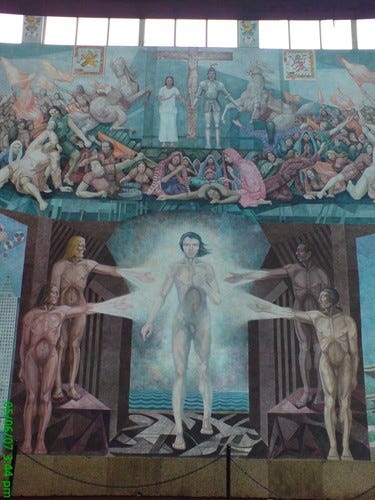
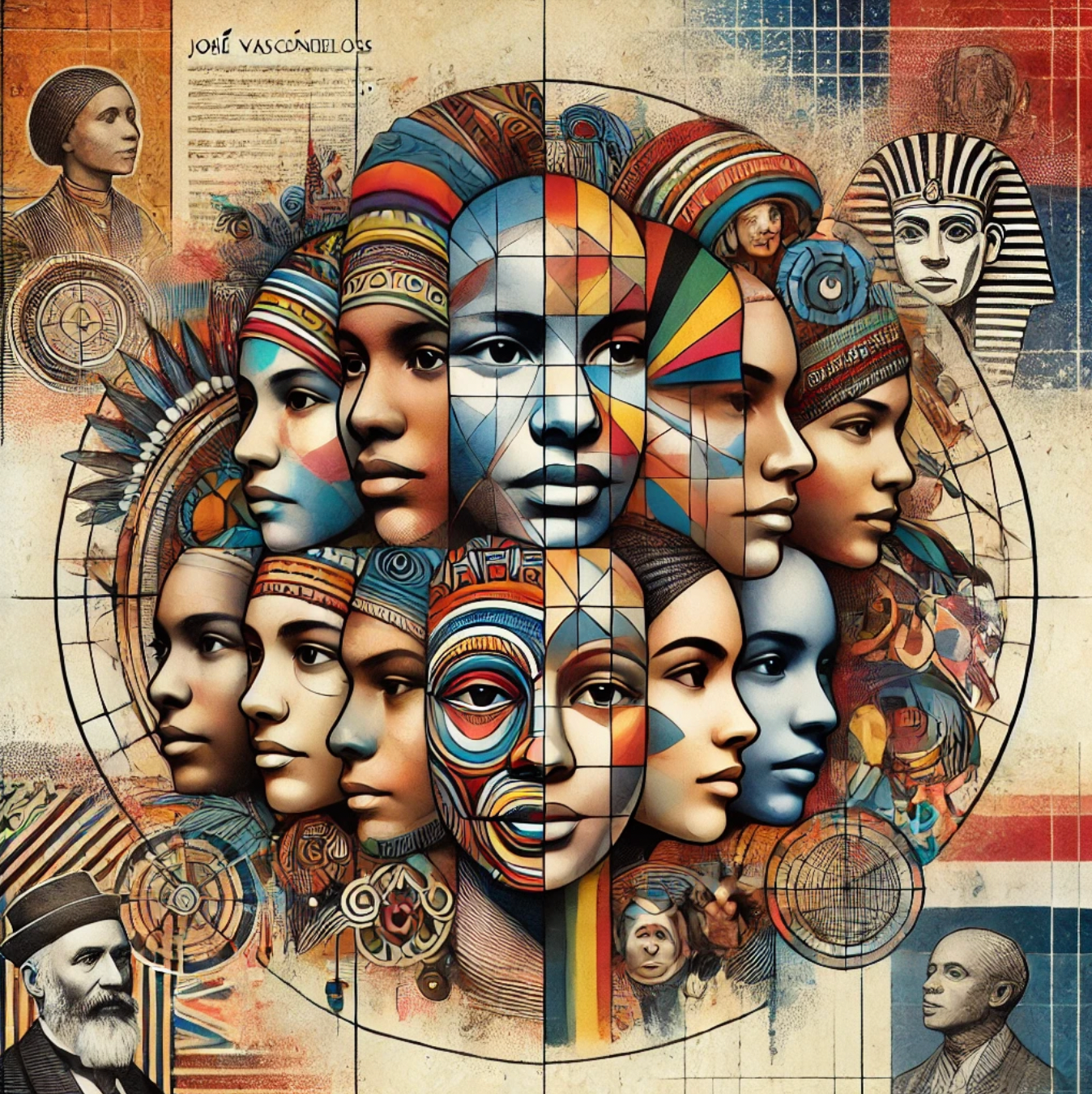
José Vasconcelos (1882–1959) was a Mexican philosopher, politician, and writer whose 1925 essay La Raza Cósmicapresents a vision of racial transcendence through mestizaje. Unlike the racial purism advocated in early 20th-century Europe, Vasconcelos envisioned a future where all races would blend into a superior, unified humanity. While his work has been criticized for its romanticized view of colonial history and the omission of indigenous oppression, it remains a foundational text in Latin American identity discourse.
Vasconcelos’ ideas found fertile ground in post-colonial Latin America, where mestizaje was promoted as a national ideal. However, his narrative also reinforced hierarchies by implicitly valuing European heritage over indigenous and African roots. Vasconcelos states, “The civilization developed and organized in our times by the whites has set the moral and material basis for the union of all men into a fifth universal race” (Vasconcelos, 1925).
While some interpret Vasconcelos’ work as an early form of multiculturalism, others argue that his vision still operates within a Eurocentric framework, as it does not truly dismantle racial hierarchies but rather reconfigures them under a new mestizo identity. This is where Vasconcelos’ ideas become problematic: by framing mestizaje as the inevitable and desirable future of humanity, he erases the realities of racial discrimination that persist despite racial mixing. The Latin American racial discourse, by promoting mestizaje, often masks ongoing inequalities and systemic racism under the guise of national unity.
The Chicano Movement and Racial Identity
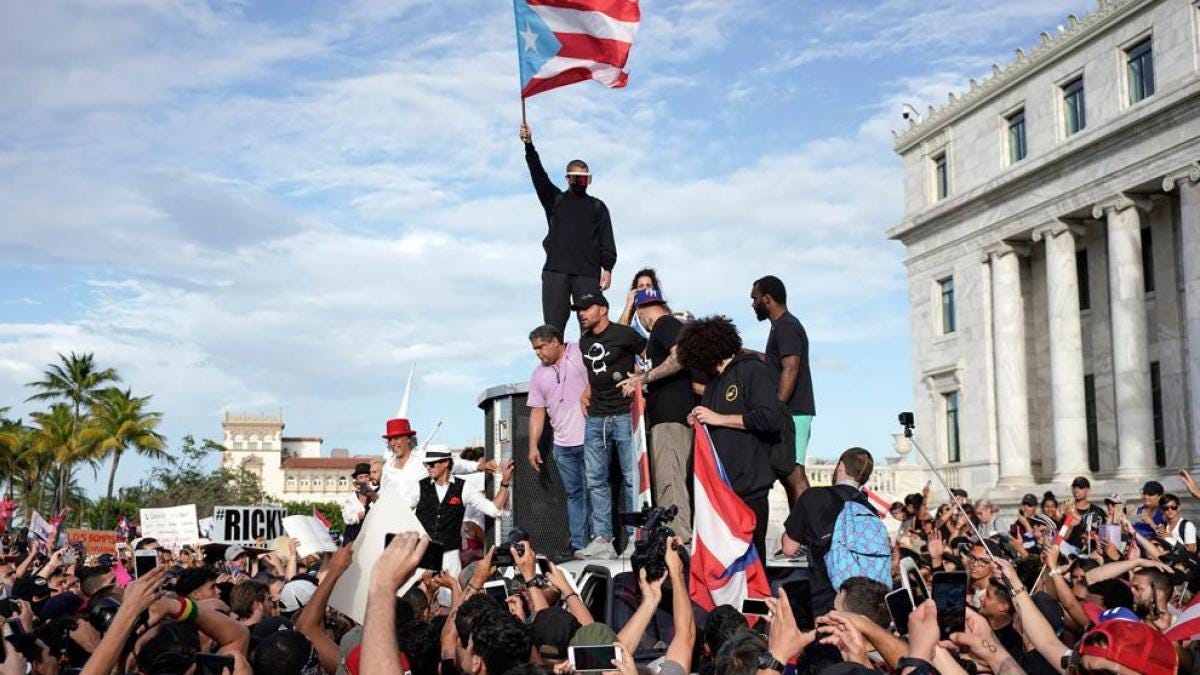
The Chicano movement of the 1960s and 1970s sought to reclaim Mexican-American identity within the U.S. racial landscape. Chicanos, neither fully accepted as white nor classified as Black, found resonance in Vasconcelos’ concept of “La Raza.” This idea provided a framework for cultural pride and resistance against Anglo-American assimilation pressures.
However, the Chicano adoption of La Raza Cósmica was not without critique. Feminist scholars later highlighted how the movement’s rhetoric often sidelined Chicana voices, perpetuating patriarchal structures even as it sought racial empowerment. Chicana feminists such as Gloria Anzaldúa emphasized the need for intersectional approaches to identity, critiquing the male-dominated discourse of the movement.
As Vasconcelos’ ideas were revisited in the Chicano movement, they were also modified to fit the specific historical and social conditions of Mexican-Americans in the United States. The idea of mestizaje was reinterpreted as a means of cultural resistance rather than as a utopian racial fusion.
Conclusion
Race in the Latin American imaginary is a complex, evolving construct that continues to shape identities both in Latin America and among its diaspora. Stuart Hall’s discursive approach helps us understand how racial narratives function within power structures, while Vasconcelos’ La Raza Cósmica provides insight into Latin America’s historical engagement with race and mestizaje. The Chicano movement’s reinterpretation of these ideas underscores the ongoing struggle for identity and representation.
Understanding race as a fluid and contested concept allows for more inclusive and critical perspectives, essential for addressing contemporary racial dynamics in Latin America and beyond. The continued reexamination of racial narratives highlights the necessity of acknowledging both historical contexts and present-day inequalities in shaping racial discourse. Additionally, moving beyond the dominant Anglo-American racial framework is crucial to fully grasp the specificities of race in Latin America, where the ideology of mestizaje often hides racial oppression.
Bibliography
Brubaker, R. (2002). Ethnicity without groups. European Journal of Sociology / Archives Européennes de Sociologie, 43(2), 163–189. https://doi.org/10.1017/S0003975602001066
Casale-Hardin, M. A. (2015, June 15). “Mejorar la Raza”: An Example of Racism in Latino Culture. HuffPost. https://www.huffpost.com/entry/mejorar-la-raza-an-exampl_b_7558892
Chabram-Dernersesian, A. (1992). I Throw Punches for My Race, but I Don’t Want to Be a Man: Writing Us–Chica-nos (Girl, Us)/Chicanas–into the Movement Script. na.
Contreras, R. (2017, July 13). Why the term “la raza” has complicated roots in the US. Southern California Public Radio. https://www.scpr.org/news/2017/07/13/73744/why-the-term-la-raza-hascomplicated-roots-in-the/
Cumplido Baeza, M. J. (2013, December 23). ¿Latinoamerica mestiza?: Reflexiones en torno al término mestizo. Hispanic American Historial Review — Online. http://hahronline.com/latinoamerica-mestiza-reflexiones-en-torno-al-termino-mestizo/
Du Bois, W. E. B. (1897). The Conservation of Races. Teaching American History. https://teachingamericanhistory.org/library/document/the-conservation-of-races/
Hall, S. (1990). Cultural Identity and Diaspora. In Identity: Community, culture, difference (pp. 222–237). Lawrence & Wishart.
Hall, S. (2017a). Familiar stranger: A life between two islands. Penguin.
Hall, S. (2017b). The fateful triangle: Race, ethnicity, nation. Harvard University Press.
Manrique, L. (2016). Dreaming of a cosmic race: José Vasconcelos and the politics of race in Mexico, 1920s–1930s. Cogent Arts & Humanities, 3(1), 1218316. https://doi.org/10.1080/23311983.2016.1218316
Mascott Sánchez, M. de los Á. (2014, March 20). “Para mejorar la raza”: Traumas que destruyen. El Financiero. https://www.elfinanciero.com.mx/opinion/maria-de-los-angeles-mascottsanchez/para-mejorar-la-raza-traumas-que-destruyen
Moses, W. J. (1993). W.E.B. Du Bois’s “The Conservation of Races” and Its Context: Idealism, Conservatism and Hero Worship. The Massachusetts Review, 34(2), 275–294. JSTOR.
Vasconcelos, J., & Jaén, D. T. (1997). The cosmic race: A bilingual edition (Johns Hopkins paperbacks ed). Johns Hopkins University Press.
메타데이터
- post_id
- 5cdc97bba83b
- slug
- race-in-the-latin-american-imaginary-5cdc97bba83b
- url
- https://medium.com/@michelleaguilarpanchi/race-in-the-latin-american-imaginary-5cdc97bba83b
- canonical_url
- https://medium.com/@michelleaguilarpanchi/race-in-the-latin-american-imaginary-5cdc97bba83b
- author_url
- https://medium.com/@michelleaguilarpanchi
- status
- ok
- fetched_at
- 2026-07-26 16:23:29