Why Most Midjourney Architecture Feels Flat (And How to Fix It)
Most Midjourney users believe architecture becomes impressive when they add more detail.
Why Most Midjourney Architecture Feels Flat (And How to Fix It)
Most Midjourney users believe architecture becomes impressive when they add more detail.
More windows.
More columns.
More ornaments.
More furniture.
More texture.
Yet despite all this added complexity, the final image often feels strangely flat.
The scene may be beautiful.
It may even be technically impressive.
But it does not feel immersive.
The viewer looks at it rather than entering it.
The reason is surprisingly simple:
Architecture is not created by details.
Architecture is created by spatial systems.
And depth is one of the most important systems of all.
Let’s explore five reasons why architectural scenes often fail and how professionals create images that feel like worlds rather than illustrations.

Mistake 1: Everything Has the Same Visual Importance
One of the most common beginner mistakes is what I call visual equalization.
Every object receives the same amount of attention.
Every surface receives the same amount of detail.
Everything competes.
Nothing dominates.
Consider this prompt:
Instead of:
castle interior with staircase, windows, candles, columns and furniture, Sony A1 II, 35mm lens — ar 16:9 — raw — v 8.1

At first glance, it sounds descriptive.
But notice what happens. All is important.
The viewer receives different instructions but no hierarchy.
The eye doesn’t know where to begin.
Professional images rarely work this way.
They establish dominance.
They create a visual leader
Everything else becomes supporting architecture.
Depth starts with hierarchy, not detail
Try:
massive stone staircase dominating an ancient castle interior, secondary windows and candles fading into shadow along the surrounding architecture, visual hierarchy centered on the staircase, cinematic architectural photography, Sony A1 II, 35mm lens — ar 16:9 — raw — v 8.1

Instead of:
palace corridor with paintings, chandeliers, windows and columns, Leica M11, 50mm lens — ar 16:9 — raw — v 8.1

Try:
grand chandelier dominating a palace corridor, surrounding paintings and columns fading into a secondary architectural rhythm, Leica M11, 50mm lens — ar 16:9 — raw — v 8.1

Mistake 2: No Receding System Exists
Many users expect a building to feel large simply because they describe a large building.
Unfortunately, MidJourney does not think this way.
A cathedral is not automatically gigantic.
A palace is not automatically monumental.
Scale must be demonstrated.
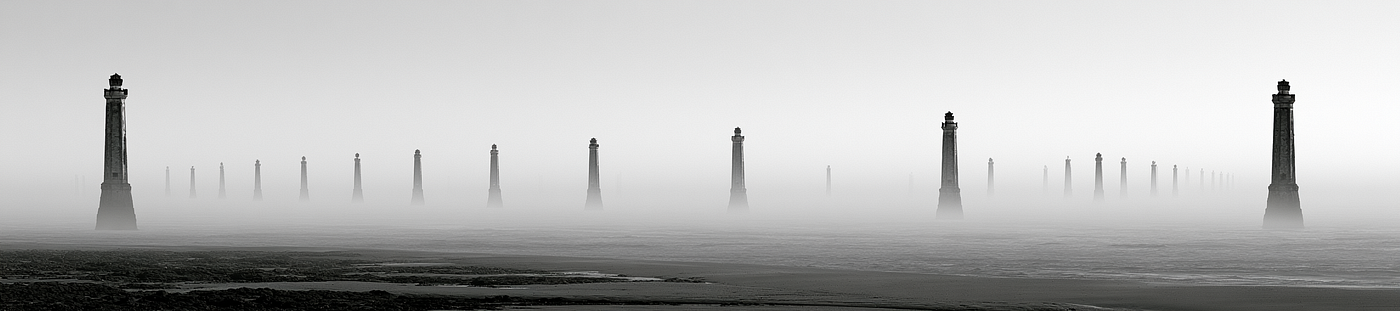
One of the most powerful ways to demonstrate scale is through recession.
Receding systems create visible distance.
Examples include:
receding corridors
receding columns
receding arches
receding balconies
receding bridges
receding rooftops
Imagine two scenes.
The first contains a beautiful hallway.
The second contains a hallway that continues through ten repeating archways disappearing into darkness.
The second scene immediately feels larger.
Why?
Because the eye can travel.
Depth becomes visible.
Distance becomes measurable.
Architecture begins behaving like a system rather than an object
Instead of:
long stone corridor inside an ancient castle, Sony A1 II, 35mm lens — ar 16:9 — raw — v 8.1

Try:
stone corridor extending through dozens of receding archways progressively shrinking into darkness, repeating architectural rhythm creating measurable distance, cinematic architecture photography, Sony A1 II, 35mm lens — ar 16:9 — raw — v 8.1

Instead of:
floating city above the clouds Sony A1 II, 85mm lens — ar 16:9 — raw — v 8.1

Try:
floating city organized around receding aerial walkways connecting increasingly distant districts disappearing into atmospheric haze, cinematic aerial architecture, Sony A1 II, 85mm lens — ar 16:9 — raw — v 8.1

Mistake 3: Everything Is Fully Visible
Human curiosity thrives on incomplete information.
Yet many prompts reveal everything.
Every doorway.
Every room.
Every structure.
Every pathway.
Nothing remains to discover
This is where occlusion becomes powerful.
Occlusion means allowing architecture to hide itself.
A wall blocks part of a corridor.
A tower conceals another tower.
A staircase disappears behind a structural element.
The viewer receives partial information, and the brain automatically wants more.
Instead of:
visible courtyard with stone fountain, Leica M11, 50mm lens — ar 16:9 — raw — v 8.1

Try:
partially hidden courtyard revealed behind massive stone arches, Leica M11, 50mm lens — ar 16:9 — raw — v 8.1

Instead of:
bridge crossing a canyon, Nikon Z9, 85mm lens — ar 16:9 — raw — v 8.1

Try:
partially hidden bridge emerging from behind enormous support pillars, Nikon Z9, 85mm lens — ar 16:9 — raw — v 8.1

Architecture becomes a journey.
The viewer begins exploring.
Depth is no longer merely seen, It is experienced.
Mistake 4: Scale Is Never Proven
A giant building without reference points often feels small.
Or worse:
It feels like CGI.
This happens because the viewer has nothing to compare against.
Our brains understand size through relationships.
A mountain feels large because people are small.
A cathedral feels massive because visitors are tiny.
A city feels endless because distant structures progressively shrink.
Scale requires evidence.
Consider adding:
tiny distant visitors
miniature silhouettes
small boats
distant pedestrians
tiny balconies occupied by figures
The moment a recognizable scale reference appears, architecture expands.
Not because the building changed.
Because perception changed.
And perception is what matters.
Instead of:
gigantic cathedral interior with enormous stone pillars, Sony A1 II, 35mm lens — ar 16:9 — raw — v 8.1

Try:
gigantic cathedral interior with tiny distant visitors walking beneath colossal stone pillars, human figures nearly disappearing inside the architecture, monumental scale contrast, Sony A1 II, 35mm lens — ar 16:9 — raw — v 8.1

Instead of :
monumental temple complex, Fujifilm GFX100 II, 80mm lens — ar 16:9 — raw — v 8.1

Try:
monumental temple complex where tiny pilgrims cross vast ceremonial courtyards beneath gigantic stone gateways, architectural scale proven through movement, Fujifilm GFX100 II, 80mm lens — ar 16:9 — raw — v 8.1

Mistake 5: Architecture Stops at the Edge of the Frame
Many Midjourney scenes feel like stage sets.
Beautiful stage sets, But stage sets nonetheless.
Why?
Because the architecture ends where the image ends.
The viewer unconsciously understands:
“This is all there is.”
Professional architectural images often suggest continuation.
The image becomes a fragment of a larger world.
Examples include:
disappearing walkways
unseen destinations
interrupted corridors
hidden courtyards
structures extending beyond the frame
The viewer senses that the world continues.
The scene gains narrative potential.
The architecture acquires mystery.
And mystery is often what transforms an image from beautiful into memorable
Instead of:
wooden boardwalk along the coast, Canon EOS R5, 35mm lens — ar 16:9 — raw — v 8.1

Try:
coastal boardwalk disappearing beyond the frame in both directions, only a fragment of the circulation system visible, architectural continuity creating a larger world beyond the image, Canon EOS R5, 35mm lens — ar 16:9 — raw — v 8.1

Instead of:
modern harbor district, Nikon Z8, 85mm lens — ar 16:9 — raw — v 8.1

Try:
harbor district with docks extending beyond the image boundaries, cranes partially cropped by the frame, infrastructure suggesting a much larger logistical system, Nikon Z8, 85mm lens — ar 16:9 — raw — v 8.1

The Real Secret
Most Midjourney users focus on objects.
Professional image creators focus on systems.
Objects decorate.
Systems organize.
Objects fill space.
Systems create space.
When architectural images fail, the problem is rarely the material, the lighting, or the texture, the problem is usually the absence of depth systems.
The eye needs somewhere to travel.
The brain needs relationships to measure.
The viewer needs reasons to explore.
Depth provides all three.
And once you begin thinking in systems instead of objects, architecture stops feeling flat.
It starts feeling alive.
Final Thought
The most immersive architectural images are not built from details.
They are built from invisible structures guiding attention, movement, scale, and curiosity.
Depth is not decoration.
Depth is architecture behaving like architecture.
And the moment you understand that, Midjourney begins creating worlds instead of pictures.
Libée Lune
I am currently developing the next volume of my Cinematic Depth Systems for Midjourney series PDF:
Module 2: Architectural Depth Systems
A complete visual study dedicated to: Architectural Perspective Systems

메타데이터
- post_id
- 5ceb46fd71d6
- slug
- why-most-midjourney-architecture-feels-flat-and-how-to-fix-it-5ceb46fd71d6
- url
- https://medium.com/@libelune/why-most-midjourney-architecture-feels-flat-and-how-to-fix-it-5ceb46fd71d6
- canonical_url
- https://medium.com/@libelune/why-most-midjourney-architecture-feels-flat-and-how-to-fix-it-5ceb46fd71d6
- author_url
- https://medium.com/@libelune
- status
- ok
- fetched_at
- 2026-06-13 00:25:45