10 Best Apps For Language Learning [Tested & Ranked]
Learning a new language is always useful. And you can perfectly do it on your own. I’ve tested 10 apps to help you find the best for your…
10 Best Apps For Language Learning [Tested & Ranked]
Learning a new language is always useful. And you can perfectly do it on your own. I’ve tested 10 apps to help you find the best for your needs.
Photo by Mimi Thian on Unsplash
Learning a new language is always useful. You can communicate with speakers from a different cultural background, and when you go on a vacation or business trip, it’s really helpful to get around in a different country.
But not everyone has the time to attend a course at a local school — and if you want to learn a very uncommon language, your local school might not even offer courses in that language!
Luckily, there are online learning apps that allow you to learn a new language at your own pace, wherever you are and whenever you want.
Online learning apps are not necessarily worse than your local teacher. There are really good ones out there, and I’ve put 10 of them to the test to help you find the best one for your needs. 😊
Hi, I’m Angie. I’m a university-trained linguist and translator, teaching languages both offline and online for 15+ years. I’m passionate about helping students achieve fluency and empowering them to become confident language learners.
I regularly share the latest updates and news about language learning and teaching in my newsletter. You can sign up here. 📩
Disclosure: This article may contain affiliate links. If you purchase through them, I may earn a small commission at no extra cost to you.
10 Best Apps For Language Learning At A Glance
If you’d ask me to quickly sum up my rundown, here’s what I can tell what the apps are best for in one short sentence:
- **LingoDeer → **for understanding grammar clearly, especially in Asian languages.
- **Mondly** → for structured learning with grammar based on your native language.
- **Duolingo** → for daily learning and vocabulary building in a game-like way.
- **Babbel** → for learning practical, in-real-life conversations with solid grammar explanations.
- **Talkio AI**→ for speaking confidently through AI conversation practice.
- **Pimsleur** → for speaking and listening through audio repetition.
- **Memrise** → for memorizing vocabulary and getting used to native pronunciation.
- **Transparent Language Online** → for studying a very wide range of languages in a structured learning system.
- **TalkPal** → for practicing AI conversations to build speaking fluency.
- **Drops → **for quickly learning lots of vocabulary in short, visual lessons.
10 Best Apps For Language Learning [Tested & Ranked]
1. LingoDeer
Screenshot via lingodeer.com
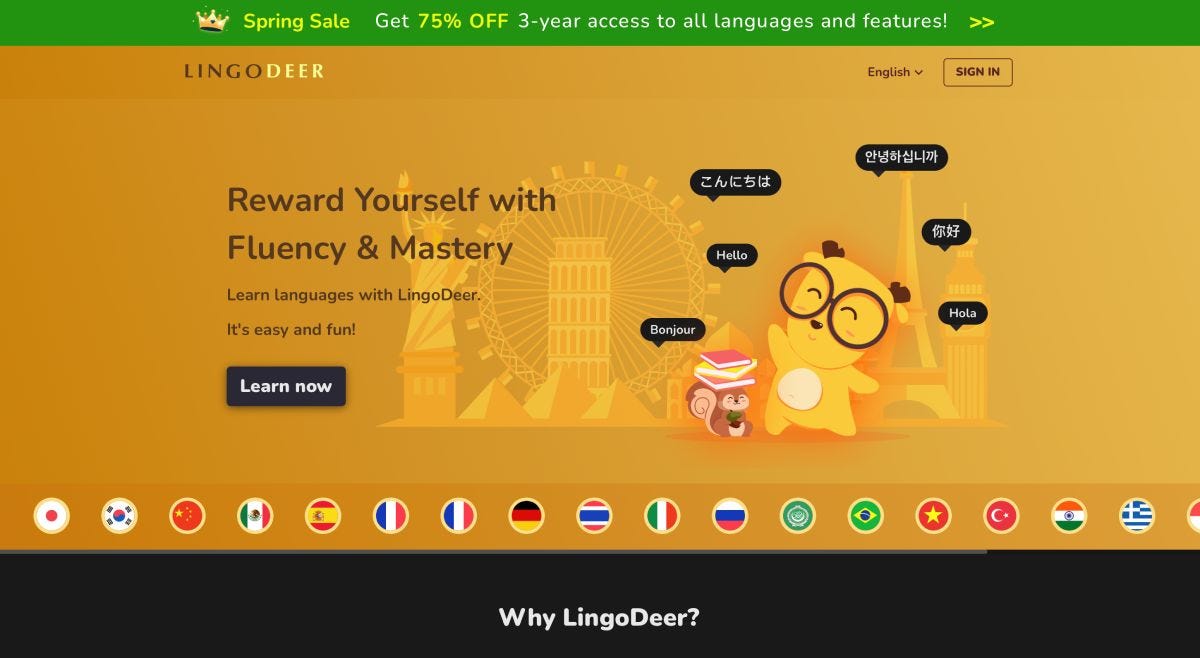
LingoDeer is one of the best language learning apps out there — and it’s also one of my favorites. I like that it comes with a structured and grammar-focused approach, making it easy to understand sentence structures, verb conjugation, adjective declension, and so on.
It also offers listening practice as well as reading and writing exercises, including pronunciation training and vocabulary drills. The app uses recorded native audio instead of robotic text-to-speech in many lessons, which gives you a natural learning experience.
LingoDeer is best for beginners. It can give you an excellent foundation, but it’s not optimal for advanced fluency.
LingoDeer supports around 20 languages, with a heavy focus on Asian languages. So, if you want to learn Japanese, Korean, Chinese, Thai, Malay, or Vietnamese, this is the app to go.
LingoDeer at a glance:
💬 20+ languages, including Japanese, Korean, Mandarin Chinese, Spanish, French, German, Arabic, Russian, Vietnamese, and Thai.
✅ Best for:
- beginners and slightly advanced users
- getting a solid grammar foundation
- self-study
- people wanting to learn an Asian language
2. Mondly

Screenshot via mondly.com
Mondly is another favorite of mine. It’s somewhere between Duolingo’s gamified style and Babbel’s more serious learning approach. What I like most about the app is that it lets you learn from your native language.
You can select your native language and the language you want to learn, which makes is much easier to get ahead with the foreign language. There are more than 1000 language combinations so you are very likely to find your combination.
Many learners like Mondly because it clearly explains sentence structure, verb tenses, and grammar rules, and shows you how to use everything in practice.
Mondly focuses on practical, everyday language skills and keeps you going with short daily lessons. Learning is topic-based and covers real-life situations. However, the app lacks in-depth speaking practice as you would get from Talkio AI or TalkPal.
Mondly at a glance:
✅ Best for:
- grammar-focused learners
- learners who like a structured approach
- learners who like quick daily lessons
- learners who don’t need so much conversation practice
💬 **41 languages**, including Spanish, French, German, Japanese, Korean, Arabic, Hebrew, Turkish, Russian, Portuguese, Dutch, and Polish.
3. Duolingo

Screenshot via duolingo.com
Duolingo is perhaps the most popular learning app out there. At least, it’s the first app that turned language study into something that feels more like a game than a task.
Lessons are quite short, usually between 3 to 10 minutes, and they include lots of stuff you’d actually find in a computer game, such as streaks, leagues, badges, daily goals, and the famous green owl mascot called Duo.
The app is designed to make you come back every day and continue “playing.” You’ll learn through translation exercises (which I think are really fun and one of the best ways to learn a foreign language), listening and pronunciation practice, sentence matching, typing, and speaking prompts.
You can start learning for free, and since recently, Duolingo also offers free advanced content up to roughly B2 level for many major languages.
Duolingo at a glance:
💬 40+ languages, including Spanish, French, Japanese, Korean, Chinese, Arabic, Hindi, and also more niche languages like Welsh, Scottish, Hawaiian, Swahili, and even fictional languages like Esperanto, Klingon, and High Valyrian.
✅ Best for:
- beginners and casual learners
- playful learning with a gaming feel
- travel basics
- vocabulary practice
4. Babbel

Screenshot via babbel.com
Babbel is a premium language learning app that focuses on language learning for real-life situations. It’s almost like the opposite of Duolingo because instead of gamification, it takes a more “serious” approach. It focuses on grammar and practical conversation and is rather aimed at adults.
The lessons are around 10–15 minutes and designed for daily use on your mobile phone. They’re conversation-focused and feature lots of useful phrases, dialogues, pronunciation, and listening comprehension. Many recordings are from native speakers, which helps with realistic pronunciation and listening.
Babbel doesn’t support as many languages as the other apps, but for the ones supported, you can go into much greater depth. Unfortunately, there’s limited free content and most features require a subscription.
Babbel at a glance:
💬 14 languages, including Spanish, French, German, Italian, Portuguese, Dutch, Swedish, Norwegian, Polish, Turkish, Russian, Indonesian, Danish, and Mexican Spanish.
✅ Best for:
- work & travel
- restaurants
- introductions
- everyday conversations
5. Talkio AI

Screenshot via talkio.ai
Talkio AI is one of the most popular AI apps to learn — as its name suggests — talking in a language. The app’s philosophy is all about repeating phrases, answering spoken questions, doing roleplays, practicing pronunciation, and having AI conversations.
The app focuses on real-world situations, and an AI tutor teaches you how to respond naturally, for example, when ordering food, making small talk, traveling, or at work.
One of the biggest benefits of Talkio AI is that it helps reduce the “freezing up” feeling when you’re trying to speak a new language. Compared with apps like Babbel or LingoDeer, Talkio focuses much less on grammar teaching and sentence structure.
You can subscribe to Talkio AI either per month at $19/mo or per year at $10/mo. This makes Talkio one of the most affordable apps on the list, and they even offer plans for schools and teams.
Talkio AI at a glance:
✅ Best for:
- learners afraid to speak
- pronunciation practice
- conversation confidence
- learners who want to respond quickly
💬 70+ languages, including dialects and accents like US/UK/Indian English, Spanish variants, and Arabic dialects.
6. Pimsleur

Screenshot via pimsleur.com
Pimsleur is one of the oldest language learning apps out there and it’s heavily focused on listening. You start by listening to an audio lesson, which is around 30 minutes long.
You listen to native speakers, then you answer questions aloud, and repeat phrases using a spaced-repetition system developed by linguist Dr. Paul Pimsleur, who gave the app its name.
In fact, the pronunciation training is Pimsleur’s strongest feature. Because you constantly repeat after native speakers, the app helps you develop a natural pronunciation with rhythm and intonation.
You can think of Pimsleur as a hands-free learning app that you can use while driving, walking, exercising, or cooking, because you can basically study without looking at a screen.
Pimsleur at a glance:
✅ Best for:
- pronunciation
- speaking confidence
- busy commuters
- audio learners
💬 50+ languages, including some less common ones like Ojibwe, Dari, Twi, Croatian, and Icelandic.
7. Memrise

Screenshot via memrise.com
Memrise, as you can already guess by its name, mainly focuses on vocabulary memorization, phrase memorization, and listening comprehension.
Similar to Pimsleur, it uses spaced repetition and shows you short native-speaker videos. You’ll hear different accents, speaking speeds, formal and casual speech, and you’ll see real facial expressions.
There are daily lessons and also AI chat features. Beyond that, Memrise has its native memory learning system that shows words again right before you’re likely to forget them. This is a great way to help with long-term retention and vocabulary recall.
Memrise at a glance:
✅ Best for:
- memorizing words
- retaining phrases
- quick review sessions
- everyday expressions
💬 35 languages, including major languages like Spanish, French, German, Japanese, Korean, Chinese, Arabic, Turkish, but also more uncommon ones like Icelandic, Yoruba, Welsh, and Mongolian.
8. Transparent Language Online

Screenshot via transparent.com
Transparent Language Online is not so well-known, but it’s a really powerful language learning app that focuses on skill-building across reading, writing, listening, and speaking.
It’s rather designed for “serious” self-study and especially popular with schools, government programs, libraries, and other institutions.
Transparent Language gives you lots of freedom when it comes to your learning practice. You can choose lessons, jump between topics, customize your study, and focus on specific skills.
The app’s biggest strength is its focus on learning the alphabet and script of non-Latin languages like Arabic, Japanese, Hindi, and Korean. As opposed to most other apps on the list, Transparent Language Online is available for offline learning and works both on mobile and desktop via a web browser.
Transparent Language Online at a glance:
✅ Best for:
- serious self-study
- less common languages
- alphabet/script learning
- libraries/schools
💬 120–140+ languages depending on the subscription type, including less common languages like Icelandic, Welsh, Breton, Esperanto, and Balinese, as well as indigenous and native American languages like Cherokee, Cree, Dakota, and Gwich’in.
9. TalkPal

Screenshot via talkpal.ai
TalkPal, like its name already reveals, is an AI-powered language learning app. It focuses on conversation practice and speaking fluency, and tries to simulate talking with a real person using AI chat and voice conversations.
To learn to speak a language fluently, TalkPal offers AI conversations, roleplays, debates, and other speaking and pronunciation exercises. You can text-chat with AI and speak with AI tutors, practicing lots of real-life situations, such as ordering food, job interviews, travel conversations, or describing photos.
TalkPal analyzes your speech and corrects your pronunciation when necessary. If you’re more of an introvert, it can help you overcome the fear of speaking with a real person because the AI provides a judgment-free space to practice speaking.
TalkPal at a glance:
✅ Best for:
- learners afraid to speak
- conversational practice
- pronunciation work
- people who like AI roleplay
💬 130+ languages, including nearly all most popular languages and more niche languages like Albanian, Armenian, Assamese, Azerbaijani, Croatian, Estonian, Georgian, and Urdu.
10. Drops

Screenshot via languagedrops.com
Drops takes a similar game-like approach to language learning as Duolingo. It’s for people who want to have fun learning a language rather than pursue serious self-study.
The app focuses on visual vocabulary learning. Lessons are really short (around 5 minutes) and include mini-games like matching words to images, dragging letters into place, picking correct translations, or repeating vocabulary in quick bursts.
The main goal of Drops is to help you memorize words through visual associations and recall them quickly. It doesn’t teach you grammar rules, sentence structure, or verb conjugation. Speaking practice and listening are also limited.
However, if you’re looking for a way to train vocabulary with appealing visuals, Drops might be the way to go for you. The free version allows you to learn for 5 minutes per day. For longer learning sessions, you have to pick one of the paid plans.
Drops at a glance:
✅ Best for:
- vocabulary building
- casual learners
- people who like visual learning
- a fun approach to recall practice
💬 50+ languages, including most major languages like Spanish, French, German, Japanese, Korean, Chinese, Arabic, Russian, and even rare languages like Igbo and Ainu.
Bottom Line
At the end of the day, there is no single best app that will help you master a language in all aspects, because each one focuses on a different part of learning.
**Duolingo and Drops** are best for building a daily habit and learning basic vocabulary.
**Babbel, Mondly, and LingoDeer are best for understanding grammar and forming real sentences. [Memrise](https://www.memrise.com/) and Pimsleur** help you memorize words and improve your listening and pronunciation skills.
**Talkio AI and TalkPal offer real conversation practice for speaking fluency, and [Transparent Language Online](https://www.transparent.com/)** is best for structured learning across a very wide range of languages.
So, if you want to become proficient in a language, the best thing you can do is combine several apps: one for grammar, one for vocabulary and listening, and another one for speaking practice.
That doesn’t mean you’ll have to use all apps at the same time. Start with one thing, for example grammar and sentence structure, and then gradually progress to the other parts of learning a language.✌️
Get My Insider Reviews & Recommendations — As a linguist, teacher and enthusiastic language learner, I’ve spent thousands of hours teaching and learning languages. I’m here to help, so you can cut through the noise and focus only on what actually works.
**Join 500+ subscribers** getting my honest breakdowns, comparison guides, and exclusive insights you won’t find in these public articles.

Image created by author using ChatGPT
메타데이터
- post_id
- 5cee7e95d36f
- slug
- 10-best-apps-for-language-learning-tested-ranked-5cee7e95d36f
- url
- https://medium.com/activated-thinker/10-best-apps-for-language-learning-tested-ranked-5cee7e95d36f
- canonical_url
- https://medium.com/activated-thinker/10-best-apps-for-language-learning-tested-ranked-5cee7e95d36f
- author_url
- https://medium.com/@cleverlanguagelearning
- status
- ok
- fetched_at
- 2026-06-22 07:15:07