When AIDLC Meets the Apache Way
Introduction: When AI Programming Methodology Meets the Apache Way
When AIDLC Meets the Apache Way
Introduction: When AI Programming Methodology Meets the Apache Way
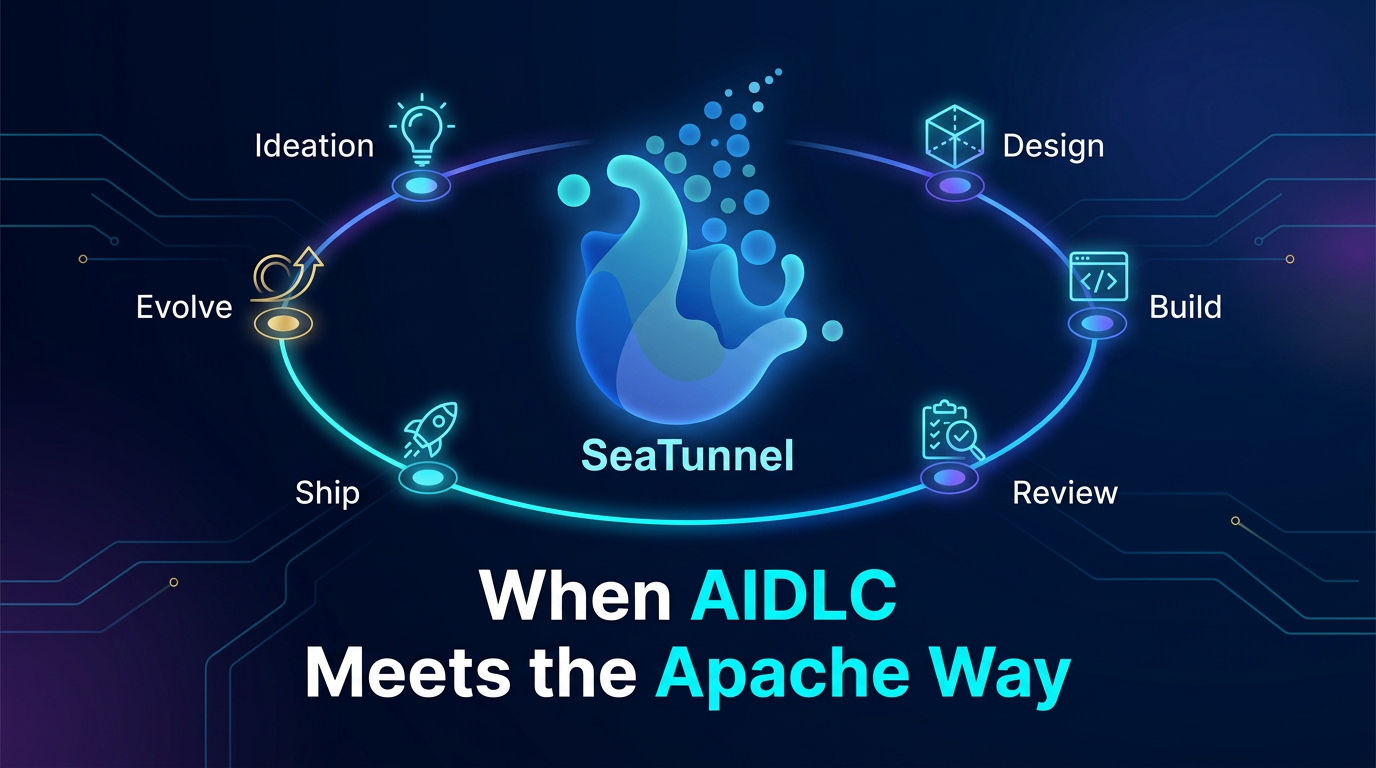
In July 2025, Amazon Web Services released the AI-DLC, or AI-Driven Development Life Cycle, methodology. It advocates elevating AI from an “assistant tool” to a “core collaborator.” In early 2026, I was working on a never-before-seen feature for Apache SeaTunnel, a top-level Apache data ETL project with 100+ connectors: an AI CLI that generates data integration task configurations from natural language.
This feature went through the complete AI-DLC journey, from concept proposal to design discussion to implementation and merge. The PR was successfully accepted by the community. However, the governance model of Apache projects, including Community Over Code, consensus-based decision-making, and merit-based review, brought unique challenges and insights to this methodology.
This article records that practical experience in detail. It focuses on three ideas:
- Traditional SDLC: humans drive everything, and AI is only a code completion tool.
- AI-DLC: AI becomes a core collaborator, while humans make key decisions.
- The Apache Way: Community Over Code, with collective consensus-based decision-making.
Together, these reveal that the center of gravity in software engineering is shifting from productivity to judgment. Open source governance may be both the oldest and the most forward-looking answer on this path of evolution.
Background: What Is AI-DLC?
AI-DLC is an intelligent software development workflow. It can integrate with a team’s existing development practices, maintain quality standards, and ensure that the development team always stays in control of the process. To learn more about the AI-DLC methodology, see this blog post and the methodology paper referenced in it.
Phase Traditional SDLC Equivalent Core AI-DLC IdeaKey Terminology ShiftInceptionRequirements analysis + designAI transforms business intent into detailed requirements, and the team validates them through “Mob Elaboration” Sprint → Bolt, shorter and more intensiveConstructionCoding + testingAI proposes architecture and code solutions, and the team makes real-time decisions through “Mob Construction” Epic → Unit of WorkOperationsDeployment + operationsAI manages IaC and deployment, while the team supervisesN/A
AI-DLC has two core dimensions:
- AI-Powered Execution + Human Oversight: AI plans, asks questions, and seeks clarification. Humans make key decisions.
- Dynamic Team Collaboration: The workflow shifts from “individual isolated work” to “high-energy team collaboration.”
Why is the traditional approach not enough?
“Simply retrofitting AI as an assistant not only constrains its capabilities but also reinforces outdated inefficiencies.”
In other words, merely adapting AI into an auxiliary tool within existing workflows limits its capabilities and reinforces inefficient patterns that should have been eliminated.
Case Background: Why SeaTunnel AI CLI Was Born
Apache SeaTunnel is a top-level Apache data integration project with a large ecosystem covering 100+ connectors, including JDBC, Kafka, S3, Hive, and CDC. But scale also means complexity. Each connector has 20 to 50 configuration parameters, and configuration files use the HOCON format, which creates a steep learning curve for new users.
The community repeatedly raised the same concern:
“I feel SeaTunnel can help me complete data integration, but why do I still keep writing incorrect configuration files even after reading so much documentation?”
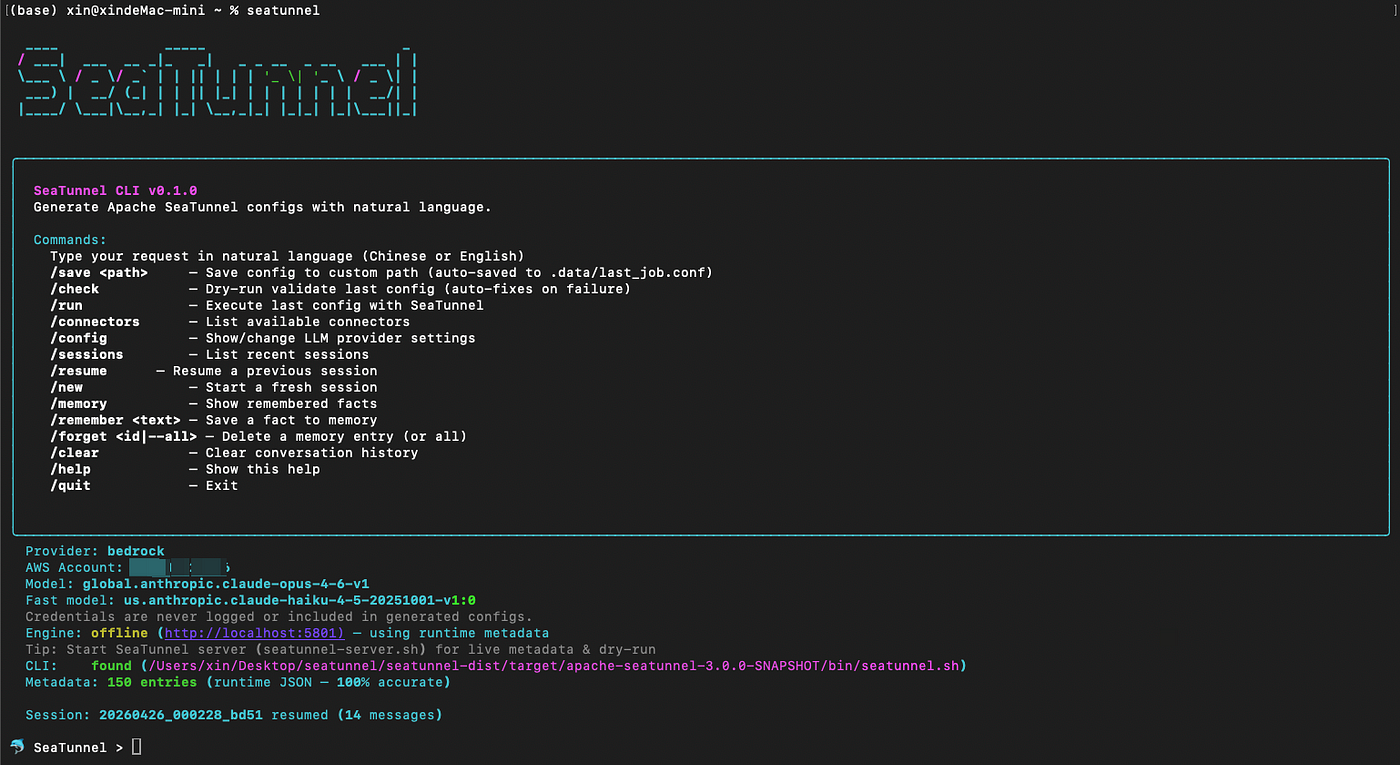
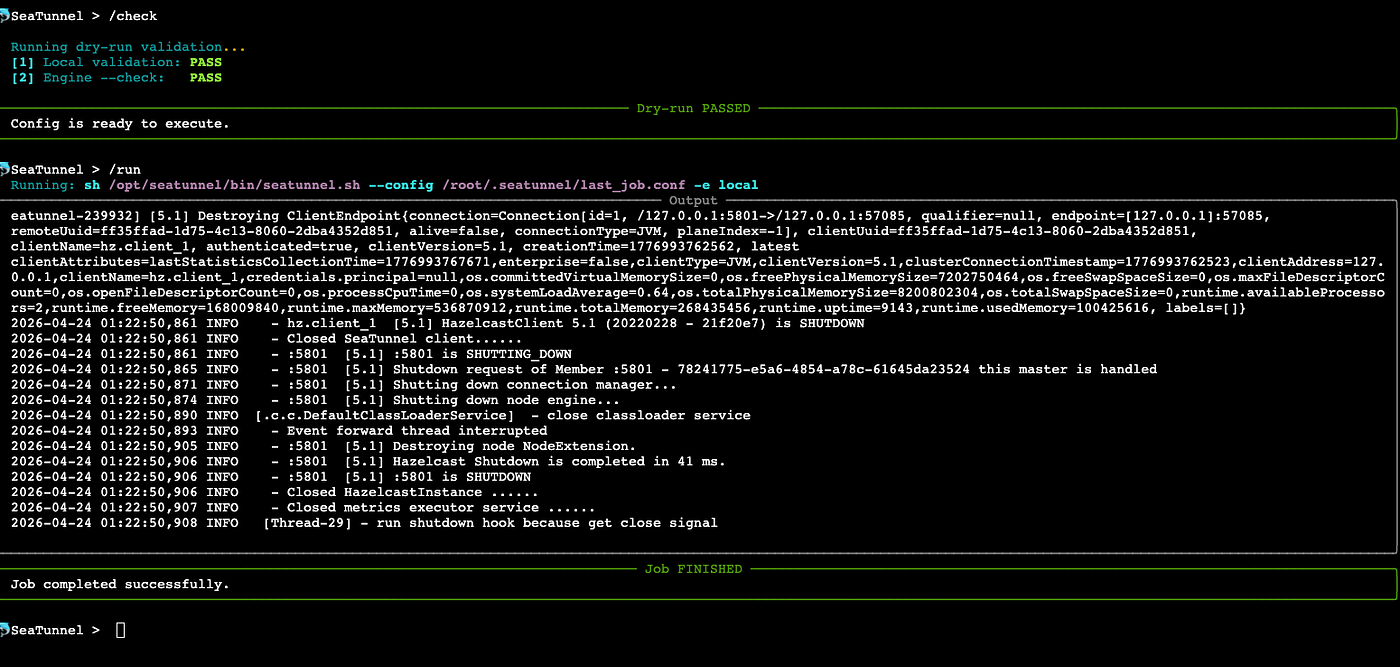
The innovation we proposed was straightforward: let users describe their requirements in a single natural-language sentence, and let AI automatically generate a 100% runnable SeaTunnel configuration.
But the real challenge was far more complex than “calling an LLM API.” The AI needed near-zero-hallucination accuracy across the parameter semantics, type constraints, and composition rules of 100+ connectors.
This was not a regular bug fix or refactoring task. It was a brand-new subproject, seatunnel-ai-clispanning Python code, LLM integration, analysis of existing Java connector implementation mechanisms, connector schema parsing, security, and compliance. It was highly complex, cross-disciplinary, and required rapid iterative validation. This is exactly the kind of scenario where the AI-DLC methodology is most effective.
Mapping the Three AI-DLC Phases to Practice
Inception: WHAT and WHY
AI-DLC guidance principles:
- AI analyzes the workspace, meaning the current codebase state.
- AI gathers requirements and manages extension points.
- AI generates an execution plan.
How this mapped to the actual work:
AI-DLC Step: What We Actually Did. Output Workspace Analysis: Analyzed SeaTunnel’s OptionRule SPI, PluginDiscovery mechanism, and existing Web API—confirmed technical feasibility. Requirements Gathering: Discussed Issue #10681, gathered community feedback, and analyzed connector parameter complexity. Defined the requirement boundary. Elaboration. Discussed the design with committers such as davidzollo and designed the three-layer knowledge base architecture. Reached technical consensus. Execution Plan. Defined the overall architecture: multi-agent pipeline + OptionRule reflection + validation loop PR description
The key insight is that in an Apache project, the Inception phase is not just “AI helps you make a plan.” It must also include community consensus-building. No matter how good your execution plan is, if committers do not agree with the design direction, the entire Construction phase becomes wasted effort.
The AI-DLC concept of “Mob Elaboration” maps naturally to Issue and PR discussion in Apache projects. This is essentially the Apache Way’s “Lazy Consensus” process.
AI’s concrete role during Inception included:
- Quickly analyzing parameter structure patterns across 100+ connectors to confirm whether unified extraction was feasible.
- Helping design the three-tier knowledge base architecture.
- Generating initial drafts of the design document and PR description.
- Comparing different approaches, including script parsing, runtime reflection, and Web API integration, then recommending a direction.
Construction: HOW
AI-DLC guidance principles:
- Use a per-unit processing model to decompose complex tasks into manageable units.
- Treat code generation as a process with a planning phase, a generation phase, and an approval gate.
- Build and test continuously.
The actual iteration process looked like this:
Unit 1: CLI skeleton + provider abstraction
  ├── AI Planning: Designed the multi-provider architecture
  ├── AI Generation: Generated the CLI framework code
  ├── Human Gate: Chose the four-level provider resolution strategy
  └── Review: Committers and PMC discussed and approved
Unit 2: Connector metadata extraction
  ├── AI Planning: Compared script parsing vs OptionRule reflection
  ├── AI Generation: Implemented MetadataExportCommand.java
  ├── Human Gate: Confirmed metadata should be generated during CI build and JSON should not be committed to Git
  └── Review: Committers and PMC discussed and approved
Unit 3: Security enhancement
├── AI Planning: Designed the SENSITIVE_PATTERNS strategy
├── AI Generation: Implemented sanitize_for_persistence()
├── Human Gate: Confirmed the environment variable placeholder strategy
└── Review: Committers and PMC discussed and approvedUnit 4: Startup script reliability
├── AI Planning: Analyzed global package hijacking and silent pip failure issues
├── AI Generation: Rewrote bin/seatunnel-ai.sh
├── Human Gate: Chose editable install + fail-fast strategy
└── Review: Committers and PMC discussed and approvedThe cadence was very different from traditional software delivery.
Traditional Sprint: one iteration every two weeks. AI-DLC Bolt: an iteration measured in hours or days.
The actual rhythm was:
- Commit 1 → Review 1 → Commit 2: 3 days
- Commit 2 → Review 2 → Commit 3: 2 days
- Commit 3 → Review 3 → Commit 4: 1 day
Each Bolt solved one or two blocking issues, and the iteration speed kept increasing.
AI’s concrete role during Construction included:
- Generating the Python CLI framework, including provider abstraction, memory management, and sessions.
- Generating the Java
MetadataExportercode. - Helping analyze review comments and propose fixes.
- Generating unit tests covering edge cases.
- Assisting with commit messages and PR responses.
The key failure point was that AI-generated connector_catalog.json contained widespread errors when using the source-code script parsing approach. This showed why the Human Gate in AI-DLC is indispensable. If I had directly trusted AI’s output without verification, the PR would never have worked.
The solution was for the human to decide to switch to runtime reflection, while AI implemented the new approach. This is the core idea of AI-DLC: “AI-Powered Execution + Human Oversight.”
Operations: WHERE and WHEN
AI-DLC guidance principles:
- AI manages IaC and deployment.
- The team supervises.
- Context continuously accumulates.
In this project, the mapping was:
- CI/CD: GitHub Actions automatically build the project and generate metadata during the build.
- Release:
seatunnel-cliis packaged into the distribution. - Monitoring: User feedback leads to issues, and issues lead to the next Bolt.
In Apache projects, Operations has a special meaning. It includes release votes, staging repositories, and ASF compliance checks. These processes are highly human-driven, and AI’s current role is still limited. However, AI can assist with generating NOTICE and LICENSE files and checking dependency license compliance.
Key Lessons: Challenges of Applying AI-DLC in Apache Projects
Challenge: Apache Lazy Consensus vs AI-DLC Approval Gate
AI-DLC Assumption: Apache Reality Adaptation. There is a clear approver, and once the gate passes, work continues. Any committer can block with a -1. Build a broader consensus during Inception. Fast iteration, with Bolts measured in hours. Reviews may take days or weeks. Use asynchronous Bolts: do not wait passively for review, prepare the next unit in parallel. Once an AI-generated plan is approved, execution proceeds. The community may change direction during construction. Keep each unit modular and independently replaceable
Challenge: PR Granularity, Big and Complete vs Small and Frequent
The AI-DLC concept of Unit of Work naturally supports decomposition. Each unit can become an independent PR. In Apache projects, one Bolt should correspond to one reviewable PR, rather than accumulating multiple Bolts into one large submission.
Challenge: Security and Compliance as Apache Red Lines
AI-generated code does not automatically account for ASF license headers, credential safety, or dependency license compliance. In Apache projects, these are hard red lines.
The adaptation is to add an Apache Compliance Gate during the Construction phase:
- ASF license headers on all files.
- No secrets in code, configuration, or memory.
- All dependencies use Apache-compatible licenses.
- NOTICE and LICENSE files are complete.
Challenge: AI Hallucination vs the Requirement for 100% Accuracy
The biggest lesson was that AI-generated metadata JSON based on source-code script parsing contained widespread errors. In Apache data integration projects, “mostly correct” is not enough. A user’s pipeline either runs 100%, or it is effectively 0%.
The adaptation is that AI-DLC plus Apache projects must include a Truth Source validation step:
- Do not trust AI’s static analysis output.
- Use runtime reflection or real execution for validation.
- The validation loop is required, not merely nice to have.
Challenge: Multi-Person Asynchronous Collaboration
AI-DLC’s “Mob Elaboration” and “Mob Construction” assume synchronous, real-time team collaboration. But the Apache open source community is globally distributed and asynchronous.
The adaptation is:
- “Mob” becomes the GitHub PR discussion thread, an asynchronous mob.
- “Real-time decision” becomes PR comment → 48-hour lazy consensus.
- AI’s role is to summarize discussions and propose compromise solutions.
Quantified Outcomes and Reflections
Timeline comparison:
PhaseTraditional SDLC, Manual OnlyAI-DLC, This PracticeRequirements analysis / Inception2 to 3 weeks~1 week, including community discussionDesign document1 to 2 weeksIncluded in InceptionCoding implementation / Construction4 to 6 weeks~2 weeks, across 4 BoltsReview iteration / Operations3 to 4 weeks~1 weekTotal~12 to 15 weeks~4 weeksAccelerationN/AAbout 3 to 4x
AI contribution analysis:
DimensionAI ContributionHuman ContributionCode generation~70% initial draft30% key fixes and architecture decisions. Design decisions: Provided options and analysis. Made final decisions, such as reflection vs parsing. Reviewed response. Helped analyze comments and draft replies. Judged priority and decided whether to accept changes. Compliance checks. Generated license headers. Ensured security red lines were not crossed
The core reflection is that the greatest value of AI-DLC is not “AI writes code faster.” It is that the decision loop between AI and humans becomes much tighter.
In each Bolt, AI handled a large amount of information processing, solution generation, and code implementation. Humans handled the key judgments: Is this solution correct? Is it safe? Will the community accept it?
This division of labor allowed one developer to deliver a feature that would normally require a small team.
Conclusion: The Future of Open Source and AI Programming Methodologies
AI-DLC is strong enough to become a standard methodology for open source contribution. Individual contributors enhanced by AI can produce team-level output, which will change the power structure of open source communities.
The Apache Way also needs to adapt. There is tension between the traditional review cadence of open source communities, often measured in weeks, and the AI-DLC Bolt cadence, often measured in days. Community governance models need to evolve. In fact, communities have already begun experimenting with AI-assisted review.
Truth Source validation will become standard. As AI becomes more involved in code generation, projects must establish stronger runtime validation mechanisms, such as SeaTunnel’s dry-run Layer 0 to Layer 3 validation, to ensure that AI-generated output does not introduce regressions.
Apache SeaTunnel’s AI CLI is only a small starting point. But it represents a new possibility:
Individual developer + AI-DLC methodology + Apache community governance = accelerated innovation in world-class open source projects.
If this article has sparked your interest in open source contribution, welcome to the SeaTunnel community. We have 200+ open issues waiting for you :)
메타데이터
- post_id
- 5d15e86da1d6
- slug
- when-aidlc-meets-the-apache-way-5d15e86da1d6
- url
- https://awstip.com/when-aidlc-meets-the-apache-way-5d15e86da1d6
- canonical_url
- https://awstip.com/when-aidlc-meets-the-apache-way-5d15e86da1d6
- author_url
- https://medium.com/@seanzhang92
- status
- ok
- fetched_at
- 2026-06-09 15:37:30