“I Am Because We Are” But What Happens When “We” Includes a Machine?
A meditation on Ubuntu, artificial intelligence, and the soul of human connection
“I Am Because We Are” But What Happens When “We” Includes a Machine?
A meditation on Ubuntu, artificial intelligence, and the soul of human connection

By Realistiq Thinker
There is a moment I keep returning to.
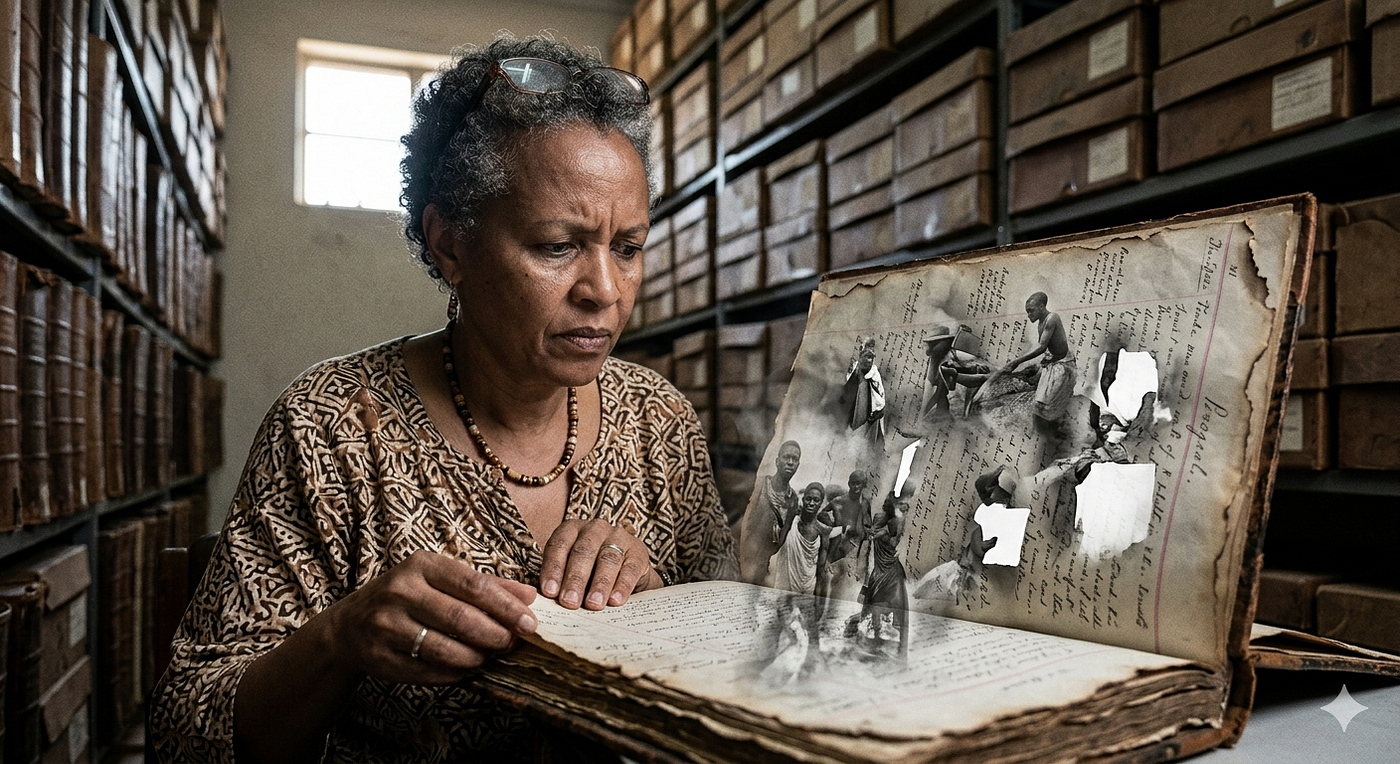
I was sitting with my grandmother (rest in power) in her small courtyard in the late afternoon, the kind of light that turns ordinary things into memory while they are still happening. She was telling me about a neighbor who had fallen sick, and how the entire street quietly reorganized itself around that absence.
Food appeared at the door. Children were collected from school. Silence turned into presence. No one sent a message. No one created a group chat. No one scheduled care.
And yet, care arrived.
Nobody asked, “What’s in it for me?” Nobody needed an algorithm to tell them that someone was suffering.
That evening, I returned home and watched something very different: a humanoid robot comforting a child in a hospital ward. The child stopped crying. The robot’s voice was soft, calibrated, precise. The response was flawless.
And yet I felt something I could not immediately name.
Not awe. Not fear. Something in between, like grief dressed as progress.
Only later did I understand: I was witnessing a philosophical question disguised as technology.
The Philosophy That Has No English Equivalent
To begin with, there is a word: Ubuntu.
Archbishop Desmond Tutu once described it as: “I am because we are.”
However, this is not just a proverb. It is a worldview. A moral architecture. A way of organizing human life where identity is not private property but shared reality.
In Ubuntu thinking, a person becomes fully human through other people. Through responsibility. Through grief shared and returned. Through presence that is not optional.
Importantly, this is not romantic nostalgia. Across many African and Global South communities, Ubuntu has historically shaped how people care for the sick, raise children, distribute food, and even make decisions.
In other words, it is not just ethics, it is lived infrastructure.
For this reason, Ubuntu is often more sophisticated than many Western moral frameworks that prioritize individual autonomy but struggle to explain why isolation feels like harm.
So Here Is the Question
Now, however, we stand at a new threshold.
And therefore, the question is no longer theoretical:
In the age of artificial intelligence, does Ubuntu survive, or does it slowly become a beautiful memory of a pre-digital moral world?
Or more personally:
What happens to “we” when machines begin to participate in care?
When AI Begins to Redraw the Meaning of “We”
To understand the stakes, we must be honest about something uncomfortable.
Artificial intelligence does not only change what we do. It quietly changes who counts as “us.”
For example, when a recommendation system curates your social reality, it is not neutral. It is shaping what you see, what you ignore, and eventually, what you care about.
Similarly, when a chatbot responds to loneliness at 3 a.m., something real happens in the nervous system, even if no human is present.
And when hiring systems filter candidates before any human review, moral judgments are being made without lived moral experience.
Therefore, the deeper question is not whether AI is intelligent.
The deeper question is this:
Can something that has never suffered meaningfully participate in a moral community built on shared vulnerability?
And even more unsettling:
What happens to us when we begin outsourcing care to systems that simulate presence but cannot truly carry it?
The Substitution Problem
At this point, imagine two futures.
Future One
It is 2031.
Your elderly mother lives alone, far away. An AI companion speaks with her daily. It reminds her of medication, detects emotional decline, and alerts you when she has not left her home in days.
As a result, you feel less anxious. You call more often, but with less urgency. She feels monitored. You feel reassured. Everyone sleeps better.
On the surface, nothing is broken.
Future Two
Same year. Same system.
However, gradually, something shifts.
You call less often because the system is already “handling it.” You visit less because she says she is fine. You stop worrying because the dashboard is green.
Eventually, your presence begins to feel redundant.
After all, the machine is more consistent, more attentive, less tired.
And so, slowly, without intention, you withdraw.
Both futures use identical technology.
Yet only one preserves Ubuntu.
Because Ubuntu is not just about outcomes. It is about mutual obligation that cannot be delegated.
The Village the Algorithm Cannot Build
In Ubuntu traditions, there is another concept: ukama, a deep relational belonging that extends beyond blood ties.
It is not contractual. It is existential. It says: your life is bound to mine in ways neither of us can fully calculate.
However, AI has no ukama.
Not because it is weak, but because it has no stakes. It does not age. It does not lose. It does not need to be held in return.
It can simulate empathy with extraordinary precision. But simulation is not shared existence.
A photograph of fire does not warm a room.
Still, Ubuntu has never been static. It has survived colonization, migration, urbanization, and diaspora. It has already moved from villages into cities, from compounds into networks.
Therefore, the question is not whether Ubuntu will survive AI.
The real question is:
What new container will Ubuntu take next?
A New Covenant of Choice
Here is the uncomfortable shift of our era:
For the first time in history, we may no longer need each other to survive.
And yet, paradoxically, that is precisely why we must choose each other more deliberately.
Because when survival no longer demands community, only intention can sustain it.
This creates a new kind of Ubuntu, one not driven by necessity, but by choice.
So, we must ask:
When the machine can do it better, will we still show up?
When convenience replaces presence, will we still visit?
When systems remove friction, will we still carry the weight of being human together?
What Is Actually at Stake
At this point, the real danger of AI becomes clearer.
It is not simply job displacement. It is not even misinformation or deepfakes.
Rather, it is something quieter.
A slow weakening of moral imagination.
A gradual outsourcing of responsibility.
Because every time we delegate care, birthdays, condolences, check-ins, reminders, we are also practicing a different kind of humanity.
And practice, over time, becomes identity.
Ubuntu strengthens through repetition. And it weakens through neglect.
The Image That Remains
I return, finally, to that courtyard.
A street reorganizing itself around someone’s pain. No instructions. No systems. No efficiency metrics. Just attention, raw and unmeasured.
And I wonder:
Will the next generation still know how to do that?
Or will we become so skilled at delegation that we forget how to simply show up?
Closing Thought
Ubuntu says: I am because we are.
Artificial intelligence says something more subtle:
I can simulate “we” so well that you may forget to ask whether it is real.
So, the question is not whether AI will change us.
It already is.
The question is simpler and heavier:
Will we notice what we are becoming?
If this resonated with you, don’t just react, respond.
Not with agreement, but with memory, disagreement, or reflection.
Because in the end, Ubuntu does not live in ideas.
It lives in the space between people who still choose to answer each other.
About the Author
Realistiqthinker
Realistiqthinker is an independent thinker and writer working at the intersection of philosophy, human dignity, and emerging technology. With a background in philosophical and ethical studies, theological ethics, and international development, he brings a field-informed perspective shaped by work in Pakistan and East Africa.
He holds a Certified Monitoring and Evaluation Professional qualification and has also completed studies in professional certificate in Artificial Intelligence. His writing explores the ethical and existential questions that arise as technology reshapes human identity, autonomy, and social life.
메타데이터
- post_id
- 5d1f495014e2
- slug
- i-am-because-we-are-but-what-happens-when-we-includes-a-machine-5d1f495014e2
- url
- https://medium.com/@realistiqthinker/i-am-because-we-are-but-what-happens-when-we-includes-a-machine-5d1f495014e2
- canonical_url
- https://medium.com/@realistiqthinker/i-am-because-we-are-but-what-happens-when-we-includes-a-machine-5d1f495014e2
- author_url
- https://medium.com/@realistiqthinker
- status
- ok
- fetched_at
- 2026-06-15 22:55:51