Ferris Bueller’s Day Off: 40 Years On
How does this sacred text of Generation X hold up after four decades?
DILLON ON FILM
Ferris Bueller’s Day Off: 40 Years On
How does this sacred text of Generation X hold up after four decades?
Credit: Paramount
Warning: Contains spoilers
I didn’t see writer-director John Hughes’s Ferris Bueller’s Day Off at the cinema. The film had a 15 certificate in the UK, and at eleven years old, it took me a little longer before I dared to sneak into films underage; an underrated and thrilling coming-of-age ritual that, according to my children, is much harder to do these days. Whilst underage, I was never refused admission to any film at the cinema (nor was I ever refused alcohol in pubs under the age of 18, but that’s a transgressive tale for another time). However, my own children have had to devise more cunning methods for their own underage cinemagoing; an activity I encouraged, as such scheming teaches initiative, planning, and requires a bit of courage.
(For the record: Both my underage cinemagoing and that of my children still involved ticket purchases. Whatever else one might do to subvert the British Board of Film Classification, cinemas must be financially supported.)
Perhaps you can infer from my parenting style that I’m both Generation X and a product of Ferris Bueller’s rule-defying schtick. Well, in fairness, I was a rebel long before the release of this film, but when I caught up with it on VHS a couple of years after the cinema release, it certainly struck a chord with me, considering at the time I was up to my eyeballs in an ultra-strict evangelical Christian school in which breathing in the wrong direction would get you in trouble. Suffice it to say, in addition to open defiance via pranking, I found a variety of cunning ways to get away with things, Ferris Bueller-style, under the noses of the teachers.
Of course, Ferris Bueller’s Day Off specifically satirises some of the more woeful aspects of American high school, but I find it has a more universal resonance for those enduring the absurdities of most forms of teenage schooling. My own views on education and schools are largely iconoclastic. I’m firmly pro-education but deeply anti-schools in most of their current manifestations in the western world, with a few notable exceptions (Finland, for example). But I digress. The point here is that the first act’s satirical laughs at the expense of American high school certainly hit the target.
Credit: Paramount
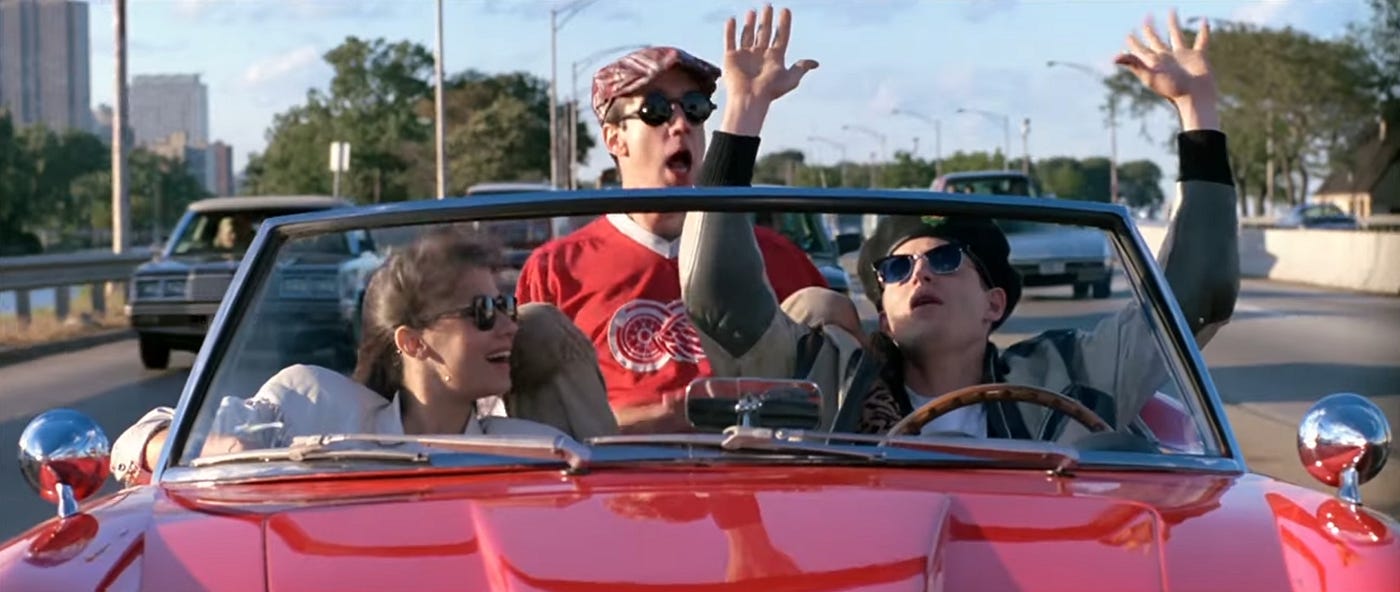
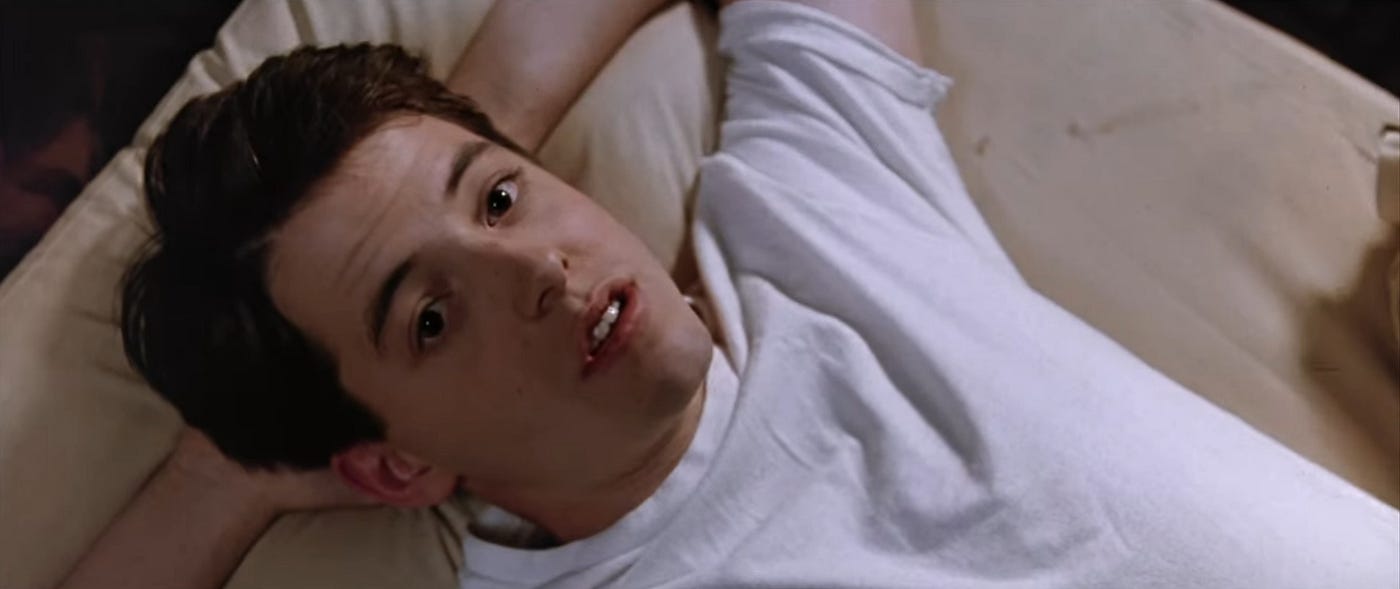
For those unfamiliar with the narrative, our teenage protagonist Ferris (Matthew Broderick) fakes an illness and tricks his parents into letting him have the day off school. What directly follows is a triumphant exclamation of “They bought it!”, an MTV logo that’s now a symbol of a sadly bygone era, and the first of many fourth-wall-breaking monologues. These expound on Ferris’s subversive but sensible philosophy concerning needing to take a look around once in a while, or you miss life, as well as first-world problems such as being given a computer instead of a car for a birthday present. But most critically, he delivers a key speech that sums up latchkey kid Generation X apathy.
“I did have a test today… It’s on European socialism. I mean, what’s the point? I’m not European. I don’t plan on being European. So, who gives a crap if they’re socialists? They could be fascist anarchists, it still wouldn’t change the fact that I don’t own a car… Not that I condone fascism, or any “ism”, for that matter. “Isms”, in my opinion, are not good. A person should not believe in an “ism”; he should believe in himself.”
There’s a reason Generation X gets stereotyped as self-reliant, distrusting, politically unengaged, and rebellious, with a sense of humour that doesn’t give an airborne fornication who gets offended by it. This speech sums it up and provides insight into why I shrug at the lunacy of modern politics, often driven by “isms” on all sides of the debate. At times like these, I’m channelling my inner Ferris Bueller.
Credit: Paramount
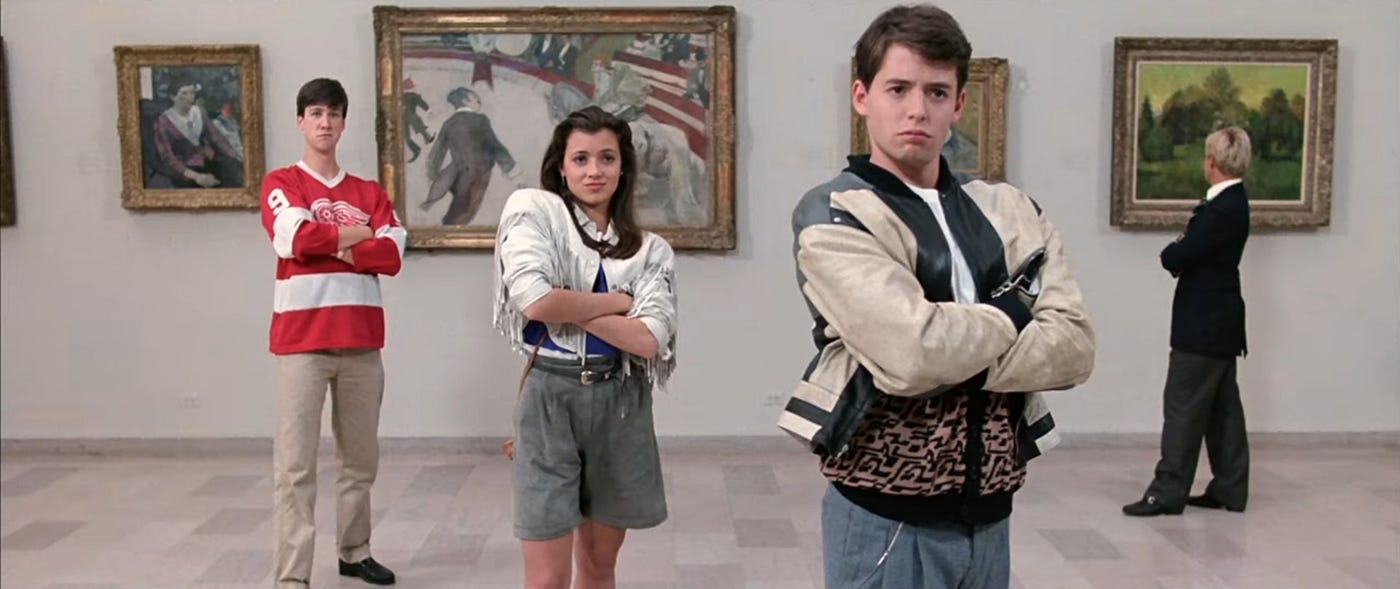
Not that I think Ferris Bueller’s Day Off is a particularly deep or incisive film. It has a few things on its mind, which I’ll come back to in a bit, but for the most part, quite rightly, it’s just about delivering laughs. These come thick and fast in the first act, with Ferris dragging his hypochondriac best friend Cameron (Alan Ruck) into his schemes, and also a more willing participant in the form of his girlfriend, Sloane (Mia Sara). The antagonist, Dean of Students Edward Rooney (Jeffrey Jones), obsessively pursues Ferris, determined to put an end to his shenanigans.
Most of the best jokes are in the first part of the film. These include the famously monotone teachers taking the register (“Bueller… Bueller…”), deeply dull lessons delivered to deeply unengaged pupils (some hilarious close-ups), and the hypocritical absurdities of Rooney’s behaviour (for instance, that amazing shot of him running, then slowing down as he passes a classroom door with a window, then running again, three times in a row). I also love the farcical shenanigans of his interactions with his assistant, Grace (Edie McClung). (“Oh, Ed… You sounded like Dirty Harry just then!”) Ferris’s synthesised illness sound effects are a lot of fun too.
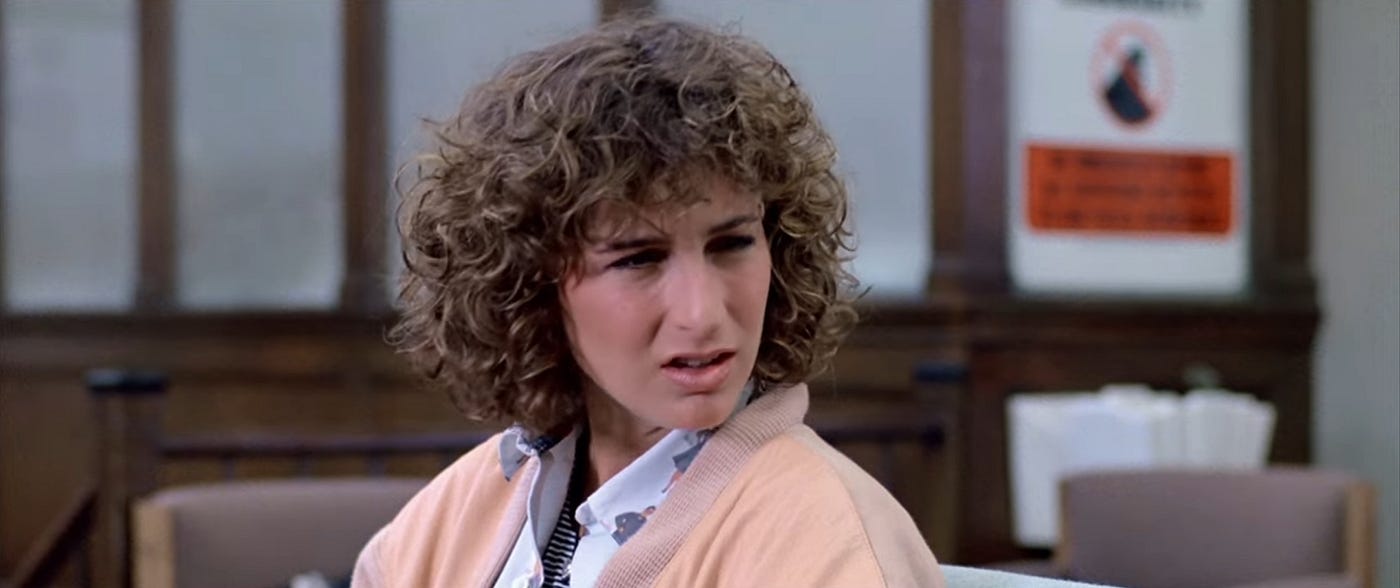
Subsequently, instead of everything unravelling for Ferris and co during their trip to Chicago, everything goes wrong for Rooney. This is a pleasingly amoral idea, but the more indulgent moments, such as the musical numbers during the parade and the slapstick gags with Rooney as he attempts to expose Ferris’s deception, aren’t as inspired as the sharper jokes in the first act. However, Rooney’s farcical interactions with Ferris’s sister Jeanie (Jennifer Grey), who is jealous of her brother’s ability to get away with his outrageous activities, always trigger a guffaw from yours truly. Realising there’s an intruder in her home, but at that point not knowing who it is, Jeanie speaks to Rooney via the intercom, warning him that the police are on their way, and that she has “a scorching case of herpes”. There’s also a silly *Star Wars* (1977) joke that always makes me giggle.
Credit: Paramount
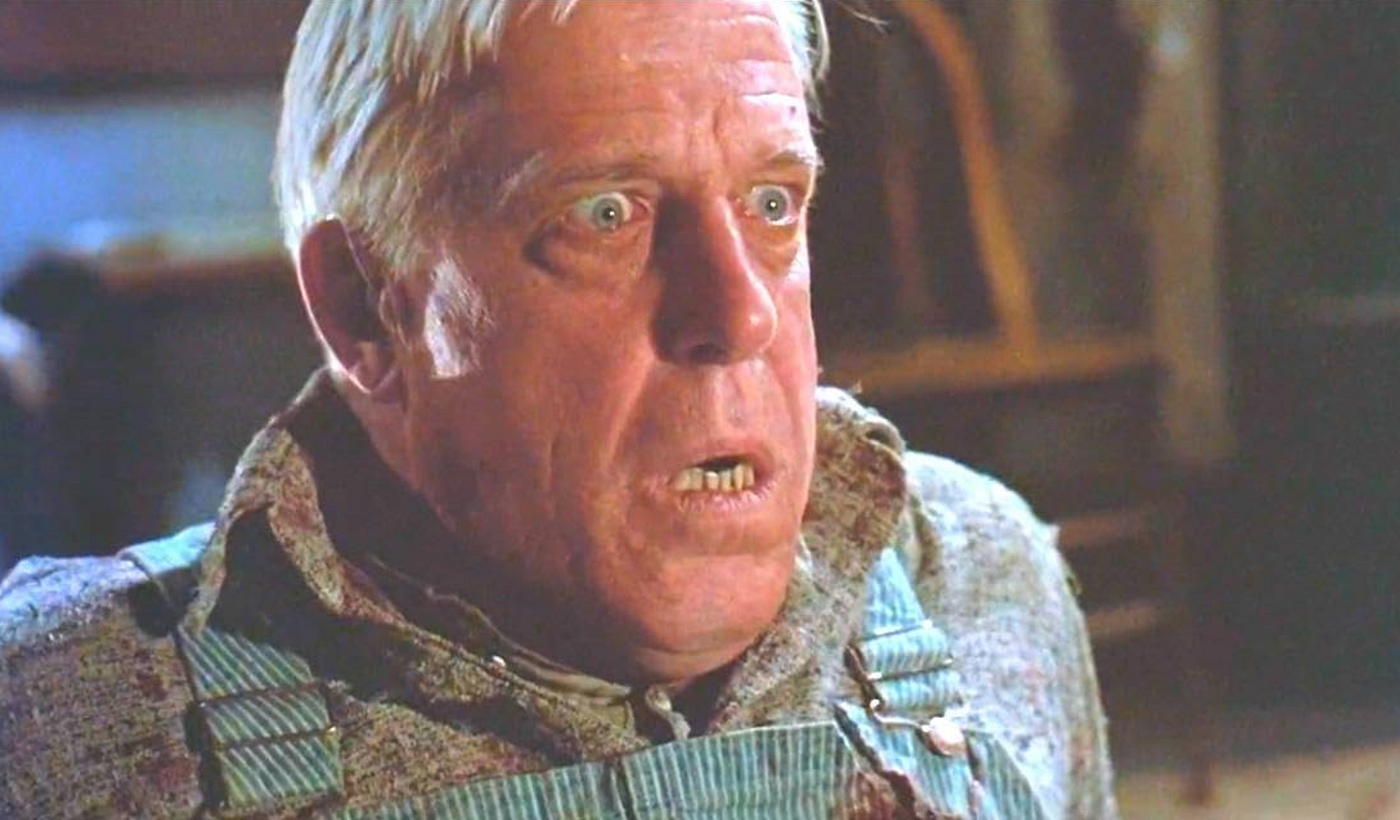
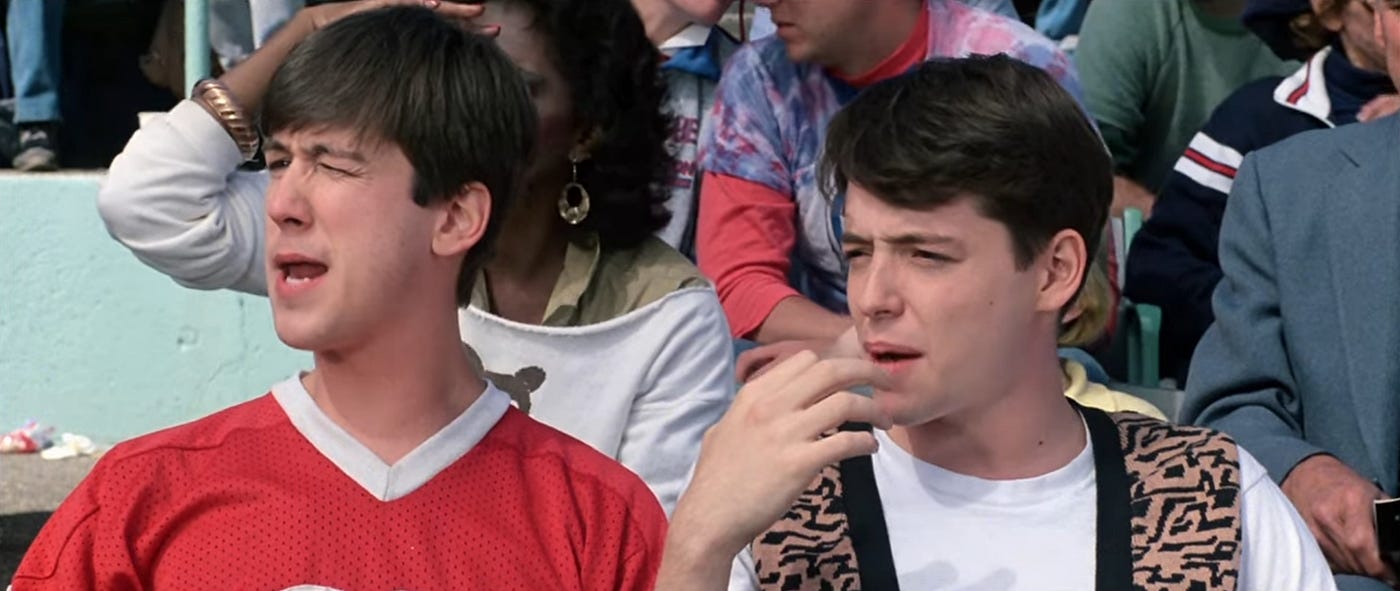
However, the key character in the film is not Jeanie, Sloane, or even Ferris, but Cameron. His miserable home life, especially his appallingly materialistic parents (deftly kept offscreen), has done a great deal of psychological damage. It’s not surprising that this witty, intelligent, thoroughly likeable young man (far more likeable than Ferris, in my opinion) has a memorable meltdown at the end of act two, ultimately destroying his father’s beloved vintage Ferrari that he, Ferris, and Sloane half-inched for the day. For Cameron, the car represents his father, his messed-up priorities, and the lack of love he has shown throughout his entire life. It’s also, by extension, a surprisingly sharp critique of the neglectful parents of Generation X children.
Not that Ferris Bueller’s Day Off should be taken as some kind of anti-capitalism screed. Remember, Ferris warns against “isms”. What’s more, in one aside, he waxes lyrical about the Ferrari, urging viewers to pick one up if they have the means. Therefore, Cameron’s meltdown is hardly a condemnation of wealth and status symbols, but more a brief pause to reflect that, whilst materialism is all well and good to a point, it should never take priority over family relationships.
There’s an inherent compassion for young people in John Hughes’s films that I believe extends beyond Generation X and perhaps explains why Ferris Bueller’s Day Off remains perennially popular. For instance, my Generation Z children both love it, probably more than I do. It certainly isn’t a perfect film, and I wouldn’t list it among my favourite comedies of all time, but outside of The Breakfast Club (1985), this is probably Hughes’s finest work. The performances and direction are solid. I also quite like the soundtrack, with Yello’s ‘Oh Yeah’ and The Dream Academy’s variant of The Smiths’ ‘Please Please Please Let Me Get What I Want’ proving particular highlights.
Credit: Paramount
In this era of legacy sequels, I’ve often wondered what it might be like to see Ferris and co four decades on. I quite like the idea of Ferris becoming a depressed low-level corporate employee who finds increasingly elaborate ways to skip work and pull the wool over the eyes of his belligerent middle manager. As for Cameron and Sloane, I reckon both would have far more successful careers than Ferris. But both would return to participate in his schemes. Perhaps it could be called Ferris Bueller’s Off Day? Not sure we need a Charlie Sheen cameo this time, though.
On second thoughts, scratch that idea. Let’s leave Ferris where he is: A smug, self-satisfied, but hugely enjoyable product of 1980s Generation X rose-tinted nostalgia, with a beautiful and adoring girlfriend he probably doesn’t deserve, and a best friend who, admittedly, really did need a day off. Should Ferris have got away with it? Probably not. But after that frenetic final act race to get home before his parents, it’s a lot more satisfying that he does.
The Dillon Empire beyond Medium
For a full list of my published novels, click here.
For my website, click here.
For my Patreon page, click here.
For my Substack page, click here.
For the Dillon on Film podcast, click here.
메타데이터
- post_id
- 5d2cee539b93
- slug
- ferris-buellers-day-off-40-years-on-5d2cee539b93
- url
- https://fanfare.pub/ferris-buellers-day-off-40-years-on-5d2cee539b93
- canonical_url
- https://fanfare.pub/ferris-buellers-day-off-40-years-on-5d2cee539b93
- author_url
- https://medium.com/@simondillon
- status
- ok
- fetched_at
- 2026-06-22 12:55:45