Modern Integration Unleashed: BizTalk Migration, Azure Advantage & the Vendor Crossroads
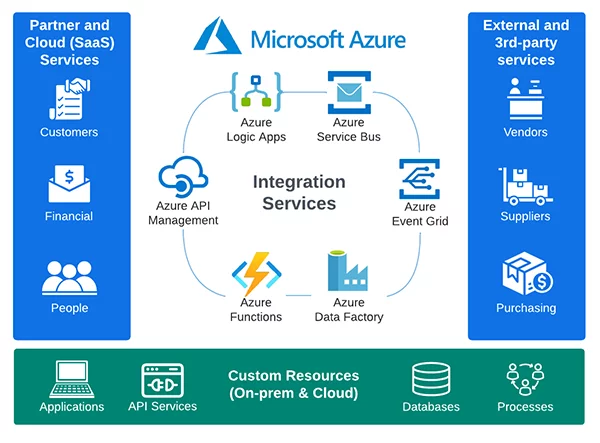
Azure Integration Services — comprising Azure Logic Apps, API Management, Service Bus, Event Grid, Functions, and Data Factory — has…
Modern Integration Unleashed: BizTalk Migration, Azure Advantage & the Vendor Crossroads
Azure Integration Services — comprising Azure Logic Apps, API Management, Service Bus, Event Grid, Functions, and Data Factory — has firmly established itself as a leading integration platform-as-a-service (iPaaS). Most notably, Microsoft has been recognized as a Leader in Gartner’s Magic Quadrant for iPaaS, for both 2023 and 2024, thanks to its strong execution, comprehensive vision, and robust partner ecosystem.
What Gives AIS Its Edge?
- Flexible, modular architecture: Businesses can adopt only the components they need — whether messaging, APIs, workflows, or data pipelines — within a unified ecosystem Microsoft Azure.
- Pay-as-you-go pricing: Eliminates heavy capital expenditure associated with traditional middleware; AIS enables scalable, usage-based costs
- Global reach & availability: Accessible in 50+ Azure regions worldwide, offering enterprise-grade reliability and support Microsoft Azure.
- Deep Microsoft ecosystem integration: Seamlessly connects with Azure, .NET, Azure AD/Entra ID, and enterprise compliance/security tools
- Constant innovation: Rapidly evolving with AI, event-driven patterns, enhanced observability, and a rich partner ecosystem.
AIS vs. Competitors
While there were alternatives exist like IBM , webMethods, MuleSoft (Anypoint Platform), SAP, and Oracle, AIS stands out for:
- Superior Microsoft/enterprise alignment
- Simplified, low-code experiences versus complexity in traditional middleware
- Cloud-native scalability and innovation vs. legacy on-prem packaging
BizTalk Server → Azure Integration Services
Why Migrate?
- End of mainstream support: Microsoft ends support for BizTalk in April 2028, with extended support until 2030. Post that, there will be no updates, creating security and operational risks.
- Cloud-native advantages: AIS offers modern REST APIs, serverless compute, automatic scaling, and hybrid working patterns — areas where BizTalk lags
- Cost-efficiency & agility: From capex-heavy, device-dependent BizTalk to lean, consumption-based Azure services.
- Familiar developer experience: Logic Apps reuses concepts like the Business Rules Engine, maps, and orchestration — easing migration and learning.
Migration Strategy & Best Practices
- Phased, hybrid approach: Prioritize low-risk workloads first, maintain BizTalk in parallel, and allow iterative learning.
- Big-bang migrations are discouraged due to complexity, potential rework, and slower value realization.
- Leverage migration tools & integration accounts for mapping schemas, agreements (EDI), and rules — helping re-use investments and reduce rebuild effort.
- Careful planning: Document existing workflows, triggers, adapters, and dependencies to map to Logic Apps, Service Bus, Functions, etc.
- ROI justification: Emphasize reduced maintenance, faster delivery, scalability, security compliance, and future-readiness with cloud-first architecture.
When Might BizTalk Customers Consider Other Vendors?
While AIS is a strong choice — especially for organizations embedded in the Microsoft ecosystem — certain scenarios may tilt customers toward alternatives:
- Non-Microsoft-centric environments: If infrastructure is built on IBM, Oracle, or SAP ecosystems, in-place middleware like IBM Integration Bus or SAP PI/PO may align better.
- Highly specialized protocols or adapters: BizTalk’s third-party adapter ecosystem may not fully map to AIS; some niche adapters may be better maintained on-prem or with vendors like IBM Websphere MQ/ACE or webMethods.
- Vendor consolidation strategy: Some enterprises may prefer consolidating on platforms like MuleSoft (Anypoint) for API-centric integration with strong multi-cloud support, or Oracle for entirely Oracle-aligned enterprises.
- Regulatory or data sovereignty constraints: Industries with strict on-prem or data flow restrictions may require middleware with dedicated, localized deployments — still within options like IBM or on-prem BizTalk (extended support).
Conclusion & Call to Action
Azure Integration Services is a powerful, modern successor to BizTalk — backed by deep Microsoft integration, flexible modular services, and a global, cloud-native platform. For BizTalk customers, migrating to AIS offers lower costs, increased agility, and staying current with enterprise innovation.
That said, scenarios do exist where alternative middleware platforms may still be the right strategic fit — particularly outside the Microsoft ecosystem or in highly specialized use cases.
Recommendation:
- Initiate a migration assessment to evaluate infrastructure, reuse potential, and cost/benefit.
- Start with a pilot wave to gain early ROI and training.
- Plan for a hybrid coexistence to ensure smooth transition.
메타데이터
- post_id
- 5d3bfbacbccf
- slug
- modern-integration-unleashed-biztalk-migration-azure-advantage-the-vendor-crossroads-5d3bfbacbccf
- url
- https://medium.com/@rajeshm.eai/modern-integration-unleashed-biztalk-migration-azure-advantage-the-vendor-crossroads-5d3bfbacbccf
- canonical_url
- https://medium.com/@rajeshm.eai/modern-integration-unleashed-biztalk-migration-azure-advantage-the-vendor-crossroads-5d3bfbacbccf
- author_url
- https://medium.com/@rajeshm.eai
- status
- ok
- fetched_at
- 2026-07-21 17:51:44



