Put Teachers at the Centre of Education Reform
New curricula, technology and assessments matter — but teachers turn reform into learning.
Put Teachers at the Centre of Education Reform
New curricula, technology and assessments matter — but teachers turn reform into learning.
A government can redesign a curriculum overnight.
It can purchase devices, introduce new examinations and announce ambitious education targets.
But reform only becomes real when a teacher enters the classroom and makes it work.
That is why teachers should not be treated as the final delivery mechanism of education reform. They must be involved as its designers, leaders and most important partners.
Kenya’s Tusome (“Let’s Read”) programme shows what becomes possible when teachers are placed at the centre of reform. Introduced nationally in 2015 to improve reading among approximately seven million children in Grades 1–3, Tusome combined practical teacher training with simple lesson guides, one textbook per student and regular classroom coaching. Teachers were not merely handed a new curriculum — they received the tools and continuing support needed to use it effectively. Evaluations found meaningful improvements in reading outcomes, demonstrating a simple truth: education reform succeeds when teachers are prepared, supported and trusted to lead it.
Global statistics: teachers and education reform
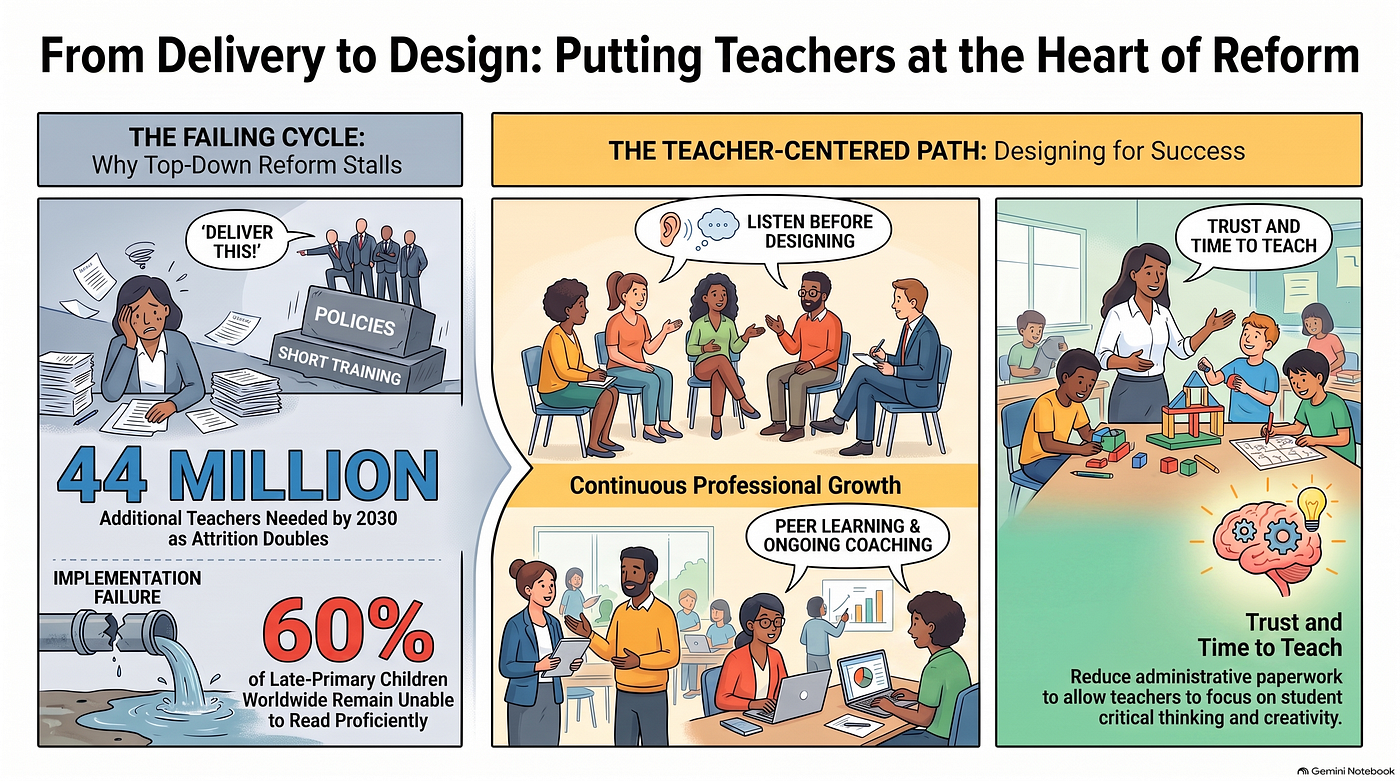
- 44 million additional teachers are needed worldwide by 2030 to achieve universal primary and secondary education. Around 31 million of them will be required at secondary level. UNESCO
- Global primary-teacher attrition almost doubled — from 4.62% in 2015 to 9.06% in 2022. Many teachers leave within their first five years. UNESCO
- Addressing the global teacher shortage would require approximately US$120 billion annually for additional salaries by 2030. UNESCO
- In OECD’s 2018 international teacher survey, 48% of teachers reported experiencing “quite a bit” or “a lot” of workplace stress. OECD
- In the same survey, 25% of teachers expected to leave teaching within five years. Even among teachers aged 50 or younger, the figure was 14%. OECD
- OECD’s 2024 survey found that only 55% of teachers believed their recent professional learning had positively affected their teaching. Training participation alone, therefore, does not guarantee useful development. OECD TALIS
- In Tanzania, participation in collaborative planning, classroom observation, peer learning and mentoring increased from approximately 40% to 80% in districts implementing a national continuous professional-development framework. Teachers also reported greater job satisfaction and confidence. World Bank
- UNESCO reports that 250 million children were out of school globally in 2023. Recruiting teachers is therefore not separate from expanding access — it is essential to it. UNESCO
Together, these statistics support one conclusion: education systems cannot reform successfully by changing curricula and assessments while leaving teachers overstretched, insufficiently supported and absent from decision-making.
Reform often reaches teachers too late
In many education systems, reform follows a familiar sequence:
- Experts design a policy.
- Authorities prepare new materials.
- Schools receive instructions.
- Teachers attend short training sessions.
- Implementation begins immediately.
Teachers are then held responsible when outcomes fall short.
But a presentation explaining a new curriculum is not the same as preparing someone to teach it. Meaningful reform requires practice, coaching, classroom resources, peer learning and time for reflection.
Teachers should be involved before policies are finalized — not merely informed after decisions have been made.
What teacher-centred reform should look like
1. Listen before designing
Teachers understand classroom realities that may not appear in policy documents.
They know:
- Which concepts students struggle to understand
- Where language barriers affect participation
- How class size changes teaching methods
- Why students become disengaged
- Which activities work in real classrooms
Every major reform should include structured teacher consultation, classroom observation and pilot testing.
2. Replace one-off training with continuous development
A single workshop rarely changes teaching practice.
Teachers need:
- Practical demonstrations
- Opportunities to rehearse new methods
- Coaching and constructive feedback
- Professional learning communities
- Examples adapted to local classrooms
- Follow-up support throughout implementation
Professional development should be part of a teacher’s working life, not an occasional event added to an already heavy workload.
3. Give teachers time to teach
Teachers cannot focus fully on learning when they are overwhelmed by paperwork, administrative duties, large classes and constant reporting.
Reform should examine how teachers spend their time.
Technology should reduce unnecessary work — not create additional platforms, forms and monitoring requirements.
4. Build trust alongside accountability
Accountability matters, but accountability without support produces fear and compliance.
A strong system asks two questions:
- What outcomes are teachers responsible for?
- What support does the system owe teachers so they can achieve them?
Teachers should have clear expectations, useful feedback and the professional freedom to respond to students’ needs.
5. Prepare teachers for the skills students now need
Today’s students require more than subject knowledge.
They need opportunities to practise:
- Communication
- Critical thinking
- Problem-solving
- Collaboration
- Digital citizenship
- Emotional regulation
- Creativity and adaptability
Teachers cannot confidently develop these abilities if they have not received the tools, examples and professional learning needed to teach them.
6. Recognize teachers as reform leaders
Some of the most useful educational innovations begin inside classrooms.
Systems should identify effective teachers and create pathways for them to become:
- Mentors
- Instructional coaches
- Curriculum contributors
- Research partners
- School-level innovation leaders
Leadership should not require teachers to leave teaching completely.
What Bangladesh can do now
Bangladesh has expanded access to education, but access alone is not enough. The next stage must focus on the quality and relevance of learning.
Practical priorities include:
- Involving teachers in curriculum and assessment design
- Providing continuous, school-based professional development
- Connecting teacher training to actual classroom challenges
- Reducing unnecessary administrative workload
- Supporting teachers to integrate life skills with academic subjects
- Developing mentorship networks for new teachers
- Recognizing and sharing successful classroom practices
- Measuring whether training changes teaching — not simply how many teachers attended it
Reform should make teachers more capable and confident, not merely more monitored.
The principle is simple
Teachers are not one component of education reform.
They are the people through whom every other component must pass.
A curriculum cannot inspire a student by itself. Technology cannot notice confusion, encourage a hesitant learner or adapt a lesson with empathy.
Teachers do that.
If we want stronger schools, more relevant learning and students who are ready for life, we must stop designing reform around teachers.
We must start designing it with them.
Sources
UNESCO — Global Report on Teachers
World Bank — No Learning Poverty
메타데이터
- post_id
- 5d66eaac1279
- slug
- put-teachers-at-the-centre-of-education-reform-5d66eaac1279
- url
- https://medium.com/@hello_38693/put-teachers-at-the-centre-of-education-reform-5d66eaac1279
- canonical_url
- https://medium.com/@hello_38693/put-teachers-at-the-centre-of-education-reform-5d66eaac1279
- author_url
- https://medium.com/@hello_38693
- status
- ok
- fetched_at
- 2026-08-19 08:03:59




