A Cleaning Shift Is Not Covered Just Because It Is on the Schedule
For small cleaning teams, the risky part is often the space between “assigned” and “actually confirmed.”
A Cleaning Shift Is Not Covered Just Because It Is on the Schedule

A cleaning shift can look covered when it really is not.
The client is on the schedule.
The cleaner’s name is next to the job.
The start time is there.
So at first glance, everything looks fine.
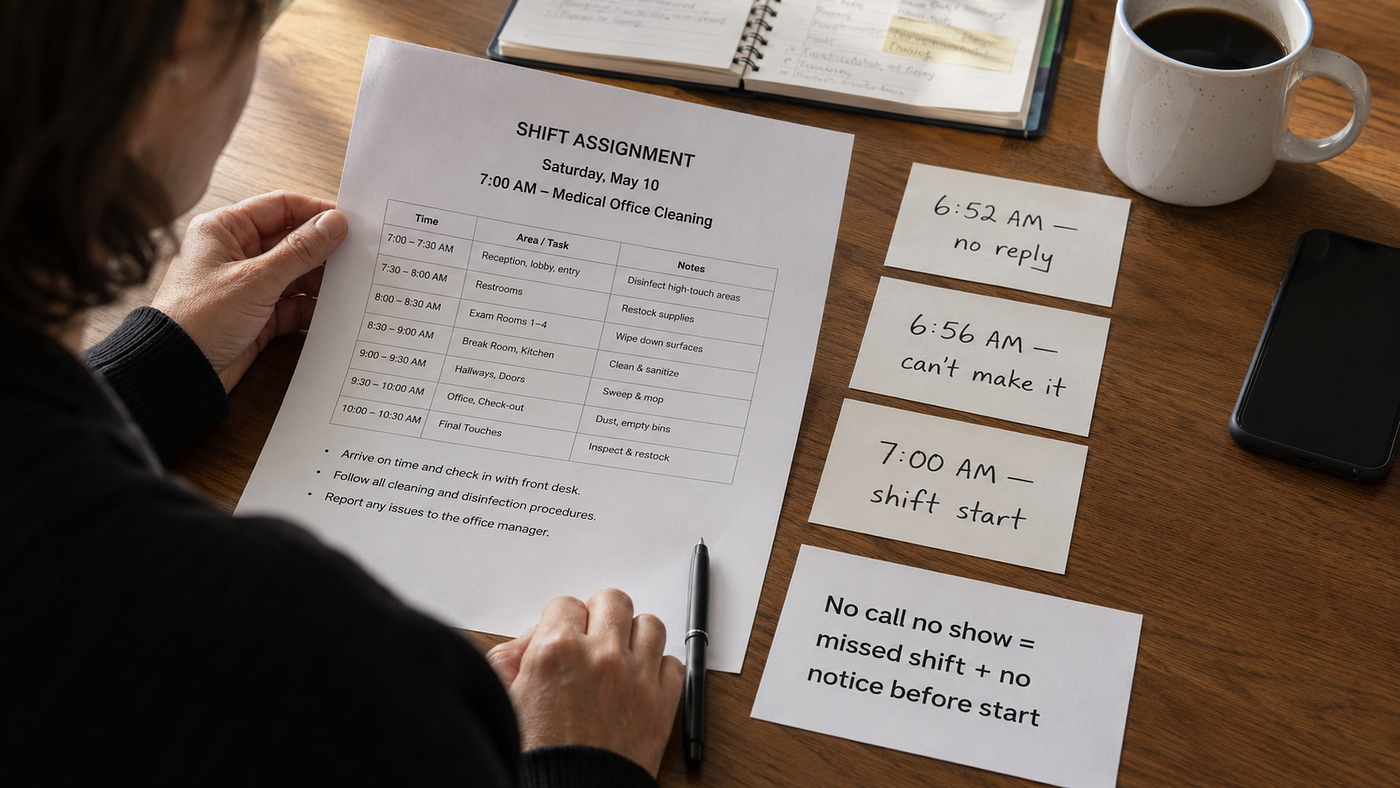
But the owner is still checking the phone at 7:20 in the morning because one cleaner never replied. The job starts at 8:00. The client has the office open early. The schedule says someone is going, but the owner does not actually know that yet.
That is the uncomfortable part.
A name on a schedule can make a shift look safe before it really is.
And for a small cleaning team, that gap can become expensive fast.
A client does not see the spreadsheet. They do not know whether the cleaner was assigned, reminded, or “probably coming.” They only know whether someone shows up.
That is why I think cleaning shift coverage is worth separating from scheduling.
A scheduled shift means the job has been planned.
A covered shift means someone has clearly confirmed they are going to do the work.
Those are not the same thing.
If you want the clean definition, this page explains **what cleaning shift coverage means** in the context of small cleaning teams.
But the simple version is this:
Coverage is the answer to the question the owner actually cares about before the job starts:
Who is really going?
Not who was assigned last week.
Not who usually handles that client.
Not who might have seen the message.
Who is confirmed to go.
The awkward middle state
Most of the stress sits in the middle.
A cleaner is assigned, but silent.
Nothing has gone wrong yet. The client has not complained. The shift is still sitting there on the schedule like any other job.
But the owner knows it is different.
Maybe the cleaner is reliable and will probably show up. Maybe they saw the message and just did not reply. Maybe they are driving, sleeping, working another job, or waiting to check with someone at home.
Maybe everything is fine.
That word is the problem.
“Maybe” is not coverage.
Small teams live with a lot of maybe. Sometimes they have to. A five-person cleaning team does not have the same systems as a large janitorial company. People text. Plans change. A lot of coordination happens in the owner’s head.
But when a client-facing job is close to starting, maybe is a bad place to leave it.
The shift is not truly covered until someone gives a clear yes.
“Can anyone cover?” can create more confusion
The same thing happens when a cleaner calls out.
The owner gets a message:
“Sorry, I can’t make it today.”
Now the schedule is wrong.
So the owner jumps into the group chat:
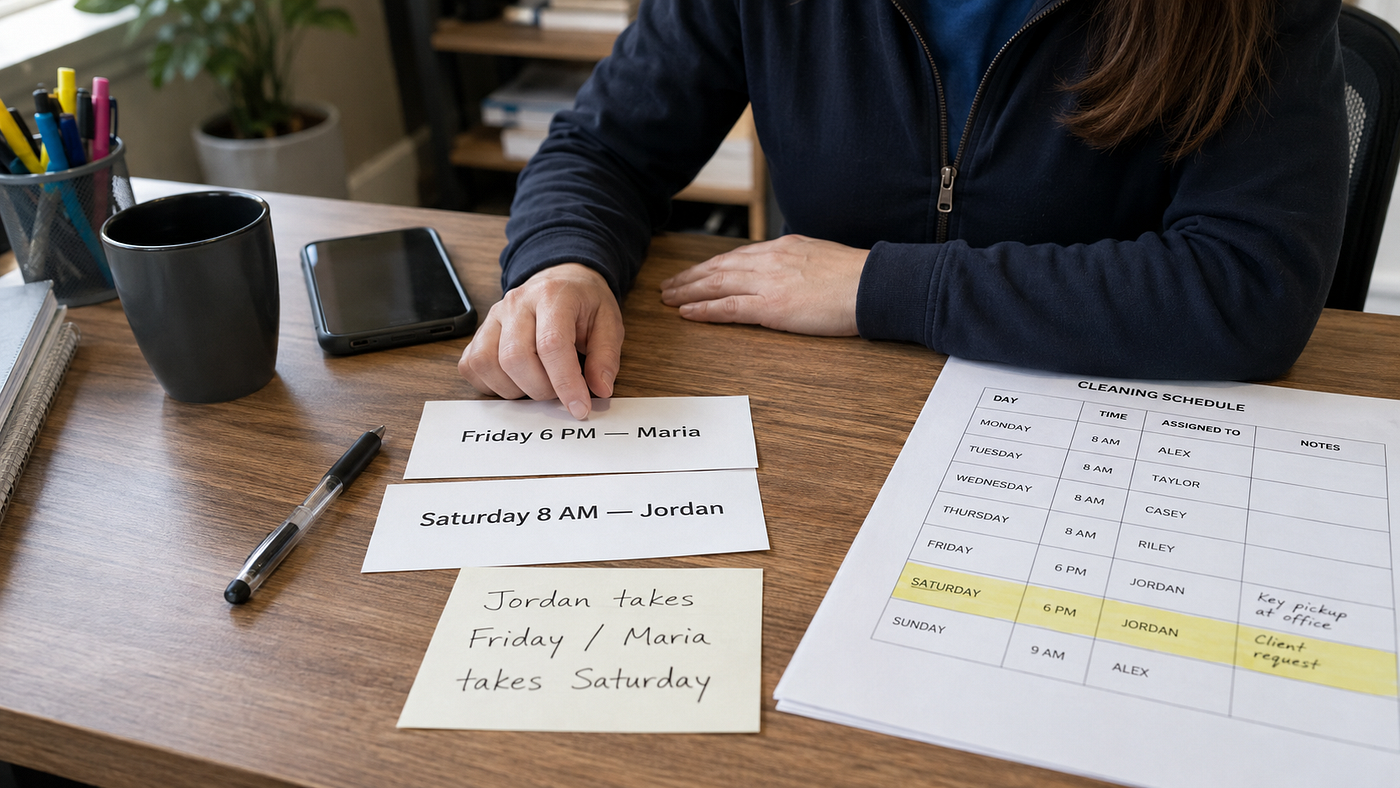
“Can anyone cover this?”
That is the normal move. It is fast. It may even work.
But it can also create a second problem.
Someone asks, “What time?”
Someone else asks, “Where is it?”
Another cleaner says, “I might be able to.”
The owner answers one person privately.
The group chat keeps moving.
Now there are messages, but still no real answer.
The shift is not covered because people are talking about it.
The shift is covered when one person clearly accepts the job and everyone knows that is the updated plan.
That sounds obvious when written out, but in the middle of a busy morning it is easy to miss. The owner feels like they are handling it because they are sending messages. But the job may still be sitting in the same risky state:
No confirmed cleaner.
That is the thing to watch.
A replacement is not coverage until they say yes
This is one of those small operational details that causes more trouble than it should.
A cleaner says, “I might be able to take it.”
That is helpful.
But I would not call the shift covered yet.
“I might” still leaves the owner holding the risk. The replacement may need to check the address. They may realize the job is too far away. They may think they are only offering, not officially taking it.
The owner needs a closing step.
Something like:
“Thanks. Please confirm you are taking the 10 AM Oak Street job.”
It can feel a little repetitive. It can feel too direct if the team is used to casual texting.
But that clear yes is what changes the shift from open to covered.
Without it, the owner is still guessing.
And guessing is the part that makes the morning heavy.
The client does not care how many messages were sent
This is the part that makes coverage different from internal scheduling.
A missed shift is not just an internal mistake. It becomes visible.
If a residential client waited at home and nobody arrived, they remember that. If an office cleaning job was supposed to happen before staff came in and it did not, people notice. If a commercial account already had one bad experience, another missed visit can turn into a cancellation or a review the owner really did not need.
The client does not care that the owner posted the schedule.
They do not care that a reminder was sent.
They do not care that someone in the group chat said “maybe.”
They care whether the job happened.
That is why coverage should be treated as a client-facing risk.
If a shift is not confirmed, it is not just an admin detail. It is a possible client problem waiting to happen.
The schedule can stay simple
I do not think every small cleaning team needs a big scheduling system right away.
Many teams already have something that works well enough for planning.
Google Sheets.
A shared calendar.
A notebook.
A group text.
A weekly schedule copied from last week.
It may not be beautiful, but it is familiar.
The problem is that those tools often show the plan better than they show the current risk.
A spreadsheet row may still show the original cleaner after that cleaner called out. A calendar may show the job time, but not whether the cleaner replied. A group chat may contain the replacement, but the answer is buried between supply questions and client notes.
So the owner becomes the coverage system.
They remember who confirmed.
They remember who stayed silent.
They remember who said maybe.
They remember which job still needs cover.
That can work for a while. Until the morning gets busy.
And mornings get busy.
The useful question before every job
Before a cleaning job starts, the question is not only:
“Is this job scheduled?”
That is the easy question.
The more useful question is:
“Is this job covered?”
For me, covered means a few simple things.
The person doing the job is known.
They have confirmed.
They know the time and location.
If the original cleaner cannot make it, the replacement has clearly accepted.
It does not have to be more complicated than that.
But it does have to be clear.
Because a job can be assigned and still be risky. A cleaner can be reminded and still not confirmed. A replacement can be mentioned and still not officially taking the job.
That is the gap small teams need to catch before the client does.
A shift on the schedule is not automatically a covered shift.
That is the small difference that matters.
Scheduling tells the owner what should happen. Coverage tells the owner whether someone is actually going to make it happen.
For small cleaning teams, that difference shows up in the most ordinary places: a silent cleaner, a vague reply, a call-out, a replacement who has not fully said yes.
None of it looks dramatic at first.
But that is usually how missed jobs start.
Not with a big warning.
Just with one shift that looked covered because it was on the schedule, even though nobody had really confirmed it.
메타데이터
- post_id
- 5d6eaecde0cf
- slug
- a-cleaning-shift-is-not-covered-just-because-it-is-on-the-schedule-5d6eaecde0cf
- url
- https://medium.com/@Miran969/a-cleaning-shift-is-not-covered-just-because-it-is-on-the-schedule-5d6eaecde0cf
- canonical_url
- https://medium.com/@Miran969/a-cleaning-shift-is-not-covered-just-because-it-is-on-the-schedule-5d6eaecde0cf
- author_url
- https://medium.com/@Miran969
- status
- ok
- fetched_at
- 2026-08-23 08:26:11