Commerce Tool vs Hybris
🚀 commercetools
Commerce Tool vs Hybris
🚀 commercetools
commercetools is a cloud-based commerce platform and software company — the product and the company share the same name. It’s a privately held enterprise software company headquartered in Munich, Germany, that builds a headless, API-first ecommerce platform used by large businesses around the world.
Key facts
- Founded: 2006 in Munich, Germany.
- Founders: Dirk Hoerig and Denis Werner.
- The company’s platform helps enterprises build and scale ecommerce experiences using modern, cloud-native architecture with modular, API-driven services.
- It was acquired and grown with backing from investors including Insight Partners and retains links with REWE Digital / REWE Group historically.
In short, commercetools is built and maintained by the commercetools company itself, a specialized ecommerce software company, rather than being a product of another large software vendor like SAP
🚀 commercetools vs SAP Hybris
Commercetools and SAP Hybris (SAP Commerce Cloud) are two enterprise ecommerce platforms.
commercetools:
- A cloud-native, headless ecommerce platform built from the ground up with microservices and APIs.
- Uses MACH principles (Microservices, API-first, Cloud-native, Headless), letting businesses build bespoke commerce experiences across websites, apps, marketplaces, IoT devices, etc.
SAP Hybris (SAP Commerce Cloud):
- A traditional enterprise ecommerce suite (now part of SAP Commerce Cloud) that has evolved over time from a monolithic Java-based platform with APIs added on.
- Strongly integrated into the broader SAP ecosystem (ERP, CRM, supply chain).
🧱 Architecture
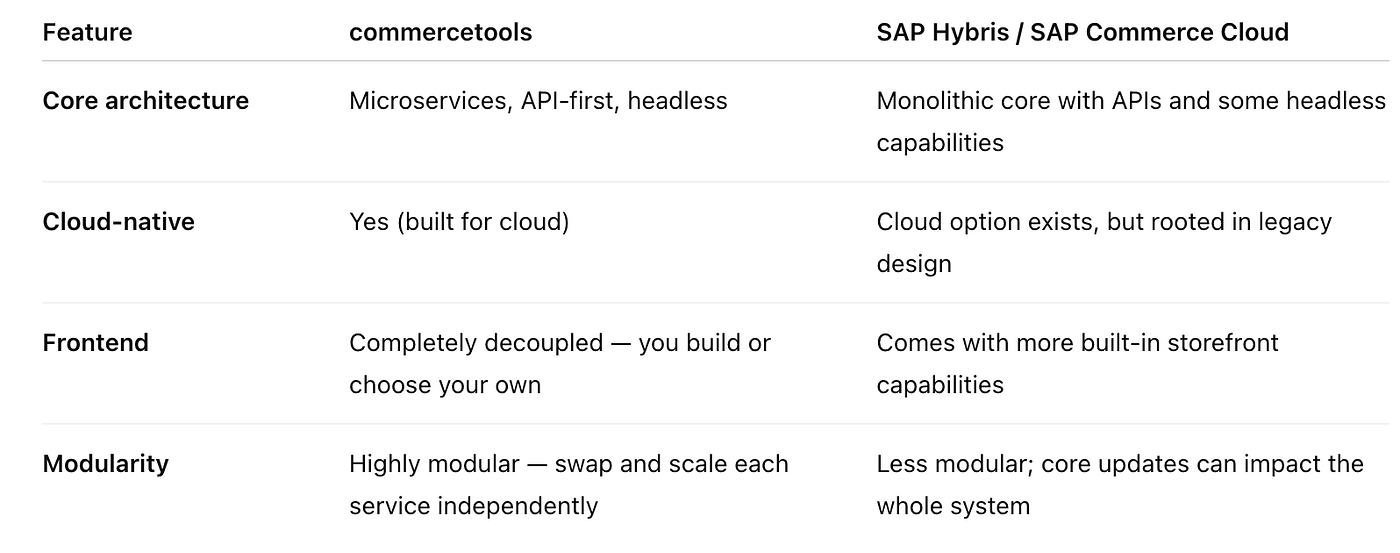
Key takeaway: commercetools is designed for agility and composability, while Hybris is more traditional with tightly-coupled components.
⚙️ Customization & Integrations
commercetools
- Pure API-first: every function (cart, catalog, orders, promotions) is accessible via API, enabling flexible frontend designs (React, Vue, mobile apps).
- Easy integration with best-of-breed tools (CMS, search, PIM, etc.).
- Requires development expertise — you build your own frontend or integrate with frameworks/third-party tools.
SAP Hybris
- Offers built-in tools (CMS, storefront, PIM) out of the box, simplifying initial setup for enterprises.
- Deep native integration with SAP back-office systems (ERP, CRM, supply chain), which can be a huge advantage if you’re already SAP-centric.
- Customization is possible via Java extensions and SAP’s tooling but can be complex and costly.
📈 Scalability & Performance
commercetools
- Highly scalable due to microservices — individual services can scale independently, and deployment is smoother.
- Ideal for companies expecting frequent changes or innovation.
SAP Hybris
- Stable and robust for large catalog sizes and complex enterprise requirements.
- Scalability can be constrained by legacy parts of the platform and may require heavier infrastructure.
💰 Total Cost & Time To Market
commercetools
- Typically lower TCO over time with cloud-hosted, versionless updates included.
- Faster development cycles due to decoupled design — but initial implementation requires skilled dev teams.
SAP Hybris
- Higher upfront licensing and customization costs.
- Longer implementation timelines because of its complexity and monolithic nature.
📊 Pros & Cons — At a Glance
commercetools
✔ Pros
- Truly headless and MACH-compliant.
- Extremely flexible for modern digital experiences.
- Lower long-term maintenance costs (cloud-native).
✘ Cons
- Requires strong development resources.
- You need to integrate or build features that come baked into other platforms.
SAP Hybris / Commerce Cloud
✔ Pros
- Enterprise-ready with deep SAP ecosystem integration.
- Mature tooling and built-in ecommerce features.
- Robust support and large install base (market share).
✘ Cons
- Less agile and flexible than modern headless platforms.
- Higher TCO and slower innovation cycles.
🧩 When to Choose Which?
Choose commercetools if:
- You want maximum flexibility and control over every user experience.
- You’re aiming for a composable, microservices-driven architecture.
- Speed to market and modern frontend stacks matter.
Choose SAP Hybris if:
- You operate large enterprises already embedded in SAP systems.
- You prefer more built-in ecommerce features and a standard monolithic platform.
- Deep ERP/CRM integration is mission-critical.
메타데이터
- post_id
- 5d7a2b28c443
- slug
- commerce-tool-vs-hybris-5d7a2b28c443
- url
- https://medium.com/@qingedaig/commerce-tool-vs-hybris-5d7a2b28c443
- canonical_url
- https://medium.com/@qingedaig/commerce-tool-vs-hybris-5d7a2b28c443
- author_url
- https://medium.com/@qingedaig
- status
- ok
- fetched_at
- 2026-06-09 15:37:30