LLM Council: A New Architectural Governance Layer for the AI-Integrated SDLC
Over the last decade, software engineering evolved from monoliths to microservices, to cloud-native, to distributed data ecosystems. The…
LLM Council: A New Architectural Governance Layer for the AI-Integrated SDLC
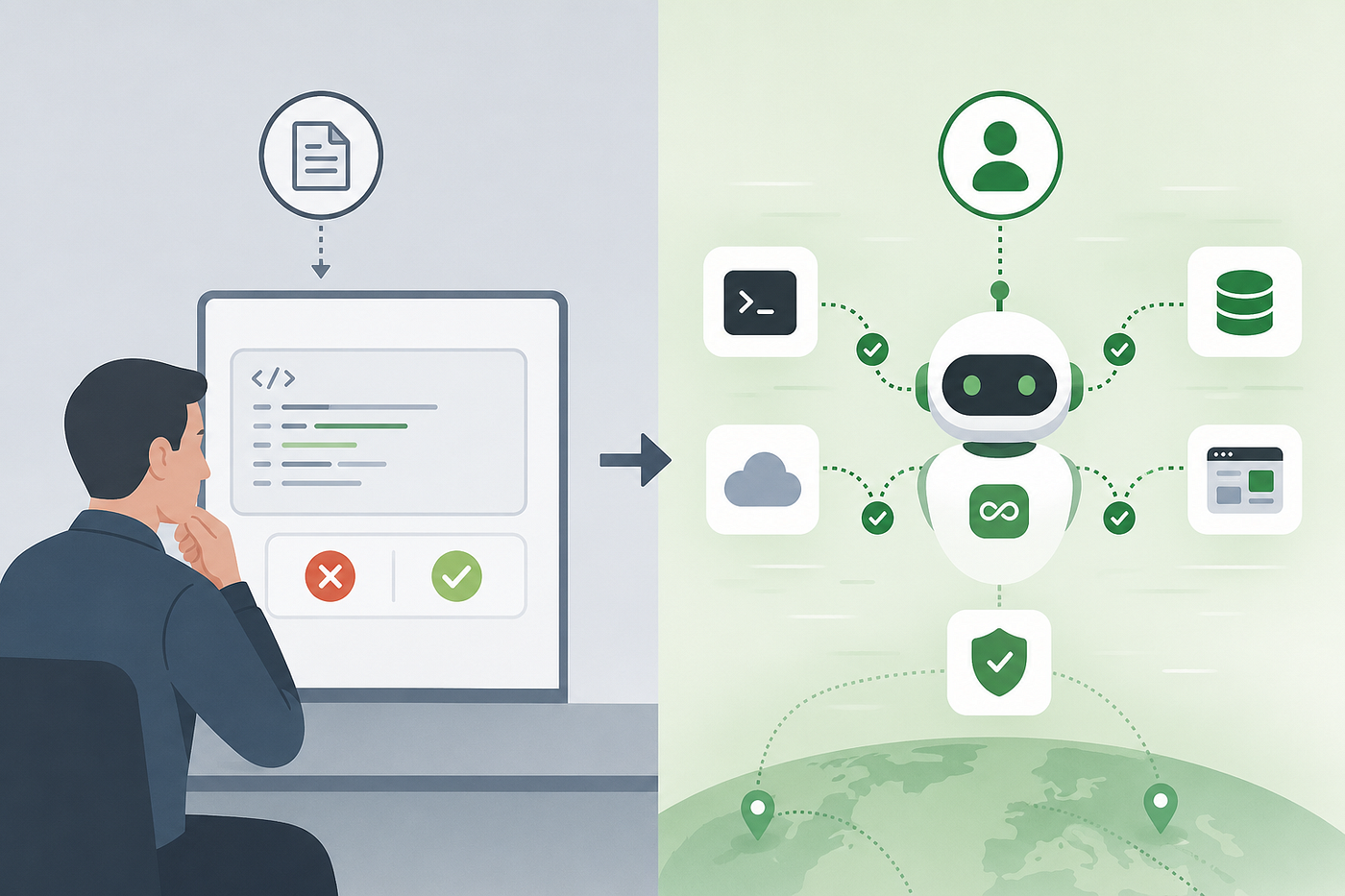
Over the last decade, software engineering evolved from monoliths to microservices, to cloud-native, to distributed data ecosystems. The next transformation — already underway — is the infusion of Large Language Models into every engineering workflow. But as teams accelerate development using AI, a structural gap becomes undeniable:
We lack a governance model that can keep pace with AI-driven creation.
Traditional architecture review boards, secure SDLC processes and design checklists were built for human throughput. They cannot absorb or validate the volume, speed or autonomy with which LLMs now generate code, infrastructure configurations, system designs and API contracts.
This is the context in which the LLM Council emerges — not as a tool, not as a “group of agents,” but as a new governance abstraction that blends organizational policy with autonomous validation.
The Core Premise: AI Velocity Without Governance Creates Architectural Drift
When LLMs participate directly in design and development, they amplify both engineering velocity and architectural entropy.
The symptoms are already visible in AI-augmented teams:
- Accelerated code generation with inconsistent adherence to architectural standards
- Shadow APIs and services created rapidly without lifecycle considerations
- Design decisions taken by LLMs without traceability or rationale
- Security gaps creeping in due to templated or hallucinated patterns
- Compliance exposure where AI pulls in insecure libraries or unlicensed dependencies
The organization challenge is no longer “how do we adopt LLMs?” It is how do we absorb AI into the SDLC without compromising architectural coherence, security posture and operational integrity?
This is precisely the function of an LLM Council.
What an LLM Council Actually Represents
At a CTO level, the LLM Council is a meta-architecture framework with four responsibilities:
1. Guardrails for AI-Driven Creation
Every AI-generated artefact — code, architecture, API definitions, IaC, test suites — passes through automated governance aligned to:
- Organizational architecture doctrine
- Security baseline
- Compliance constraints
- Performance & scalability principles
This shifts governance from a periodic human review to an always-on, policy-encoded, AI-interpretable layer.
2. Preservation of Architectural Intent
In fast-moving delivery environments, the biggest risk with LLMs is dilution of architectural intent. An LLM Council enforces:
- Principles (Separation of concerns, domain boundaries)
- Standards (API conventions, naming, observability)
- Canonical patterns (event-driven, layering, resilience models)
It ensures “AI-accelerated delivery” never erodes the architecture that underpins system longevity.
3. Autonomous Risk Interpretation
LLMs are excellent at pattern recognition. The LLM Council uses this to surface systemic risks:
- Architectural misalignment
- Performance bottlenecks
- Data governance lapses
- Third-party dependency vulnerabilities
- Ambiguity or incompleteness in requirements
This provides the CTO’s office with a predictive view instead of a retrospective audit.
4. Strategic Traceability
Every design decision — human or AI — must have:
- Rationale
- Alternatives considered
- Risks acknowledged
- Policy references
The Council generates living architecture documentation automatically, solving a decades-old engineering problem.
Why the LLM Council Is Not “Just Another AI Agent System”
Several teams have initially dismissed this concept as “multi-agent orchestration.” That is a misunderstanding at the architectural level.
A multi-agent system executes tasks. A Council governs intent, compliance, and systemic integrity. A multi-agent system can accelerate inconsistencies but a Council prevents them.
A multi-agent system is operational where as a Council is architectural.
For the CTO, the distinction is fundamental.
Where the LLM Council Fits in the Enterprise SDLC
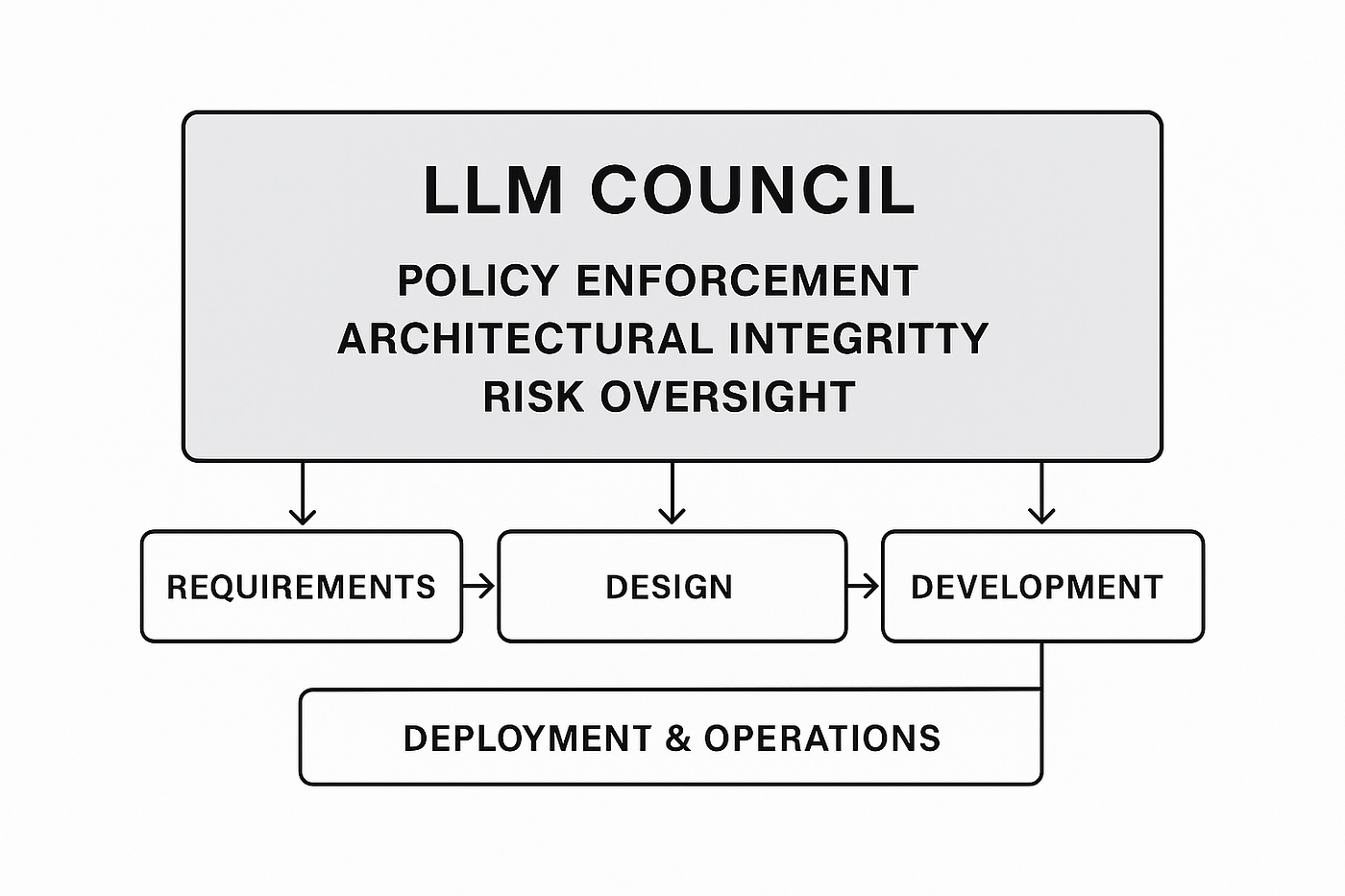
The LLM Council becomes a horizontal governance fabric that overlays:
- Architecture Review
- Secure SDLC
- API Governance
- Data Governance
- Cloud Resource Standards
- Developer Productivity Platforms
- CI/CD Quality Gates
It is not a replacement for existing controls; it is the unifying interpretive layer that:
- Reads code
- Reads diagrams
- Reads policies
- Reads intent
…and ensures alignment between them.
This creates a self-reconciling SDLC, where AI-accelerated execution stays anchored to enterprise architectural truth.
A CTO-Level Example
Imagine your engineering teams use LLMs to propose a new event-driven service. The LLM Council automatically analyzes:
- Whether the domain boundary aligns with your DDD maps
- Whether the design is over-fragmented or under-modularized
- Whether the chosen patterns violate resilience or latency constraints
- Whether data flows comply with encryption, retention, residency rules
- Whether dependencies introduced pose licensing or supply chain risks
This is architectural governance at machine speed — without adding process friction.
Why a CTO Should Champion the LLM Council
Because it aligns three imperatives that often conflict:
- Speed AI accelerates everything. The Council ensures speed scales safely.
- Security & Compliance Governance is embedded at creation time — not bolted on later.
- Architectural Integrity The long-term health of the software estate is protected, not compromised, by AI adoption.
This positions the organization to leverage AI not as a productivity enhancer alone, but as a strategic multiplier of engineering coherence and resilience.
The Strategic Shift
The LLM Council represents the next evolution in enterprise engineering:
- From manual governance → to autonomous governance
- From static policy documents → to executable governance logic
- From isolated design reviews → to continuous architectural alignment
- From human bottlenecks → to AI-enforced architectural integrity
This is the architectural operating model that will define AI-era software development.
LLM Council
메타데이터
- post_id
- 5d879aab3d60
- slug
- llm-council-a-new-architectural-governance-layer-for-the-ai-integrated-sdlc-5d879aab3d60
- url
- https://medium.com/@srinib100/llm-council-a-new-architectural-governance-layer-for-the-ai-integrated-sdlc-5d879aab3d60
- canonical_url
- https://medium.com/@srinib100/llm-council-a-new-architectural-governance-layer-for-the-ai-integrated-sdlc-5d879aab3d60
- author_url
- https://medium.com/@srinib100
- status
- ok
- fetched_at
- 2026-06-09 15:37:30