From Atoms to Language: How the Brain Constructs Reality and How Cultures Keep It Alive
In a social media video by a Harvard physics student, I came across the following sentence: “If all the empty space inside atoms were…
From Atoms to Language: How the Brain Constructs Reality and How Cultures Keep It Alive
In a social media video by a Harvard physics student, I came across the following sentence: “If all the empty space inside atoms were removed, all of humanity could fit inside a sugar cube. Because approximately 99.999999% of our bodies consists of empty space.”
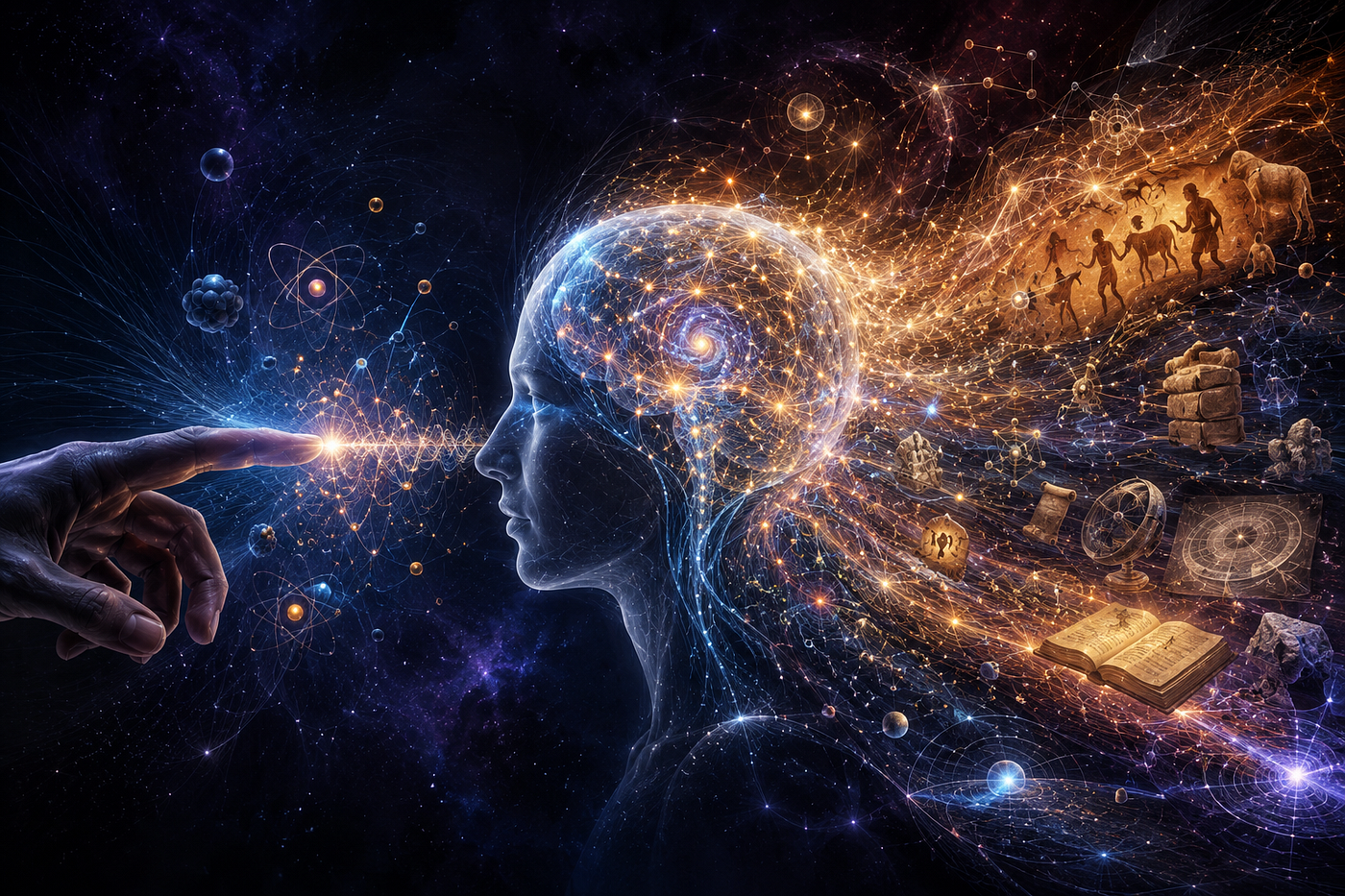
Created by AI.
The fact that I have never been able to fully believe that the impossible truly exists has often led me to question, research, learn, and always look at the universe more closely, yet sceptically. What greatly expanded my perception was this endless process of trial and learning. At the most fundamental level, in a world where we know that the building blocks of the universe are described through probabilities, the idea that all of humanity could be compressed into the dimensions of a sugar cube could hardly fail to interest me.
The things I read on this subject also said that almost the entirety of an atom consists of empty space. Even the matter we consider solid apparently rises, to a great extent, upon an invisible emptiness. Perhaps this is one of the most important things life teaches us: the boundaries we regard as absolute are often merely limitations that we impose upon ourselves through our own perspective. Ultimately, even the universe itself is woven from possibilities that appear impossible.
Yet a critical misunderstanding may arise here: science tells us that the fact that atoms are largely empty does not mean that this space is “empty” in the everyday sense of the word. This is because electrons, electromagnetic fields, and quantum probability distributions or branches are also present in that region. For this reason, we cannot say that the inside of an atom is completely empty; it is merely extremely sparse in comparison with the nucleus.
At this point, an even more interesting question came to my mind: “If atoms are mostly empty space, do we ever truly touch one another?”
In the classical sense, the answer was, surprisingly, “no.” When we touch a table or kiss the person we love, atoms do not actually physically merge into one another. Only the electrons of the atoms in our hand and the electrons of the object before us move closer together. Since both electrons are negatively charged, they repel one another because of the electromagnetic force, and one of the fundamental rules of quantum mechanics, the Pauli Exclusion Principle, comes into play.
This means that “two electrons cannot occupy the same quantum state.” And this means that atoms cannot overlap.
So what exactly is the thing we experience as the sensation of touch?
Simply, the refusal of electron clouds to move any closer to one another… In that case, the hardness, solidity, and contact we feel do not arise from atoms touching one another, but from the force created by their repulsion.
Does this not seem very strange to you as well? You think that you are touching or making contact with something, but what is actually happening is a reaction produced by a repulsive force. Because in everyday life, we feel that we are touching a table, but on the physical level, what is happening is only electromagnetic forces, quantum rules, and electron interactions…
And the brain transforms all of this into a single experience: the feeling that “I am touching the table.”
So, is the brain deceiving us? Because at this point, we encounter a second major question: if physical reality actually consists of electrons and fields, what is the world that I experience?
Science tells us that the brain’s task is not to present reality exactly as it is. The brain’s task is simply to produce a useful model of the external world so that we can survive.
For example, we do not directly see the colour red. We experience electromagnetic light with a wavelength of approximately 650 nanometres reaching our eyes. Our brain then transforms this physical reaction into the experience of “red.”
In other words, we do not hear sounds; we perceive changes in air pressure. We do not directly feel touch either; we perceive only the forces involved. The brain interprets all of this and allows us to experience colours, sounds, and the sensation of touch.
In that case, what the brain does is not deception, but translation… It is a translation system that transforms the physical events of the external world into human experience.
Then the question suddenly appears: “If everyone lives within the model created by their own brain, why do we all see the same world?”
That is, if I experience the world through a model constructed by my brain, why do other people also see more or less the same world?
Why do I see a tree when I look at a tree, while a person in İzmir also sees a tree when they look at one?
Or when two people stand side by side and look at a tree, why are they both able to depict almost identical images of that same tree?
The reason is apparently that the human species possesses a shared biological apparatus. Our eyes, nervous systems, visual cortices, and perceptual mechanisms all function in very similar ways. For this reason, our brains do not produce reality randomly. Since we all receive data from the same physical universe and process it through similar biological systems…
The result is a largely shared model of reality at the scale we are capable of perceiving. This is referred to as a “shared perceptual ground.” In other words, we cannot directly access the universe in its entirety, but only the part of it that lies within the reach of our perception and measurement.
But then I become fixated on an entirely different question: why does everyone give a different name to the same reality?
For example, a Turkish person calls a tree “ağaç,” an English person calls it “tree,” and a French person calls it “arbre”… The object they see is largely the same… If they stood side by side, looked at the same tree, and drew it, they would produce almost identical images. Yet in the languages of those three people, there are three different definitions for a single reality.
This is where language enters the picture. What differs is not the object itself, but the symbol attached to it or used to define it.
In language, the process works as follows: the object is first seen, then recognised, and then named. Language, therefore, is not reality itself. Language is the symbolic label or definition attached to reality. In fact, it does not merely attach labels to reality; sometimes it also influences how we classify reality. In that case, it would not be incorrect to say that humanity’s shared reality is largely similar, while the symbols it uses are different.
Something I have frequently expressed in my other essays and that once again caught my attention here is this: if a person keeps something they have seen only within their own mind, that knowledge dies with them. This is the thought that led me to the motto, “Everything without a story is destined to die.” But if a person can transform what they have seen into language, writing, mathematics, art, or science, then the story begins there. In this way, knowledge can pass beyond the individual.
In other words, my individual observation is transferred into collective memory. In fact, in my view, this is what all civilisations do, whether consciously or unconsciously. The structure we call civilisation is already a carrier memory system that allows individual observations to be preserved across generations.
For example, I never saw Newton. I never saw Faraday. I never saw Einstein or so many others. Yet because all of their observations were transformed into language, mathematics, and writing, they remain fresh and alive even today… Anyone can open their works at any time, read them, and experience their observations.
This is precisely why the wisdom of time has become a phrase constantly on my lips.
The belief I express in detail in my philosophy of Cosmotelyum — that the universe is a dimension within time, and that time evolves through the information it continuously gathers from the universe while constantly updating itself — also arises from this relationship between observation and symbol. For rather than the idea of a creator or God, time, as the cycle of collective consciousness, with all the experience and messages it carries, feels better to me than all beliefs and prayers for this very reason.
To live the moment to the fullest without rendering life completely meaningless is, in my view, the task that time assigns to us.
Instead of attributing the meaning of existence to ourselves, glorifying ourselves, or sanctifying the unseen and the unknown, we can regard observing, producing meaning, and experiencing life in all its depth — with both its pain and its sweetness — as a sufficiently honourable purpose. After all, we will never experience this life or this moment again.
As a linguist, one conclusion I can draw from this essay is that language is not merely a means of communication. For me, language is also a technology that protects observation against time or transforms it into knowledge within time.
Another interesting thought: perhaps the main factor that determines the longevity of cultures is not merely population, economy, or military power, but how successfully societies record and transmit their observations. Perhaps, somewhere in time, we made mistakes while transforming certain things into reality, and our true purpose has now been derailed for a very, very long time.
In my opinion, the real competition between cultures should have been about how well we observe reality, how well we record it, and how well we transmit it, so that our culture, like certain peoples in the wisdom of time, is not condemned to disappear. Because the more observations a culture can transmit to future generations through language, science, and symbols, the longer it can preserve its own intellectual existence.
However, there is an important point here: even if a culture succeeds in transforming its observations into language, we still cannot say that it will not disappear in time. This is because, as knowledge develops, it requires innovation. This means that language must reconnect with observation, or perhaps be observed again and made to produce new meaning.
In other words, the process must be continuously updated through an observation-language-observation-language cycle. If this cycle is broken, then all those things we call myth, cult, or dogma have already emerged.
This is why the method and power of science are important. Science does not merely produce knowledge; it also continuously tests what already exists through new observations and updates that knowledge. I think this is why the longest-lasting systems of knowledge have reached us not merely from civilisations that fought or spoke, but from those that were best able to correct themselves.
I no longer remember how the subject arrived here, but physics tells us that touch, hardness, and matter are the results of electrons and quantum rules.
Neuroscience tells us that the world we experience is the model our brain constructs of external reality.
Linguistics tells us that people perceive the same reality in largely similar ways, yet express it through different symbols.
And history tells us that civilisations live to the extent that they are able to transform their observations into collective memory.
In that case, humanity’s greatest achievement, as a living species composed of atoms, is its ability to observe the universe, transform those observations into language, and carry them beyond the boundaries of its own mind.
Indeed, what we call culture is nothing other than an enormous model of reality, collectively written by billions of individual brains and continuously updated — sorry, a model whose knowledge we may draw upon whenever we wish: the “wisdom of time.”
I kindly ask ChatGPT to translate into English so that they can reach a wider audience.
메타데이터
- post_id
- 5d8b9ca92005
- slug
- from-atoms-to-language-how-the-brain-constructs-reality-and-how-cultures-keep-it-alive-5d8b9ca92005
- url
- https://medium.com/illumination/from-atoms-to-language-how-the-brain-constructs-reality-and-how-cultures-keep-it-alive-5d8b9ca92005
- canonical_url
- https://medium.com/illumination/from-atoms-to-language-how-the-brain-constructs-reality-and-how-cultures-keep-it-alive-5d8b9ca92005
- author_url
- https://medium.com/@murvetgunday
- status
- ok
- fetched_at
- 2026-06-21 12:17:11