Ada Lovelace: World’s First Programmer
In 1815, a young girl was born in London, the daughter of a poet and a mathematician. Her name was Ada Lovelace, and she would go on to…
Ada Lovelace: World’s First Programmer
In 1815, a young girl was born in London, the daughter of a poet and a mathematician. Her name was Ada Lovelace, and she would go on to imagine machines that could do far more than just count.
At a time when “computers” were humans sitting at desks solving equations by hand, Ada was dreaming of something extraordinary: a machine that could think.
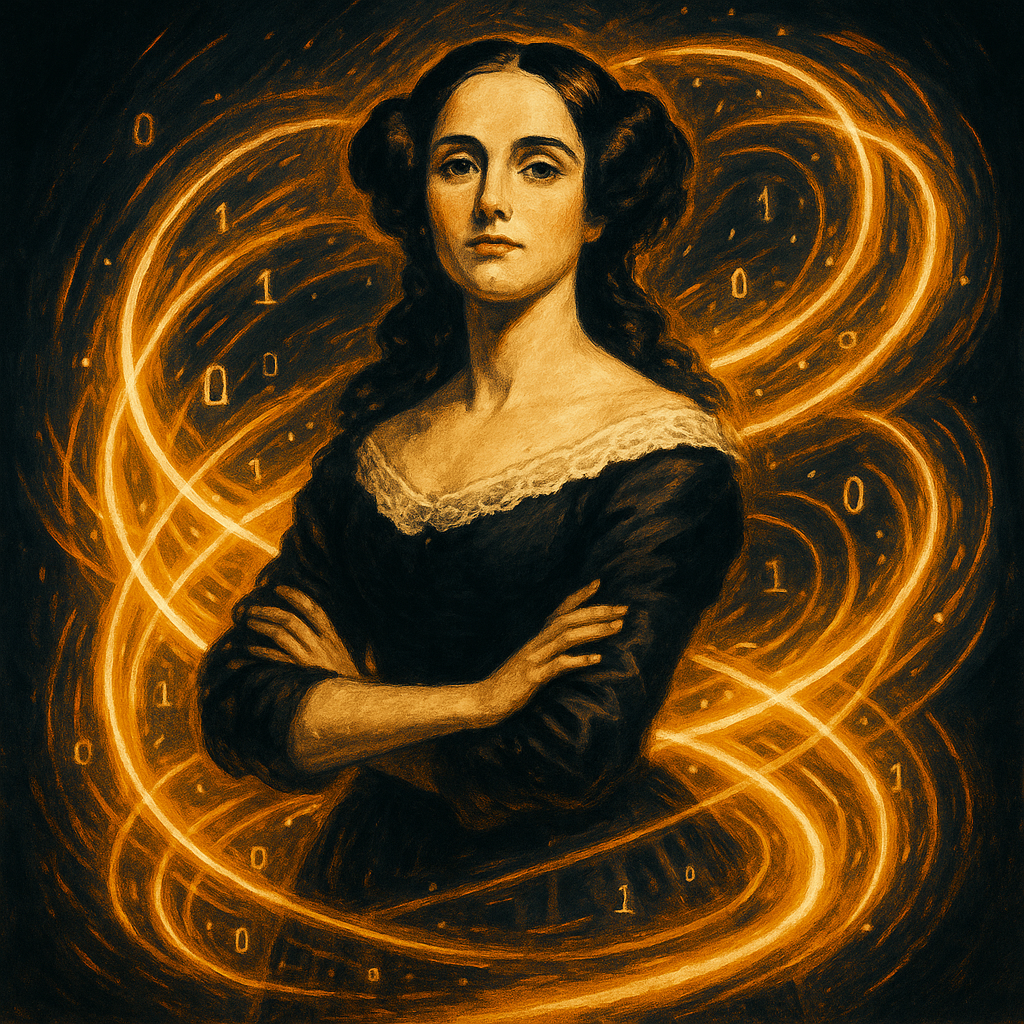
Ada Lovelace
From Poetry to Programming
Ada was the daughter of Lord Byron, the famous poet, and Annabella Milbanke, a woman deeply interested in mathematics. Her parents separated soon after her birth, and her mother, wary of Byron’s emotional temperament, insisted Ada be taught science and math.
That unusual decision shaped history.
As a teenager, Ada studied mathematics with some of the leading minds of her era. But it was when she met Charles Babbage, the inventor of the Analytical Engine, that her imagination caught fire.
The Analytical Engine was a mechanical machine designed to perform complex calculations, a vision that would later inspire modern computers.
While translating an Italian paper about Babbage’s work, Ada didn’t stop at mere translation. She added her own notes, and those notes changed everything.

Ada’s notes
The First Algorithm in History
In her notes, Ada described how the Analytical Engine could follow a set of instructions to compute numbers, what we now call an algorithm.
She essentially wrote the first computer program, more than a century before computers existed.
Her method outlined how a machine could be told what to do, not by physical gears alone, but through logic and sequence.
But Ada’s insight went deeper than computation.
The First Person to Predict Artificial Intelligence
While most people of her time saw machines as tools for calculation, Ada saw machines that could create.
She believed a computing engine could one day compose music, make art, and express ideas, all based on data and logic.
That prediction, written in the 1840s, reads like a prophecy of Generative AI.
Before anyone spoke of neural networks, ChatGPT, or AI-generated music, Ada had already described the concept:
“The Analytical Engine might act upon other things besides numbers.”
In simple terms, she was saying that a machine could use rules to produce beauty.

Ada’s history
The Courage Behind the Code
Ada lived in a time when women were rarely allowed near the sciences. She studied mathematics secretly as a teen, exchanged letters with scientists decades older than her, and published ideas under initials to avoid criticism.
She was not trying to prove women could code; she was proving that curiosity has no gender.
Her notebooks were rediscovered a century later, and when modern computing began to take shape, her name resurfaced not as a footnote, but as a foundation.
Why Ada Lovelace Still Matters
Every woman who writes code, leads an AI lab, or questions the ethics of machine learning is continuing Ada’s work.
When we speak of fairness in AI or design systems that include every voice, we echo her belief that technology should expand human creativity, not limit it.
Ada never saw her machine come to life. But her ideas became the backbone of computing as we know it.

Women in AI, today!
A Line from Ada to Today
Today, AI researchers like Dr. Fei-Fei Li, Timnit Gebru, and Joy Buolamwini push for the same balance of imagination and accountability that Ada envisioned.
Lovelace Day, celebrated every October, reminds us that innovation begins when someone dares to imagine differently.
The Future She Imagined Is Here
When you ask a generative model to paint, compose, or write, you are using the dream Ada Lovelace wrote down two centuries ago.
Her story is not just about the first program.
It is about the first person who looked at a machine and thought, what else could it do?
That single question continues to shape every new leap in AI.
Written by: Arthi Rajendran, AI Engineer and Creator of The Arthi AI Collective
(Follow for more stories that connect history, humanity, and AI.)
메타데이터
- post_id
- 5d95f49acf29
- slug
- ada-lovelace-worlds-first-programmer-5d95f49acf29
- url
- https://code.likeagirl.io/ada-lovelace-worlds-first-programmer-5d95f49acf29
- canonical_url
- https://code.likeagirl.io/ada-lovelace-worlds-first-programmer-5d95f49acf29
- author_url
- https://medium.com/@arthirajendran
- status
- ok
- fetched_at
- 2026-07-25 19:03:14