Feeding 10,000 People Without Chaos: The Logistics of Mega Event Catering
The largest catering operation most people will ever attend is a big wedding — perhaps 1,500 guests, two hours of service, a fixed venue…
Feeding 10,000 People Without Chaos: The Logistics of Mega Event Catering
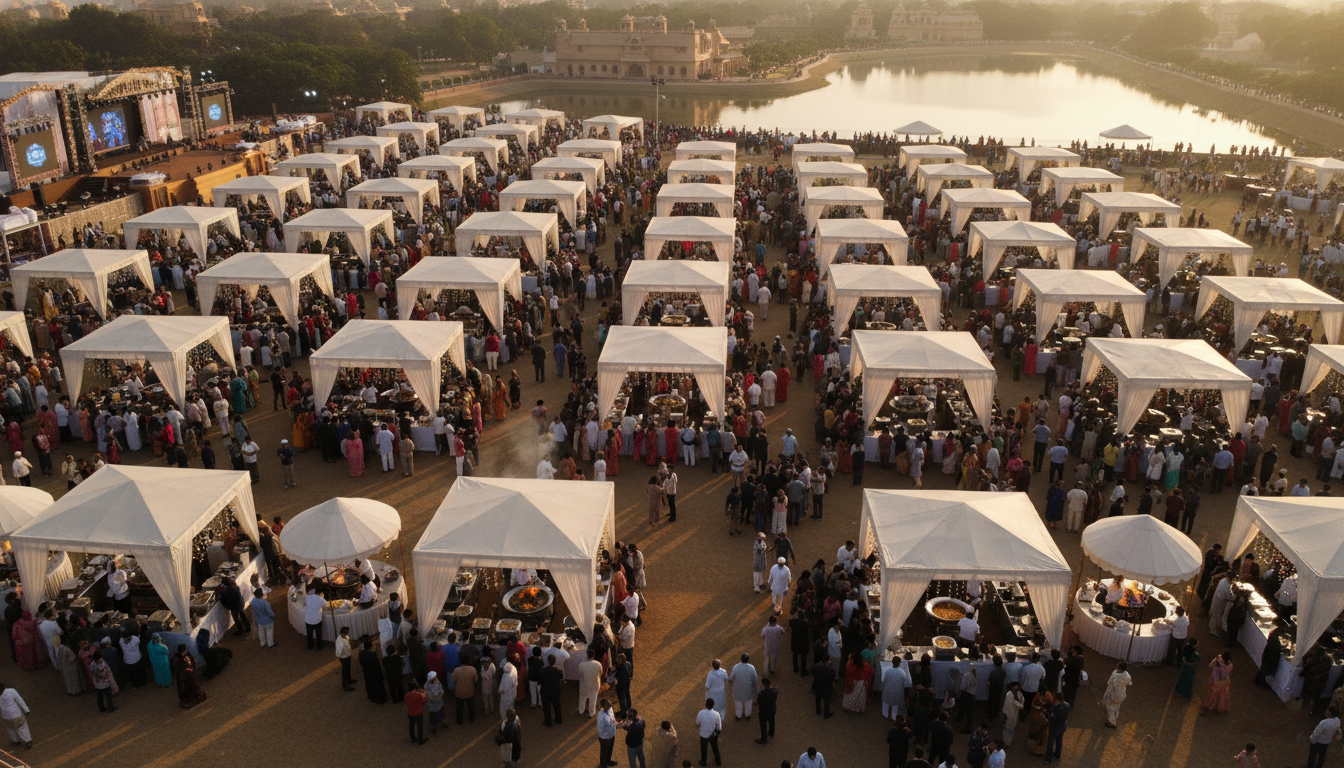
The largest catering operation most people will ever attend is a big wedding — perhaps 1,500 guests, two hours of service, a fixed venue. Now imagine a religious festival gathering, a corporate product launch for a national brand, or a government-sponsored community event. The guest count is 10,000. The service window is four hours. The venue is a partially covered open ground with limited infrastructure.
Welcome to the world of mega event catering — a discipline that has almost nothing in common with conventional event food service, except the ingredients.
The Numbers That Change Everything: At 500 guests, a catering mistake is manageable. A dish that runs short can be quickly supplemented; a temperature issue can be corrected in the next batch; a service delay affects a table, not a thousand people simultaneously. At 10,000 guests, the margin for error is essentially zero. Every operational decision must be made in advance, stress-tested against failure scenarios, and have a documented contingency plan. Consider what 10,000 meals actually involves. A traditional South Indian thali service requires approximately 300–400 grams of rice per person, plus multiple accompaniments. That is four to five tonnes of rice alone. Cooking, holding, transporting, and serving this volume requires industrial-scale thinking that is fundamentally different from scaling up a regular kitchen operation.
The Architecture of a Mega Event Kitchen: Professional mega event catering does not happen from a single kitchen. The operation is distributed. Central production kitchens handle large-batch cooking of stable dishes — rice, dal, sambar, sweets — days in advance where safe, or in coordinated batches from the morning of the event. Satellite prep units closer to the venue handle finishing, plating, and live cooking that cannot be done far in advance. At the venue itself, the physical layout of kitchen infrastructure is planned with the same rigor as the food. Gas connections, water access, waste management stations, and generator backup must all be mapped before a single vessel arrives. Experienced mega event caterers walk every venue in advance with this operational lens — not as a guest or an aesthete, but as a systems engineer.
Service Flow Engineering: With 10,000 guests, queue management is itself a major logistical challenge. The goal is never to have anyone wait more than eight to ten minutes from the moment they join a service queue. Achieving this requires calculating serving capacity per station, designing the number of parallel service lines needed, training staff for high-speed but dignified service, and managing crowd flow with physical layout and signage. For seated service — common at certain South Indian religious events where guests eat simultaneously on rows of banana leaves — the synchronization challenge is extraordinary. Service teams must be coordinated like a relay system, with clear communication channels, section assignments, and real-time supervision to ensure that a guest seated furthest from the kitchen receives their food at the same temperature and within the same timeframe as those closest to it.
Supply Chain Complexity: Procuring ingredients for a 10,000-person event is a supply chain operation in its own right. Last-minute purchases are not an option; nor is relying on a single supplier for any critical ingredient. Professional mega event caterers work with backup supplier networks, carry strategic ingredient buffers, and have pre-negotiated emergency procurement relationships that can be activated if a primary supply fails. For fresh produce, this requires advanced ordering coordinated with real-time quality checks on delivery. A batch of tomatoes that arrives sub-quality the morning of an event is not a small problem. It is an operational crisis if the catering team does not have the vendor relationships and inventory planning to address it instantly.
Waste Reduction at Scale: One of the most underappreciated challenges of mega event catering is food waste. Overproduction at 10,000-person scale generates waste measured in hundreds of kilograms. Experienced operators develop precise portion projection models based on event type, demographic profile, and time of day. A daytime religious event will have different consumption patterns than an evening corporate gala; a predominantly elderly guest list eats differently than a mixed-age family gathering. Responsible caterers also establish protocols for surplus food — partnerships with community organisations, pre-planned donation logistics, and on-site segregation that makes redistribution feasible. These are not gestures; at mega event scale, they represent meaningful quantities of food and a genuine ethical responsibility.
The Team Behind the Event: A 10,000-guest event requires a service team of 150 to 250 people, depending on service format. Recruiting, training, briefing, and managing this workforce for a single day is itself a significant human resources operation. The head catering supervisor on event day is managing something closer to a military field operation than a dinner party — communicating via headsets, making real-time decisions about restocking, adjusting service speeds, and troubleshooting equipment failures without visible disruption to the guest experience.
The clients who understand this are the ones who have the best events. They do not try to micromanage catering logistics on the day. They trust the professionals they have hired, communicate their priorities clearly in advance, and let the operation run.
GALAGOURMET has managed food operations for events exceeding 10,000 guests across Bangalore and surrounding regions. If you are planning a large-scale community event, religious gathering, or corporate function, let’s talk about what professional mega-event catering actually looks like.
메타데이터
- post_id
- 5da4ecece9e0
- slug
- feeding-10-000-people-without-chaos-the-logistics-of-mega-event-catering-5da4ecece9e0
- url
- https://medium.com/@galagourmet.ft/feeding-10-000-people-without-chaos-the-logistics-of-mega-event-catering-5da4ecece9e0
- canonical_url
- https://medium.com/@galagourmet.ft/feeding-10-000-people-without-chaos-the-logistics-of-mega-event-catering-5da4ecece9e0
- author_url
- https://medium.com/@galagourmet.ft
- status
- ok
- fetched_at
- 2026-06-23 17:05:31


