STR Compliance Layers 2026: The 5 Rules That Govern Every Airbnb and Vrbo Property
Before listing a property on Airbnb or Vrbo, there’s one question every host usually asks: Is short-term renting legal at my property? But…
STR Compliance Layers 2026: The 5 Rules That Govern Every Airbnb and Vrbo Property

Before listing a property on Airbnb or Vrbo, there’s one question every host usually asks: Is short-term renting legal at my property? But answering that question requires looking beyond a simple yes or no. In this guide, we’ll break down the five layers of Airbnb compliance every host needs to understand and what each one means for your property.
Why “Is It Legal?” Is Not the Only Question to Ask
The question “is short-term renting legal at my address?” feels natural for a new host, but it’s actually the wrong starting point, because there’s rarely a single yes-or-no answer. Your property is governed by multiple, overlapping layers of rules at the same time, and each one can shut you down independently of the others.
This trips up more hosts than almost anything else. In Florida, for example, you can hold a valid state license and still be illegal under your condo association’s bylaws. In Austin, Texas, you can qualify for a license type and still be blocked because of which zoning district your property sits in. Understanding the layered structure of STR compliance, rather than treating it as one rule to check off, is the single most useful mental model you can build as a host, whether you’re just starting out or managing a growing portfolio.
The Quick Answer
Every short-term rental property sits inside five potential layers of regulation: state or provincial law, county or regional rules, city or municipal ordinance, zoning designation, and private restrictions like HOA or strata bylaws. You have to comply with all of them, not just the ones that are easiest to find. A Florida host can hold a state DBPR license and still get shut down by their HOA. A Vancouver host can hold a city business license and still be fined $1,000 a day by their strata council. Missing even one layer can undo everything you’ve done right at the others.
Breaking The Five Layers Down
Layer 1: State or Provincial Law This is the broadest layer, and it sets the outer boundaries for everything below it.
- Florida requires every whole-unit short-term rental rented more than three times a year for stays under 30 days to hold a state license from the Department of Business and Professional Regulation (DBPR), plus registration with the Florida Department of Revenue to collect the 6% state sales tax. This applies no matter which Florida city or county the property is in.
- British Columbia’s Short-Term Rental Accommodations Act imposes a principal-residence requirement across most of the province, a rule that overrides what individual cities might otherwise allow, with only limited municipal opt-outs.
- Texas applies a statewide 6% Hotel Occupancy Tax (HOT) on top of whatever city HOT applies, in Austin, that combination brings the total tax burden to roughly 17% of the booking.
- This layer changes fastest of any of the five, so a rule that was true last year may already be outdated.
Layer 2: County or Regional Rules Below the state level, counties often add their own requirements, and this is the layer hosts miss most often, because it’s easy to assume “state rules” or “city rules” cover everything.
- In Florida, Lee County (which includes Fort Myers Beach and Captiva Island) layers a county Tourist Development Tax on top of the state’s 6% sales tax, pushing the combined rate well above the state minimum.
- Along Florida’s First Coast, St. Johns, Nassau, Flagler, and Duval counties each require their own certificate, business tax receipt, and tourist tax, these four separate county-level registrations for four neighboring counties, on top of the same state license.
- Near Orlando, most of the Disney-area vacation villas actually sit in Kissimmee and Davenport, inside Osceola and Polk counties and not the City of Orlando itself, which means county rules, not Orlando’s city ordinance, govern most of that market.
- Unincorporated areas (more on this in a future post) are usually regulated directly by the county, with no city government involved at all.
Layer 3: City or Municipal Ordinance This is the layer most hosts think of first, and it’s usually the most detailed, for licensing, permit fees, occupancy limits, and renewal deadlines.
- Austin, Texas requires a separate operator’s license for every unit, a new license costs $836.30, is non-refundable even if denied, and Development Services has quoted six to eight weeks for processing a single-family application.
- Toronto charges a Municipal Accommodation Tax (MAT), currently 8.5% through July 31, 2026, set to revert to 6% afterward unless council extends it; this is a city-specific rate that has nothing to do with Ontario’s provincial rules.
- Newport News, Virginia also passed its short-term rental ordinance back in 2022 but only began actively enforcing it in August 2026, a reminder that a city having a rule on the books and a city actually enforcing it are two different things.
- Two properties a few blocks apart can face completely different city rules if they fall into different council wards or fee zones within the same city.
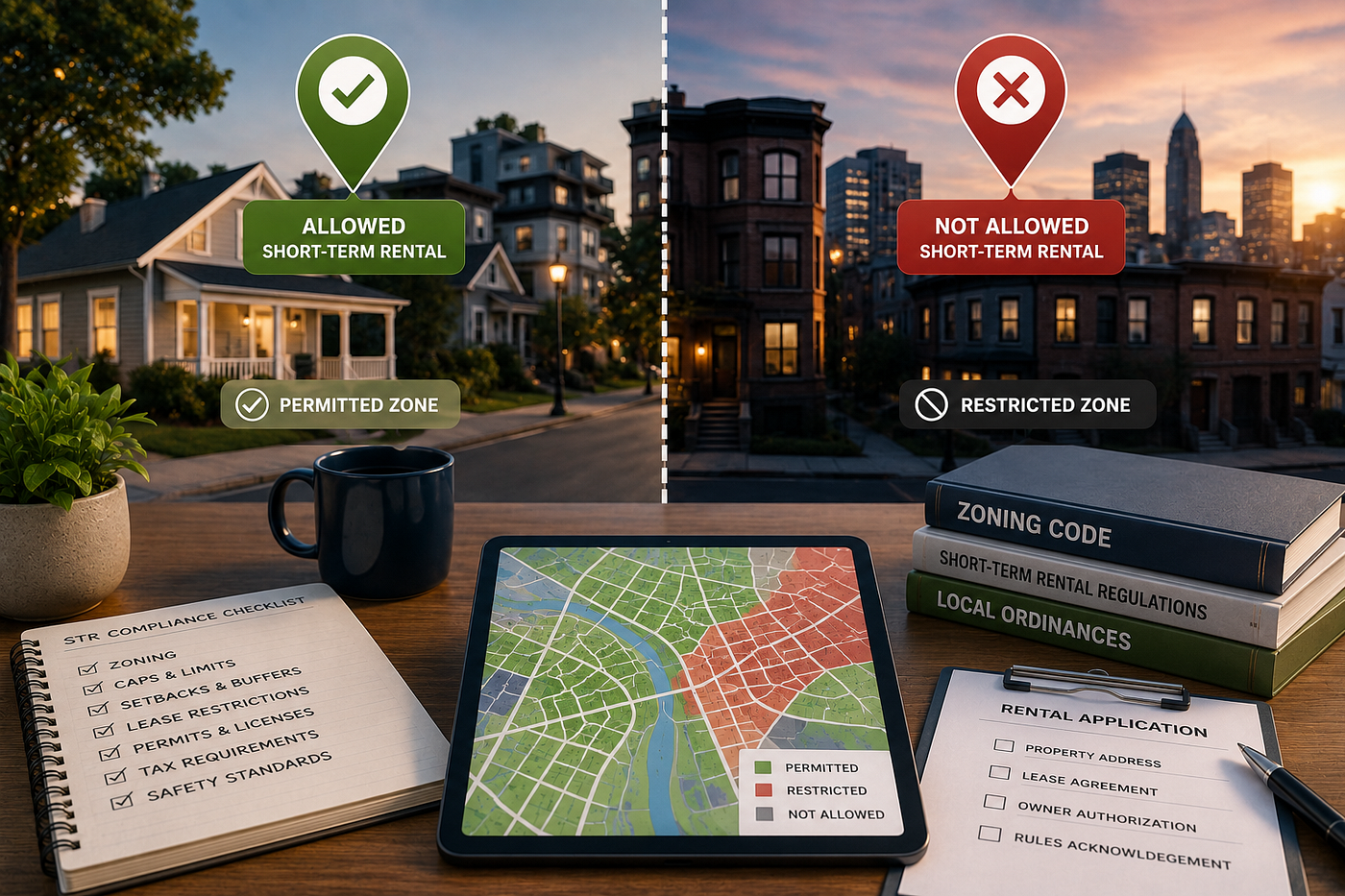
Layer 4: Zoning Zoning is different from a city ordinance, even though the two are related and their distinction confuses a lot of hosts. A city can have a general STR ordinance, but zoning determines whether short-term rentals are allowed at your specific address at all, regardless of what the ordinance says citywide.
- Austin splits licenses into types tied directly to zoning:
- A. Type 1 (owner-occupied) is allowed broadly across residential zones.
- B. Type 2 (non-owner-occupied, whole-home) has historically been restricted to commercial and mixed-use zoning districts, with a 1,000-foot separation requirement between Type 2 properties and density caps limiting them to a small percentage of single-family homes in a given census tract.
- Because Austin’s STR zoning rules have shifted more than once in recent years, a property that qualified for a Type 2 license two years ago may not qualify today, or vice versa. Always confirm current zoning eligibility directly with the city before assuming a past approval still applies.
- Many cities require a Conditional Use Permit (CUP) for whole-home rentals in residential zones, a public-hearing process where, in some jurisdictions, if a set percentage of nearby property owners formally object, approval requires a super-majority vote from the planning commission and city council instead of a simple majority.
- Zoning can change independently of the STR ordinance itself, a city can leave its licensing rules untouched while rezoning a neighborhood in a way that quietly makes your property non-compliant.
Layer 5: Private Restrictions: HOA, Strata, and Lease Terms This is the layer hosts forget most often, because it isn’t “government”, but it can shut you down just as fast as any layer above it.
- Florida’s state preemption law limits how far cities can restrict short-term rentals, but it explicitly does not touch HOA or condo association rules. A Florida host can be fully compliant with the DBPR, the Department of Revenue, and their county, and still receive a cease-and-desist letter from their own condo board.
- In British Columbia, strata corporations can fine owners up to $1,000 per day for violating a strata bylaw against short-term rentals, a penalty that stacks on top of, not instead of, any city or provincial fine.
- If you’re a tenant, not an owner, your lease may prohibit subletting or short-term rental use outright, regardless of what your landlord’s HOA or the city allows.
- These rules usually aren’t searchable online the way government ordinances are, Florida hosts are routinely advised to read their CC&Rs (Covenants, Conditions & Restrictions) before their first booking, not after their first complaint, because HOA cease-and-desist letters tend to arrive without warning.
Common Mistakes Hosts Make
Assuming a state or city license means you’re fully compliant: A Florida DBPR license only confirms you’ve cleared that layer. It says nothing about whether your condo association allows short-term rentals at all.
Checking only the layer that’s easiest to find: State licensing pages and city ordinances are the most Google-able layers, so hosts research those and stop, but county tax accounts and HOA bylaws are just as enforceable and far less visible online.
Not knowing whether their property is inside a city or in unincorporated county territory: A huge number of hosts near markets like Orlando genuinely don’t know that their property is regulated by Osceola or Polk County, not the City of Orlando itself, which sends them researching the wrong rulebook entirely.
Treating zoning approval as permanent: Austin’s own zoning rules for non-owner-occupied rentals have shifted multiple times in recent years. A license type that was available when you bought the property isn’t guaranteed to stay available at renewal.
Ignoring HOA or strata rules because “the state allows it”: This is one of the most expensive mistakes a host can make. Florida’s state preemption protects hosts from overly restrictive city rules, it does nothing to protect them from their own HOA. Government approval and private approval are two separate systems, and you need both.
Not rechecking after a rule change at any single layer: Because these five layers move independently, a change at just one, such as a Toronto tax rate reverting, an Austin zoning update, or a new strata bylaw can make a previously compliant property non-compliant, even if nothing changed at the other four layers.
Your Action Checklist
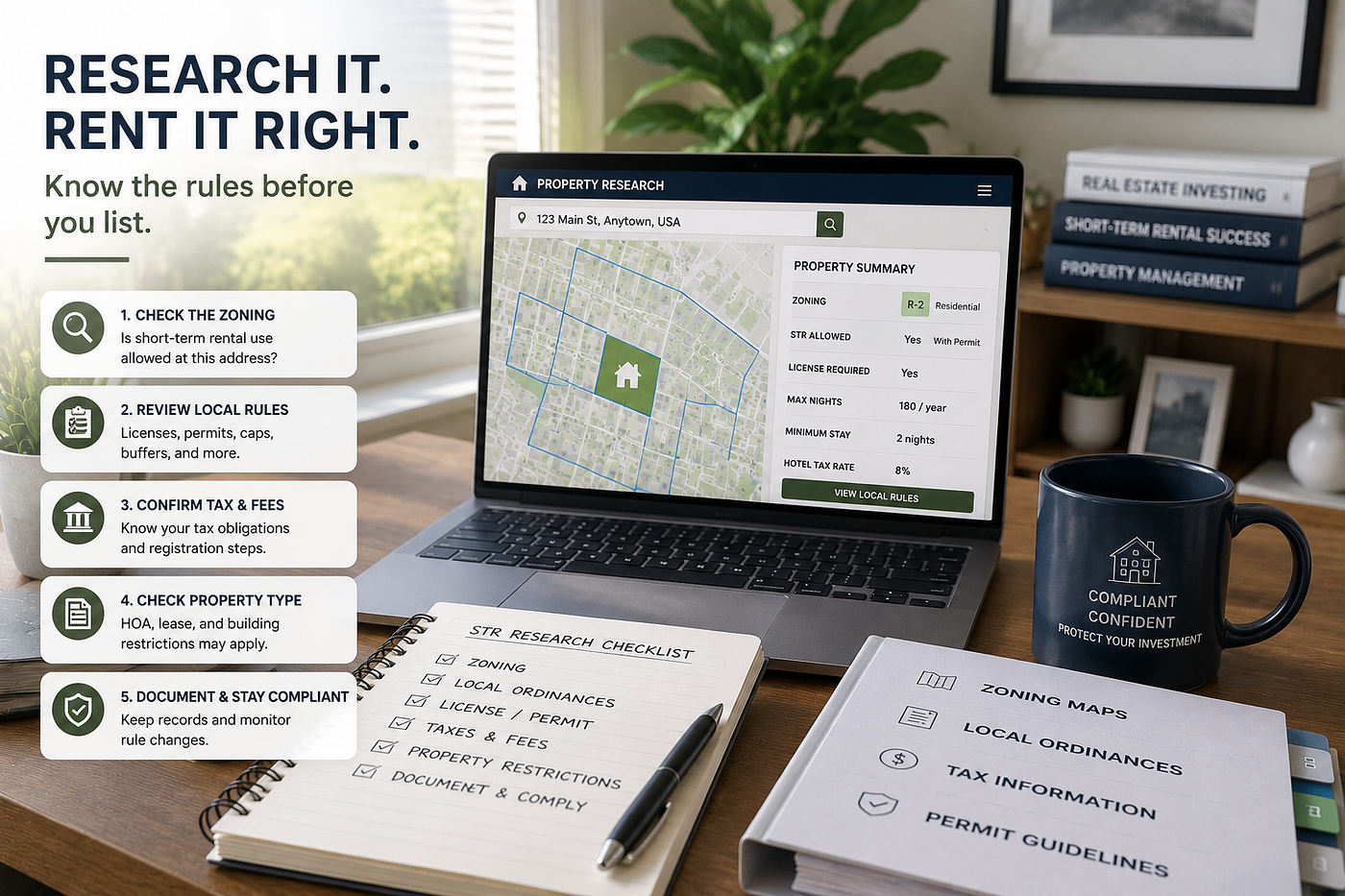
- Identify your property’s exact layers before assuming compliance: Confirm your state/province, county, city, zoning designation, and any HOA or strata governance that applies to your specific address.
- Determine whether your property is inside city limits or in an unincorporated area: This single fact changes who actually regulates you at the local level, as it does for hosts near Orlando, Miami, and many other metro areas.
- Request your HOA or strata’s governing documents (CC&Rs or bylaws) directly: Don’t rely on general online searches, since these documents are often not published publicly.
- Check your zoning designation separately from your license or permit: (even if your application was already approved): Zoning and licensing are frequently reviewed by different departments and can drift out of sync over time.
- Re-verify all five layers annually, or after any local election, rezoning announcement, or HOA annual meeting: These are the events most likely to trigger a rule change at one layer without touching the others.
- Keep a simple record of each layer’s requirements and renewal dates: Keep your records in one place, so you’re not reconstructing this research from scratch every year.
Conclusively, there’s rarely a single rulebook governing your short-term rental, there are five, stacked on top of each other, each capable of shutting you down independently of the others. A Florida host can be perfectly licensed by the state and still lose their listing to an HOA vote. An Austin host can be licensed by the city and still be blocked by zoning. The hosts who stay compliant long-term aren’t the ones who got lucky, they’re the ones that partnered with compliance companies and those who learned to check every layer, not just the most visible one.
Not sure how many layers of regulation actually apply to your specific address? Get your compliance report at lodgecompliance.com
메타데이터
- post_id
- 5da78ee28fe3
- slug
- str-compliance-layers-2026-the-5-rules-that-govern-every-airbnb-and-vrbo-property-5da78ee28fe3
- url
- https://resources.lodgecompliance.com/str-compliance-layers-2026-the-5-rules-that-govern-every-airbnb-and-vrbo-property-5da78ee28fe3
- canonical_url
- https://resources.lodgecompliance.com/str-compliance-layers-2026-the-5-rules-that-govern-every-airbnb-and-vrbo-property-5da78ee28fe3
- author_url
- https://medium.com/@taraomotere
- status
- ok
- fetched_at
- 2026-08-16 10:34:10