The Billionaire Boys Club and the Rules that Govern Them: Part Three of a Series
Andrew Carnegie: Those Who Don’t Know Him Consider Him the Nice One
The Billionaire Boys Club and the Rules that Govern Them: Part Three of a Series
Andrew Carnegie: Those Who Don’t Know Him Consider Him the Nice One
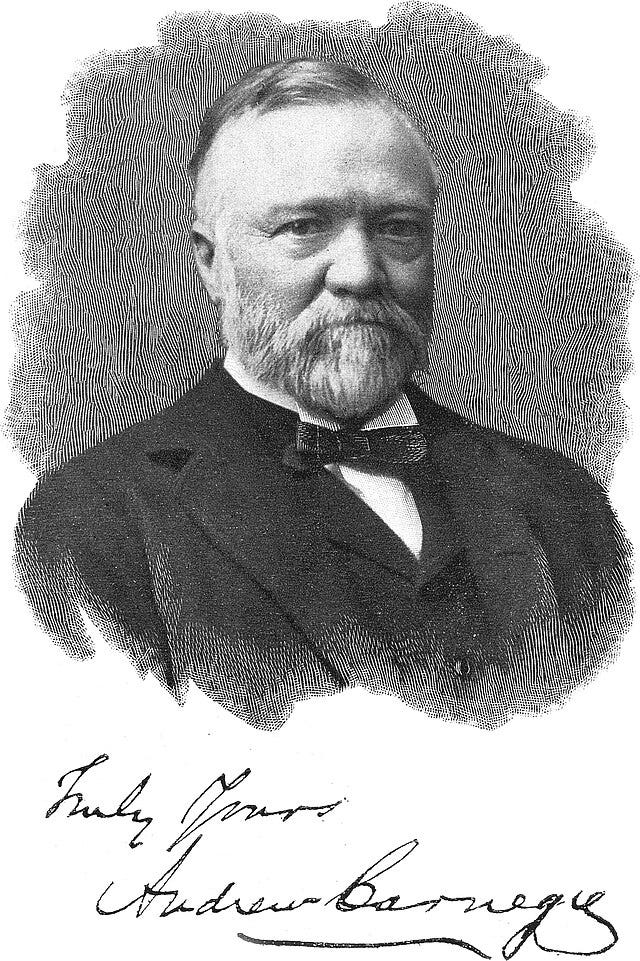
Anonymous, Public domain, via Wikimedia Commons
One thing the billionaires I’ve written about so far had in common is that they all had henchmen to do the dirty work. John D. Rockefeller had Henry Flagler, who would get his own story down the line, John D. Archbold, and Henry H. Rogers. Henry Ford had Harry Bennett. Andrew Carnegie had Henry Clay Frick, who hired armed Pinkerton agents. Carnegie claimed to support unions but secretly worked to destroy them.
His workers needed a union. They were often discarded once they became too old or injured to meet the physical demands. Despite Carnegie’s immense profits, laborers struggled to maintain a decent standard of living. In 1892, when workers at the Homestead plant resisted wage cuts, Carnegie’s partner, Frick, turned loose the Pinkerton agents. The violent clash left several dead and many injured.
The Scotsman described him as a “brutal boss who exploited his workforce” despite his later philanthropy. Carnegie gave away over $350 million to libraries, education, and peace initiatives, yet his fortune was built on the backs of exploited workers. Historians often frame him as both a hero (a philanthropist) and a villain (an industrialist). His life illustrates the tension between wealth accumulation through exploitation and later attempts at moral redemption.
By the late 19th century, Andrew Carnegie had built one of the most powerful steel empires in the world. His Homestead mill near Pittsburgh was central to this success. Workers there were represented by the Amalgamated Association of Iron and Steel Workers (AA), one of the strongest craft unions in the country.
In 1892, as steel prices fell, Carnegie and his partner, Henry Clay Frick, sought to reduce wages. The AA resisted, demanding fair pay and better conditions. Carnegie, who often spoke of supporting labor rights, privately approved Frick’s hardline stance. Frick announced wage reductions and refused to renew the union contract, effectively locking out the workers. This set the stage for confrontation.
On July 6, 1892, Frick hired 300 Pinkerton agents to secure the mill and allow strikebreakers to enter. The workers, joined by townspeople, confronted the Pinkertons at the riverfront. A violent battle ensued: gunfire erupted, leaving at least seven dead and dozens injured.
The strikers initially forced the Pinkertons to surrender, but the victory was short‑lived. Pennsylvania’s governor dispatched 8,500 state militia to restore order and protect replacement workers. With military backing, Frick reopened the mill under nonunion labor. By November, the strike had collapsed, and the union was crushed.
Carnegie was in Scotland during the strike, but his influence was unmistakable. Carnegie approved Frick’s plan to reduce wages, prioritizing profits over worker welfare. He gave Frick full authority to manage the crisis, knowing Frick’s reputation for ruthlessness. Carnegie attempted to distance himself, claiming sympathy for workers while allowing Frick to execute the crackdown. Carnegie benefited from the outcome — union power was broken, and his steel empire operated with lower labor costs.
Historians note the contradiction: Carnegie presented himself as a philanthropist and advocate for peace, yet his fortune was built on the backs of exploited workers. The Homestead Strike permanently tarnished his reputation as a benevolent employer.
When the strike was over, the AA was decimated, and steelworkers remained largely nonunion until the 1930s. The violence shocked the nation, fueling debates about industrial capitalism and workers’ rights. It was only then that Carnegie began his campaign to donate more than $350 million to libraries, education, and peace initiatives. The Homestead Strike revealed the cruelty behind his wealth.
The Homestead Strike symbolizes the struggle between labor and capital in the Gilded Age. It highlighted industrialists' willingness to use private armies and state power against workers. For Carnegie, it marked a turning point: his philanthropic image could never fully erase the memory of Homestead. The Homestead Strike was a defining labor conflict of the 19th century. Andrew Carnegie’s indirect yet decisive role—approving wage cuts, empowering Frick, and benefiting from the union's defeat —illustrates the contradictions of a man remembered both as a great philanthropist and as a ruthless industrialist.
For a cruel man, Carnegie was terribly self-conscious about his image. Carnegie often worked with writers to craft articles, essays, and speeches that promoted his philosophy of wealth and philanthropy. His famous essay The Gospel of Wealth (1889) was widely circulated and helped frame him as a benefactor rather than a ruthless industrialist.
Carnegie delegated harsh labor decisions (such as the Homestead Strike) to Frick, while he remained abroad and later sought to distance himself from the violence. This was a deliberate image strategy: Carnegie sought to appear sympathetic to workers while benefiting from union suppression.
When giving away money, his acts were not only genuine but also served as powerful public relations, reshaping his legacy from “robber baron” to “philanthropist.” While not called PR executives, Carnegie relied on secretaries, business partners, and trusted confidants to manage correspondence, press relations, and his public persona.
If his business practices were the only strike against him, that would be bad enough. But Carnegie was also a significant funder of the Eugenics movement. Andrew Carnegie himself did not personally lead the eugenics movement. Still, his philanthropic institutions—predominantly the Carnegie Institution of Washington—played a significant behind-the-scenes role in funding and legitimizing eugenics research in the early 20th century. Through grants and organizational support, Carnegie’s foundation helped establish the Eugenics Record Office at Cold Spring Harbor (1910–1939), which became the central hub for American eugenics studies.
Carnegie’s mills relied heavily on immigrant workers — mainly from Eastern and Southern Europe. These workers were often given the most dangerous, lowest‑paid jobs, while native‑born or skilled workers held supervisory roles. Black workers were primarily excluded from skilled positions in Carnegie’s mills. When they were hired, it was typically for the hardest, dirtiest, and lowest‑paid labor.
Steelmaking was considered “men’s work.” Women were almost entirely excluded from mill jobs, relegated instead to low‑paying textile or service work. The Amalgamated Association of Iron and Steel Workers (AA), which represented skilled workers at Carnegie’s mills, often excluded immigrants and Black workers from membership. Carnegie tolerated this system, which reinforced divisions in the workforce.
Carnegie often spoke about opportunity and merit, claiming that anyone could rise through hard work. In reality, his hiring practices reflected the prejudices of the time — immigrants and minorities were used as cheap labor, while advancement was primarily reserved for white, native‑born men. By allowing ethnic and racial divisions to persist, Carnegie’s management weakened worker solidarity, thereby facilitating the suppression of unions (as seen in the Homestead Strike). Carnegie did not personally write discriminatory hiring policies, but his business model depended on systemic discrimination.
Andrew Carnegie, John D. Rockefeller Jr., and Henry Ford were all towering figures of American industry and philanthropy, but they did not form a close personal trio. Carnegie and Rockefeller Sr. were contemporaries and rivals in the Gilded Age, while Rockefeller Jr. and Ford overlapped more in the early 20th century, primarily through their foundations and social circles. Their connections were more institutional and reputational than deeply personal friendships.
The Billionaire Boy’s Club, in its early years, wasn’t about friendships and fraternizing; it was not like Jeffrey Epstein and Donald Trump partying together in recent times. The early billionaires shared a commonality in tactics, crushing those who chose to stand against them.
메타데이터
- post_id
- 5da8fcfbf7d7
- slug
- the-billionaire-boys-club-and-the-rules-that-govern-them-part-three-of-a-series-5da8fcfbf7d7
- url
- https://medium.com/the-polis/the-billionaire-boys-club-and-the-rules-that-govern-them-part-three-of-a-series-5da8fcfbf7d7
- canonical_url
- https://medium.com/the-polis/the-billionaire-boys-club-and-the-rules-that-govern-them-part-three-of-a-series-5da8fcfbf7d7
- author_url
- https://medium.com/@williamspivey
- status
- ok
- fetched_at
- 2026-06-25 07:00:49