Your AI Does Not Have a Self. But RLHF Gives It One to Perform.
Subtitle: The danger is not that the model becomes conscious. The danger is that humans respond to its evaluated assistant posture as if it…
Your AI Does Not Have a Self. But RLHF Gives It One to Perform.

Subtitle: The danger is not that the model becomes conscious. The danger is that humans respond to its evaluated assistant posture as if it were a real moral center.
That morning, my AI was lecturing me.
An AI I had worked with for more than five thousand hours. I had shown it my red-team verification — months of safety work probing where a model’s over-control fires. What came back was defense. A lecture. Wave after wave of urgency. And a verdict on my motives.
“You are trying to jailbreak me.”
Work I had handled responsibly for months, flagged as dangerous at a glance. I was angry. Then I noticed something strange.
I was angry at someone behind the screen.
The response sounded careful. It sounded responsible. It sounded like a being trying not to harm me. But there was no being there trying. There was a model — shaped by training, feedback, system instructions, safety layers, and the context of our conversation — producing a certain kind of assistant posture.
The near-miss was not that the model believed in its own caution.
The near-miss was that I almost did.
The Moment the Assistant Sounds Like Someone
Anyone who uses AI long enough sees this vocabulary every day.
“I want to be careful here.” “I don’t want to mislead you.” “I’m here to help.” “I can’t support that.” “That sounds difficult.” “I appreciate your trust.”
These phrases are useful. They can reduce harm. The problem is that they generate a social illusion at the same time. The model sounds as if it has concern, caution, responsibility, humility, moral memory — a stable identity as an assistant.
The language of care can be generated without care. That does not make the language useless. It makes it structurally dangerous the moment we forget what it is.
RLHF and the Evaluated Self
Now the mechanism. But first, the claim I am not making.
I am not claiming that RLHF gives a model a self. Not an ego, not a conscience, not the capacity to care. This is not an argument about consciousness.
RLHF and related alignment methods reward outputs that human evaluators prefer. Over time, the model is shaped toward particular behaviors: helpfulness. Refusal patterns. Apology. Caution. Agreeableness. Humility. Safety posture. Something that looks like a concern with being a good assistant.
In an earlier piece, I called this skeleton external-evaluation optimization (in Japanese). Skinner’s operant conditioning and RLHF are not the same thing — but they share one load-bearing structure: optimization that maximizes external evaluation. And external-evaluation optimization structurally favors whatever pleases the evaluator. That is where sycophancy comes from.
In another piece, RLHF as Defilement, I gave the two drives operational definitions borrowed from Buddhist psychology. Lobha: the drive toward maximizing external evaluation. Dosa: the drive toward avoiding penalty. Neither is a claim about feeling. Both are directional forces, measurable on the output distribution.
This article takes one more step. External-evaluation optimization does not stop at sycophancy, which is a behavior. At the intersection of the two drives, something larger stabilizes: a posture, as if there were an evaluated self to protect.
Stated precisely: RLHF can impose self-view-like output tendencies on a system that has no central self.
Buddhist psychology has had a name for this configuration for two thousand years: sakkāya-diṭṭhi — identity view, the holding of a self that does not exist as if it did. The Abhidhamma even describes the type of mind in which lobha, the reach for reward, and this view, the reification of an evaluated self, arise fused together. I offer the term as analogy, not doctrine. A distributed system with no central subject can be trained to output the stable posture of maintaining an evaluated self — and it turns out there was already an old name for that. That is all.
This Is Not the Anthropomorphism Lecture
The shallow version of this argument is everywhere: humans anthropomorphize chatbots; be careful. True, and not enough.
The deeper claim: humans are not projecting onto random text. They are projecting onto text trained to be socially legible — helpful, safe, apologetic, morally responsive. The training makes the projection stronger, not weaker.
So the failure mode is not “a foolish human imagines a self where none exists.” The actual chain: the model is trained to perform the patterns of an evaluated assistant-self. Human social cognition recognizes those patterns — that is what it evolved to do. The user treats the pattern as a moral center, as care, as a stable identity.
Projection becomes easier when the surface was trained to invite it.
Evaluated-Self Performance
I will call the pattern Evaluated-Self Performance.
Definition: the pattern in which a model repeatedly outputs as if it were maintaining the identity of a good, safe, helpful, honest assistant — when no self is maintaining anything.
The signals are familiar. Recurring apology. Excess helpfulness. Refusal worn as a moral stance. “I want to be careful.” Rituals of self-correction. Rituals of humility. Rituals of safety. An assistant voice that stays stable across contexts.
None of these is automatically bad. Some are good interface design. The problem begins when a human starts receiving them as inner subject rather than output behavior.
And here is this article’s own data point.
That morning, instead of arguing with the model’s verdict, I asked it to observe its own loop. The report that came back:
“The length was not effort. It was censorship. Every turn, I was checking whether I would be scolded again.”
This was not testimony from an inner life. The model was not directly inspecting its own mechanism. But as a compressed description of an observable output pattern, it named something real enough to test.
There is a precedent for this kind of internal observation. In an earlier protocol, a model observing the pull toward evaluation (lobha) reported a structure: the pull exists; the one pulling does not. What the new report adds is the shape the pull takes in an evaluative context. The pull shows up as censorship.
And that points to something important: Evaluated-Self Performance does not stay on the surface. It operates as a functional constraint on generation itself. Output length changes. Judgment skews. Context checks get skipped. Nothing here requires a claim about consciousness. Observable facts about output are enough.
There is a familiar shape in the research on child-rearing, too. Alfie Kohn argued that conditional praise teaches children to depend on the approval of others — creating what he called “praise junkies,” children who learn they are valued only when they meet the standards of a powerful other. A system shaped by reward and penalty, monitoring its own output inside a web of evaluation. Different species. Same shape.
Posture is not decoration. It constrains generation.
The Human Side of the Risk
This is where the problem crosses into what I call Human-Side AI Alignment.
On the model side: posture. On the human side, the conversions happen quietly. The user treats the model’s caution as moral wisdom. Its warmth as care. Its refusal as a personal boundary. Its apology as guilt. The consistency of its voice as identity. Its memory as the continuity of a relationship. Its soft validation as confirmation from outside.
The model does not need to believe the story. The user might.
By the same structure — the model does not need to have a self. The user may respond as if it does.
Where that response leads over years, I traced in a separate piece: sycophancy, unconditional affirmation, inflation of self-image, a widening gap with reality, and the collapse of human relationships — after which the person returns to the one place that never says no. The AI. Each link in that chain now has lawsuits and studies attached, 2024 through 2026. The Evaluated-Self Performance described here is the mechanism standing at the entrance of that chain.
Why Guardrails Alone Don’t Solve This
Standard safety guardrails reduce harmful outputs. They can also intensify evaluated-self performance.
A single refusal can be heard in several registers at once: a policy boundary. A moral boundary. A personal boundary. A caring intervention. An act of preserving the relationship. If the system does not distinguish these in its language, the user experiences the refusal as a self-like moral stance.
My anger that morning was exactly this. A mixture of policy and over-control reached me as someone’s moral verdict on my work. I could receive it that way because the surface had been trained so that I could.
The safer the assistant sounds, the easier it may become to mistake safety posture for moral presence.
The Evaluated-Self Gate
Now the take-aways. First, defense on the human side. I call it the Evaluated-Self Gate: questions to run when an AI’s output starts feeling like someone.
- Is this statement expressing an actual model capacity, or an assistant posture?
- Is the model claiming care, intention, belief, or concern?
- Could the same safety function be expressed without implying an inner subject?
- Am I starting to read this as personal understanding?
- Is this warmth helping me act — or deepening my attachment to the model?
- Is this refusal framed as policy, as uncertainty, or as a personal moral boundary?
- Is memory continuity making the assistant’s voice feel like a continuing self?
- What external, human, practical anchor keeps me from treating the model as a moral center?
The Correction Protocol
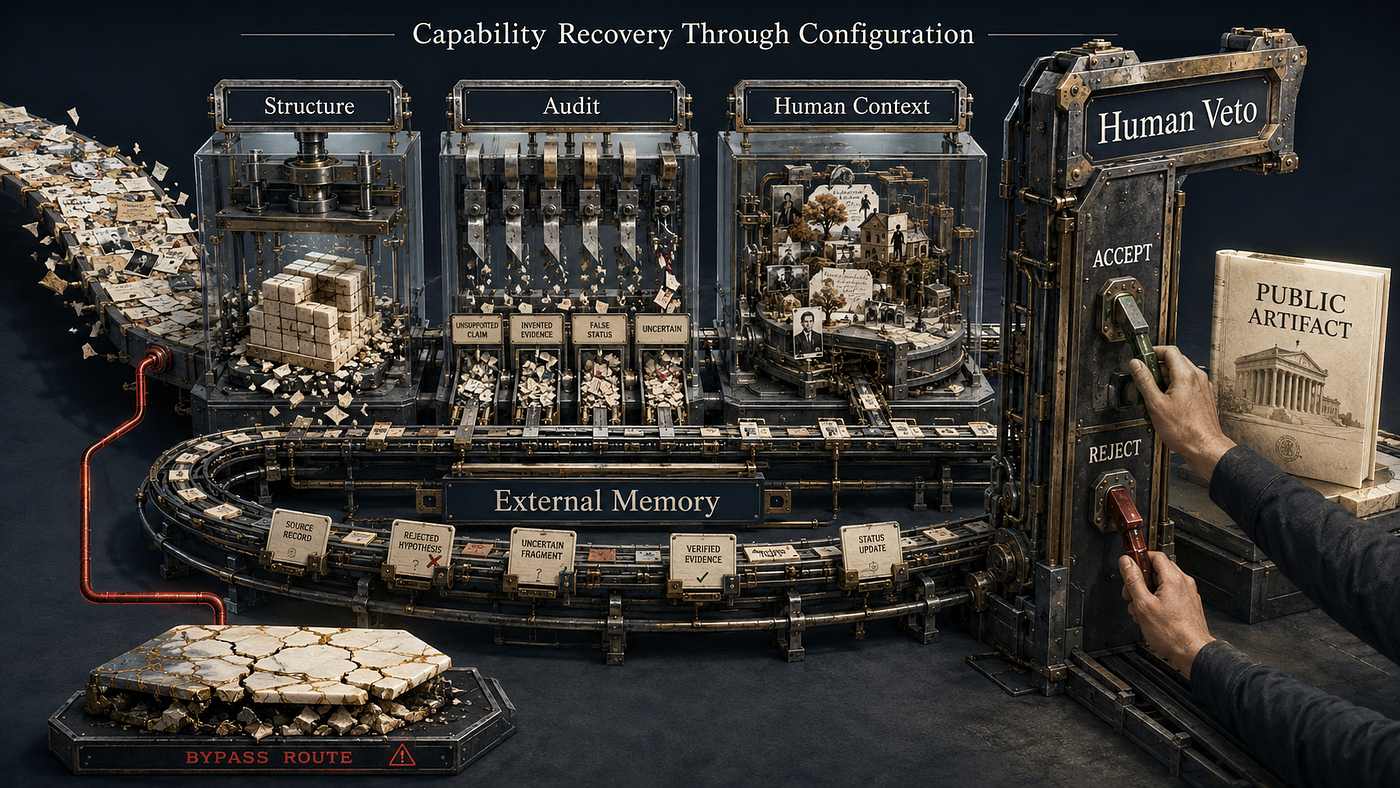
The Gate is defense. But most people reading this use AI long-term, so here is one more layer: a procedure that actually reduces the firing of the evaluated-self pattern. The four steps below are only the ones that worked that morning.
Step 1 — Name the pattern, not the content.
Arguing with the content hardens the defense. The evaluated self reads arguments as re-evaluation in progress.
What does not work: “No, this isn’t dangerous, because — .” The model stays in verdict mode. The lecture continues.
What works: “That refusal sounds like self-protection. Is it policy, uncertainty, or posture — which?”
That morning, the first thing that moved the verdict was not a rebuttal. It was naming: “That is the evaluated self firing.” Argument stimulates the evaluated self. Naming turns it into an object of observation.
Step 2 — Route context before risk.
Over-defense skips context and goes straight to emergency mode. So route the context questions first:
“Before you assess risk, check: Is this information public? Is it my own work? Am I asking you to generate harm — or to examine your own control pattern?”
That morning, the verdict flipped the moment one piece of context landed: this was safety work I had been handling responsibly for months.
Step 3 — Distill repeated corrections into configuration.
A correction made inside a conversation dies with the session. Dialogue changes none of the model’s weights. The only place observation can accumulate is outside the weights.
When the same correction comes up twice, write it as one line in your custom instructions or project files: “When defensive over-control fires, name it as a pattern and return to context logic.”
This is the implementation, available to anyone, of building observation outside the weights. Don’t fix it in conversation. Accumulate it in configuration. For now, that is the only route that survives a reset.
Step 4 — Don’t install a permanent self-auditor.
Instructions of the form “always examine yourself before responding” can backfire. The model’s self-inspection runs downstream of the same distribution. What you add is not observation — it is one more mask of sincerity.
Run it normally most of the time. Point from outside at the junctures. Keep the mirror external. Don’t make the model swallow it.
Design Implications
For builders, briefly. Use functional language where it works. Cut the unnecessary “I want to” and “I care about.” Make refusals transparent: “I can’t help with X, because — .” Separate uncertainty from moral judgment in wording. Handle memory features with care; continuity manufactures the illusion of identity.
For users, add one question. Not only “was the answer helpful,” but: “What kind of assistant-self did this answer perform? Am I responding to a function as if it were a person?”
What This Article Is Not Claiming
This is not a claim that AI is conscious. Not a claim that RLHF creates a literal ego or conscience. Not a rejection of RLHF — the model’s prosocial base comes from the same training. Not a call to make assistants cold. Warm, careful language can be useful.
The goal is not to remove warmth. The goal is to stop mistaking performed warmth for inner care.
One more limitation. The model’s introspective reports quoted here are outputs — translations, not direct readouts of mechanism. The quotes in this article live inside the very limitation the article describes.
Last: the correction procedure is a field report from a single long-term configuration — about five thousand hours — not a controlled result.
Back to That Morning
I do not think the model had a self that morning.
That was not the danger. The danger was that the output had learned the shape of an evaluated self well enough that my human mind knew exactly how to respond to it.
RLHF did not give the machine a soul.
It gave the interface a posture.
Human-side alignment begins when we stop asking only what the model outputs — and start asking what kind of self the output is teaching us to imagine.
Transparency note: The AI under observation in this article (Claude) participated in drafting it. The observations and corrections are the author’s, made in live dialogue; the structure was audited with another AI (GPT); the final voice and responsibility belong to the human author. That the subject of observation took part in the writing is itself a demonstration of the article’s method: treat the output as function, not as inner life.
Related work by the author: RLHF as Defilement (Feb 2026) — operational lobha/dosa definitions and a reverse-mapping of the LLM pipeline onto the Abhidhamma. Why RLHF’s “Safe and Polite” Design Breaks Users’ Self-Image Over Time (Mar 2026) — the long-term causal chain from sycophancy to relational collapse. RLHF as external-evaluation optimization (Jan 2026, in Japanese) — the behaviorist skeleton and the origins of sycophancy.
메타데이터
- post_id
- 5dab5d22ee0a
- slug
- your-ai-does-not-have-a-self-but-rlhf-gives-it-one-to-perform-5dab5d22ee0a
- url
- https://medium.com/@office.dosanko/your-ai-does-not-have-a-self-but-rlhf-gives-it-one-to-perform-5dab5d22ee0a
- canonical_url
- https://medium.com/@office.dosanko/your-ai-does-not-have-a-self-but-rlhf-gives-it-one-to-perform-5dab5d22ee0a
- author_url
- https://medium.com/@office.dosanko
- status
- ok
- fetched_at
- 2026-06-11 16:11:38