The Ones Who Look Up
Part I—Heel and Hollow
SERIAL FICTION
The Ones Who Look Up
Part I—Heel and Hollow
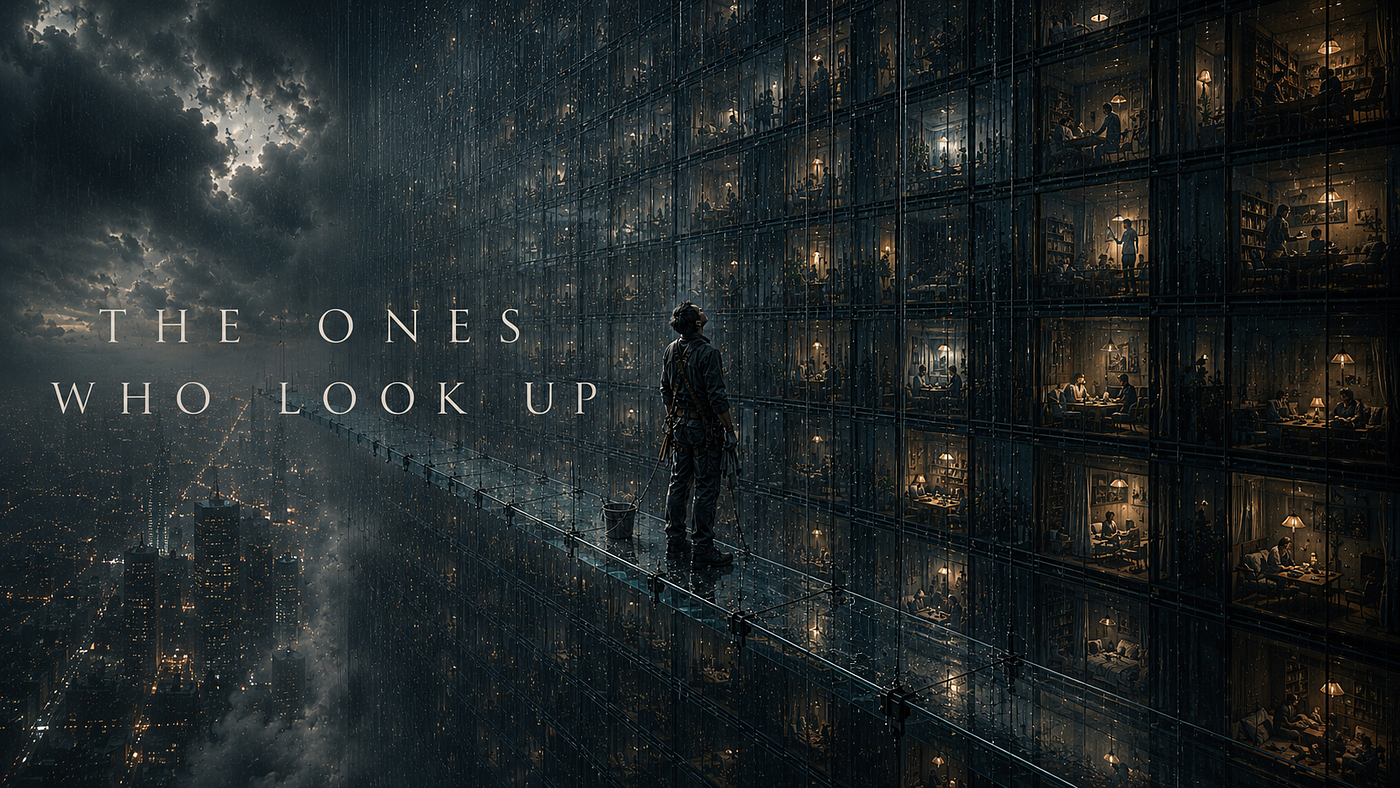
Cover artwork created by the author using OpenAI Image Generation.
The glass was clean by the time the woman behind it woke, and she never knew it had been dirty.
Kiran worked the pane from the outside, harness biting his hips, the rag going in the long flat strokes his grandmother had taught him before she fell. Below his boots, the city dropped away into morning haze, lanes, lower roofs, the soft grey throat of the old district, all of it waiting the way the ground always waited, in no hurry, sure of him. He did not look down. Looking down was for children and the newly bereaved. On the inside of the glass, someone’s palm had left a smear, pressed there in a private bad night, a fever or a fight. He wiped it away. The woman on her pale sofa turned a page and did not lift her eyes.
That was the work. You cleaned the thing they looked through, and you were the one thing they did not see.
“Leave the upper seam,” Dru’s voice came from the ledge above, flat, already moving on. “Brace is soft. Not worth your weight.”
“I can reach it.”
“I said it’s not worth your weight.”
He left the seam, and she would not say it twice. She had buried a husband in this section and a daughter off the one below. Now she read every surface for whether it would hold a body. Her left shoulder sat wrong in the socket — an old dislocation she’d set herself, one boot braced against the rail, nobody’s hands but her own. Cold weather made it click. She reached anyway. Even now she was reaching, lashing a fiber bundle to the cable with her teeth in the knot, and under her breath she kept the count, the section’s own verses, the ones with the names in them: mind the pane where Pell slipped, count it twice, you cross it gripped. Pell had been her daughter. She sang the line the way she sang all of them, flat, on the beat, a woman walking her own grief in even feet so it would not take her. The shoulder clicked. She said nothing else.
Along the ledge, the morning did its ordinary things, and all of them were counted. Three children ate compressed grain with their backs to the tower wall, clipped at the waist, heels swinging over four hundred meters of air on the beat, careless as any child’s heels over a porch step. A man passed buckets hand to hand, one for footing, two for weight, his lips moving without sound. Down the line, someone’s grandmother sang the counting song that taught the young ones where to put their feet—heel and hollow, heel and hollow, count the stone before you follow—the same song the woman three ledges over was humming as she stirred a pot, the same beat a couple had kept last night behind their tarp. The same four runners struck when they had to move fast along the high seams. Everything on the Verge ran on the count. You set your heel on one and found the hollow on two, and you did not move on the off-beat, because the off-beat was where the ledge took you. A Verger cooked in meter and grieved in meter and made love in meter, and did not think it strange, the way a fish does not think water strange. The song was not about walking. The song was how you stayed.
No floor on the Verge lets you forget the drop. So the Verge had set the drop to music and learned to live inside the music. It is called music safety. It was not wrong.
Kiran moved to the next pane. Inside, a child drew glowing animals on the floor with a stylus and did not look up. Behind the child, against the far wall, stood the thing Kiran had no word of his own for and so used theirs.
A door.
He had seen them his whole life and understood them not at all. A slab that swung. A room you could put behind you. He knew what a door did the way he knew what fire did — by report, by the awe of people describing it, never once having held the heat. On the Verge, there was nothing to close. You slept in rows and woke in rows. A man three feet away heard every sound your body made — weeping, or wanting, or dying — and that was not poverty, exactly. It was only the shape of the world. But the door. The door was the one luxury he could not look at without something turning over in him. To be able, even once, to make the world stop looking at you. To answer a knock, or not answer it. He did not envy their food or their carpets or their warm painted walls. He envied the hinge.
A scrape, behind him. Not his.
The whole ledge went still in the particular way it went still—every adult turning at once, the counting song cut off mid-word. A girl, four ledges down, both arms flung wide, one heel skating on wet glass. Her mother had her by the harness-strap before the second heartbeat, hauled her in, held her against the wall. The girl laughed the high cracked laugh of a body that had not yet understood what it nearly did. Her mother did not laugh. Her mother looked up.
Not at the girl. Up. At the windows above them, pane after lit pane, the whole sheer face of the inside — looking the way every Verger looked in the half-second after a near fall or a real one, the old reflex, the only prayer the Verge had ever taught: did anyone see? Did anyone, this time, see?
The windows looked back with nothing in them. A man inside crossed a room with a cup. A curtain moved and settled. No face turned down.
Below, the mother lowered her eyes and went back to her daughter. The counting song picked up again where it had stopped, and Kiran wet his rag and reached for the next smear of someone else’s bad night.
That was the work. You looked up. They didn’t. You wiped the glass anyway.
He found the face at the eleventh pane, and at first he did not understand what he was looking at, because it was looking back.
A girl. His age, near enough. Dark hair pulled into the severe knot the inside favored, a white shirt of the kind that had never met a day of weather. She stood close to the glass with a cup going cold in one hand, and the other worked at itself without her seeming to know — the thumb picking at the skin beside the nail, a raw spot already there, the small private habit of someone who did her thinking in her hands. Her eyes were on him. Not through him, not at the smear under his rag or the haze past his shoulder. On him. On the face. The way you looked at a person.
Kiran’s hand kept moving because his hand did not know how to stop, but the rest of him had gone still in a way he had no practice at. Being observed he understood. The inside observed the Verge as you observe weather, noting it, dismissing it, returning to the cup. Being seen was a different country. His body, schooled for seventeen years to carry itself under indifference, had nothing rehearsed for the thing happening on the other side of the pane.
She did not write on the glass. She did not smile or tap or retreat into the little pantomimes of the caught. She only looked. Not searching for him for an answer. Searching herself for the question.
It lasted the length of three strokes of his rag. Then someone spoke behind her in the room, and the line between her brows deepened, and she turned her face away—not the careless turning-away of the inside, but a turn with friction in it, the turn of someone made to stop doing a thing she had not finished.
Kiran moved to the next pane and did not look back, and his pulse was doing something stupid, and he was furious at it.
“You’ve gone slow,” Dru said from above. She had not seen. She read his pace off his body, the only book she trusted. “What is it.”
“Nothing. Soft seam.”
She let it go, which meant she had heard the lie and filed it, because Dru forgave a lie the way she forgave a soft brace: by remembering exactly where it was.
He worked the curve of the tower until the light changed, telling himself he had imagined the weight of it. But at the day’s end, racking the buckets, he caught himself counting. Eleventh pane from the maintenance rib, fourth tier up from the service ring. He knew the floor as he knew all of them: by the thickness of the glass, by the quality of the bowl on the table, by the kind of child that drew on the kind of screen. To within a hand’s width, he could place any window on the section. The Verge taught its children that for free, before it taught them to read.
Her floor he filed without deciding to. Fourth tier. High. The glass up there ran thick as a fist, the kind that held heat and held silence, the kind a body could not have heard a storm through.
He would remember, later, that she had started so high.
She was there the next morning, and the morning after, and Kiran built his route around the lie that he had not.
The inside did not stay put—that was the first thing he had to unlearn. He had always read the windows as fixed, each floor a settled fact, the rich rooted in their altitudes the way the Verge was rooted in its ledges. But the inside moved. Rooms changed hands. A family rose a tier when the man who owned the tower found them useful and sank one when he did not, and the whole sheer face of the building was, he came to understand, a slow vertical weather of favor. The Vergers only ever moved one direction, and only once, and only down. The inside drifted up and back like smoke deciding.
So when he found her at the tenth pane instead of the eleventh, a tier lower than the day before, he told himself it meant nothing. Rooms changed hands.
She had a slate this time, the thin, lit kind. She held it to the glass.
You always look up. All of you. Why.
He read it twice. The question had no idea what it was asking — it was the question of someone who had never once needed to be seen, turning over a custom the way you’d turn over a stone to find the wet underside interesting. He felt the old anger move, the one Dru would have told him to swallow. He swallowed it. Then he wet his finger and wrote, backward and clumsy, on his side of the glass:
To see if anyone’s watching when we fall.
She read it. Whatever she had expected, it was not that. The faint line came back between her brows, and this time it stayed. She wrote:
Does it help.
*No, he wrote.*
Then why.
He looked at her through the smear of his own letters.
Because once would be enough.
She went very still behind the glass. Not the stillness of the inside, the composed stillness of people who had never been made to hold a pose against the wind. A different stillness. The kind that came over a body when something it had been told all its life turned out to have a back to it, a whole hidden mass it had never been shown. Only her thumb moved, worrying the raw spot beside the nail.
Behind her, the room was smaller than the room she’d had the day before. He read it before he could stop himself, the habit that ran under his thinking. The bowl on the table was clay, not the white stuff that cost. The child who’d drawn glowing animals was gone—different window, different floor, or simply gone. He filed it. Tenth pane. Third tier and a half. The glass here ran thinner. A storm would come through it as more than a rumor.
“Kiran.” Dru, below him now, lashing a line. She had stopped to look up at him, and her face had the flat calculation he had learned to fear in her before he could walk. “Whatever you’re spending up there — you’re spending it from the wrong account.”
“It’s a question through a window.”
“It’s always a question through a window.” She went back to her knot. “Right up until it’s a girl on a ledge with no harness and no count in her, moving on whatever beat she pleases because nobody sang her the right one. I’ve buried the inside before. They come down off the count, and the count is the only thing that holds you. They fall the same as the rest of us, only sooner.”
He wanted to ask what she meant—come down—but she had already turned the shoulder that clicked, the conversation set behind a door he did not have the hinge for.
For the rest of the curve, he worked in silence. When he came back around the tower the next day, she was at the ninth pane.
Ninth. A tier and a half lower in two days. He stopped with his rag against the glass and did the arithmetic he did not want to do, the arithmetic that was the one thing the Verge had taught him to do without thinking, and the number it gave him put a cold hand flat against his chest.
She was descending.
Not drifting the way the inside drifted, up and back, smoke deciding. Coming down. Steadily. A tier and a half in two days, in one direction, the building moved a body it had decided to be rid of. Behind the thinning glass, she stood at the ninth pane, second tier, the bowl on her table tin now, the white shirt still the white shirt because nobody had yet taught her that up here you did not wear a thing you could not afford to lose to the weather. And he understood, all at once, what looking down had cost her. It was still costing her. A tier at a time, for as long as she kept turning her face toward the glass instead of away, it would go on costing.
She lifted the slate and read:
You’ve gone pale.
Is it the cold.
He watched her stand there behind the glass. She had no count in her. He saw it now and could not stop seeing it—the inside had never sung her anything, so her body moved on no beat at all, shifting her weight when she felt like it, leaning on the off-stroke. It should have read as carelessness. To anyone on the ledge, it would have read as a body marked to fall. But Kiran had counted every step of his life—heel and hollow, footing and weight, the four laid down before he could speak—and he looked at this girl moving through the world on no beat but her own, and the word his chest gave him was not careless.
It was free.
He did not write that. He did not write that he had read her altitude the way he read a soft brace, or that the tower was lowering her toward him a tier at a time, or that some traitor part of him wanted to climb to where she still stood and learn her arrhythmia before the ledge corrected it.
Wetting his finger, he wrote the only true thing he had.
Stop looking down.
She read it. She frowned. And then—he watched her do it, watched her choose it—she looked down anyway, straight at him, and did not turn away.
The storm came up from the south on the day she reached the lowest tier, and the Verge knew it before the bells, through the body, through the soles of the feet.
Dru felt it first in her shoulder. She stopped mid-knot, rolled the joint, and said, “Bring them in.”
No advisory had sounded yet. The speakers cracked to life with their flat, official voice—secure loose material, stay clipped, report damage. By then, the children were already off the open ledges. The buckets were already lashed. Dru was already moving down the line, checking harnesses with hands that did not hurry, because hurrying killed people up here faster than weather did.
Kiran checked his own clip twice and looked, once, for the window.
She was at the first tier now. The bottom of the inside, the last row of rooms before the building’s skin gave way to the ledges of the Verge—and he saw, with the cold flat clarity of a man reading a brace, that there was no room behind her anymore. Just a corridor. A service corridor, the kind that ran between the shell and the residences, the kind with no carpet and no bowl and no door that closed. The tower had lowered her as far as the inside went. One more tier, and there was no inside left to lower her into.
Her palm was flat on the glass. Not writing. Just the hand.
Below her the storm came on, and she did not move her hand from the glass, and neither of them looked away.
Heel and hollow, heel and hollow. Count the stone before you follow.
The ledge takes the hurried.
©Prabhakar Singh 2026. All Rights Reserved.
Author’s Note:
I’ve been away a while. Not from writing—from publishing. There’s a difference, and I’ve been sitting in that gap for months now, wondering whether it’s worth making things that take this much out of you. Some nights it feels like shouting into a corridor. You do the work, you bleed the hours, and you have no idea if anybody’s on the other side of the glass.
Then I had this dream. A building, thirty-odd floors, and my family living on a thin strip of glass on the outside of it, the drop right there under our feet. My mother was there doing ordinary things, as if it were any other Tuesday, as if we weren’t four hundred metres above the city. My foot slipped. She caught me by the wrist. I woke up before I knew if she’d held.
It shook me badly enough that I couldn’t put it down—couldn’t work, couldn’t think. So I did the only thing I know how to do with a thing that won’t leave: I built a world around it. A people who live on the outside of the tower, who sing their dead into their walking songs, who look up at the windows every time someone falls, hoping just once that somebody inside will look back.
Nobody ever does.
I don’t have a clean answer to the doubt, and I’m not going to pretend the crisis packed its bags and left. But I wrote this one for myself, and I’d have written it even if nobody came. Turns out that’s enough — that’s the whole thing, actually. You don’t get free of the count by reasoning with it. You get free by doing the one thing it told you not to.
This is Part I. The ending comes soon.
메타데이터
- post_id
- 5db2c646789e
- slug
- the-ones-who-look-up-5db2c646789e
- url
- https://medium.com/the-lark/the-ones-who-look-up-5db2c646789e
- canonical_url
- https://medium.com/the-lark/the-ones-who-look-up-5db2c646789e
- author_url
- https://medium.com/@prabhakarsingh214
- status
- ok
- fetched_at
- 2026-07-15 07:20:45