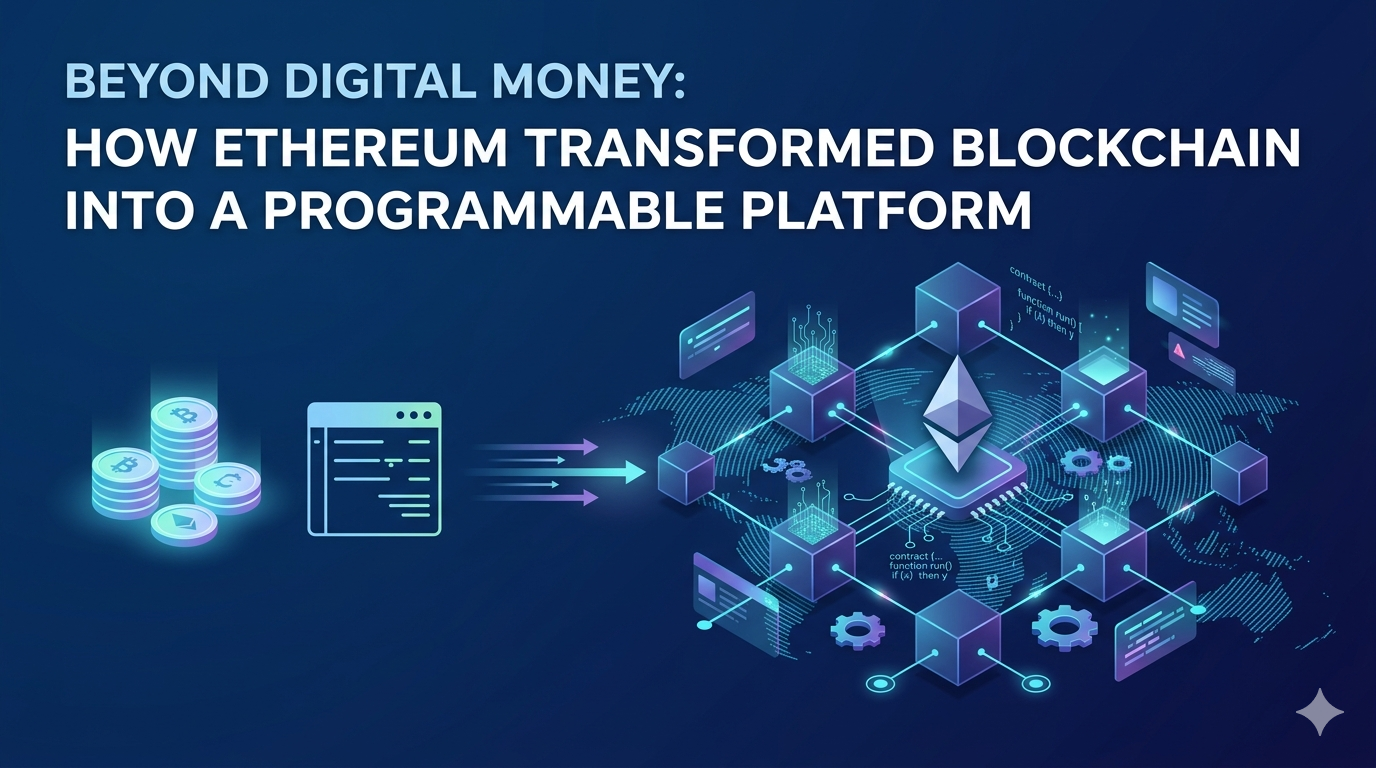
Why Everything Shouldn’t Be On-Chain: Understanding the Real Limits of Web3 Architecture
As blockchain technology evolved from a niche experiment among cryptography enthusiasts into a serious financial and computing…
Why Everything Shouldn’t Be On-Chain: Understanding the Real Limits of Web3 Architecture

Credits: Nanobanana 2
As blockchain technology evolved from a niche experiment among cryptography enthusiasts into a serious financial and computing infrastructure, it triggered a wave of excitement across the software industry. At one point, it felt like every problem suddenly needed a blockchain. People predicted that decentralized ledgers would replace databases, reinvent digital identity, and remove middlemen from almost every industry imaginable.
Fast forward a few years, and reality turned out to be a little more complicated.
Production deployments have shown that blockchains are not magical supercomputers. They are highly specialized, resource-constrained state machines with very strict tradeoffs. And honestly, that’s not a bad thing — it just means they should be used for the right jobs.
For engineers entering Web3 today, understanding where decentralized consensus creates value — and where it becomes an expensive burden — is arguably more important than learning smart contract syntax. After all, if blockchains are so powerful, why isn’t everything on-chain already?
1. The Misconception: Why “Put Everything On-Chain” Doesn’t Work
One of the biggest misconceptions in Web3 is the idea that moving an application onto a public blockchain automatically makes it more secure, transparent, and trustworthy without introducing any tradeoffs.
Fueled by the excitement around decentralization, many teams initially tried to move entire backend architectures onto smart contracts. Databases, file storage, user interactions — everything. It sounded revolutionary. In practice? Not so much.
The core purpose of a blockchain isn’t maximizing performance. Its job is to minimize trust by forcing thousands of independent participants to verify the same information. That’s very different from what cloud infrastructure is optimized for.
When developers treat blockchains like traditional databases, things quickly become painful. Costs rise, throughput drops, and maintenance becomes surprisingly difficult.
The confusion usually comes from underestimating how expensive consensus really is.
In Web2, a single server processes a request and updates its database almost instantly.
In Web3, thousands of validators independently verify transactions and maintain matching copies of the state. That redundancy is exactly what gives blockchains their trustless properties — but it also means the network moves at the speed of consensus, not at the speed of a centralized database.
Things become even more interesting when bugs appear.
Unlike traditional applications where developers can simply push a patch, smart contracts are designed to be immutable. Sure, upgrade patterns exist today, but upgrading contracts still requires significantly more planning and coordination than deploying a normal backend service.
Projects that treat blockchain as a universal backend often end up bloating the global state and creating systems that are expensive to maintain and frustrating to evolve.
As strange as it sounds, Web3 engineers need to unlearn one habit from Web2:
Not every byte deserves to live on-chain forever.
2. Architectural Bottlenecks: The Cost of Global Consensus
Building scalable blockchain applications means accepting one uncomfortable truth:
You can’t maximize security, decentralization, and scalability all at the same time.
This tradeoff, often called the blockchain trilemma, still shapes modern blockchain design.
Increasing block sizes or reducing block times might boost throughput, but it also raises hardware requirements for validators. Eventually, smaller operators get pushed out, leaving only large infrastructure providers capable of keeping up. Ironically, the network becomes less decentralized in the process.
Latency is another challenge.
Cloud applications operate in milliseconds.
Blockchains operate in seconds.
Transactions need to propagate across the network, be included in blocks, and reach sufficient confirmations before they’re considered final. Depending on the chain and security requirements, this process can take seconds or even minutes.
This makes blockchains poorly suited for ultra-low-latency workloads.
Real-time gaming, messaging systems, and high-frequency trading engines simply don’t fit naturally inside a globally synchronized state machine.
Then there is gas.
Unlike cloud infrastructure where costs are mostly hidden from end users, blockchain users pay directly for computation and storage.
And block space is scarce.
During periods of high demand, users compete for inclusion through transaction fees. What costs pennies today might cost several dollars tomorrow.
Not exactly the ideal environment for writing every social media like, inventory update, or game movement directly onto the chain.
3. On-Chain vs Off-Chain: Learning to Split Responsibilities
Modern Web3 architecture is less about maximizing blockchain usage and more about minimizing it.
The blockchain should be treated as premium real estate.
Only data that truly requires immutability, censorship resistance, or trustless settlement belongs there.
Everything else should probably live somewhere else.
Large files, user profiles, analytics, logs, and media content are usually better stored off-chain using databases or decentralized storage networks.
A common pattern is simple.
Instead of storing the entire file on-chain, developers store the file elsewhere and place only its cryptographic hash inside the smart contract.
The blockchain becomes a proof system rather than a giant hard drive.
Change even one byte of the file, and the hash changes immediately. This guarantees integrity without forcing every node in the world to store unnecessary data.
The same principle applies to computation.
Heavy workloads no longer need to run directly on Layer 1.
Modern scaling solutions bundle thousands of off-chain computations together and submit only compressed proofs or settlement results back to the base chain.
This approach dramatically increases scalability while preserving the security guarantees of the underlying network.
Ironically, becoming a good Web3 architect often means learning how to keep as much work as possible away from the blockchain.
4. The Analogy: Think of Blockchain Like a Supreme Court
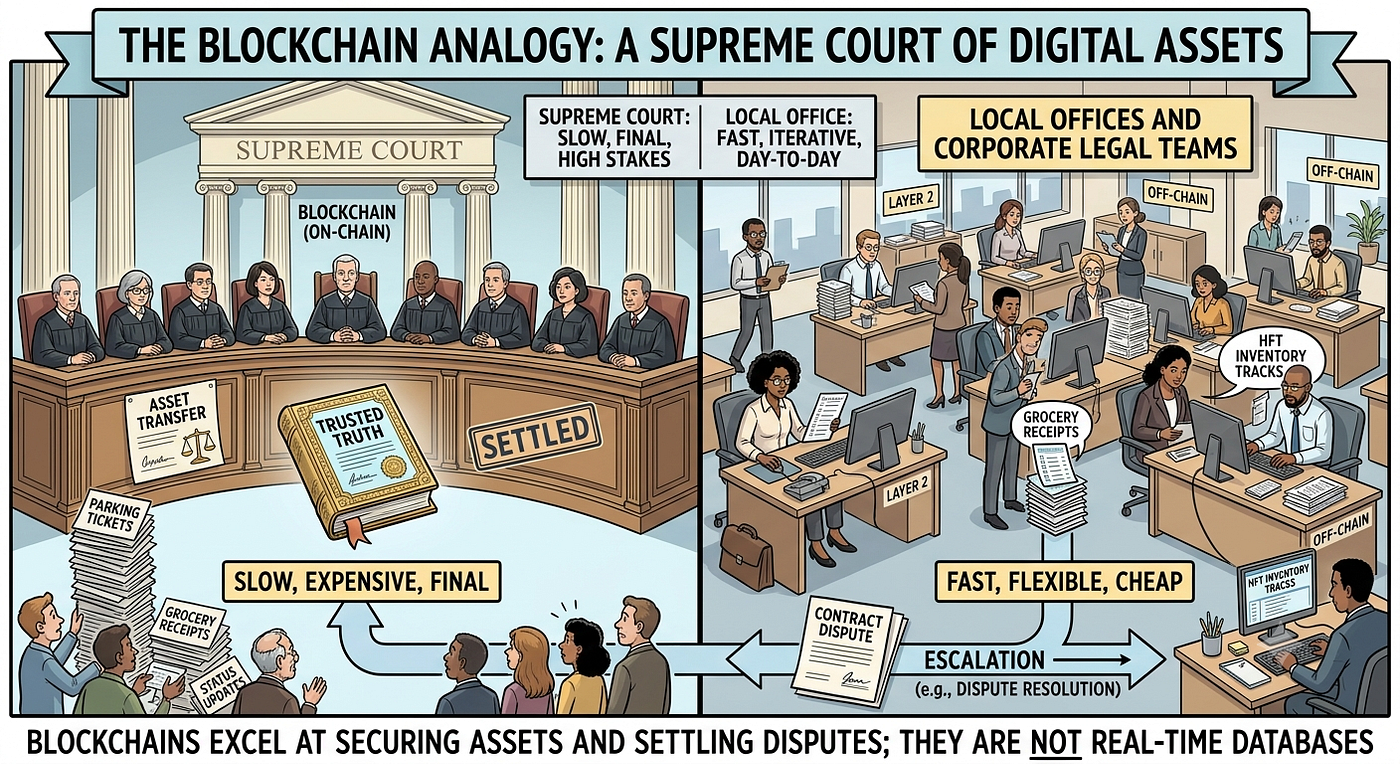
Blockchain Analogy (Credits: Nanobanana 2)
Imagine a country’s Supreme Court.
Its decisions are final, trusted, and incredibly powerful.
But it’s also expensive, slow, and designed to handle only the most important cases.
Now imagine people trying to bring parking tickets, grocery receipts, and every minor disagreement directly to the Supreme Court.
The entire system would collapse.
That’s basically what happens when developers try to run everything on-chain.
Meanwhile, day-to-day operations are handled by local offices and corporate legal teams. They are fast, flexible, and cheap because they don’t require national consensus for every decision.
Only when a dispute becomes critical do they escalate the matter to the Supreme Court.
Blockchains work the same way.
They excel at settling disputes, securing assets, and maintaining a trusted source of truth.
They are terrible at acting like real-time databases.
Trying to build a Twitter clone or a high-frequency inventory tracker entirely on-chain is like asking Supreme Court justices to approve every status update.
Technically possible?
Sure.
A good idea?
Probably not.
5. Strategic Framework: When Does Web3 Actually Make Sense?
The question isn’t:
“Can blockchain do this?”
The better question is:
“Does this problem actually require blockchain?”
A blockchain only makes sense when multiple parties need to coordinate without trusting a central authority.
If a single organization can manage the system efficiently, introducing a public blockchain usually adds unnecessary complexity.
Web3 shines when applications need:
- Trust minimization
- Censorship resistance
- Shared ownership
- Public verifiability
- Permissionless participation
- Composable financial infrastructure
The best candidates are usually low-frequency, high-value operations.
Examples include:
- Asset settlement
- Token issuance
- Governance systems
- Identity registries
- Cross-border coordination
- Multi-party financial agreements
In these scenarios, waiting a few seconds and paying transaction fees are small prices compared to the benefits of a globally verifiable system.
Ultimately, blockchain should not be viewed as a replacement for cloud computing.
They’re solving different problems.
Cloud infrastructure optimizes speed and efficiency.
Blockchains optimize trust.
Modern applications increasingly combine both worlds.
User interfaces, analytics, and heavy computation stay off-chain.
Settlement and critical ownership records stay on-chain.
The future isn’t “everything on-chain”.
And it isn’t “blockchain versus cloud” either.
It’s hybrid architecture.
Because the job of a Web3 engineer isn’t to maximize blockchain usage.
It’s to know exactly when not to use one.
References
- Alharby, M., Aldweesh, A., & Van Moorsel, A. (2018). Blockchain-based smart contracts: A systematic mapping study of academic research (2018). In 2018 International Conference on Cloud Computing, Big Data and Blockchain (ICCBB) (pp. 1–6). IEEE.
- Cabral, D. R. de L., Antonino, P., & Sampaio, A. C. A. (2025). Demystification and near-perfect estimation of minimum gas limit and gas used for Ethereum smart contracts. Journal of Cloud Computing, 14(1), 29.
- Heimbach, L., Babel, K., & Milionis, J. (2026). EVM Workloads in the Wild: Evidence for Multi-Dimensional Gas Metering, State Growth, Delayed Execution, and Parallelism. arXiv preprint arXiv:2606.19869.
- Maxence, L., Bertelle, C., & Duvallet, C. (2025). From Contracts to Code: Automating Smart Contract Generation with Multi-Level Finite State Machines. ArXiv, abs/2507.16276.
- Reno, S., & Roy, K. (2025). CrustChain: Resolving the blockchain trilemma via decentralized storage and proof-of-capacity consensus. PLOS One, 20(8), e0328395.
- Wood, G. (2014). Ethereum: A Secure Decentralised Generalised Transaction Ledger. Ethereum Yellow Paper.
메타데이터
- post_id
- 5dc87f87a201
- slug
- why-everything-shouldnt-be-on-chain-understanding-the-real-limits-of-web3-architecture-5dc87f87a201
- url
- https://medium.com/@herlana312/why-everything-shouldnt-be-on-chain-understanding-the-real-limits-of-web3-architecture-5dc87f87a201
- canonical_url
- https://medium.com/@herlana312/why-everything-shouldnt-be-on-chain-understanding-the-real-limits-of-web3-architecture-5dc87f87a201
- author_url
- https://medium.com/@herlana312
- status
- ok
- fetched_at
- 2026-06-27 08:11:33