Okami: Wayback Wednesday Vol. 17, Part 1
I remember, as a teen, sometime around 2002, “The one I love” by REM came on the radio when a thought suddenly struck me: was older REM…
Okami: Wayback Wednesday Vol. 17, Part 1
I remember, as a teen, sometime around 2002, “The one I love” by REM came on the radio when a thought suddenly struck me: was older REM from the 1980s classic rock yet? I wasn’t sure, but several years later, around 2016, I heard Nirvana on a classic rock station. When did they cross over to classic rock status? I didn’t mean that as a slight either, but growing up in the 1990s, it was always the 60s and 70s that were classic. Now, in 2026, could we consider rock from the 90s as classic rock?
The same question enters my mind with gaming. When does a game turn retro? Is it simply when it is two generations removed from the current console? Is it in the number of years since release? How do remasters and ports impact a game's status as retro (Chrono Cross, for example)?
I touched on the first question, briefly, with my Murmasa: Demonblade review, but the second question is relevant for Okami, an excellent game that I’ve been unsure of including in my Wayback Wednesday series, now at Volume 17! It has a remaster, does that somehow turn back the clock, to any extent, on its retro status? I’ve personally decided to draw a line at 2010, as arbitrary as that may admittedly be. Muramasa was released in 2009, and Okami originally in 2006.
Retro or not, and despite its flaws, Okami has enough going for it to appeal to fans of 90s gaming.
I’ll admit, outside of the Breath of Fire series and earlier Street Fighter or Megaman games, I don’t have a lot of experience with Capcom games, and the few others I’ve tried didn’t stick. I couldn’t get into Monster Hunter or Devil May Cry after recent attempts, so I approached Okami with hesitation. Thankfully, that feeling was misplaced, and this turned out to be a solid game, despite a few glaring flaws.
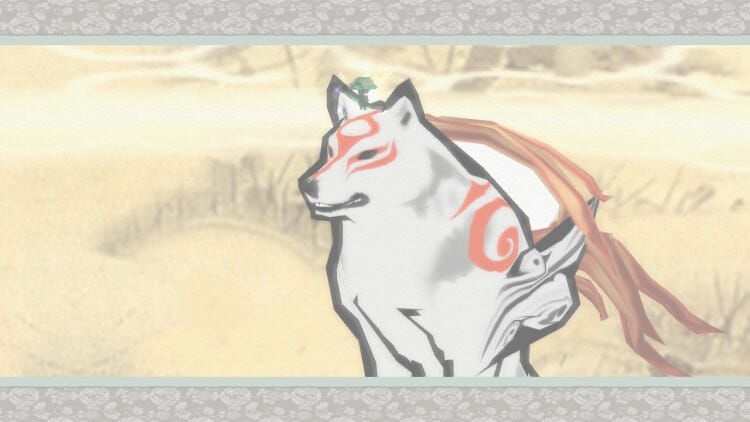
Some gamers want more female protagonists, and that’s cool. I’d love more female heroes! But is anyone like me, and tired of human heroes? Here you play as a cute but powerful wolf! Amaterasu (Ammy) Okami is the goddess of the sun who is awakened from a long sleep by spirits because nasty demons have returned to wreak havoc, including the hideous Orochi.
Although most human characters only see her as a white wolf, and a nuisance at that. However, she yields the celestial brush, which can alter her surroundings, defeat enemies, and solve perplexing puzzles. I loved Greek mythology growing up, but sadly, I don’t know too much about Japanese mythology, which heavily inspires this game. Thankfully, the writers do a great job introducing those concepts in a digestible, well-paced way. Similar to Dragon Quest, the game is loosely split into chapters, with one problem at the center of each chapter, referencing a specific Japanese legend. Get used to Susano, the dunderheaded hero who takes credit for most of Ammy’s victories. Similar to Navi from Ocarina of Time, Ammy has her annoying little sidekick, Issun. You have to tolerate her, though she isn’t as annoying as Mieu from Tales of Abyss.

The world of Nippon is based on ancient Japan, but Okami is presented as a surreal fever dream. If you played with watercolor as a child, there might be some subtle nostalgia seeping through, but it is hard to find a comparison to any other game or cartoon. Perhaps this game could be a distant cousin to something like Legend of Mana, maybe some cel-shaded games from Level 5, but again, it is so different than anything else that it easily stands out. Just know the animation is equal parts trippy, breathtaking, and phantasmagorical (I learned a new word for this review, meaning fantastic or deceptive appearance, as something in a dream or created by the imagination). But it has a pronounced beauty during the more peaceful moments and is nightmarish other times. I read an article by a known movie critic claiming that video games can’t be art, but this game could be used as Exhibit A to prove that statement wrong. Sometimes I felt like I was playing an interactive painting.

The enemies are unique, too, though more variety would have been appreciated, and this extends to the bosses. Not that they aren’t formidable and staggering, because they are, but every single major boss is repeated at least once, and a few three times. There is the infamous boss rush at the end of the game, which repeats the six major bosses. This is unnecessary padding to a game that is already lengthy enough and cheapens the seriousness of every major battle.

The music adds to the mystique with an ethereal, earthy tone. A few gave me Breath of Fire vibes, perhaps not too shocking, seeing as both are Capcom-developed. There are a lot of somber tracks using cello, piano, and violin, but not to worry, plenty of comedic relief and goofier-sounding music play during more light-hearted moments. The music that plays in the field is grand and inspiring. I found the “voice acting” to be horrid and turned it off as soon as I could. It was some kind of whisper, perhaps in Japanese but recorded backward, but it got on my nerves. Some people might say it adds to the lore, but I found it grating and somewhat creepy, and kept it off for the duration.
This game feels like a semi-open-world game in the sense that you can get sidetracked and check every corner to find well-hidden secrets. The sense of freedom is there with so much to find; however, I would not say this qualifies as a full-fledged open-world game, as it is not large enough, not even close. However, that sense of exploration remains.

Like Soul Blazer and especially Terranigma, Nippon needs reviving. In Okami, it is done in an even more distinctive way. Using a paintbrush to color the world with flora and fauna. By completing tasks in the main game or destroying monster gates, the land is slowly revived. Gaining or buying new power-ups and using different brush strokes, 13 total, allows access to new areas to unearth more nature, some very well hidden. For example, Ammy can dig up a hole that reveals a dark plant. Use the bloom brush technique to revive these plants.
But why bother helping these plants? The ever-valuable praise that functions as experience (EXP) in this game. Once enough praise is built up it can be used to extend life, ink (which allows more brush techniques to be used before requiring some downtime and doubles as MP in battle allowing for special attacks), extend hunger meter which I never used even once in the game, and extending the purse that allows more money to be carried, which I leveled up once and that was enough.

Feeding animals also earns praise.
Anyway, these brush strokes allow for direct interaction with the environment by altering it and serve as a unique way to tackle puzzles. You can paint a bridge, a wind gust, a bomb to blow up a weak wall, slow down impossibly fast obstacles, and so on. However, the game can be unforgiving in the heat of the moment. Odd, when the stakes were lower, it always seemed less strict. During a timed side-scrolling digging mini, I found controls to be non-responsive too often, coupled with having to get some bumbling NPC down to the bottom with you. In battle, they serve similar functions: a wind gust to blow a flying enemy down to the ground, a bomb to blow up an enemy’s armor, and so on. Just keep painting, the only limit is when the ink runs out!

However, that is not too much of a worry because, at least for me, I found the battles easy, outside of the very last boss. Most things can be beaten just by mashing one button, and customization is limited to being able to equip a few different weapon combinations. The game is generous with money and items, as well as how many can be held, 99. So, plenty of items that allow for temporary unlimited ink or healing 10 or more health can be purchased.
What isn’t easy are some of the puzzles, not helped by a wretched camera that truly seems to work against you. You have to get used to not having the perfect view a lot of the time; you manage with some awkward angles. It has too much momentum when you don’t need it, but it feels too laggy when you could use something quicker-moving. It is a shame because it hinders what is otherwise a great game. This isn’t Dawn of Mana levels of bad, but it could be so much better. More care should have gone into the camera, especially considering this is an HD remake. On switch R3 can be pushed so the camera is behind Ammy, but this only slightly remedies the issue, some of the time.
This can hurt in some of the platforming puzzles where speed and precise jumps are required. It is frustrating to miss a platform because of a janky camera, only to fall and lose 10 or more minutes of progress. I did some research after beating the game, and one of the puzzles a lot of people complained about was not an issue for me, the one early in the game where you are speeding down a raging river towards a huge drop, and need to connect branches to the log to stop it. Constantly pushing R1 helped to complete this, but I can see how this would pose a huge issue to others.
I had more problems later, in the races, where quick moves and timely camera changes were required to win. I also struggled with the last block puzzle and had to resort to using a camera to record the pattern and copy said pattern after swearing I did it properly, only to fail. It turns out that not only is the proper placement needed, but the correct order as well.

I ran into one soft lock where, after jumping to a new platform, Ammy got stuck, and no amount of jumping or pushing every which way could get her unstuck. I lost about 30 minutes of progress and was nervous to try this section (above) again, but luckily passed with no issue in that area, or for the rest of the game. A Google search after beating the game showed me there seems to be a small chance of soft locking at certain junctures, so just be aware.

Otherwise, this is a good game. Some might call this Zelda, but with a wolf, but that is unfair to both games, as, other than puzzles and manipulating your environment, they are vastly different. Despite shortcomings, like the puzzle and some redundancy in the late game, I’d recommend this to any gamer just for the art. But there is a decent story and wonderful music to accompany it. Especially when on sale on a digital shop (10 euros for me for 35 hours of gaming), it is a no-brainer to pick up!
Wayback Wednesday Volume 1, Part 1: Chrono Trigger and Part 2: Final Fantasy 7.
Wayback Wednesday Volume 2, Part 1: Super Metroid and Part 2: Castlevania: Symphony of the Night.
Wayback Wednesday Volume 3, Part 1: The Legend of Zelda: A Link to the Past and Part 2: Lunar Silver Star Story Complete.
Wayback Wednesday Volume 4, Part 1: Secret of Mana and Part 2: Wild Arms.
Wayback Wednesday Volume 5, Part 1: Illusion of Gaia and Part 2: Grandia.
Wayback Wednesday Volume 6, Part 1: Breath of Fire 3 and Part 2: X-Men Legends.
Wayback Wednesday Volume 7, Part 1: Star Ocean: The Second Story and Part 1: Super Mario RPG
Wayback Wednesday Volume 8, Part 1: Dragon Quest VI and Part 2: Demon’s Crest
Wayback Wednesday Volume 9, Part 1: Suikoden I and Part 2: Jeanne d’Arc
Wayback Wednesday Volume 10: Ranking the first 6 Final Fantasy games
Wayback Wednesday Volume 11, Part 1: Earthbound and Part 2: Valkyrie Profile
Wayback Wednesday Volume 12 Part 1: Legend of Legaia and Part 2: Secret of Evermore
Wayback Wednesday Volume 13 Part 1: Threads of Fate and Part 2: Soulblazer
Wayback Wednesday Volume 14 Part 1: Radiata Stories and Part 2: Robotrek
Wayback Wednesday Volume 15 Part 1: Rogue Galaxy and Part 2: Vandal Hearts
Wayback Wednesday Volume 16 Part 1: Chrono Cross and Part 2: Muramasa: The Demon Blade
메타데이터
- post_id
- 5dca95828a7f
- slug
- okami-wayback-wednesday-vol-17-part-1-5dca95828a7f
- url
- https://medium.com/@carld18/okami-wayback-wednesday-vol-17-part-1-5dca95828a7f
- canonical_url
- https://medium.com/@carld18/okami-wayback-wednesday-vol-17-part-1-5dca95828a7f
- author_url
- https://medium.com/@carld18
- status
- ok
- fetched_at
- 2026-07-10 13:01:02