Stop Asking If Students Can Use AI. Ask What They Should Use It For.
Everyone is debating whether students should be allowed to use AI. Almost no one is asking the more useful question: what should they…
Stop Asking If Students Can Use AI. Ask What They Should Use It For.

Everyone is debating whether students should be allowed to use AI. Almost no one is asking the more useful question: what should they actually use it for?
That distinction matters more than any policy your school could write. Because the real danger is not that AI will write your essay for you. The real danger is that you will let it think for you, and you will not notice the difference until the skill you needed is already gone.
The Wrong Debate Is Winning
Every week, another school district announces a ban. Every week, another op-ed argues AI will destroy critical thinking or, on the flip side, revolutionize education forever. Both camps are arguing about access when the actual problem is philosophy.
The question of whether students can use AI is far less important than whether they know what to protect from it.
Most students, left without guidance, will default to the path of least resistance. That is not a character flaw. That is just how humans work when a powerful tool appears in front of them with no instruction manual for its limits.
There Is a Learning Curve Nobody Is Talking About
When I spent a month handing my morning routine over to AI tools, I learned something that took longer to articulate than it did to experience: the tools that saved me time were the ones I used on tasks where speed was the point. The tools that cost me something were the ones I used on tasks where the struggle itself was the product.
That is the learning curve most people skip. It is not technical. It is philosophical.
You have to decide, before you open any AI tool, which category your task falls into:
- Tasks where output is the goal. Formatting a bibliography, checking grammar, summarizing a dense research paper you already understand, generating a first list of sources to evaluate. These are fine to delegate.
- Tasks where the process is the goal. Forming an opinion, wrestling with a counterargument, deciding what you actually believe about a complex topic, finding your own voice. These are not fine to delegate.
The tragedy is that most students are using AI to skip exactly the second category, which is the one that builds the capability they will need for the next forty years.
The College Essay Is the Perfect Test Case
Here is where this gets concrete. The college application essay (a short personal statement, typically 250 to 650 words, that admissions officers use to understand who you are beyond your grades) is one of the highest-stakes writing moments a young person will ever face.
It is also one of the most tempting to hand over to AI.
The prompt is stressful. The stakes feel enormous. The blank page is brutal. Of course a student will reach for the tool that promises to fill it.
But consider what the admissions officer is actually reading for. They are not grading your grammar. They are trying to hear a specific human being think through something real. The moment AI writes that essay, the one thing the essay was supposed to reveal disappears.
This is not a moral argument against AI. It is a practical one. An AI-written personal statement is a bad strategy, not just a dishonest one.
Why I Built EssayClarity Around This Philosophy
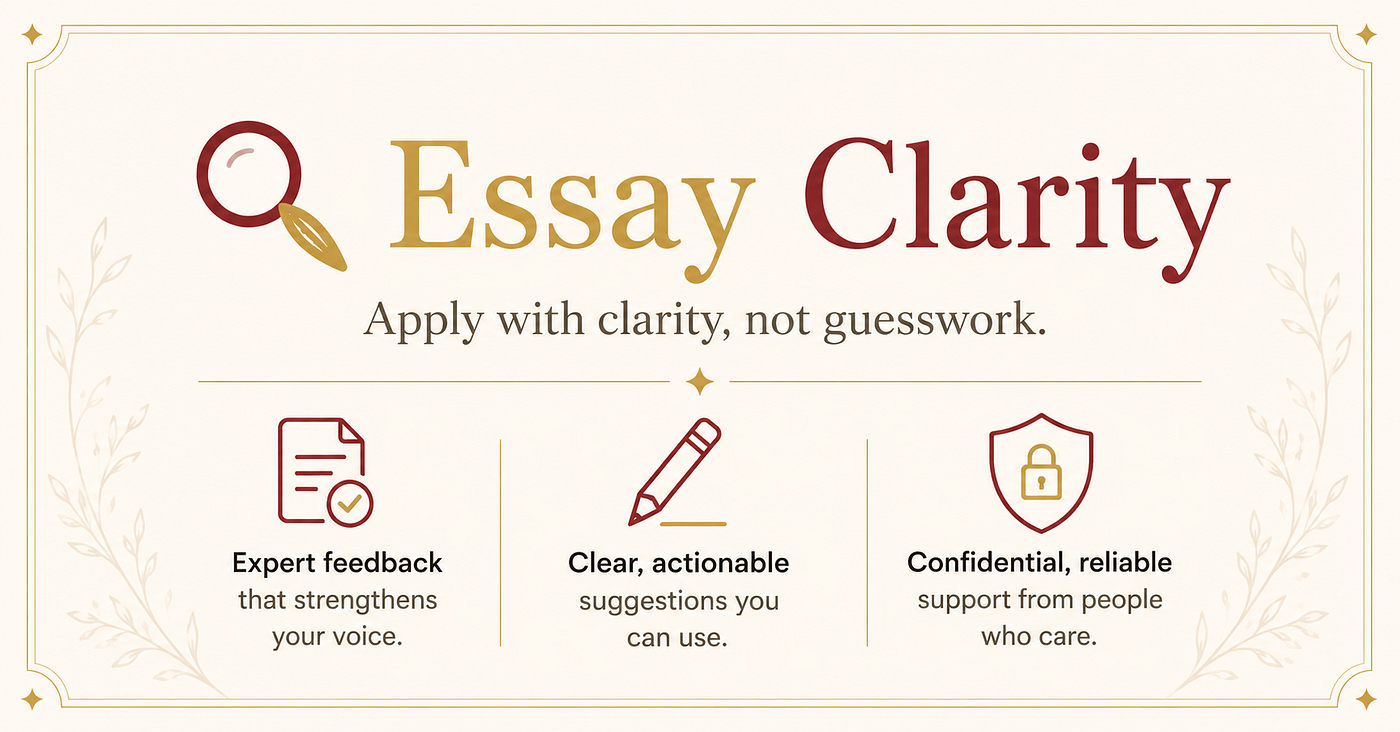
When I started building EssayClarity, I kept coming back to this exact tension. The tool had to be genuinely useful to students under real pressure, without becoming the thing that does the hard part for them.
That forced a clear design principle: EssayClarity should never write for the student. It should make the student’s own thinking clearer.
In practice, that looks like this:
- The tool asks questions that help a student excavate what they actually want to say, before they start writing.
- It gives feedback on drafts that points toward the student’s own voice, not toward a generic polished version.
- It flags where an essay sounds like everyone else, so the student can go back and find what only they could say.
- It does not generate paragraphs. It reflects back what is already there and asks whether that is really what the student means.
The difference sounds subtle. It is not. One approach produces an essay. The other approach produces a writer who also has an essay.
What Protecting Your Thinking Actually Requires
If you are a student reading this, here is the most actionable thing I can offer. Before you open any AI tool for any academic task, ask yourself one question: is the value here in the output, or in the struggle to produce it?
If the value is in the output, use the tool freely. Let it save you time on the mechanical parts. Use that time to do more of the hard thinking.
If the value is in the struggle, close the tool. Sit with the discomfort. Write the bad first draft yourself. Argue with the counterargument until you actually understand it.
This is not about being puritanical about technology. It is about being strategic with your own development. Every time you outsource the hard thing, you get a slightly worse version of yourself on the other side of it.
The Students Who Will Win With AI Are Not the Ones Using It Most
The students who will benefit most from AI are the ones who use it precisely. They will know exactly where to draw the line, and they will draw it consistently.
They will use AI to move faster on the things that do not build them, so they can spend more time on the things that do.
That is not a technical skill. It is a philosophical one. And right now, almost no one is teaching it.
The debate about whether to allow AI in schools is a distraction. The real work is helping students understand what is worth keeping for themselves. That is the curriculum that actually matters, and it has nothing to do with the tools.
메타데이터
- post_id
- 5dcadd7defea
- slug
- stop-asking-if-students-can-use-ai-ask-what-they-should-use-it-for-5dcadd7defea
- url
- https://medium.com/@mhamdouchi/stop-asking-if-students-can-use-ai-ask-what-they-should-use-it-for-5dcadd7defea
- canonical_url
- https://medium.com/@mhamdouchi/stop-asking-if-students-can-use-ai-ask-what-they-should-use-it-for-5dcadd7defea
- author_url
- https://medium.com/@mhamdouchi
- status
- ok
- fetched_at
- 2026-08-01 09:04:44




