Unlocking the Full Potential of Kafka on Kubernetes: Strategies for Bulletproof Performance and…
Hello, everyone in the tech trenches. If you’ve been knee-deep in building data pipelines that handle billions of events every day, you…
Unlocking the Full Potential of Kafka on Kubernetes: Strategies for Bulletproof Performance and Scalability in Massive Streaming Ecosystems.

Hello, everyone in the tech trenches. If you’ve been knee-deep in building data pipelines that handle billions of events every day, you probably know Apache Kafka like the back of your hand. But pairing it with Kubernetes? That’s where things get really interesting, and honestly, a bit thorny. I’ve consulted on setups for some of the biggest names out there, tweaking clusters that process petabytes without skipping a beat. Today, I’m sharing a comprehensive guide that’s drawn from those experiences, updated with the latest insights as of late 2025. We’ll dive into the theory behind Kafka’s distributed nature, explore architectural patterns tailored for Kubernetes, and walk through practical steps to implement them at ultra-large scales. This isn’t just theory; it’s the kind of actionable wisdom that solves real pain points for companies running global, multi-cloud operations. Think of it as your roadmap to turning potential headaches into smooth, efficient streaming machines.
Let’s kick things off by grounding ourselves in why this matters. In a world where real-time data drives everything from recommendation engines to fraud detection, Kafka stands out as the go-to for reliable messaging. But on Kubernetes, which is all about dynamic orchestration, you need to bridge the gap between Kafka’s stateful demands and the platform’s stateless leanings. Get it wrong, and you’re looking at broker crashes, uneven loads, or skyrocketing latencies that can cripple your system. Get it right, and you’ve got a setup that’s resilient, auto-scaling, and ready for whatever traffic spike comes your way.
The Theoretical Foundations: How Kafka’s Design Meshes with Kubernetes?
At its core, Kafka is built around a publish-subscribe model with partitions as the key unit of parallelism and scalability. Each topic breaks down into partitions, which are immutable logs of records distributed across brokers. Replication ensures durability; a replication factor of three, for instance, means each partition has two replicas, guarding against node failures. Leaders handle reads and writes for their partitions, while followers sync data in the background. This setup thrives on consistency and low latency, but it assumes stable hosts and networks.
Enter Kubernetes, the orchestrator that’s revolutionized how we deploy apps. It treats everything as cattle, not pets, meaning pods can be rescheduled or terminated at will. For stateless apps, that’s fine, but Kafka brokers need persistent identities and storage to maintain partition leadership and data integrity. Theoretically, this creates tension: Kubernetes optimizes for resource utilization through bin-packing, where pods share nodes efficiently, but Kafka performs best with isolation to avoid resource contention.
From a systems theory perspective, consider the CAP theorem -consistency, availability, partition tolerance. Kafka leans toward consistency and availability, tolerating network partitions via its ISR (in-sync replicas) mechanism. On Kubernetes, network policies and service meshes can enhance this, but missteps like ignoring pod anti-affinity can lead to correlated failures, where multiple replicas end up on the same node, violating fault tolerance principles.
In large-scale environments, say for a company like a major e-commerce giant processing trillions of events annually, this theory translates to practice through careful resource modeling. Brokers consume CPU for request handling and replication, memory for caching and buffering, and disk for log persistence. Overprovisioning leads to waste; underprovisioning causes thrashing. The key is balancing these with Kubernetes’ cgroups, which enforce limits at the container level, ensuring predictable performance even under bursty loads.
One evolving aspect is the shift from ZooKeeper to KRaft mode, which became production-ready around Kafka 3.0 and is now the default in 2025 deployments. KRaft embeds metadata management into Kafka itself using a Raft consensus protocol, eliminating ZooKeeper’s overhead. Theoretically, this simplifies the stack, reduces latency from external coordination, and improves scalability for massive clusters. In Kubernetes terms, it means fewer pods to manage and less state to persist, making your architecture leaner.
Architectural Blueprints for Kafka on Kubernetes at Scale.
Designing a Kafka cluster on Kubernetes starts with embracing stateful workloads. The foundational piece is using ordered, stable pod management to assign unique broker IDs based on pod ordinals -like broker 0, 1, 2. This ensures consistent discovery, crucial for leader elections and client connections.
For architecture, picture a multi-layered setup: At the bottom, dedicated nodes or node pools labeled for Kafka to isolate them from noisy workloads. This prevents CPU steals or memory pressure from other services. On top, define storage with high-throughput classes, preferring SSD-backed volumes with provisioned IOPS to handle Kafka’s sequential writes and random reads during recovery.
In KRaft mode, the architecture simplifies further. Brokers form a quorum for metadata, so you deploy a combined controller-broker setup for smaller clusters or separate them for giants. This reduces the blast radius of failures; if a controller pod goes down, the Raft protocol elects a new leader swiftly.
Scaling architecture involves both vertical and horizontal strategies. Vertically, size brokers generously -aim for 8 to 16 gigabytes of RAM and 4 to 8 CPU cores per broker in baseline configs, scaling up for high-throughput topics. Horizontally, add brokers dynamically, but with care: Trigger partition reassignments to distribute load evenly, avoiding hotspots where one broker shoulders too many leaders.
For ultra-large scales, incorporate tiered storage, a feature matured by 2025 in Kafka 3.8 and beyond. This offloads cold partitions to object stores like S3, freeing local disks for hot data. Architecturally, this hybrid model cuts costs while maintaining performance, ideal for archival-heavy workloads in finance or IoT.
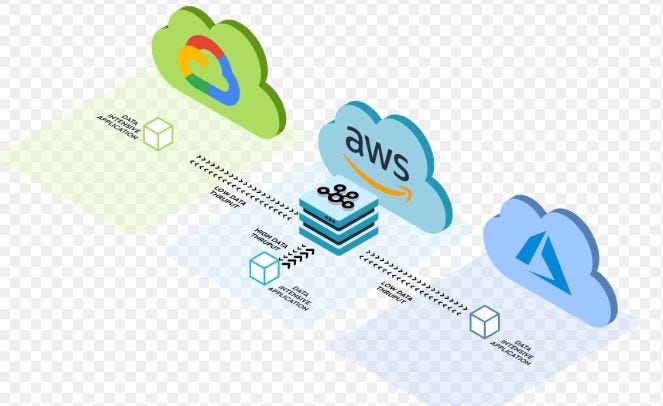
Multi-cloud adds another layer. Architect for it by using cluster linking, where independent Kafka clusters in different clouds replicate topics asynchronously. This setup tolerates inter-cloud latencies, ensuring data sovereignty and disaster recovery. Tools like MirrorMaker or native Cluster Linking handle the replication, with offsets preserved for seamless failover.
Security architecture can’t be an afterthought. Enforce mTLS for broker-client communication, integrate with Kubernetes secrets for credential rotation, and use network policies to whitelist traffic. In large orgs, role-based access via Kafka’s ACLs ties into Kubernetes RBAC, creating a unified auth plane.
Practical Implementation: Step-by-Step Guidance.
Implementing this starts with cluster preparation. Provision your Kubernetes environment-whether EKS, GKE, or AKS -with sufficient nodes. Create a dedicated namespace for Kafka to encapsulate resources and apply quotas: Limit total CPU to prevent overcommitment, say capping at 80 percent of node capacity.
Next, label nodes specifically for Kafka workloads. This involves tainting them so only tolerant pods land there, ensuring isolation. For storage, define classes with fast provisioning; in practice, target 10,000 IOPS per volume to match Kafka’s write demands during peaks.
Deploying the cluster: Use an operator like Strimzi, which abstracts complexities. It handles StatefulSets internally, assigning persistent volumes and configuring headless services for peer discovery. Start with three brokers for a basic HA setup, setting replication factors to at least three. Configure broker properties for performance: Tune the number of network threads to match CPU cores, increase socket buffers for high-bandwidth links, and set log segment sizes to balance compaction efficiency with recovery time.
For resource management, request minimum CPU and memory to guarantee allocation, while setting limits slightly higher to allow bursts. In practice, monitor for eviction risks; if a broker hits limits, Kubernetes may throttle it, causing lag. Adjust JVM heap to leave headroom for OS page cache -typically 50 percent of container memory for heap, the rest for caching.
Handling pod terminations gracefully is key. Implement disruption budgets to ensure no more than one broker goes down at a time, giving Kafka time to rebalance leaders. During scaling, add brokers one by one, then use rebalancing tools to redistribute partitions, monitoring for under-replicated ones.
In multi-cloud scenarios, set up separate Kubernetes clusters per cloud, then configure linking. Expose external advertisers for cross-cloud access, using global DNS for resolution. Practically, test failover by simulating outages; ensure consumers can switch clusters without data loss.
Performance tuning in action: Profile your workload first. For producer-heavy systems, optimize batch sizes and compression. On the consumer side, adjust fetch sizes to reduce round trips. Use monitoring to spot issues-track ISR shrinks, which signal replication lags, and act by isolating slow networks or upgrading hardware.
For large-scale ops, integrate observability. Deploy metrics exporters to feed Prometheus, graphing request latencies, throughput, and disk utilization. Set alerts for anomalies, like when consumer lag exceeds thresholds, triggering auto-scaling.
Security implementation: Rotate certs regularly via operators, enforce encryption in transit, and audit logs for compliance. In practice, for GDPR-heavy environments, enable topic-level ACLs to restrict access.
Cost optimization ties it all together. Use spot instances for non-critical brokers, but with affinity rules to maintain quorum. In multi-cloud, leverage pricing arbitrage, running compute-intensive parts on cheaper providers.
Advanced Considerations for Enterprise-Grade Deployments.
Pushing boundaries, consider hybrid modes where some topics use KRaft for metadata but fallback to ZooKeeper for legacy compatibility during migrations. Architecturally, this phased approach minimizes risk in massive systems.
Disaster recovery: Regularly snapshot volumes and test restores. In multi-region setups, use geo-replication with low RPO (recovery point objective) targets.
Edge cases like network partitions: Kubernetes’ service meshes can add retries, but tune Kafka’s timeouts to align, preventing false failovers.
Finally, governance: Document configs in version control, automate deployments via CI/CD, and conduct chaos tests to validate resilience.
Wrapping It Up: Your Path to Kafka Mastery on Kubernetes.
There you have it -a deep, holistic view into making Kafka thrive on Kubernetes. From theoretical underpinnings to architectural designs and hands-on implementation tips, this guide equips you for the toughest challenges in large-scale streaming. I’ve seen these strategies turn chaotic setups into powerhouses, saving companies fortunes in downtime and inefficiency. If you’re architecting something similar, I’d love to swap stories in the comments. Keep building, and remember: In data streaming, stability is the ultimate competitive edge.
메타데이터
- post_id
- 5de1e586fe2a
- slug
- unlocking-the-full-potential-of-kafka-on-kubernetes-strategies-for-bulletproof-performance-and-5de1e586fe2a
- url
- https://medium.com/@sachinrajakaruna95/unlocking-the-full-potential-of-kafka-on-kubernetes-strategies-for-bulletproof-performance-and-5de1e586fe2a
- canonical_url
- https://medium.com/@sachinrajakaruna95/unlocking-the-full-potential-of-kafka-on-kubernetes-strategies-for-bulletproof-performance-and-5de1e586fe2a
- author_url
- https://medium.com/@sachinrajakaruna95
- status
- ok
- fetched_at
- 2026-08-07 05:45:22