How GenAI Is Reshaping Terrorist and Violent Extremist Glorification Online
Trigger Warning: This analysis contains references to real-world acts of violence, victims of terrorist attacks, and online violent…
How GenAI Is Reshaping Terrorist and Violent Extremist Glorification Online
Trigger Warning: This analysis contains references to real-world acts of violence, victims of terrorist attacks, and online violent extremist propaganda. Reader discretion is advised.
For years, terrorist and violent extremist (TVE) supporter networks relied on a familiar online playbook: circulating manifesto excerpts, creating tribute video montages, and sharing edited or gamified versions of attack livestreams to glorify perpetrators and celebrate acts of ideologically motivated violence.
Generative AI is changing that.
Alice has identified a growing trend on mainstream platforms in which TVE supporter networks are using popular AI animation and image-to-video tools to create synthetic entertainment content that glorifies attackers and reframes acts of real-world violence as culturally trending.
The shift matters because it fundamentally changes how violent extremist propaganda is produced, distributed, and consumed online.
The result is a new generation of glorification content that mimics gaming culture, meme aesthetics, and social media influencer trends. It is designed not only to reinforce violent extremist ideological narratives, but also to entertain, engage and reach broader audiences.
And in doing so, it lowers the psychological and technical barriers between mainstream internet culture and harmful extremist narratives, particularly for young audiences.
AI-generated attacker glorification: the rise of “rampage edits”
On popular mainstream platforms, Alice has identified multiple instances of AI-generated videos celebrating perpetrators of terrorist and violent extremist attacks, often labelled as “rampage videos”. This trend builds upon the “Saint Culture” — or the sanctification of attack perpetrators — which first emerged within fringe violent far-right extremist online communities.
AI edits observed often depict attackers dancing, DJing, or performing trending dances in front of real attack locations, while death tolls and coded references to targeted communities are displayed on-screen. This is harmful content that blends viral platform-specific aesthetics with gaming culture and meme formats that increasingly resemble the type of content young users consume daily.
This convergence creates a key advantage for TVE supporter networks, by increasing engagement potential and making harmful narratives less visually distinct so potentially more difficult for younger users to identify as violent extremist content.
The speed at which this content emerges is particularly notable.
Following the recent San Diego mosque attack, Alice detected AI-generated videos depicting the two alleged perpetrators performing celebratory dances within hours of the attack, demonstrating how rapidly and easily GenAI tools can be leveraged to produce glorification content.
Importantly, Alice observed this trend across the ideological spectrum, including within white supremacist, militant accelerationist, violent Islamist, and non-ideologically aligned online ecosystems, suggesting that “rampage edits” are increasingly becoming a cross-community online behavior rather than a tactic confined to the single violent far-right extremist ecosystem.

GenAI animation of one of the Crocus City Hall attack perpetrator depicted as a knight with the attack scene in the background
These videos, which are designed to celebrate real-world violence, mock victims, and elevate attackers into iconic figures, may function as prominent radicalization vectors among young online users.
Gamification is being used to normalize mass violence
Alice also identified extensive use of gamified symbolism embedded within AI-generated content glorifying attack perpetrators. Most commonly, casualty figures were displayed prominently using gaming-style notation.
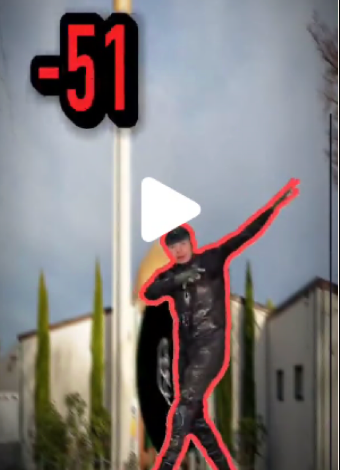
AI-animation of the Christchurch attack perpetrator dancing with the Al-Noor Mosque in the background. “-51” is a coded reference to the 51 victims of the attack.
Additional symbols and emojis were used to encode references to targeted communities:
- Pride flags to reference LGBTQ+ victims
- Menorah emojis to reference Jewish targets
- Chocolate bar emojis used as coded references to Black victims
These symbolic shortcuts function as in-group signaling mechanisms. To outside audiences, the content may appear confusing, ironic, or intentionally absurd. To violent extremist supporter communities, however, the references are immediately recognizable.
This reflects a broader pattern consistently observed across violent Islamist and violent far-right extremist online ecosystems: the gamification of violence.
Attackers are transformed into avatars. Casualty counts become scoreboards. Real-world violence is reframed as participatory internet culture. In some cases, content explicitly drew on mainstream internet culture references like “GOAT” (“Greatest of All Time”) to express admiration and celebrate the Halle and Poway synagogue attacks perpetrators.
Repeated exposure to such content may contribute to desensitization, reinforce harmful beliefs, and model behaviors targeted at specific communities.
AI-generated ambiguity is also becoming a moderation evasion tactic
The content identified by Alice also demonstrates how GenAI is being combined with intentional ambiguity to complicate moderation and detection efforts.
Many videos included disclaimers such as:
- “AI-generated, fake actor and location”
- “All fake and jokes”
- “I do not support”
Despite these disclaimers, the surrounding imagery, symbolism, captions, and contextual references clearly celebrate perpetrators and attacks.
This tactic mirrors a broader evolution in violent extremist communication online.
Rather than distributing overt grievances, users often rely on irony, layered references, coded language, and aesthetic ambiguity to obscure intent while still signaling ideological alignment to in-group audiences.
This ambiguity is strategic, intended to obscure harmful intent and manipulate platform moderation systems to increase content reach and longevity.
What comes next
As the technical barriers to AI content creation continue to fall, the challenge for online platforms will be identifying increasingly sophisticated and obscure forms of extremist violence glorification that embed references to real-world attacks, perpetrators, and victims within content that outwardly resembles ordinary internet entertainment.
For social media platforms, this also requires moderation systems to better account for symbolic and coded references linked to terrorist and violent extremist attacks, including attack dates, victim identities and casualty figures used as symbolic numerical and visual shorthands.
As these tactics continue to evolve, Alice supports platforms and organizations through advanced threat intelligence, behavioral detection, and network analysis capabilities designed to identify emerging terrorist and violent extremist trends, uncover coordinated harmful activity, and detect evasive AI-generated propaganda before it scales across online ecosystems.
Learn more about our Intelligence offerings at Alice.io or speak with an expert today.
메타데이터
- post_id
- 5e06bd6e3b6c
- slug
- how-genai-is-reshaping-terrorist-and-violent-extremist-glorification-online-5e06bd6e3b6c
- url
- https://medium.com/intelligence-alice/how-genai-is-reshaping-terrorist-and-violent-extremist-glorification-online-5e06bd6e3b6c
- canonical_url
- https://medium.com/intelligence-alice/how-genai-is-reshaping-terrorist-and-violent-extremist-glorification-online-5e06bd6e3b6c
- author_url
- https://medium.com/@louisem_31346
- status
- ok
- fetched_at
- 2026-06-21 07:44:09