Your Test Automation May Be Revealing Team Problems
What fragile tests, knowledge silos, and automation delays can tell us about the way we work
Your Test Automation May Be Revealing Team Problems
What fragile tests, knowledge silos, and automation delays can tell us about the way we work
Many automation problems are not purely technical. They are often symptoms of deeper issues involving communication, onboarding, collaboration, knowledge sharing, and decision-making.
Automation frameworks occupy a unique position within software organizations. They touch development, testing, environments, data, tooling, and delivery. Because they sit at the intersection of so many activities, they often reveal organizational stress before it becomes visible elsewhere.
Automation frameworks often act as mirrors, reflecting how teams communicate, share knowledge, make decisions, and collaborate.
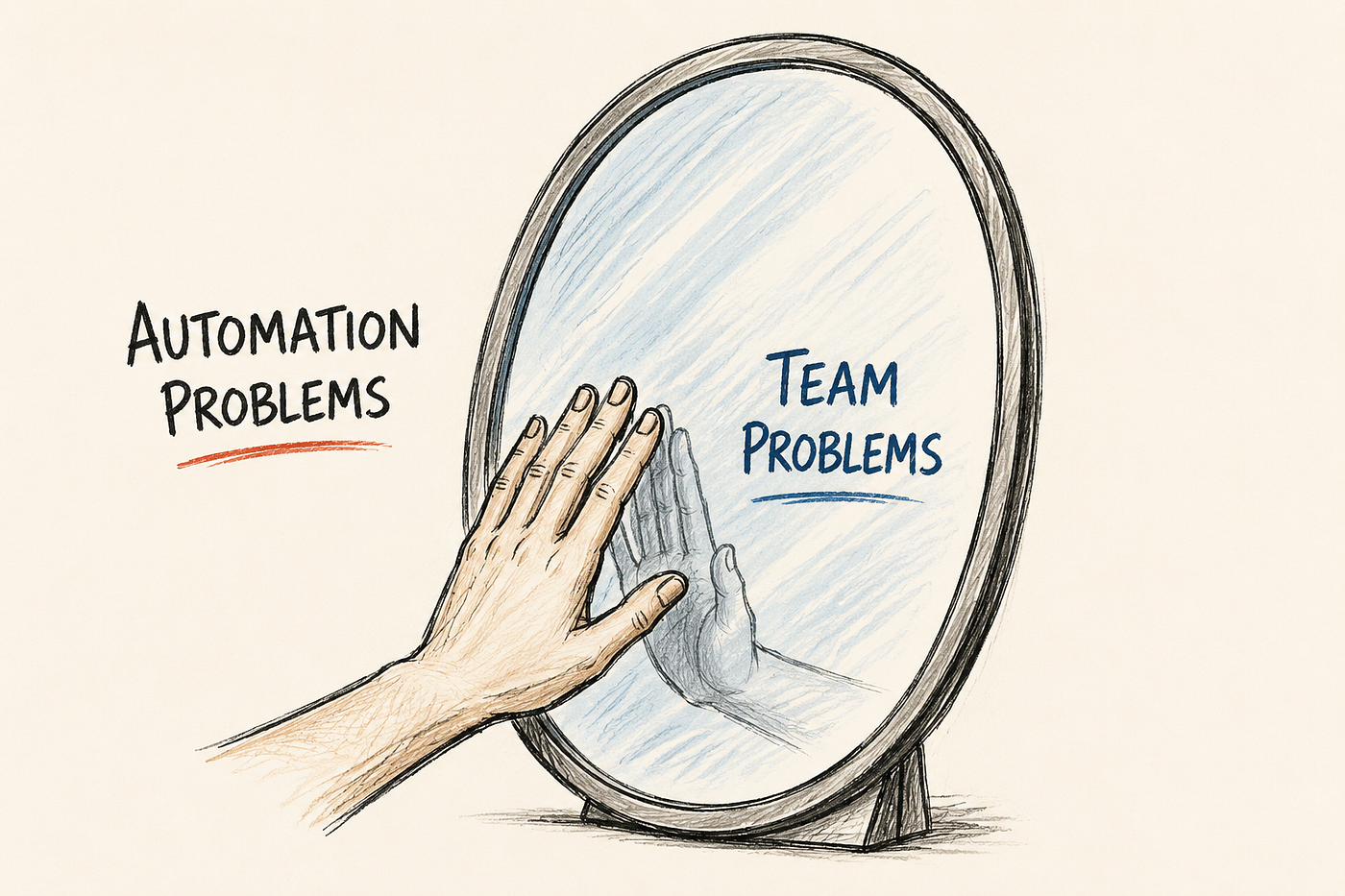
The framework may not be revealing a testing problem. It may be reflecting a team problem.
In many cases, the framework isn’t the problem. It’s showing us one.
The Long Path Problem
Imagine an automated test that requires navigating through multiple screens, creating records, configuring settings, and performing several setup steps before reaching the scenario that actually matters.
The automation engineer suspects there must be an easier way.
Perhaps a feature flag could bypass some setup.
Perhaps test data could be created through an API.
Perhaps a developer could expose a simpler route to the same outcome.
But instead of starting that conversation, the team accepts the complexity and continues automating the longer path.
The automation becomes slower. Execution becomes less reliable. Maintenance effort increases.
Automation Signal:
The test is unnecessarily complex.

Possible Team Signal:
The team is not collaborating on testability.
Highly collaborative teams often ask a different question: Do we really need to test this the hard way?
The BDD Nobody Uses Problem
Many teams adopt a BDD layer with the expectation that business analysts, product owners, or other non-technical stakeholders will contribute directly to automated tests.
The idea sounds compelling.
A shared language.
Business-readable scenarios.
Broader collaboration.
Years later, the automation team may discover that testers still write the automation, engineers still maintain the automation, and business stakeholders rarely interact with the feature files.
Yet the framework continues carrying the additional complexity.
Automation Signal:
A layer of complexity that provides little practical value.

Possible Team Signal:
Decisions are based on assumptions that were never re-evaluated.
The issue may not be the BDD framework itself.
The issue may be that the team continues optimizing for a collaboration model that never materialized.
Automation frameworks often become a fossil record of organizational assumptions that were never revisited.
The New Tester Problem
A new tester joins the team.
Months later, they still hesitate to make framework changes. They avoid touching certain components and depend heavily on senior team members for guidance.
The common conclusion is that they need stronger automation skills.
Sometimes that’s true.
But automation may be exposing a different problem.
Automation Signal:
New testers struggle to contribute.

Possible Team Signal:
Knowledge transfer depends on tribal knowledge rather than intentional onboarding.
Many automation frameworks accumulate years of decisions, conventions, shortcuts, and historical context.
Without onboarding guides, architecture documentation, example patterns, mentoring, or framework walkthroughs, new team members often spend months trying to reverse-engineer the system.
The issue may not be a lack of capability.
The issue may be that success depends on information that was never intentionally transferred.
The Framework Expert Problem
Every automation team seems to have one.
The person who understands the framework.
The person everyone calls when a build breaks.
The person who knows why a particular design decision was made five years ago.
The person nobody wants to lose.
Automation Signal:
Only one engineer can make changes safely.

Possible Team Signal:
Knowledge is concentrated rather than distributed.
The framework is revealing a team resilience problem.
If one departure creates significant operational risk, the automation is reflecting something important about how knowledge is shared.
The Coding-Only Automation Problem
Some automation teams gradually begin treating automation engineering as a programming activity rather than a testing activity.
Framework quality improves.
Code quality improves.
Execution speed improves.
Yet something else starts disappearing.
Test thinking.
Over time, automation engineers may become increasingly focused on implementing predefined scenarios rather than questioning them.
The automation faithfully executes every step.
Nobody asks whether those steps still represent the most important risks.
Nobody challenges the assumptions behind the test.
Nobody questions whether the scenario still reflects how users actually behave.
Automation Signal:
Tests execute exactly as designed.

Possible Team Signal:
The team values implementation more than investigation.
This is rarely an individual problem.
It is usually a cultural one.
When automation specialists are viewed primarily as coders, teams often underinvest in exploratory testing, risk analysis, product understanding, and critical questioning.
The strongest automation engineers are not simply people who can write code.
They are people who understand what deserves to be tested in the first place.
The Experimentation Problem
A team encounters a recurring challenge.
Perhaps they need a new automation library, a reporting tool, a visual testing solution, or simply a small utility that could eliminate hours of manual effort.
The technical solution is often obvious.
The difficult part is obtaining permission to try it.
Requests move through approval boards.
Security reviews.
Procurement processes.
Architecture committees.
Budget discussions.
Months pass before a team can evaluate whether the idea has value.
Eventually many teams stop proposing improvements altogether.
Automation Signal:
Teams continue using inefficient approaches even when better solutions exist.

Possible Team Signal:
The organization values control more than experimentation.
The issue is not that governance exists.
Large organizations need governance.
The issue appears when the cost of experimentation becomes so high that teams stop experimenting.
One of the strongest indicators is when engineers begin saying:
It’s easier to work around the problem than to get approval for a solution.
At that point, the automation framework is revealing something important about the organization’s learning culture.
Final Thoughts
The examples above may look like automation problems.
But most are not fundamentally about automation.
They are about
Collaboration.
Knowledge sharing.
Onboarding.
Assumptions.
Testing culture.
Learning culture.

Automation Problem → Team Dynamic → Organizational Behavior
Automation frameworks are unusual systems. They sit at the intersection of development, testing, environments, data, tooling, and delivery.
Because they touch so many parts of an organization, they often feel organizational stress before it becomes visible elsewhere.
When automation starts struggling, the most valuable question may not be:
How do we fix the framework?
It may be:
What is the framework trying to tell us about the way we work?
Sometimes the most important thing automation reveals has nothing to do with automation at all.
메타데이터
- post_id
- 5e16d498958f
- slug
- your-test-automation-may-be-revealing-team-problems-5e16d498958f
- url
- https://aiqualityengineer.cc/your-test-automation-may-be-revealing-team-problems-5e16d498958f
- canonical_url
- https://aiqualityengineer.cc/your-test-automation-may-be-revealing-team-problems-5e16d498958f
- author_url
- https://medium.com/@swatipriyaseela
- status
- ok
- fetched_at
- 2026-07-09 05:26:43