The Birth of Conscious Order
Sailko — Nymphaeum of Trajan (Ephesus, Turkey), Wikimedia Commons (CC BY-SA 3.0).
The Birth of Conscious Order
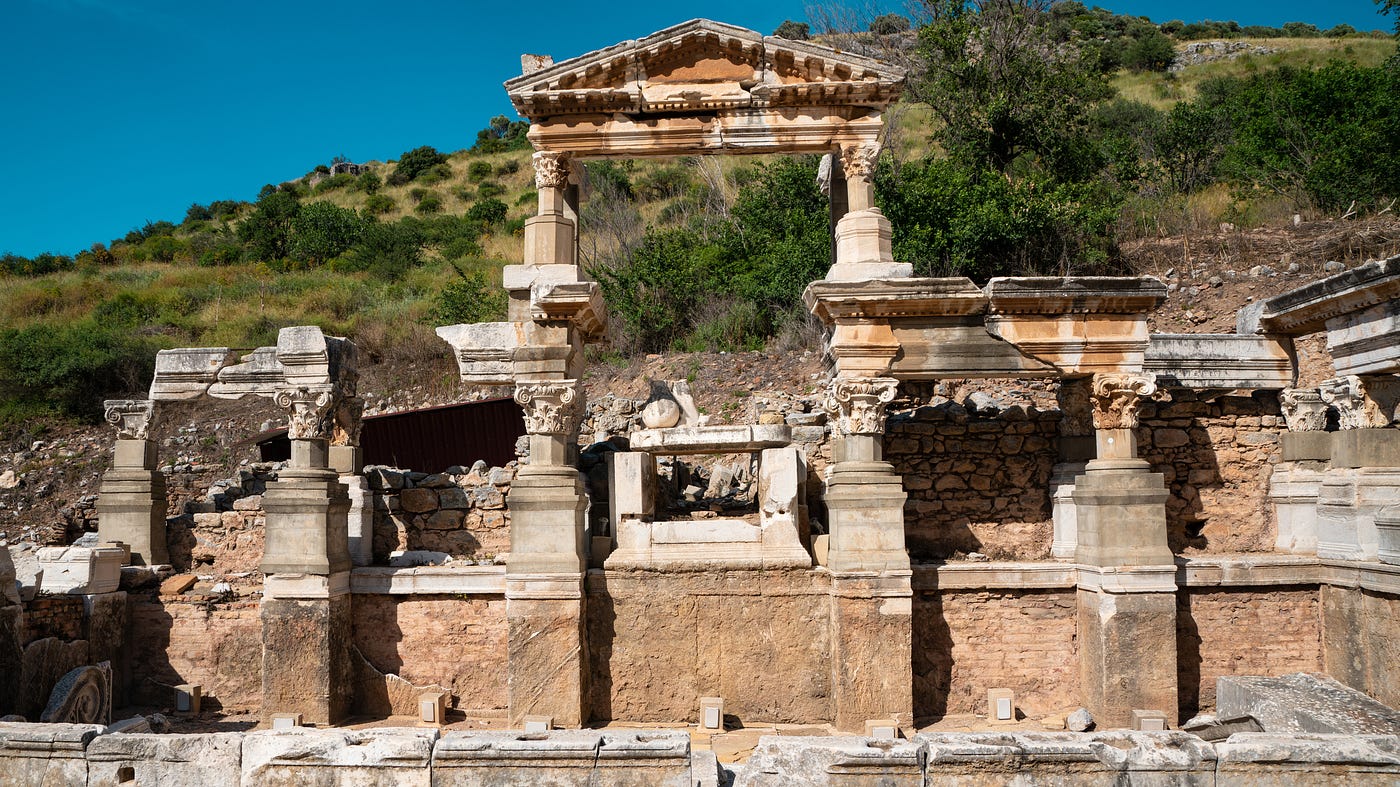
Sailko — Nymphaeum of Trajan (Ephesus, Turkey), Wikimedia Commons (CC BY-SA 3.0).
Prehistory was the time when humanity reproduced without experiencing it as a problem. History becomes conscious when humanity begins to sense that, without order, continuity is not guaranteed.
Before cities, before archives, before power had a name, continuity was a brute phenomenon. Humans were born because desire and necessity pushed them; because the tribe had to grow or disappear; because life was short and death was normal. There was family, there were roles, there was belonging — but not as a project: as custom. Social organization was real, but it was not articulated. It was not an idea; it was inertia.
In that world, the future existed only as biological extension. No one defended it as a principle, because no one conceived it as a problem. There was no theory of continuity. There was survival.
The decisive difference appears when human beings stop living entirely within the system and begin to see it from the outside — when society becomes complex enough to fracture, and conscious enough to ask what holds it together.
This is not a technological leap, but a mental one: the moment humanity understands that a civilization does not endure by instinct, but by architecture.
At that point, history in the strict sense becomes visible — when order ceases to be repetition and becomes obligation.
In different places, thinkers emerged who asked the same question in different words: what prevents a society from disintegrating? What preserves continuity when chaos stops being an external threat and becomes an internal possibility?
In Greece, the city-state was no longer an extended tribe; it was a convergence of interests, tensions, ambitions, generations, and moral conflicts. In China, the territory was no simple community; it was a mosaic of fragile loyalties, power struggles, wars, and ruptured social bonds. In both cases, civilization confronted the same dilemma: when order becomes fragile, life in common is no longer natural. It must be built.
The importance of figures such as Socrates and Confucius does not lie in their famous phrases or cultural prestige, but in the kind of obsession they embody: the conviction that society is a system. That mere existence is not enough — it must be sustained. And that without a framework of duty, transmission, and authority, the whole dissolves.
That intuition — society as a system — is the silent origin of everything that followed.
A society understood as a system implies something stark: that the individual is not the center, but a part. That every role has a function. That authority is not merely force, but custody. That the state does not exist to satisfy desires, but to prevent collapse. That the family is not an emotional option, but an infrastructure of continuity. And that the future, in order to exist, must be protected even when the present does not wish to do so.
There is no need to idealize that order to recognize its power. It was unjust, hierarchical, and often cruel. But it was built to endure. And that is not a moral detail — it is a structural property.
Modernity often tells its story as a progressive liberation of the individual from tradition. But that narrative omits a more uncomfortable fact: for millennia, what kept civilization alive was not the pursuit of personal fulfillment, but the capacity to reproduce and transmit. And that capacity depended on stable structures, not on preferences.
In the ancient world, the role of man, the role of woman, the place of the state, and the place of the child were not merely “customs.” They were components of an architecture of continuity. Their justice could be debated; their function could not.
This is why, when those thinkers spoke of order, they did not speak of stillness. They spoke of the minimal condition for tomorrow to exist — an equilibrium defended not by nostalgia, but by necessity. If the whole breaks, no freedom survives, because there is no stable world left to sustain it.
In this sense, classical civilization was not naïve. It knew the future was not automatic. It knew chaos was not an accident, but the natural state to which everything returns when the framework that contains it weakens.
This awareness, precisely, is what makes intelligible something often presented as a purely technical turn: the beginning of the Industrial Revolution.
The Industrial Revolution did not begin as a gesture against the old order. In its origin, it was a wager to reinforce it — a way to expand capacities — production, energy, transport, organization — in order to sustain growing societies without falling into hunger, scarcity, and fragility. It was a solution to real limits, not a moral manifesto.
Industrialization is often imagined as the birth of modern greed. But its first face was different: discipline, foresight, construction, continuity. To industrialize requires stability. To build factories requires a state capable of imposing rules. To plan requires a horizon. To sustain the effort of generations requires the idea of a future.
In its initial phase, industrialization did not destroy the human system it inherited; it used it. It functioned because it rested on a social base that had already understood, for centuries, the value of order.
The family remained the central unit, even as its forms began to change. Work — though displaced from field to factory — could still organize a predictable life. The state — by interest or conviction — still thought in terms of continuity. And the child, with all the contradictions of each era, remained the concrete figure of tomorrow.
This, to a large extent, is what early industrialization protected: not tenderness, but transmission. Not equality, but stability. Not individual freedom, but collective continuity.
Here lies the paradox that is difficult to accept today: the modern world was not born as an immediate rupture of order; it was born as its refinement.
The rupture came later.
It came when the economy ceased to be a means within the system and became the supreme criterion that reordered everything else — when economic logic — efficiency, mobility, substitution, optimization — began to demand that human life adapt to it, rather than exist in service of life.
At that point, the economy does not merely influence society; it governs it.
And when a single criterion governs, everything else becomes secondary. Bonds become costs. Stability becomes rigidity. Commitment becomes friction. The child becomes an obstacle.
This did not happen suddenly, nor by conspiracy. It happened by internal coherence. Every system, when it discovers it can push a little further, does so. And human beings have an ancient and dangerous tendency: to confuse capacity with obligation. If we can accelerate, we accelerate. If we can optimize, we optimize. If we can make the world more flexible, we do so — even if that flexibility ends up breaking the structure that sustains it.
This is not about demonizing wealth or denying that industrialization produced real benefits. To do so would be absurd: the reduction of material suffering in parts of the world is a historical fact. But there is a harsher question, one rarely asked because it is too uncomfortable:
What remains of a system when its success destroys the conditions of continuity that made it possible?
Here a dogma characteristic of our age appears — a dogma not proclaimed, but obeyed: the idea that growth is a virtue in itself. The belief that every limit is an error. The faith that the future will be better by definition, and that if something breaks along the way, it will be repaired by the same movement that broke it.
That dogma has something religious about it — not because it invokes gods, but because it demands obedience without final questioning. Because it rejects moral evaluation of the ultimate outcome. Because it turns the system into an end, rather than an instrument.
And when a system becomes an end, it can no longer be judged by what is essential: does it make life possible? Does it make tomorrow possible? Does it make continuity possible?
If the result of a model is a world in which the species moves toward a sustained loss of continuity — not through war or plague, but through exhaustion and renunciation — then the question is no longer whether the system produces wealth. The question is whether that wealth had meaning.
This is not an accusation. It is a criterion.
For centuries, the most lucid civilizations understood something elementary: society must be organized to endure. Not to be desired. Not to be excused. To endure.
Late modernity is the first historical stage that attempts to sustain itself without that premise. It seeks freedom without structure, continuity without duty, a future without cost, growth without limit. And in doing so, it displaces the moral axis that once sustained civilization — the obligation of the present to answer to tomorrow.
It is within this displacement that the fate of the child is decided. Not because anyone hates the child, but because the system no longer needs the child as its center. It tolerates the child as a choice, manages the child as a variable, postpones the child as a project.
Prehistory reproduced by instinct. History reproduced by order. Our era attempts to live without either.
From this point forward, what matters is neither nostalgia nor morality, but architecture.
There was a time when the present organized itself for the sake of tomorrow.
That time was sustained by order.
메타데이터
- post_id
- 5e1ecb8741f1
- slug
- the-birth-of-conscious-order-5e1ecb8741f1
- url
- https://medium.com/enlivenment/the-birth-of-conscious-order-5e1ecb8741f1
- canonical_url
- https://medium.com/enlivenment/the-birth-of-conscious-order-5e1ecb8741f1
- author_url
- https://medium.com/@max.vega.author
- status
- ok
- fetched_at
- 2026-06-11 05:11:55