MEXC Exchange Listing Explained (2026): Requirements, Liquidity & Why Most Projects Struggle After…
Most crypto founders focus heavily on securing an exchange listing.
MEXC Exchange Listing Explained (2026): Requirements, Liquidity & Why Most Projects Struggle After Listing
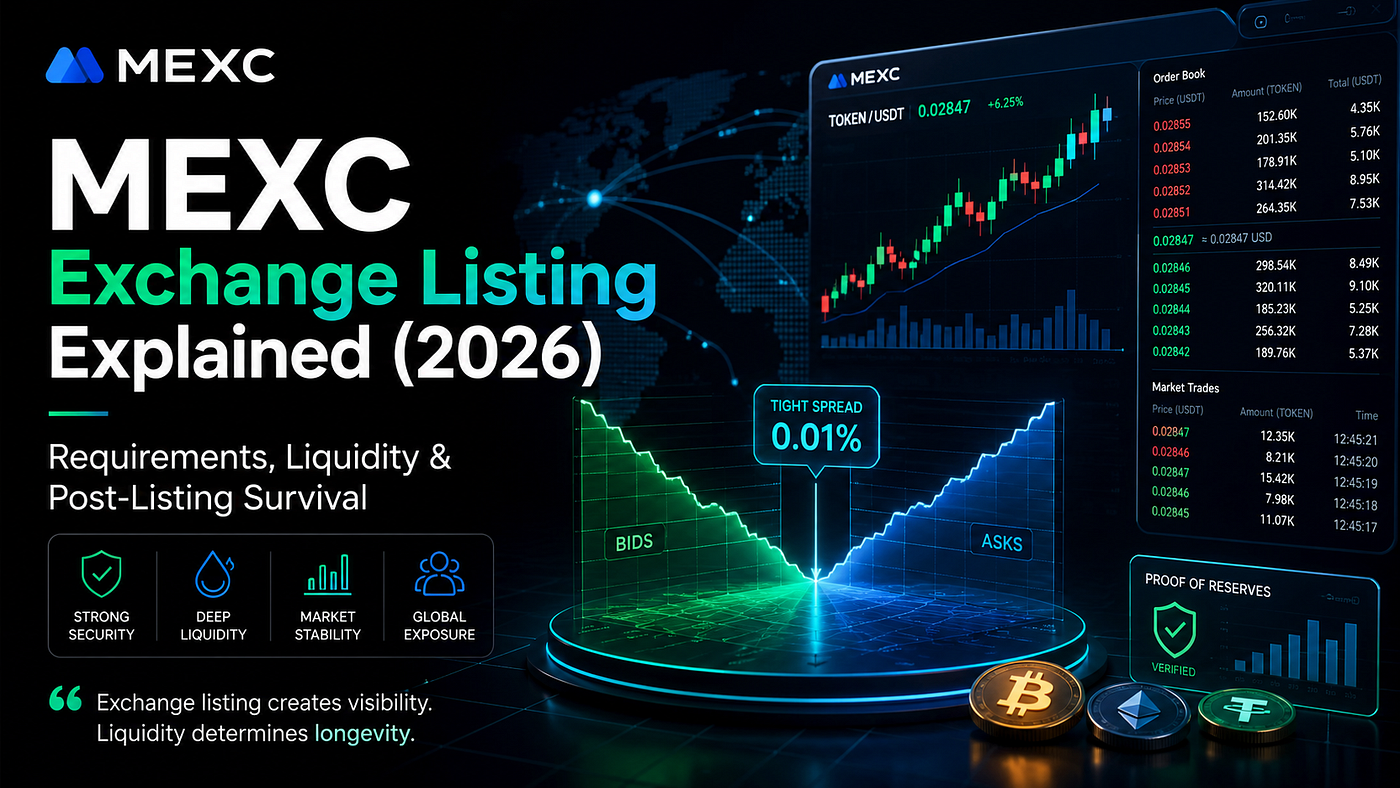
Most crypto founders focus heavily on securing an exchange listing.
Far fewer prepare for what actually determines success once trading begins.
A token can generate strong hype, secure exchange attention, trend briefly, and still lose momentum within days.
In many cases, the problem is not listing approval — it’s what happens after real trading starts.
Because exchange listing is only one part of the equation.
Liquidity, market stability, order book depth, and post-listing trading conditions often determine whether a market sustains momentum or fades quickly after launch.
This is one of the reasons MEXC has become one of the most actively discussed exchanges for emerging crypto projects, altcoins, meme coins, and early-stage token launches.
Known for fast-moving listings, broad asset availability, and strong retail trading activity, MEXC has become a major destination for projects looking to expand global market access.
In this guide, we break down:
- how MEXC listings work
- what projects should prepare before applying
- common listing requirements and review considerations
- why liquidity matters after approval
- and how strong market structure impacts long-term trading performance
What Is MEXC Exchange in 2026?
Founded in 2018, MEXC is a global cryptocurrency exchange serving millions of users across a large international market.
The platform has become particularly popular for:
- emerging token listings
- early-stage crypto projects
- meme coin exposure
- active altcoin trading
- fast-moving market discovery
MEXC supports thousands of crypto assets and continues expanding its spot and derivatives ecosystem globally.
One of the reasons many projects target MEXC is its reputation for listing newer assets earlier than some larger centralized exchanges, giving emerging projects additional visibility and trading exposure.
The platform is widely associated with:
- aggressive altcoin expansion
- fast-moving listings
- strong retail trading activity
- broad token availability
For many projects, MEXC represents an important step toward broader exchange exposure and market accessibility.
Why Emerging Projects Target MEXC Early
For many developing blockchain ecosystems and Web3 startups, MEXC offers:
- faster market access
- broader retail visibility
- earlier exchange exposure
- stronger altcoin discovery potential
This makes the exchange particularly attractive for:
- new blockchain ecosystems
- meme coin projects
- utility token launches
- growing Web3 communities
Compared to some larger exchanges with longer approval cycles, MEXC is often viewed as more accessible for developing projects preparing for broader exchange visibility.
However, successful listing is not simply about submitting an application.
Exchanges increasingly evaluate:
- project legitimacy
- liquidity readiness
- market stability
- trading sustainability
- community quality
- security standards
- operational credibility
That distinction matters more than many founders realize.
MEXC Listing Requirements & What Exchanges Typically Evaluate
While exchanges do not publicly disclose every internal review factor, projects applying for MEXC listings are commonly expected to demonstrate strong operational readiness.
This typically includes:
1. Project Credibility & Documentation
Projects should present:
- professional branding
- active development
- clear documentation
- transparent team structure
- legitimate ecosystem value
- realistic tokenomics
Strong presentation quality helps improve exchange confidence during the review process.
Weak or incomplete project presentation often creates immediate concerns during exchange evaluation.
2. Technical & Security Preparation
Projects should ensure:
- verified smart contract deployment
- stable infrastructure
- reliable blockchain integrations
- audit completion
- security testing against common vulnerabilities
Security concerns remain one of the most important risk factors for exchanges evaluating new listings.
3. Community & Market Activity
Exchanges generally evaluate whether a project demonstrates:
- active community engagement
- sustained market interest
- realistic ecosystem growth
- healthy trading behavior
- organic visibility
Artificial engagement or unstable activity patterns can negatively impact credibility during exchange review.
4. Liquidity & Market Structure Readiness
One of the most overlooked areas of exchange preparation is liquidity structure.
A token can secure listing approval and still struggle immediately after launch if:
- liquidity remains shallow
- spreads become unstable
- order books lack depth
- slippage increases aggressively
Weak liquidity becomes visible extremely quickly once volatility enters the market.
This is one of the reasons professional market making and liquidity planning matter heavily before listing even begins.
Not all exchange listings create the same market impact.
Trading quality, liquidity depth, and post-listing support often matter more than listing announcement hype itself.
High-Level MEXC Listing Process
While exact procedures may vary, the MEXC listing process generally includes:
- Project application submission
- Internal exchange review
- Due diligence and compliance checks
- Technical integration review
- Liquidity and trading preparation
- Listing coordination and launch
Approval outcomes often depend less on hype — and more on operational readiness, liquidity structure, and long-term trading sustainability.
Projects may also be evaluated for different listing categories or trading zones depending on market quality and exchange requirements.
Approval timelines and review requirements can vary significantly depending on:
- project quality
- ecosystem traction
- market conditions
- operational readiness
- liquidity preparation
MEXC Proof of Reserves & Transparency
Transparency has become increasingly important across centralized exchanges following major industry failures in recent years.
MEXC has publicly emphasized Proof of Reserves reporting as part of its broader transparency initiatives.
The exchange has published reserve disclosures covering major assets such as:
- BTC
- ETH
- USDT
- USDC
- other supported cryptocurrencies
Proof of Reserves frameworks are designed to improve transparency around exchange-held assets and reserve backing.
Transparency and reserve reporting now play a much larger role for both projects and traders evaluating exchange credibility and operational trust.
For many market participants, exchange transparency has become a major factor when assessing platform reliability.
Why Liquidity Determines Post-Listing Success
Many projects focus heavily on:
- listing announcements
- influencer campaigns
- launch marketing
- community hype
But underestimate what happens once real trading begins.
That is often where post-listing problems start.
Without proper liquidity support:
- spreads widen
- slippage increases
- execution quality deteriorates
- volatility spikes aggressively
- trader confidence fades quickly
Even relatively small buy or sell pressure can create major price movement inside weak order books.
This creates unstable trading conditions and poor post-listing market performance.
Strong liquidity and professional market making help support:
- tighter spreads
- smoother execution
- healthier order books
- more stable trading conditions
- stronger long-term trading sustainability
Strong marketing can create attention temporarily.
Weak market structure destroys retention quickly.
Exchange listing creates visibility.
Liquidity determines whether the market remains functional after the attention fades.
For a deeper breakdown of liquidity, order books, and trading stability, see our crypto market making guide.
Common Reasons Projects Struggle After MEXC Listing
Most post-listing failures are not technology failures.
They are market structure failures.
Common issues include:
- weak liquidity
- shallow order books
- unstable spreads
- low trader retention
- unrealistic launch expectations
- lack of ongoing market support
Some projects generate strong launch attention but fail to maintain stable trading conditions once volatility increases.
This often leads to:
- declining confidence
- weaker volume sustainability
- unstable price behavior
- fading market participation
Strong launch marketing rarely solves weak trading conditions long-term.
The projects that sustain momentum after listing are usually the ones that prepare:
- liquidity
- market structure
- trading stability
- operational execution
before trading even begins.
How to Prepare for a Successful MEXC Listing
Projects preparing for exchange listings should approach the process strategically rather than reactively.
Preparation should typically include:
Documentation & Branding
- professional website
- active social presence
- whitepaper or litepaper
- clear token utility explanation
- realistic roadmap presentation
Security & Compliance
- smart contract audits
- infrastructure testing
- legal preparation
- operational verification
Liquidity & Market Structure Planning
- liquidity allocation
- market making preparation
- order book support strategy
- spread management planning
Community Development
- organic ecosystem growth
- realistic engagement expectations
- long-term community retention
One of the biggest mistakes founders make is preparing heavily for launch day…
without preparing for the 30–90 days that follow.
MEXC Listing & Long-Term Sustainability
Getting listed is important.
Maintaining healthy trading conditions afterward is equally important.
Projects that sustain momentum after exchange listings are usually the ones that prepare:
- liquidity
- market structure
- execution quality
- trading stability
before launch even begins.
For many projects, exchange readiness becomes most important before launch — not after problems begin.
Structured MEXC Listing Preparation
Preparing for a MEXC listing requires more than simply submitting an application.
It often requires coordination around:
- liquidity planning
- market making
- exchange readiness
- trading stability
- operational execution
If you’re preparing for a MEXC listing and exploring structured exchange listing support:
https://www.cryptolistingpro.com/mexc-listing
Final Thoughts
In 2026, MEXC remains one of the most important exchanges for emerging crypto projects seeking broader market exposure and retail visibility.
But successful exchange listing is not only about getting approved.
The projects that maintain momentum long after launch are usually the ones that prepare:
- liquidity
- market structure
- trading conditions
- operational readiness
before trading even begins.
Because in the end:
Exchange listing creates visibility.
Liquidity, trading stability, and market structure determine whether the market survives after the attention fades.
메타데이터
- post_id
- 5e3558449ea5
- slug
- mexc-exchange-listing-explained-2026-requirements-liquidity-why-most-projects-struggle-after-5e3558449ea5
- url
- https://medium.com/@cryptolistingpro/mexc-exchange-listing-explained-2026-requirements-liquidity-why-most-projects-struggle-after-5e3558449ea5
- canonical_url
- https://medium.com/@cryptolistingpro/mexc-exchange-listing-explained-2026-requirements-liquidity-why-most-projects-struggle-after-5e3558449ea5
- author_url
- https://medium.com/@cryptolistingpro
- status
- ok
- fetched_at
- 2026-06-22 17:31:34



