99.95% of North American Sign Language Use Traces to One Paris Classroom
The Indigenous sign languages were here first. Way before anyone else. There are about 160 documented signers, but I did the math on how…
Photo by Samantha Gades on Unsplash
The records go quiet in 1890.
99.95% of North American Sign Language Use Traces to One Paris Classroom
The Indigenous sign languages were here first. Way before anyone else. There are about 160 documented signers, but I did the math on how much one deaf-school group got and how little everyone else received.
Let’s look at the numbers for how many people use sign language and how far back the records go. The estimates show about 544,000 people.
Now, let’s look at where their sign languages originated from.
Between 99.95% and 99.97% (depending on how you define a signer) of that population uses sign language that came from one single tradition started at a deaf school in Paris back in the 1760s.
There were only about 160 signers and their sign languages that were in North America before any Europeans came. That can be accounted for in one tiny, ancient group and one large modern group.
This is what I have pieced together for myself.
I have lived in four different locations and different languages have crossed over like a ghost. ASL slipped through from Jakarta and Singapore to upstate New York, because I learned it at school and silenced it in my mind. No other school could give me an opportunity. But the other languages that have existed for a long time: people lost their opportunity to teach and to recognize them.
People tend to think all sign languages in North America are equal. For example, ASL, LSQ, Maritime Sign Language, Plains Sign Talk, Inuit Sign Language, and Hawai’i Sign Language. Six languages, one continent, a team photo for the rest of the world.
But that photo is real, and the idea of equality is false.
One family got schools, got dictionaries, got a full database of over 2,700 signs, got legal recognition in Canada, got academic recognition in 45 states in the U.S., and ranks 3rd in college class attendance across America.
Indigenous sign languages? A missionary was counting fingers in 1890 but, after that, 135 years of silence and no official recognition, no schools, no record.
That is why I am finally seeing the real truth about it all now.
One classroom in Paris
Tree branches matter, and for a good reason. Most of the time the mistakes people make are similar. They simply flatten everything into a single list of names without the additional information.
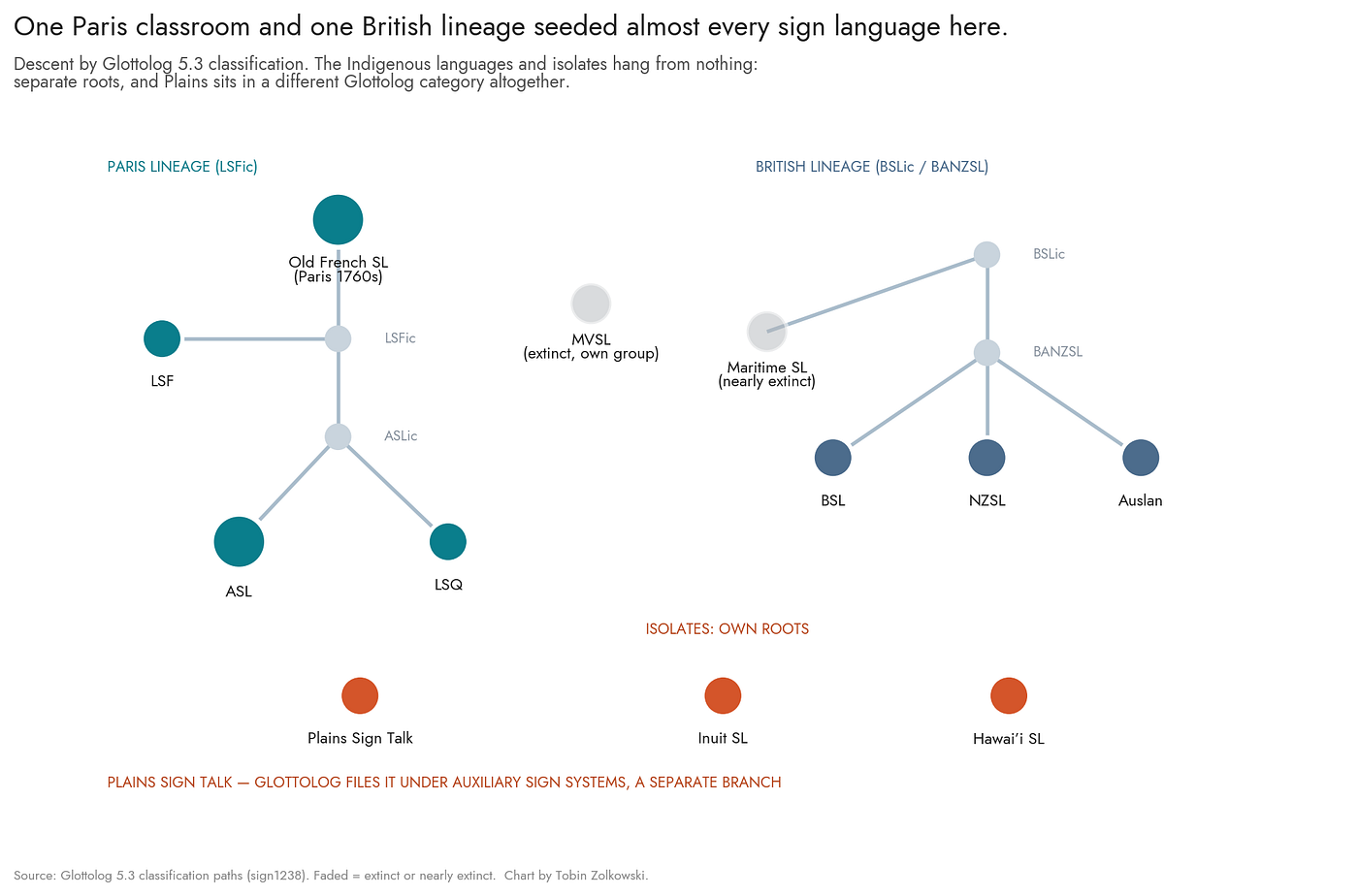
Let’s break it down. There is a French Sign Language that came from the Paris Deaf community and became official when Charles-Michel de l’Épée opened his school in the 1760s. This is the root. Not rival. Not competitor. This is the ancestor.
I was able to make a trip down to that school in 2016. It was there, and it is still there today. It has helped and taught deaf kids for over 250 years. This family has a real address.
French Sign Language (LSF) is a direct descendant of the original system. And what about ASL? It can trace its roots directly back to that Paris school. And this is easy to follow with a names list as well. In 1817, Laurent Clerc, a Parisian deaf teacher, went on to establish the American School for the Deaf with Thomas Hopkins Gallaudet. The mix from Paris with the students from the school included MVSL (Martha’s Vineyard Sign Language). This was a village language where deafness was so prevalent that even the hearing people signed.
Nora Groce wrote about this world in her book Everyone Here Spoke Sign Language (1985). MVSL is now gone with the last of its native deaf signers dying in the 20th century.
While MVSL died, it got absorbed. ASL carries that legacy like English carries Norse.
Quebec Sign Language (LSQ) is on that same tree. Quebec made their own version because of contact between LSF and ASL. They all have the roots to Paris. This isn’t abstract for my family: my mom went to high school in Trois-Rivières, Quebec.
So when I say “the Paris lineage,” I mean three living languages: ASL, LSQ, and LSF. All of it is tied to one classroom, one teaching method, one path out through Hartford, and eventually across the continent.
The British tree is literally a separate tree. BSL, Auslan, and NZSL are part of a sign language family called BANZSL, of which Paris is not a part. ASL and BSL are not alike at all. They have completely different sign systems, and vocab, and only about 26% of the core signs are even somewhat alike, even when compared sign for sign in the Hawai’i sign language study (Clark et al., 2015). And even that leaves a huge difference.
What about Auslan? That divides into two separate dialects, north and south, as well. Right now, I’m learning BSL and Auslan, more specifically North Auslan, since I’m a Queenslander.
So you know, if my family stayed in Queensland like they would have, I’m sure I would’ve learned the same sign style as those folks.
For me, this isn’t all just studying. The difference that ASL and BSL have is the equivalent of three separate languages of homework.
And airports? Yep!
It also demolishes the biggest myth out there. That myth is… sign language is universal. False. It’s much more complicated than that. A Deaf person’s understanding of what’s going on is more dependent on their family tree than their world map.
For example, a Deaf American in Paris has the same one-handed spelling as them, so they can use spelling on the spot. Then, they use the sign systems with ASL. But take that American to London. Guess what? No spelling. No nothing. They got a whole different system. Literally, of the signs they will get, only one in four will be similar (if that). Even if they’re in the same spoken language… which is the case with the US and UK, London will still be a whole different world for the Deaf American. France and the US are similar in sign systems… but spoken systems? Nada! UK and the US? Spoken systems? Yes! But sign systems? Not at all!
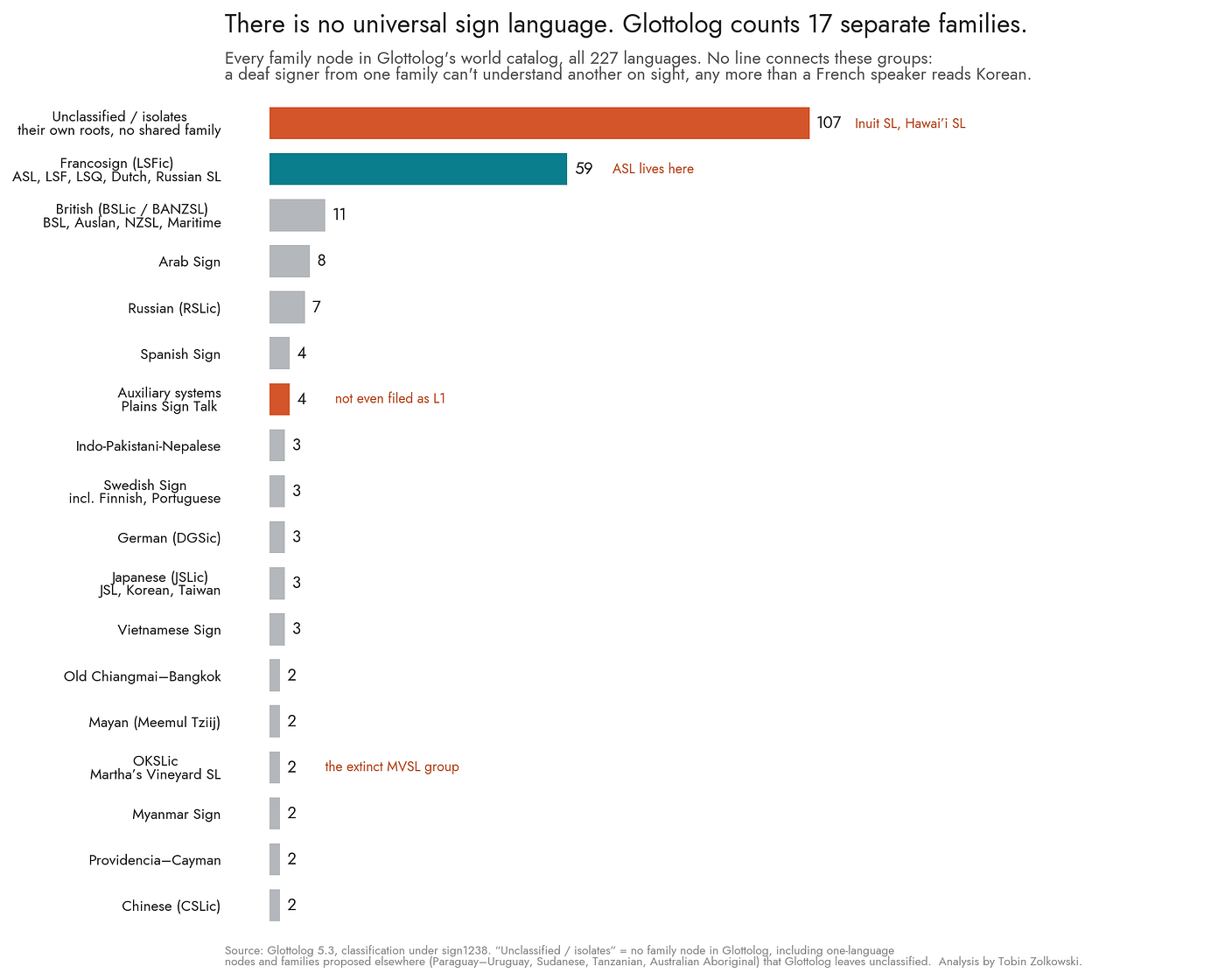
Think of Glottolog as a way to organize all 227 sign languages in the same fashion as spoken languages. This completely dismisses the thought of there being a ‘pure’ universal language.
Which sign language family is the largest? Francosign, the Paris group, with 59 member languages. The next is the British group with 11. German, Japanese, Arabic, Spanish, Russian, and Swedish each have one or two. Then there are some small families most people don’t know: Vietnamese, Mayan, Chinese, Myanmar, Old Chiangmai-Bangkok, and Providencia-Cayman. There are 17 families in total and 107 sign languages which belong to no family. This includes Inuit Sign Language and Hawai’i Sign Language.
I still remember being 14 and living in a hostel in Singapore. There was a Deaf Brit there. I thought I was going to have a really hard time communicating with him. I was shocked at how easy it was to become friends with him after having a few beers. I thought I had finally communicated with him. The beer worked where the family tree failed. This was a long time before I finally understood Auslan and BSL.
BANZSL is important to North America because of a certain dying branch; but I will get to that next.
What the winner got
We’re gonna break this down simple.
A dictionary. A Dictionary of American Sign Language on Linguistic Principles, edited by William Stokoe, Dorothy Casterline, and Carl Croneberg, was published in 1965. This book was the first in the field, and convinced most doubters that signed languages are real languages. William Stokoe’s original work on the structure of ASL began in 1960. The field has kept at it for over sixty-five years.
A database. ASL-LEX 2.0 (Sehyr, Caselli, Cohen-Goldberg, and Emmorey, 2021) contains 2,723 ASL signs and provides data related to the sign’s structure, frequency, iconicity (how much the sign looks like what it means), and more. It’s all free. And for any Indigenous sign language of North America, there’s nothing comparable. Not even in the same ballpark.
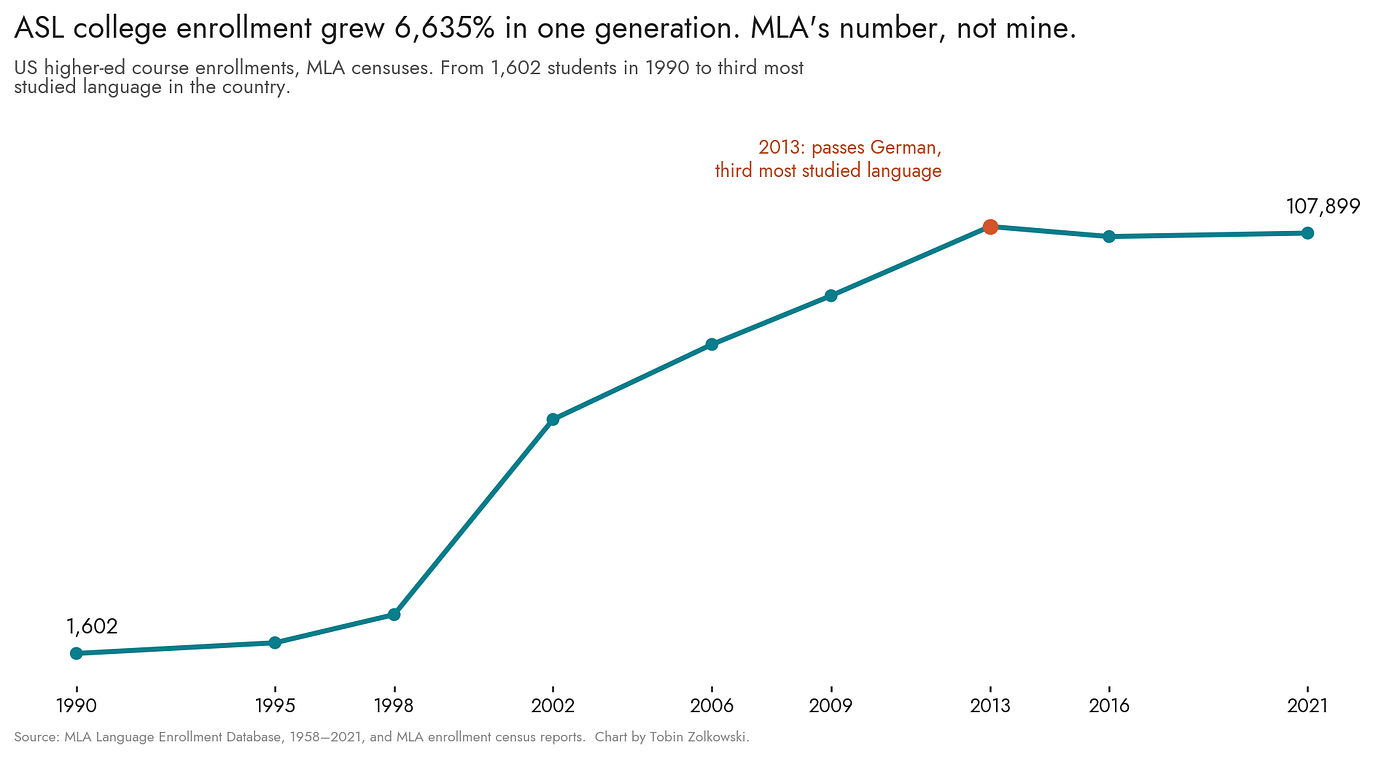
A teaching economy. The MLA reported 1,602 students studying ASL in the US in 1990. ASL became the third most popular language (after Spanish and French) to be taught in US colleges, overtaking German by 2013. ASL held this position through 2021, with 107,899 students (a 6,635% increase from the 1990 figure which was also from the official stats, not from guesswork, I swear). That figure was pulled directly from the database. 107,899 is what they counted. When two counting methods give the same figure, believe the figure.
Here are two notes from the MLA reports. One says the MLA had a new counting method in 2013 so the MLA reports that surge is from the new method. The other note says ASL includes non-language study departments, such as Speech Pathology, Social Work, etc. A 67-fold increase is absurd to ignore.
We’ve obviously had to fight to get everything we have, and saying the ASL institutions just “fell from the sky” would be insane. For example, in March of 1988, deaf students literally shut down Gallaudet University, the biggest and most important University for Deaf people located in Washington D.C., for a week. They did this after Gallaudet’s board of trustees picked a hearing individual as the University president over the two Deaf candidates. They even blocked the campus gates using protest buses.
The protest ended when I. King Jordan was appointed president. That made him the first Deaf president of Gallaudet in the 124 years the University has been in existence. The protest also prompted hearing America to recognize and treat ASL as a legitimate language (Christiansen & Barnartt, 1995). That pushed the Modern Language Association (MLA) to begin counting the number of ASL students enrolled. You can interpret this in whatever fashion you prefer, but the Deaf community most definitely sees this as cause and effect, and so do I.
Even the winning lineage drew lines. Hartford admitted its first Black student back in 1825. The South refused. In the Southern States, separate schools for Black Deaf children were established in 1869 in Raleigh and opened in 17 other States as well as the District of Columbia. The last of these segregated schools was integrated in 1978.
Black ASL also emerged from these segregated schools. It incorporated a wider signing space, two-handed signs, forehead signs, and a unique vocabulary. It also borrowed from African American English and has a more conservative approach to sign. Carolyn McCaskill, a member of the first integrated class at the Alabama School for the Deaf, conducted this research and described Black ASL as the same language, the same time, but different schools.
All Black ASL signers count toward numbers of ASL signers. However the rules of ASL change when schools are segregated and separate from one another. The difference in ASL itself proves the shape of Black ASL.
[embed]
You can see dialects stretch beyond race boundaries. ASL has a dialect that some have called a Philadelphia accent. Deaf folks from Philly are mocked for their strange signing, but it’s more than a cruel prank. There’s a project that’s focusing on Philly ASL variations (Fisher and Tamminga at Penn, Hochgesang at Gallaudet), and it’s using Labov’s model to study local ASL variations that are likely to disappear. And they are disappearing, toward the Gallaudet standard.
Everything in this article is heading toward the dominant version.
There are even older signers who use the sign for Wanamaker’s (a Philly department store that closed decades ago) even when there’s no store with that name. Auslan also has a separate North and South division. As a language survives, regional accents can be seen.
As for Plains Sign Talk? It is still waiting for its second count, a wait of 135 years.
If there’s one thing that can be said about Philadelphia, it’s that it’s definitely not special. Every state has its own residential school system which builds up pockets of their own unique languages. Because of this, making the “birthday” sign can really confuse a lot of people, just like how some people say “pop” or “soda” (this was first mapped in 2001 by Lucas, Bayley, and Valli).
There’s variation across borders too. ASL in Canada is the same language with vocabulary differences, like English in Canada and the States. Sign language in Canada can have three different signs for “about”: the normal one, one variant in the Atlantic, and one in Ontario. The Maritimes also borrow from MSL and like we said Canada took the institutional route.
The Canadian Cultural Society of the Deaf spent twenty years creating “The Canadian Dictionary of ASL” (Bailey and Dolby 2002) which has 8700 entries with a lot of Canadian specific words and has entries broken down by province. Compared to the rest, this is a lot of vocabulary just for the sake of vocabulary.
Legal standing: Canada’s Accessible Canada Act (2019) states in Section 5.1(2):
American Sign Language, Quebec Sign Language and Indigenous sign languages are recognized as the primary languages for communication by deaf persons in Canada.
According to the National Association of the Deaf, in the U.S. 45 states acknowledge ASL as a world language for college credit.
Let’s focus on that Canadian Act. “Indigenous sign languages.” Plural. Names omitted. ASL is named. LSQ is named. The languages that came before the both of them get lumped into one. A law that specifies two languages and ignores the rest shows, really, which languages have the support, be it schools, communities, institutions or otherwise. And the Deaf advocates in Canada fought fiercely to get that in there. I’ll take that over nothing.
The winner was never declared either
This should make my country and everyone else cringe, but it doesn’t seem like anyone cares.
It’s pretty much a mystery how many people use American Sign Language. Not a soul knows. The figure of 500,000 that we always see is a number that comes from one source. It’s from Schein and Delk’s census of deaf people from 1971 and 1972. In 2006, Mitchell, Young, Bachleda, and Karchmer examined that data and found that every other estimate of ASL users in the U.S. relied on that single study. The survey in question didn’t ask anything about ASL. They asked the question in a broader sense about signing. Their analysis had the figure of 479,629 people who were using sign in some form for the year 1972. That’s the number. It’s the basis of every other number cited, so it’s a dumpster fire. Every larger estimate you’ve seen is something where people just cited the original figure and made up a number.
And why hasn’t anyone else made an attempt to update it? The official reason is buried somewhere in the Census Bureau. Because signed languages aren’t written, they can’t be used in ballots or voting forms.
What struck me the most was not any of that data. It was the framing of the data. The Census Bureau just coded it as an English response so ASL was erased. Since I work with live data, I can tell you, with that kind of error, the data is going to be processed and you will lose the language completely.
What was the most recent attempt to guesstimate this number? Mitchell and Young analyzed data from the National Health Interview Survey (2010–2018) to say between 863,000 and 1.1 million deaf and hard of hearing adults who use some form of sign language exist in the U.S. Once more, this is not focused on the use of ASL, but rather ‘signing’ in some general sense. Had sign language been included as a distinct language within the American Community Survey, it would fall as one of the top ten most common non-English household languages, between Arabic and Korean.
Why is no one doing anything about this?
Top ten, and officially coded as English.
Given this is the record for the world’s dominant language (the one with Gallaudet and 100,000 plus students), you can imagine what the record is like for the rest of the world.
Canada does better. And the difference? Just one census question.
Statistics Canada has an open-ended question regarding language. In the 2021 census, the number of individuals who reported being able to converse in ASL was 37,620, and 6,195 in LSQ. As for language as their first, 8,415 reported ASL and 1,860 reported LSQ.
Those are the only counted occurrences of sign language by the government in North America, and Canada got all of them by simply placing one question. The US does the same but discards the information at the intake.
Two languages Canada is losing
Maritime Sign Language (MSL) is basically the British version of sign language that made its way to this continent. Deaf communities from the UK and the North East of the USA met up in Atlantic Canada in the 1700s and the 1800s and are believed to be the origin of MSL in the Canadian Maritime provinces.
MSL was practiced at the Halifax School for the Deaf from 1857 to 1961, after which, other schools started to use American Sign Language (ASL), and MSL ceased to be used.
Judith Yoel’s 2009 dissertation from the University of Manitoba estimated that there were around 100 original MSL users in Nova Scotia, and near none were in Newfoundland and Prince Edward Island. In 2024, Bev Buchanan, Deaf and a native sign user of Halifax, spoke to the CBC and said she was one of the near 100 original users of MSL in the province. Her research found 20+ archival videos of the Nova Scotia Cultural Society of the Deaf and documented over 3000 signs. 900 of them show up only in MSL.
[embed]
There are community VHS tapes and a researcher’s glossary. Ethnologue states that MSL is “moribund”, so no children are learning it anymore, and Glottolog states that it is near extinction. The ASL used in the Maritimes has adopted some MSL signs, the same way ASL absorbed signs from Martha’s Vineyard.
So what do you think killed MSL? Some people think it’s because people are too scared to sign. Not true. The real reason is oralism. You even have those hearing educators that spent an entire century attempting to remove signing from the deaf community. Guess what? The Paris lineage defeated them. And it defeated other sign languages the same way. Whoever controls the deaf school ends up shaping the sign language of the next generation.
And it happens inside the family too. I checked Glottolog (the catalog linguists use to classify languages) and LSQ sits at “shifting” endangerment. It is federally recognized in a law. It is Paris lineage. There is a full descriptive grammar on the shelf (Dubuisson, UQAM, 1999). And Glottolog still has it at “shifting.” The pressure is ASL.
Of the languages, ASL is the only “not endangered” language in North America. ASL is the dominant language and it continues to squeeze the rest.
The languages that were here first
Plains Sign Talk was the main language in the Great Plains, and is also called Plains Indian Sign Language or Hand Talk. It was a huge help to the many tribes that had no similar spoken languages to use for trading since they all communicated with this one signed language. It was also used by most deaf tribe members as their main language.
The first serious documentation of this signed language was by Garrick Mallery between 1880–81. He even claimed that it extended the whole way to the other side of the continent. Leading scholar of Native Deaf history, Melanie McKay-Cody, seems to think that is an exaggerated claim, and for good reason. Almost certainly, the reach of the language was much less than that but was very hard to measure.
By 1890, one missionary, Lewis Hadley, did a head count of sign language users within 29 tribal nations, and estimated there were about 102,460 users. McKay-Cody was able to find that Hadley had made an error, and under counted his data. The actual number was nearly 111,000, and that was the first and last official count of Plains Sign Talk users. Since then, no one has tried to count again. In fact, the largest Indigenous language network in North American history has had no official census for the last 135 years! That was done by a missionary taking a few notes in his notebook.
What happened between those points isn’t mysterious, nor is it something that just died out naturally. Native languages were banned at boarding schools, and Hand Talk was a Native language. Deaf Indigenous children were sent to schools where they were forced to use ASL. The same system that helped establish the Paris lineage completely eradicated the use of Plains Sign Talk.
A big claim you will read is that American Sign Language (ASL) is a colonial language and that it essentially ‘stole’ the signs and structure it has today. I think that drapes over the real disrespect to the deaf community and the scholars actually studying the language: the deaf community created ASL and fought through oppression for the recognition and right to use their language through the many signs that create ASL.
Plains Sign Talk (PST) and ASL have both faced oppression, but unlike PST, ASL was actually favored by the system.
Hartford-style deaf schooling kept deaf children together and carried on a sign language through generations. Indian boarding schools for Native American children disrupted their families and the use of their sign language. One of these schooling systems created the foundations of a sign language; the other system destroyed a sign language.
It is possible that ASL did take some signs from PST. Gallaudet did use some descriptions of the Indian Sign Language that were published and circulated in the American Annals of the Deaf, which reached many deaf educators, to support his claim to teach deaf children using signs. Native American signers did visit deaf residential schools and, in many cases, Native children were enrolled in the school for Native children right next to the deaf school. Many of these Native and Black children were already using Hand Talk.
Jeffrey Davis analyzed 170 pairs of signs from early Hand Talk documentation and ASL. He stated that 50% of the examples were so similar that he believes it is likely that lexical borrowing (the borrowing of vocabulary) took place. He is aware that the number of examples is small. I will adopt his tone, with caution. That is earned.
Now, let’s assume that both doors are open: the deaf school admitted Native American children as a part of the assimilation plan, and ASL was likely to borrow signs from Hand Talk because of that. However, the door to Black Deaf people remained closed for more than a century. Therefore, Black Deaf people created their own version of ASL, which is separate and distinct. The institution made the decision as to who would get absorbed and who would get locked out, and the language clearly illustrates every single decision made.
At least the history goes back to 1930. Hugh L. Scott was a General in the United States Army. He learned Plains Sign Talk over a career in the American West and later received 5,000 dollars from Congress. He used this money to host a three-day event in Browning, Montana. There, he got 18 leaders from different tribes to come, and film crews recorded the whole council.
[embed]
The goal was to capture every participant to create a film that illustrated over 1,300 signs. Scott died and never completed the film. The raw footage stayed in the Library of Congress, that is, until the National Endowment for the Humanities funded a Jeffrey Davis project that put everything on the internet.
Right now, there are revival efforts to increase the use of Plains Sign Talk and there are still a few signers. But if there are any studies on the use of the sign language, I was not able to find them so I did some research on my own.
Unbelievably, Glottolog said Plains Sign Talk ranks as one of the sign languages with the highest depth of documentation. This means over the years, Plains Sign Talk has had a lot of research and written work published on the different signs that make up the language. Mallery and Scott’s work contributed to the high ranking. But in the same listing, the sign language was considered nearly extinct. It is the most documented Indigenous sign language in North America and yet, following generations never continued to use the language. Documentation is great to have but without the use of a language, it is useless.
Inuit Sign Language is a one-of-a-kind language in the Canadian Arctic. It’s unrelated to American Sign Language or Plains Sign Talk.
In 2000, James MacDougall estimated around 155 Deaf people lived in Nunavut. MacDougall predicted only about 47 of those people used IUR. However, Joke Schuit, who did fieldwork there starting in 2010, believed in 2015 that there were less than 40 Deaf users of IUR. Schuit also estimated at least two hearing signers for every deaf one, which puts hearing users of IUR around 80.
Nunavut is home to 5.7 Deaf people per 1,000 residents. That is nearly 6 times the rate in southern Canada. That statistic is a positive for the population, however, it is a negative for the preservation of IUR because ASL is the only sign language used in schools and government services. Without IUR being taught to children, it is rapidly being replaced by ASL.
In 2008, the Nunavut Legislative Assembly became the only institution to support IUR. It provides IUR interpretation alongside ASL.
Hawai’i Sign Language is the most extreme example of isolation, especially as a cautionary tale, and is completely disconnected from any other form of sign language. Linda Lambrecht, Barbara Earth, and James Woodward’s research from 2013 concluded that only 12% of the basic vocabulary of HSL is even close to ASL. By way of example, ASL and BSL, two unrelated languages, have 26% in common.
HSL emerged in Hawaii in the 1800s and was used by the deaf Hawaiian population before ASL made it to Hawaii in the 1940s. At the time of the research, it was estimated that there were 280 deaf people over the age of 65 living in Hawaii, and about 40 of them were reported to know HSL, although many of them were known to mix HSL with ASL. According to the documentation project from 2019, it was reported that only about 10 people still used HSL (Woodward, in Island Scene).
[embed]
Okay, let’s check out the date. Back in March 2013, linguists said HSL was a thing. They said this language was used in the U.S. for over 150 years. The paper trail starts with an 1821 letter to Thomas Hopkins Gallaudet himself. The letter describes deaf Hawaiians signing. Since the 1930s, no one has documented a language (spoken or signed) that has been completely unknown in this country. And for real, this language wasn’t hiding. No one with funding ever looked for it…
Who actually documented this language? Linda Lambrecht is Deaf and a native signer of the language. She is the reason HSL is getting attention after years of researchers ignoring her claims. The leading scholar of Plains Sign Talk, Melanie McKay-Cody is Deaf and Cherokee. Bev Buchanan is also Deaf and created the only existing MSL glossary using old community recordings. It’s obvious that documenting a dying sign language is only possible when a Deaf person is involved.
Then there are languages where I can’t even make a guess. The Coast Salish and surrounding people of the Pacific Northwest made their own traditions of signing; there are more signing traditions beyond the Plains network; and Oneida Sign Language has an active revival in Ontario. But I couldn’t find any peer-reviewed articles estimating numbers of signers. Not one. And no, I won’t make numbers up to fill in a chart for fun. The absence is the answer. For most of North America’s Indigenous sign languages, all we know is that they’re not documented.
Was it always gonna end like this? A language with schools versus a language without?
Yeah. That’s the system.
The export market
The influence of Deaf Culture is not limited to the water. Deaf schools leave their host communities with a new language, and local sign languages begin to diminish in a generation. This is true in many places across three continents.
Africa is the largest example and it started with one man’s work; that man was Andrew Foster. He was the first Black Deaf student to graduate from Gallaudet University in 1954. In 1956 he started the Christian Mission for Deaf Africans. By the time he died in a plane crash in Rwanda in 1987, he had opened 32 Deaf schools in 13 African countries. Before Foster opened schools, Africa only had a dozen Deaf schools, if that.
These schools used American Sign Language, and that was the starting point for the expansion of the Ghanaian and Nigerian Sign Languages. Now, many Deaf people in Nigeria refer to their sign language as ASL, however Ghanaian and Nigerian scholars disagree with that notion. They are correct, since both languages have incorporated local signs and have evolved independently of one another. (Asonye et al., 2018).
Foster did more for deaf kids in Africa than all the colonial governments combined. The local deaf communities used their local languages to help. Adamorobe Sign Language in Ghana is older than Foster’s work, and is now endangered with people leaving to use GSL. How about Bura Sign Language in Nigeria? It still exists in one remote area of Nigeria (Blench & Warren, 2006). The story is similar to North America. One good-intentioned person was trying to help, but the local languages had the situation under control.
Jamaica packs the whole story into just one decade. Top Hill’s Konchri Sain was (and maybe still is!) one of the few sign languages used by Deaf and hearing people of all ages and walks of life in St. Elizabeth, Jamaica.
In 1975, American Mennonite schoolteachers showed up to open the first formal deaf school in the area. They brought Signed English and American Sign Language (ASL). The school did not accept the local language, and the school’s policy was to suppress the use of Konchri Sain in and outside the classroom.
By 1985, Konchri Sain was mostly dead, kept alive only among older monolingual Deaf people. Everyone else completely switched to Jamaican Sign Language (JSL), which is, more or less, an ASL-based sign language. This switch was almost instantaneous; by the mid 1980s, the vast majority, if not all, were using JSL.
So, within ten years from 1975 to 1985, school leaders completely changed the entire language system.
Singapore is a good example of what happens to a language when it begins second. Peng Tsu Ying was a deaf educator from Shanghai who arrived in Singapore in 1948, started teaching deaf children at his home in 1951, and opened the Singapore Chinese Sign School for the Deaf in 1954. The school taught in Shanghainese Sign Language.
In 1976, the deaf community was introduced to Signing Exact English (SEE). SEE is a version of Manually Coded English, and most of the signs are modified or taken directly from ASL. By 1978 the deaf association adopted SEE-II as their medium of instruction.
The class based on Shanghainese Sign Language was closed in 1983.
Singaporean linguists have found that Singapore Sign Language is about 30% Shanghainese Sign Language, 40% ASL and have some local signs.
I spent a good part of my childhood in Singapore, and let me tell you, the deaf community named their sign language in 2008. They were still using SEE until 2015 when they switched to SgSL.
Thinking of this through a data engineer’s lens, the community worked on a system that used ASL signs for about 40 years before anyone bothered to come up with a local version and build the output.
Then, there’s International Sign, which some people call a world sign language. While I see why some would, I don’t really think that’s accurate. International Sign is used in environments such as the World Federation of the Deaf (WFD) congresses and the Deaflympics and is understood to be a system that signers improvise during negotiation. Because of this, International Sign has limited vocabulary that is mainly ASL and European sign languages. It is not something that is learned in the deaf community as it is not a community language. The WFD and World Association of Sign Language Interpreters have said so in a statement where they refer to International Sign as a “contact variety,” and when surveying member countries, the countries of the survey do not consider International Sign a language. So, it is a “contact variety.”
Yes, its vocabulary is limited and the same as the other sign languages that are based in the Paris world and are used in the global institutions.
Glottolog assesses how much each language is used. The signed languages of Ghana, Nigeria, and Jamaica are not considered endangered. Adamorobe and Konchri Sain are considered to be shifting.
If you combine the viewpoints of the coequal language theory and the lingua franca theory, ASL (and all its variants) is a worldwide contact language for deaf education, similar to how a language and method of instruction used in the mission schools spread throughout the British Empire in colonial times. This has benefited local communities a great deal, as many students who would not have been educated received some degree of literacy and were able to enroll in Gallaudet University. This benefited the communities of Ghana, Jamaica, and Nunavut, and came at the same cost to the others.
What’s not on the list?
Some of these examples just don’t belong here. They aren’t even real languages.
Signed Exact English (SEE) and other so-called manually coded English systems are literally systems. They use hand shapes of American Sign Language to represent English syntax and words, one sign at a time. They’re decomposable. For example, “running” is the sign for “run” plus a separate suffix sign for “-ing.” SEE has about 80 of these affix markers. They were developed for English instruction for deaf students in 1970s. But no community ever adopted SEE as a language. Comparing SEE to ASL is like comparing Morse code to English. It’s ridiculous.
Pidgin Signed English? Now usually referred to as Contact Sign, is a blend that occurs when an ASL user and an English speaker come into contact. It is real and it is used, and certainly not a language of its own. It occurs between languages, not out of thin air.
Then we have ProTactile: totally different and in its own league. It is grounded in the DeafBlind Community, and is a tactile language since around 2007. ASL Tactile grammar and ProTactile is a different system. We don’t know yet if it can be called a language, but it is not the sign language systems that we usually see on the lists in North America. It is way more interesting and new than what we usually see.
The score and the math
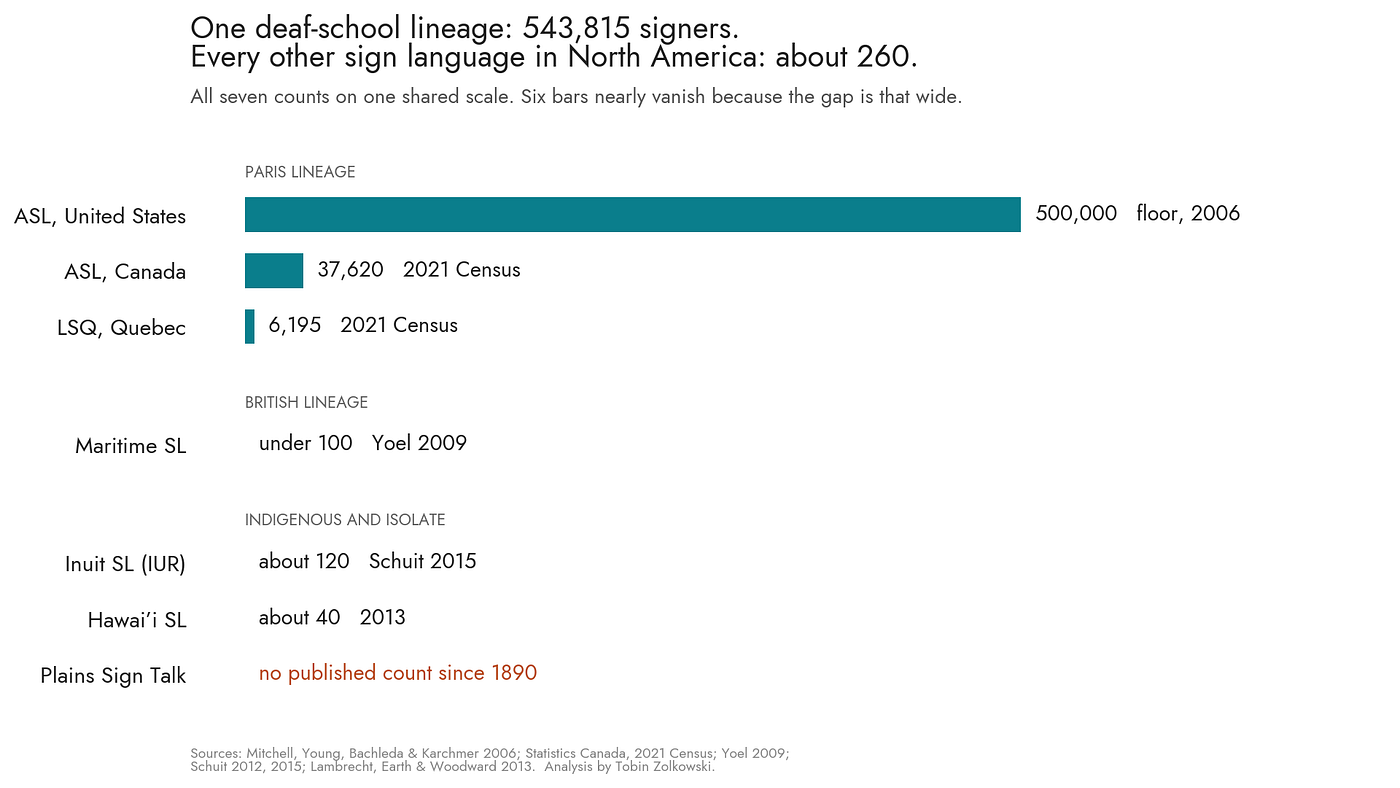
Here’s the deal. It’s a single grid. All numbers come from actual data. Each gap means we don’t have the data, and we’re not making it up.
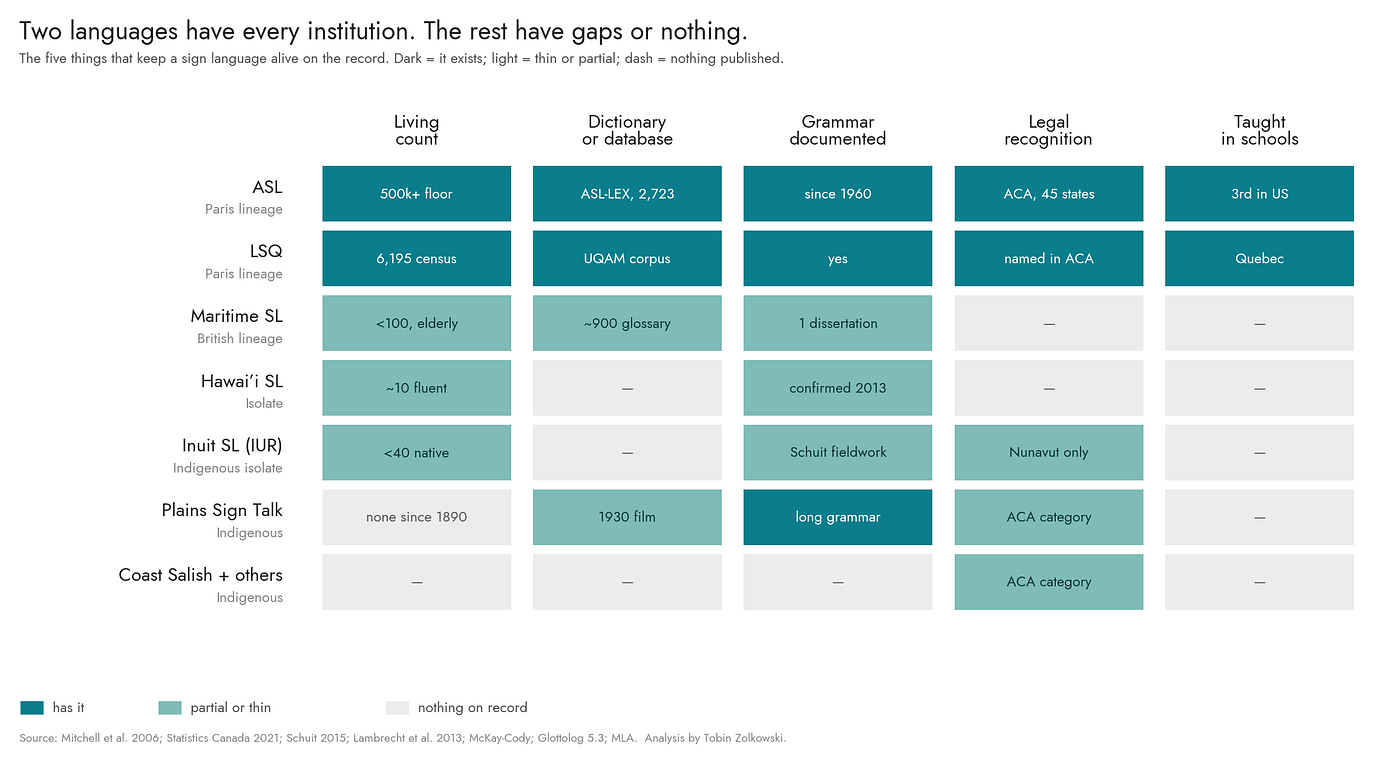
Reading this from left to right, the two top rows are completely filled (i.e., no gaps). Everything beneath that is either partially filled or completely empty. Most gaps will be in the languages that were earlier in history.
Now the methodology. Here it is.
One scope note: this piece counts the US and Canada. Mexico’s census doesn’t count signers, and Mexican Sign Language is another Paris descendant anyway, so adding it would only widen the share.
Most of the numbers in the chart can’t be, and won’t be, compared. Mitchell’s 500,000 only counted the main users of ASL. Canada’s census counted those who can have a conversation. The study from Hawai’i counted whoever said they know the language. This is how bad analysis is done, so I did it the correct way: the ratio two times, one for each definition. You decide which one is the better ratio.
Strict definition means only the main users on both sides. For the Paris side, that’s 479,629 ASL main users (Mitchell) and 8,415 ASL + 1,860 LSQ from the Canadian census. That’s a total of 489,904. For the Indigenous and isolate side, that’s the same definition, and it’s less than 40 deaf native IUR signers plus about 10 HSL signers and nothing from Plains Sign Talk, which is a total of about 50. Put MSL’s sub-100 elderly signers on the record too and everything outside the Paris lineage is about 150. The Paris share of all counted signers is 99.97%. Against the Indigenous and isolate side alone, the ratio is roughly 9,800 to 1.
Loose tier: any known claim of use or knowledge, both sides. Paris Lineage: a floor of 500,000 plus 37,620 ASL conversationalists plus 6,195 LSQ conversationalists in Canada. Total: 543,815. Small side, same loose standard: 40 claimed HSL, about 120 IUR including Schuit’s hearing second-language signers, still zero counted for Plains Sign Talk. Total: about 160, or about 260 with MSL. Share of all counted signers: 99.95%. Ratio against the Indigenous and isolate side: about 3,400:1.
Loose or strict, the answer doesn’t change. The Paris Lineage has 99.95% to 99.97% of all signers for which a published record exists, and the concentration only worsens under a strict standard. This is, of course, what one would expect. The tallies for the smaller languages are inflated with claims of knowledge and second-language signers while ASL’s floor is 1972.
And Plains Sign Talk contributes zero to all the tallies. The zero means no one counted. After 135 years of institutional neglect, no one can even guess what it has. Whatever its true number is, it makes my ratio smaller. The real gap is wider than anything I can show you.
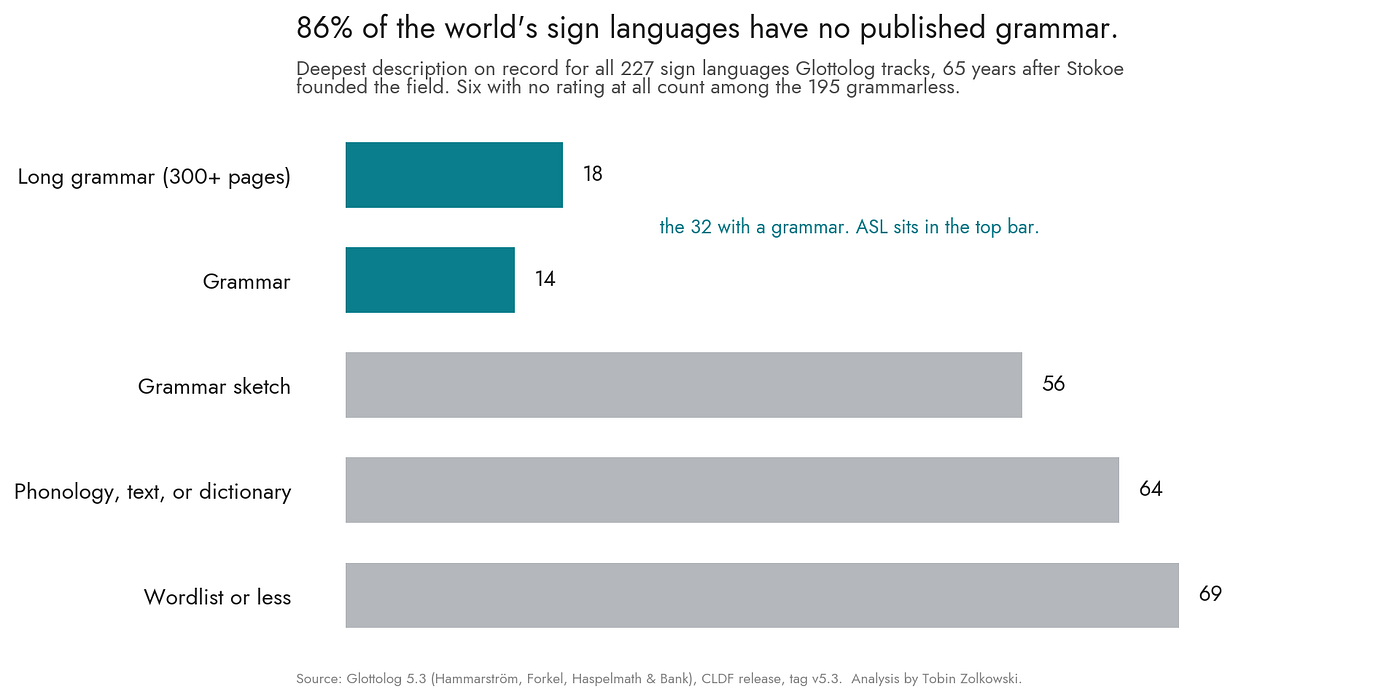
This time, it’s a global computation. I downloaded Glottolog’s entire dataset, containing 27,178 entries. I filtered the dataset to the 227 sign languages and connected each sign language to the most detailed description available. Of the 227, 32 have some form of grammar. 69 have descriptions that amount to “wordlist or less.” 65 years after Stokoe founded the field, linguists have published full grammars for 14% of the known sign languages. ASL is one of the 18 long-grammar entries.
The read
Back in the Plains Sign Talk section, I called the colonial claim a drape over the real story. Now, you see the complete scope: Canada, the Arctic, Hawai’i, and three more continents. The truth? It’s colder than your average villain’s evil scheme.
Languages don’t get to hold the title of survival for the heck of it or because they were the first to arrive on the scene. They survive because of a language institution: a school that teaches the language, a dictionary that recognizes the language, a census that includes the language, a law that gives the language a name.
The Paris descendants got all four. But for the Indigenous sign languages on this continent? They got one congressional allocation for putting the language on film, one general who didn’t get around to crossing the finish line of the project, and one token word in a Canadian act to acknowledge (just about) the languages.
You can see this in real time, on the most minuscule scale, how the system works. IUR kids are being funneled to ASL because that’s the only language offered in the school. MSL lost its Halifax school in 1961 and began to disappear right after that. HSL wasn’t recognized by anyone until 2013, because no school was ever assigned to study it. It didn’t need to be malicious. It only needed the money to keep going to the same institution.
While this may be specific to North America, your deaf education institutions made a long-term decision long ago about the language to prioritize and that decision still shapes the education system to this day, for better or for worse. Glottolog has 227 documented languages and 195 of those have no grammar at all. There’s a good chance your language is one of them.
The fixes are easy to understand, and that’s why I believe in them. The US Census tried a sign language question in the past, and Canada proved it’s possible. Ask the question. Then count Plains Sign Talk properly, the first count since a missionary and a notebook in the 1890s.
We need to support the documentation of other neglected languages so we can record the elders who are the last speakers of that language.
Also, what Plains Sign Talk showed is that no archives can replace the service that schools provide, so let’s count how many languages there are, record the elders, and bring these languages back to the kids. That last step is the only one that actually worked in the past.
Scott figured the recording step out for the languages using a movie camera and $5,000, and the Library of Congress let his reels sit in the archives for eighty years.
There’s eighteen Chiefs on screen telling jokes in a language that the Government refuses to recognize.
That is the Archive. But the counting? That’s up to us.
Sources:
*Mitchell, Young, Bachleda & Karchmer, “How Many People Use ASL in the United States? Why Estimates Need Updating,” Sign Language Studies 6(3), 2006. Mitchell & Young, “How Many People Use Sign Language? A National Health Survey-Based Estimate,” 2022. Schein & Delk, The Deaf Population of the United States, 1974. Statistics Canada, 2021 Census of Population (knowledge of languages, mother tongue). Accessible Canada Act, S.C. 2019, c. 10, s. 5.1(2). Stokoe, Casterline & Croneberg, A Dictionary of American Sign Language on Linguistic Principles, 1965. Sehyr, Caselli, Cohen-Goldberg & Emmorey, “The ASL-LEX 2.0 Project,” Journal of Deaf Studies and Deaf Education 26(2), 2021; interactive lexicon at asl-lex.org. MLA, Enrollments in Languages Other Than English surveys, 2013 and 2021. National Association of the Deaf, “States That Recognize American Sign Language,” 2023. Groce, Everyone Here Spoke Sign Language, 1985. Christiansen & Barnartt, Deaf President Now! The 1988 Revolution at Gallaudet University, 1995. McCaskill, Lucas, Bayley & Hill, The Hidden Treasure of Black ASL: Its History and Structure, Gallaudet University Press, 2011. Lucas, Bayley & Valli, Sociolinguistic Variation in American Sign Language, 2001. Bailey & Dolby (eds.), The Canadian Dictionary of ASL, Canadian Cultural Society of the Deaf / University of Alberta Press, 2002. Fisher, Tamminga & Hochgesang, the Philadelphia Signs Project, University of Pennsylvania and Gallaudet University; Fisher et al., “Examining Variation in the Absence of a ‘Main’ ASL Corpus: The Case of the Philadelphia Signs Project,” 2016. McKee & Kennedy, “Lexical Comparison of Signs from American, Australian, British, and New Zealand Sign Languages,” 2000. Yoel, “Canada’s Maritime Sign Language,” PhD dissertation, University of Manitoba, 2009. CBC News, “How this N.S. woman is working to revitalize Maritime Sign Language,” May 29, 2024. Mallery, Sign Language Among North American Indians, 1880/1881. McKay-Cody, “Plains Indian Sign Language: A Comparative Study of Alternate and Primary Signers,” 1996, and reporting in Canadian Geographic, 2025. Davis, Hand Talk: Sign Language among American Indian Nations, 2010, and NEH Documenting Endangered Languages archive; Davis, “North American Indian Signed Language Varieties: A Comparative Historical Linguistic Assessment,” Sign Language Studies; Davis & Supalla, on Navajo signing, 1995. MacDougall, “Access to Justice for Deaf Inuit in Nunavut,” Canadian Psychology 42(1), 2001; MacDougall, Access to Justice for Deaf Persons in Nunavut, report for the Department of Justice Canada, 2000. Schuit, “Signing in the Arctic,” 2012; “Inuit Sign Language,” in Sign Languages of the World, 2015. Lambrecht, Earth & Woodward, “History and Documentation of Hawai’i Sign Language: First Report,” 2013; Clark, Lambrecht, Rarrick, Stabile & Woodward, “Documentation of Hawai’i Sign Language,” 2015. Gallaudet University archives on Andrew Foster; Kiyaga & Moores, “Deafness in Sub-Saharan Africa,” American Annals of the Deaf, 2003. Asonye, Emma-Asonye & Edward, “Deaf in Nigeria: A Preliminary Survey of Isolated Deaf Communities,” SAGE Open 8(2), 2018. Blench & Warren, “An Unreported African Sign Language for the Deaf among the Bura in Northeast Nigeria,” 2006. “Sign language planning and policy in Ontario teacher education,” Language Policy, 2020. Nyst, “A Descriptive Analysis of Adamorobe Sign Language (Ghana),” PhD dissertation, University of Amsterdam, 2007. Dolman, “Sign Languages in Jamaica,” Sign Language Studies 52, 1986. Adone, Bauer, Cumberbatch & Maypilama, “Colour Signs in Two Indigenous Sign Languages,” in Sign Languages in Village Communities, 2012. Cumberbatch, “Jamaican Sign Language,” in Sign Languages of the World: A Comparative Handbook, De Gruyter Mouton, 2015. WFD-WASLI joint statement on International Sign; WASLI, “Frequently Asked Questions: International Sign,” June 2019. Island Scene, “Sign Preservation,” 2019. Tay & Ng, “Revisiting the Past to Understand the Present: The Linguistic Ecology of the Singapore Deaf Community and the Historical Evolution of Singapore Sign Language (SgSL),” Frontiers in Communication 6:748578. Hammarström, Forkel, Haspelmath & Bank, Glottolog 5.3, CLDF release v5.3 (languoids, AES endangerment, MED descriptive status).*
메타데이터
- post_id
- 5e4028490d55
- slug
- 99-95-of-north-american-sign-language-use-traces-to-one-paris-classroom-5e4028490d55
- url
- https://medium.com/@grateful_aqua_goat_147/99-95-of-north-american-sign-language-use-traces-to-one-paris-classroom-5e4028490d55
- canonical_url
- https://medium.com/@grateful_aqua_goat_147/99-95-of-north-american-sign-language-use-traces-to-one-paris-classroom-5e4028490d55
- author_url
- https://medium.com/@grateful_aqua_goat_147
- status
- ok
- fetched_at
- 2026-07-27 06:50:25