Military Sexual Trauma
Clinical Care, Command Climate, and Institutional Accountability
Military Sexual Trauma
Clinical Care, Command Climate, and Institutional Accountability
Operational & Defense Psychology Review — Advancing Military Strategy and Capability by Bridging Research and Practice (Article 6 of 20 in the Military Psychological Consultation Series) By Dr. Jerry D. Smith Jr., PsyD Editor, O&DPR | Clinical & Forensic Psychologist | U.S. Military Behavioral Health Consultant
Military organizations invest heavily in readiness, cohesion, and performance optimization. Yet one of the most corrosive threats to all three operates internally, often invisibly, and with long term psychological and operational consequences. Military sexual trauma, commonly abbreviated as MST, represents not only a clinical challenge but a systemic stress test of leadership credibility, institutional ethics, and cultural integrity.
For professionals operating at the intersection of clinical care and organizational consultation, MST demands a dual lens. It is not enough to treat the individual. One must also interrogate the system that allowed the injury to occur and, in some cases, to persist unaddressed.
This article advances a framework that integrates trauma informed clinical practice with command level consultation and institutional accountability. The goal is to move beyond reactive care toward proactive structural change.
The Clinical Reality Beneath the Surface
MST is not a monolithic experience. It spans a spectrum that includes harassment, coercion, assault, and repeated boundary violations. Its psychological footprint is equally varied, often presenting as a complex interplay of post-traumatic stress, moral injury, depression, and identity disruption.
Consider the case of Captain Elena Ruiz, a logistics officer with an otherwise exemplary record. Following an assault by a superior officer during deployment, she returned to duty outwardly composed. Internally, however, her cognitive bandwidth narrowed. Sleep fragmentation, hypervigilance, and intrusive recollections began to erode her decision-making speed. Her performance reviews shifted subtly, noting reduced initiative and increased withdrawal.
What went unrecognized initially was not just trauma, but betrayal. The perpetrator was embedded within the command structure that was supposed to ensure her safety. This dynamic introduces a layer of psychological injury that differs from civilian trauma contexts. Trust is not just interpersonal. It is institutional.
Clinically, this requires a recalibration of approach. Standard trauma protocols remain essential, including evidence-based modalities such as cognitive processing therapy and prolonged exposure. However, MST cases often require additional attention to power dynamics, professional identity, and career trajectory concerns.
Patients frequently ask questions that extend beyond symptom relief. Will reporting end my career? Can I trust my chain of command? Am I now seen as a liability?
These are not peripheral concerns. They are central to recovery.
Command Climate as a Psychological Variable
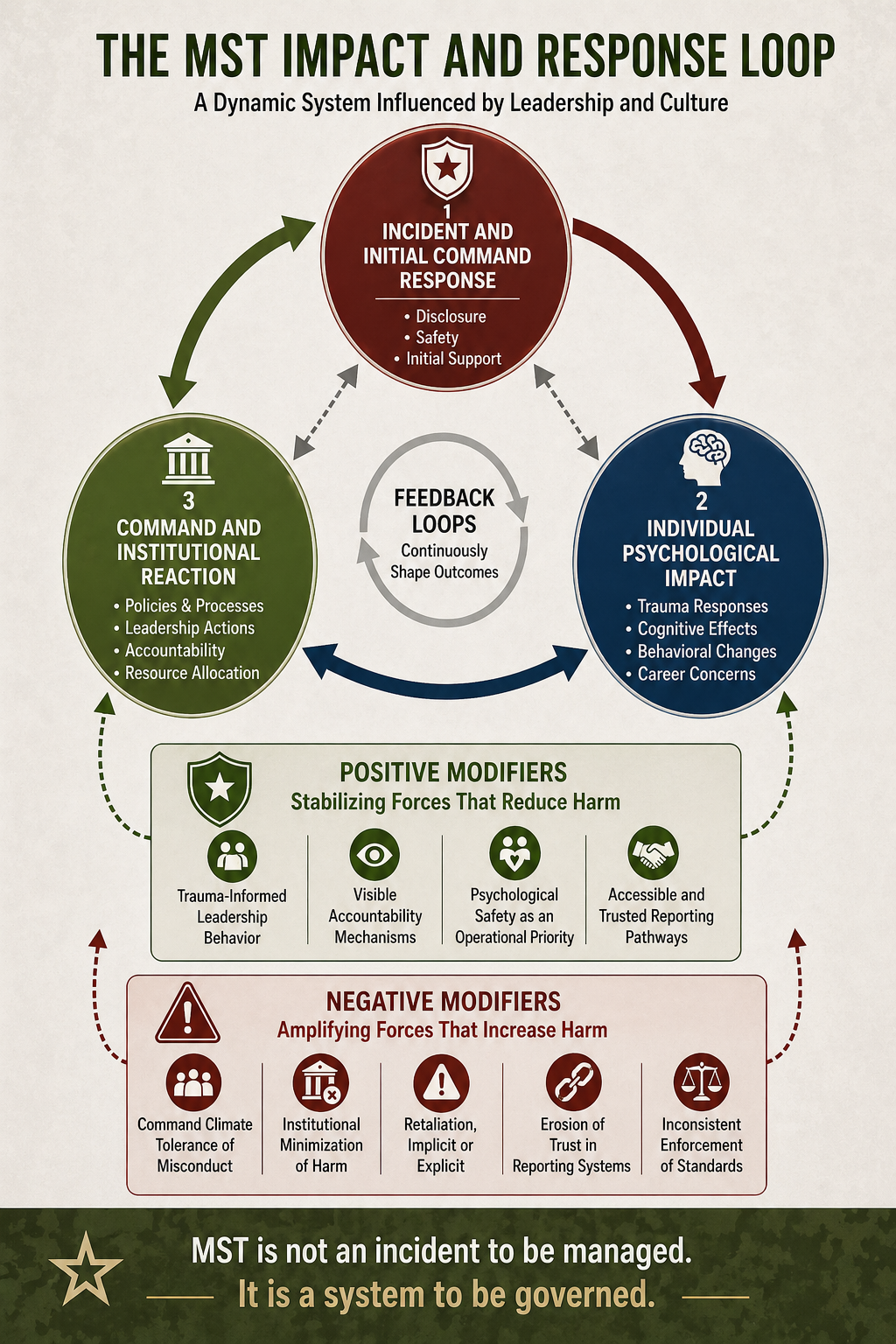
From a consultation standpoint, command climate functions as a psychological multiplier. It can either mitigate or amplify the impact of MST.
A psychologically safe command climate is characterized by clear reporting pathways, visible accountability, and leadership behaviors that reinforce dignity and respect. In contrast, a toxic climate often includes implicit tolerance of misconduct, minimization of complaints, and retaliation against those who report.
Take the example of Staff Sergeant Malik Turner, assigned to a unit with a reputation for operational excellence but poor interpersonal leadership. When a junior enlisted member disclosed harassment, the initial response from leadership was procedural but emotionally detached. The emphasis was on avoiding disruption rather than addressing harm.
Turner observed the process closely. Months later, when he experienced unwanted sexual contact during a training exercise, he chose not to report. His decision was not based on ignorance of policy. It was based on observed reality.
This illustrates a critical point. Policies do not define climate. Behavior does.
For consultants working with command teams, the task is to translate abstract values into observable leadership practices. This includes:
- Modeling appropriate interpersonal boundaries
- Responding to disclosures with clarity and empathy
- Ensuring transparency in investigative processes
- Actively monitoring for retaliation dynamics
Command climate is not a static attribute. It is continuously constructed through micro behaviors and leadership decisions.
Institutional Accountability Beyond Compliance
Most military organizations have established frameworks for addressing MST. These include reporting systems, investigative bodies, and victim support services. While necessary, these structures often operate within a compliance mindset.
Compliance answers the question: Are we following the rules?
Accountability asks a more demanding question: Are we achieving the intended outcomes?
From a systems perspective, accountability requires data integration, feedback loops, and leadership ownership. It also requires a willingness to confront uncomfortable truths about organizational culture.
A useful analogy for someone with experience in high stakes environments, whether clinical or even scuba diving in complex underwater terrains, is this: compliance is checking your equipment before a dive. Accountability is continuously monitoring your environment, your depth, your air supply, and your team, adjusting in real time to prevent catastrophe.
In MST contexts, this translates into:
- Tracking not just reports, but resolution timelines and survivor satisfaction
- Conducting climate assessments that include anonymous feedback
- Holding leaders responsible for patterns within their units, not just individual incidents
- Integrating behavioral health insights into command decision making
Without these elements, institutions risk creating a facade of action without substantive change.
The Role of the Military Psychological Consultant
For clinicians and consultants, particularly those with forensic expertise, MST cases present a unique opportunity to influence both individual outcomes and systemic reform.
The consultant operates across three interconnected domains:
1. Clinical Care
Deliver trauma informed, evidence-based treatment that acknowledges the dual impact of personal violation and institutional betrayal. This includes:
- Validating the survivor’s experience without prematurely steering toward forgiveness or reconciliation
- Addressing career related anxieties as legitimate therapeutic concerns
- Coordinating with medical and legal entities while maintaining patient autonomy
2. Command Consultation
Engage with leadership to translate clinical insights into actionable strategies. This often involves:
- Educating commanders on the psychological impact of MST
- Advising on communication strategies following incidents
- Supporting the development of unit level interventions to restore trust
3. Forensic and Ethical Oversight
In cases that involve investigation or litigation, the consultant may provide expert analysis on:
- Credibility assessments
- Psychological impact statements
- Organizational factors contributing to the incident
This triadic role requires both clinical depth and organizational fluency. It also demands a tolerance for complexity and, at times, ambiguity.
Barriers to Reporting and Engagement
Despite increased awareness, underreporting remains a persistent challenge. The barriers are multifaceted:
- Fear of retaliation or career stagnation
- Perceived stigma associated with victimization
- Lack of confidence in investigative processes
- Cultural norms that prioritize toughness and self-reliance
In one observed case, Lieutenant Aaron Feldman, an intelligence officer, experienced repeated harassment from a peer. Although he recognized the behavior as inappropriate, he reframed it internally as something to endure. His rationale was shaped by a belief that reporting would signal weakness and potentially derail his advancement.
This highlights the intersection of gender norms, military culture, and professional identity. MST is not limited by gender, but male survivors often face additional barriers due to societal expectations around masculinity.
Addressing these barriers requires targeted interventions, including:
- Normalizing help seeking as a component of operational readiness
- Highlighting diverse survivor narratives
- Ensuring confidentiality and clarity in reporting options
Toward a Culture of Integrated Responsibility
Addressing MST effectively requires a shift from isolated interventions to integrated responsibility. This means aligning clinical care, command leadership, and institutional policy around a shared objective: preserving both human dignity and operational effectiveness.
For professionals like yourself, operating in clinical, forensic, and executive advisory roles, this integration is not theoretical. It is practical. It informs how you structure consultations, how you engage with leadership, and how you advocate for systemic change.
The future direction of military psychology in this domain will likely involve:
- Greater use of data analytics to identify risk patterns
- Enhanced training for leaders on psychological safety
- Closer integration between behavioral health and command structures
- Continued emphasis on ethical accountability at all levels
Closing Perspective
MST challenges the foundational assumptions of military cohesion and trust. It exposes gaps between stated values and lived experience. For clinicians and consultants, it also presents an opportunity to influence meaningful change.
The work is not easy. It requires navigating sensitive disclosures, engaging with hierarchical systems, and advocating for individuals within complex organizational contexts.
Yet the stakes are clear. When MST is addressed effectively, the benefits extend beyond individual recovery. They reinforce the integrity of the institution itself.
In the next article, the series will examine moral injury in combat and non-combat roles, expanding the discussion of psychological harm within military contexts and its implications for treatment and leadership.
메타데이터
- post_id
- 5e63fdb0d893
- slug
- military-sexual-trauma-5e63fdb0d893
- url
- https://medium.com/operational-defense-psychology-review/military-sexual-trauma-5e63fdb0d893
- canonical_url
- https://medium.com/operational-defense-psychology-review/military-sexual-trauma-5e63fdb0d893
- author_url
- https://medium.com/@jds3232
- status
- ok
- fetched_at
- 2026-07-17 10:42:52