What Size Commercial Solar System Does My Business Need?
The right commercial solar system size matches your daytime electricity use and available roof space, not just total annual consumption…
What Size Commercial Solar System Does My Business Need?
The right commercial solar system size matches your daytime electricity use and available roof space, not just total annual consumption. Most Australian businesses land between 10 kW and 100 kW+ after reviewing 12 months of interval data. Aim for high self-consumption so every kilowatt-hour offsets expensive grid power rather than low-value exports.
Introduction
Choosing the right size commercial solar system is one of the most important decisions a business owner or facilities manager will make. Go too small and you leave savings on the table. Go too large and you risk exporting excess generation at low feed-in rates while tying up capital that could have been used elsewhere.
Australian businesses are well placed. Many operate during daylight hours, so solar generation lines up neatly with demand. Electricity prices remain high, and federal incentives through the Clean Energy Regulator still reduce the net cost of systems under 100 kW via Small-scale Technology Certificates (STCs). Larger systems can generate Large-scale Generation Certificates (LGCs) for ongoing revenue.
This guide walks through the practical steps we use at United Energy Group when sizing commercial systems. It draws on real load-profile analysis, roof assessments and current Australian network and rebate rules. By the end you will know what data to gather, how system size is calculated, and what questions to ask any installer before signing a contract.
How do you work out the right commercial solar system size?
The correct commercial solar system size is the one that maximises self-consumption of the electricity it generates while staying within physical and network limits. Start with your actual daytime load, not a rule-of-thumb based on roof area or annual bill total.
Most commercial installers request 12 months of interval meter data (usually 15- or 30-minute readings) from your electricity retailer. This data shows exactly when your business uses power. Overlay expected solar generation for your location and roof orientation, then size the array so that the majority of production is used on site. Industry practice commonly targets 60–80 % self-consumption for strong financial returns, especially where feed-in tariffs are low.
Other factors that immediately affect size include usable roof space after walkways, plant and shading, structural capacity of the roof, available switchboard and transformer capacity, and any export limits imposed by your Distribution Network Service Provider (DNSP). Future plans for electric vehicle chargers, heat pumps or expanded operations should also be factored in so the system is not undersized within a few years.
Why does daytime load matter more than total annual usage?
Businesses that run mainly during the day — retail, offices, warehouses, manufacturing, hospitality — are ideal solar candidates because generation and consumption overlap. A café open 7 am–3 pm or a factory with daytime production shifts will self-consume far more of its solar output than a business whose peak load occurs after sunset.
Monthly electricity bills only show total kilowatt-hours. Interval data reveals the shape of the load curve. Two businesses with identical annual consumption can need completely different system sizes if one has a flat daytime baseload and the other has sharp afternoon peaks or heavy overnight refrigeration.
Demand charges (based on peak kW) are another reason precise sizing matters. A well-matched solar system can reduce those peaks, delivering savings beyond simple energy displacement.
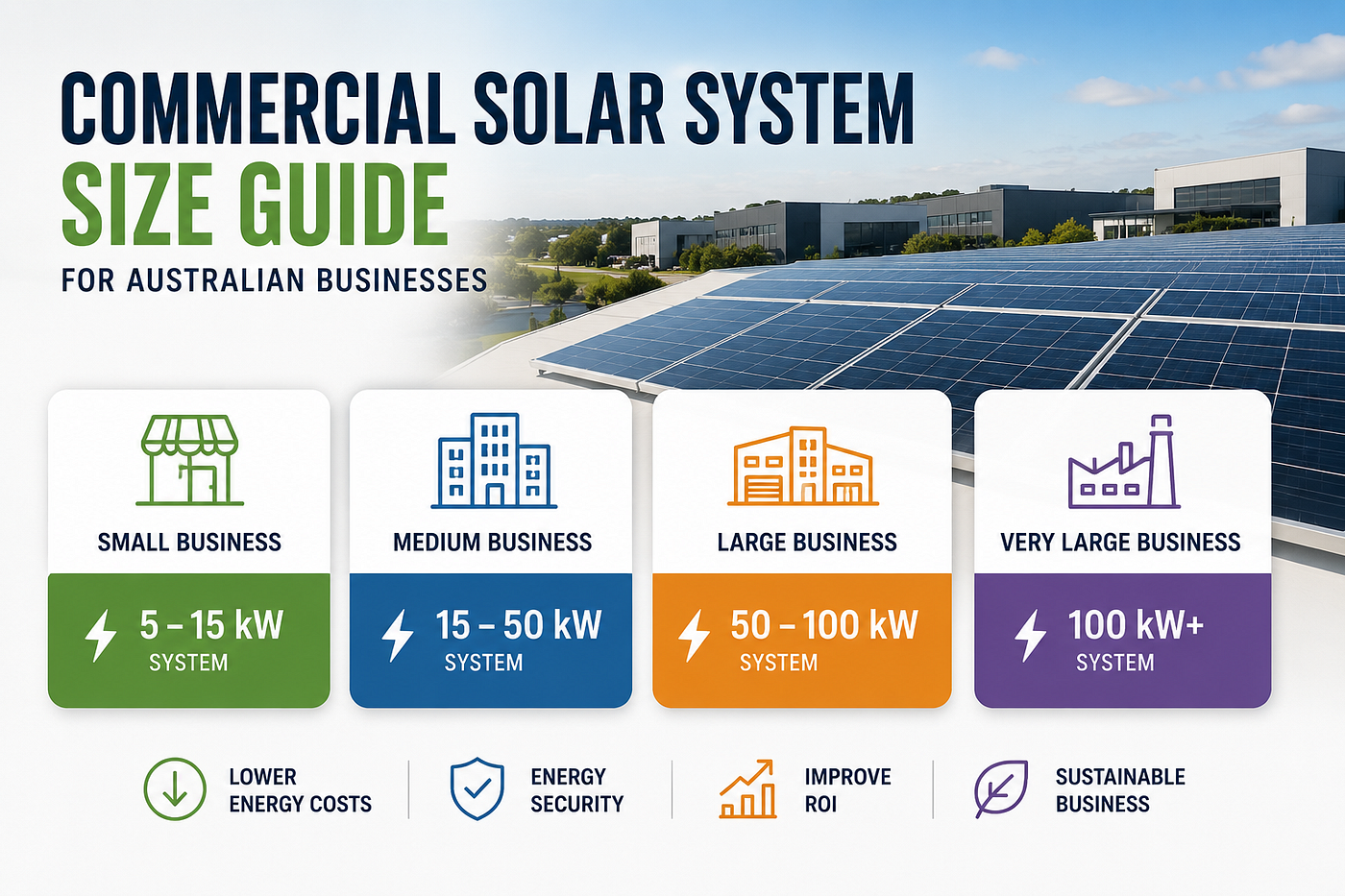
What system sizes suit different types of Australian businesses?
These ranges are practical starting points based on typical Australian commercial profiles. Final sizing always depends on your specific interval data and site constraints.

Systems under 100 kW are treated as small-scale under the Renewable Energy Target and can claim STCs at installation. Systems of 100 kW and above are accredited as power stations and create LGCs based on actual generation each year. Near the 100 kW threshold, careful modelling is required because the financial treatment changes.
How do STCs and LGCs affect the decision?
Under the Clean Energy Regulator’s Small-scale Renewable Energy Scheme, eligible systems of no more than 100 kW can create Small-scale Technology Certificates. These are usually assigned to the installer at the point of sale and reduce the upfront price. The deeming period shortens each year as the scheme winds down toward 2030, so earlier installation captures more value.
Systems of 100 kW or greater fall under the Large-scale Renewable Energy Target. They generate one Large-scale Generation Certificate for each megawatt-hour of eligible generation. LGCs are created and sold over the life of the system, providing an ongoing revenue stream rather than an upfront discount. Accreditation and ongoing reporting requirements are more involved, so experienced commercial installers manage this process.
In Victoria, businesses may also access discounts under the Victorian Energy Upgrades program for systems between 30 kW and 200 kW, subject to eligibility and accredited provider requirements. Always confirm current rules with your installer and the relevant government sites, as programs change.
What role does roof space and structural capacity play?
A modern commercial panel (typically 400–600 W+) occupies roughly 2–2.4 m². Allow extra space for walkways, fire access, existing plant, skylights and shading setbacks. Usable area is often significantly less than total roof area.
Structural engineers may need to confirm the roof can carry the additional dead and live loads, especially on older buildings or lightweight structures. Tilt frames increase wind loading and may require extra ballast or penetrations. Ground-mount or carport options become relevant when roof space is limited or when shading is severe.
Orientation and pitch also matter. North-facing is ideal in most of Australia, but east–west arrays can spread generation across more hours and improve self-consumption for businesses with longer operating days.
How do network rules and export limits influence size?
Your DNSP controls grid connection. Larger systems usually require a formal connection application, technical assessment and sometimes additional protection equipment. Export limits are common; some sites receive zero-export approvals if the local network is constrained.
Modern inverters that support CSIP-AUS or equivalent protocols and emergency backstop requirements (where applicable) help satisfy network rules. Choosing Clean Energy Council approved components simplifies compliance. A good commercial installer will handle the pre-approval process early so the design reflects real network constraints rather than optimistic assumptions.
Should you add battery storage to a commercial solar system?
Battery storage is not automatic. It makes sense when:
- Significant generation would otherwise be exported at low value
- Demand charges are high and the battery can shave peaks
- Backup power for critical loads is required
- Time-of-use tariffs create a large differential between daytime and evening rates
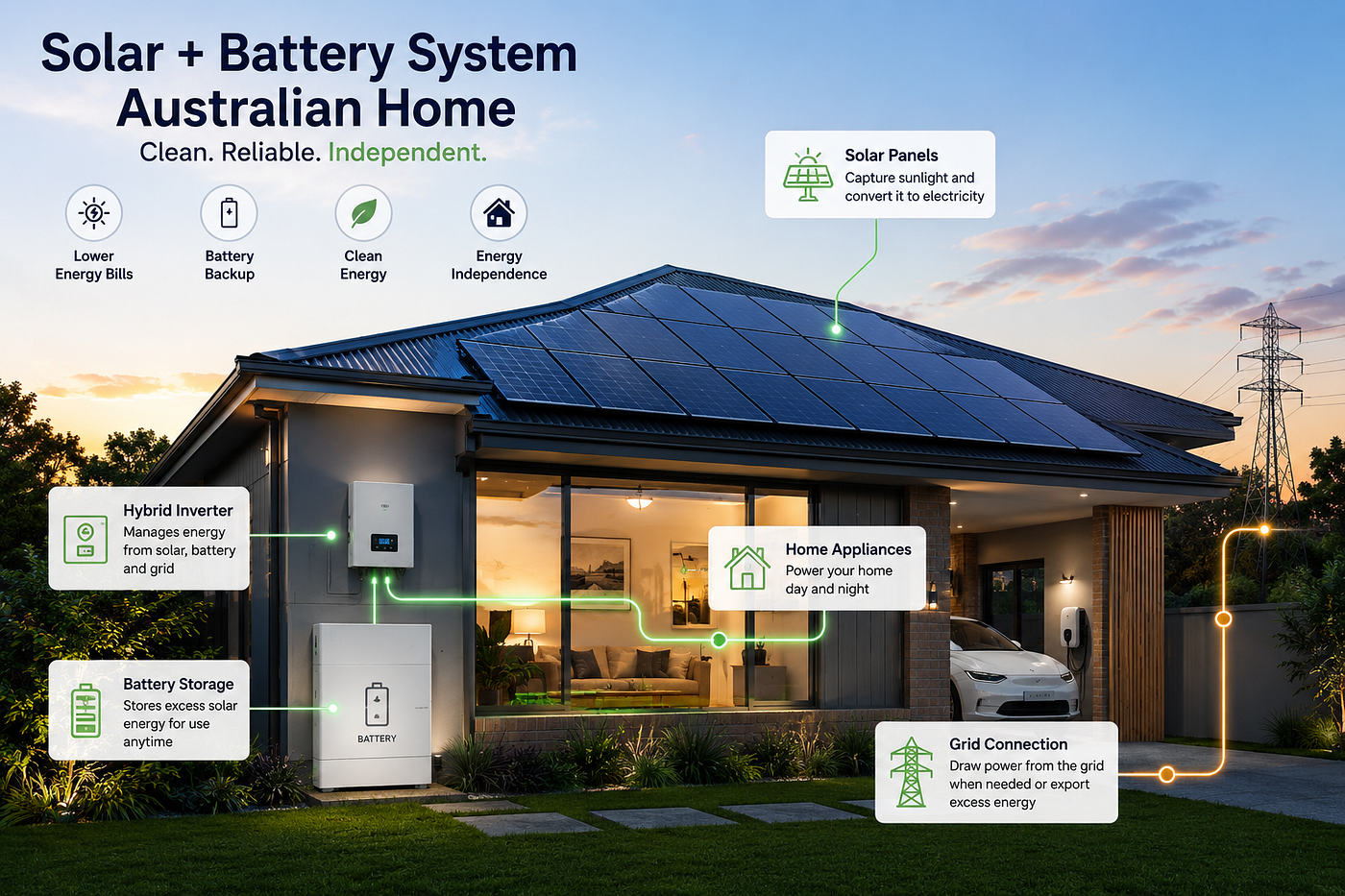
Commercial battery sizing is driven by the residual evening or peak load after solar, not by a simple kWh-per-kW rule. Interval data again provides the foundation. Hybrid inverters or separate battery inverters can be integrated depending on the overall design.
Step-by-step process to size your commercial solar system
- Collect 12 months of interval electricity data and recent bills.
- Note operating hours, shift patterns, seasonal peaks and any planned load growth (EV chargers, new equipment, longer hours).
- Arrange a site assessment: roof condition, orientation, shading, switchboard capacity, structural notes.
- Have the installer model solar generation against your load profile and calculate expected self-consumption and savings under your actual tariff.
- Review options for different system sizes, battery inclusion, and the STC versus LGC boundary if you are near 100 kW.
- Confirm network application requirements and any export limits.
- Obtain a detailed proposal that includes component brands, warranties, expected performance, payback modelling and ongoing monitoring.
- Check that the designer and installer hold appropriate Solar Accreditation Australia credentials and that products appear on Clean Energy Council approved lists.
Practical examples from Australian businesses
A suburban medical centre with steady weekday daytime air-conditioning and equipment loads often lands in the 20–40 kW range. High self-consumption delivers rapid payback.
A warehouse with large roof area and daytime forklift charging and lighting might support 80–150 kW. If the load is flatter, a slightly smaller system relative to roof capacity can still deliver excellent returns by avoiding excess export.
A food-processing site with refrigeration running around the clock may combine a substantial solar array with battery storage sized to cover the evening peak demand charge window.
These outcomes only become clear once interval data is analysed. Generic “fill the roof” advice is rarely optimal for commercial economics.
Common mistakes to avoid
- Sizing purely from the monthly bill or roof area without interval data
- Ignoring future load growth or planned electrification
- Accepting an oversized system that will export most of its output
- Overlooking network export limits until after the design is locked
- Choosing the cheapest quote without checking component quality, installer accreditation or realistic performance assumptions
- Failing to model demand-charge savings where they form a large part of the bill
How many solar panels does a commercial building need? It depends on panel wattage and required system size. A 50 kW system using 500 W panels needs around 100 panels, plus space for walkways and clearances.
Is a 100 kW commercial solar system worth it? Yes for many warehouses and medium industrial sites, provided self-consumption is high. At 100 kW the incentive switches from STCs to LGCs, so modelling both sides of the threshold is important.
How do I calculate commercial solar system size from my electricity bill? Monthly bills are only a starting point. Request 12 months of interval data from your retailer and have a commercial installer overlay solar generation to find the optimal size.
What roof space is needed for a commercial solar system? Roughly 5–6 m² of usable roof per kilowatt of system capacity after allowances for access, plant and shading. A 100 kW system often needs 500–600 m² of clear area.
Do commercial solar systems qualify for STCs? Yes, systems of no more than 100 kW that meet Clean Energy Regulator and Clean Energy Council requirements can create Small-scale Technology Certificates.
What is the difference between STCs and LGCs for commercial solar? STCs provide an upfront discount for systems under 100 kW. LGCs are created annually from actual generation for systems of 100 kW and above and can be sold for ongoing revenue.
How long does a commercial solar system take to pay for itself? Well-sized systems with strong self-consumption commonly achieve payback in 3–6 years, depending on electricity tariffs, system cost after incentives, and location.
Can I install commercial solar if my roof is old? A structural assessment is required. Many roofs can be reinforced or the system can be designed with lighter components or alternative mounting.
Should my commercial solar system include a battery? Only if you have significant residual evening load, high demand charges, or a need for backup. Interval data decides whether the extra cost is justified.
What happens if my commercial solar system is too big? Excess generation is exported at low feed-in rates, reducing the return on investment and potentially triggering stricter network conditions.
Do I need network approval for a commercial solar system? Yes. Larger systems almost always require a formal connection application and technical assessment by your Distribution Network Service Provider.
How much does a commercial solar system cost in Australia? Costs vary with size, components and site complexity. Larger systems generally achieve lower dollars-per-watt. Current market pricing and incentives should be confirmed with a detailed quote.
Can commercial solar reduce demand charges? Yes. By lowering peak demand during daylight hours, solar (and batteries where used) can cut demand-charge components of commercial electricity bills.
What warranties should I expect on a commercial solar system? Quality panels typically carry 25-year performance warranties. Inverters usually carry 5–10 years (extendable). Workmanship warranties from the installer are also essential.
Is commercial solar suitable for leased premises? It can be, subject to landlord approval, lease terms and who owns the system and receives the benefits. Specialist commercial structures are sometimes used.
How do I choose a commercial solar installer? Look for Solar Accreditation Australia credentials, Clean Energy Council product knowledge, proven commercial project experience, transparent load-profile modelling and clear handling of network applications.
Conclusion Getting the size of your commercial solar system right is less about filling every square metre of roof and more about matching generation to the way your business actually uses electricity. Interval data, a thorough site assessment and realistic modelling of self-consumption, incentives and network rules produce systems that deliver reliable savings for years.
United Energy Group designs and installs commercial solar systems tailored to Australian businesses. If you would like us to review your interval data and provide a clear, obligation-free recommendation on the right commercial solar system size for your site, get in touch. We will walk you through the numbers so you can decide with confidence.
메타데이터
- post_id
- 5e7ccc9ab0f8
- slug
- what-size-commercial-solar-system-does-my-business-need-5e7ccc9ab0f8
- url
- https://medium.com/@united_energy_group/what-size-commercial-solar-system-does-my-business-need-5e7ccc9ab0f8
- canonical_url
- https://medium.com/@united_energy_group/what-size-commercial-solar-system-does-my-business-need-5e7ccc9ab0f8
- author_url
- https://medium.com/@united_energy_group
- status
- ok
- fetched_at
- 2026-08-16 19:50:22