White paper: The Governance Machinery for Combining Startup Agility and Enterprise Reliability in…
Tired of hybrid chaos burning 80% of engineering time? Adopt three loops: No-Code → Low-Code → Full Integration. Speed + reliability…
White paper: The Governance Machinery for Combining Startup Agility and Enterprise Reliability in IT
As I’ve said before, we don’t scale solutions — we scale problems when we mix two loops with fundamentally different cultures.
Studies show that teams spend up to 80% of their time on:
- Exploring existing code / product
- Reworking or adding to old code
- Handling incidents
- Making architectural changes
If we had a car that consumed 80% of its fuel just idling and only 20% actually moving cargo, we’d scrap it without a second thought. Yet in business, we keep throwing money at inefficiency and call it “operational cost.” Strange, isn’t it?
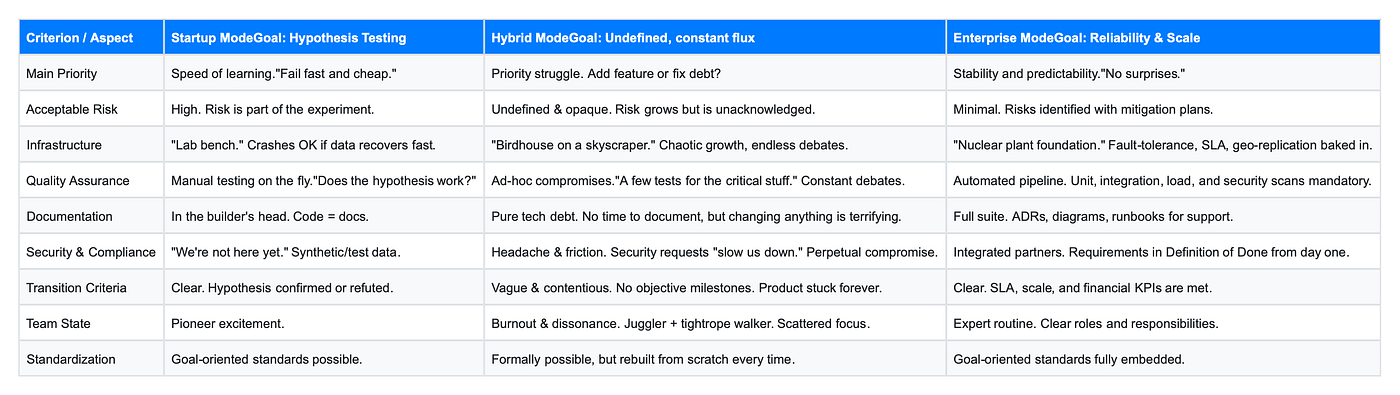
In my previous article, we broke down why the hybrid approach — where a single team tries to combine the speed of hypothesis testing with the rock-solid reliability of production operations — leads to burnout, losses, and strategic failure.
But if hybrid is a dead end, what’s the alternative? How can a large enterprise preserve the entrepreneurial edge of a startup without destroying the stability that its core business depends on?
The answer lies in building a three-loop governance system, where each loop operates by its own rules, has clear objectives, and doesn’t try to be everything to everyone. This isn’t just an organizational chart — it’s a full-fledged governance machinery that demands deep expertise in the Theory of Constraints, regular management practices, architectural approaches, leadership, and a culture of innovation. It’s complex to set up, but it’s the only way to reconcile the two opposing faces of the IT business.
🔄 The Three Loops: No-Code, Low-Code, Full Integration
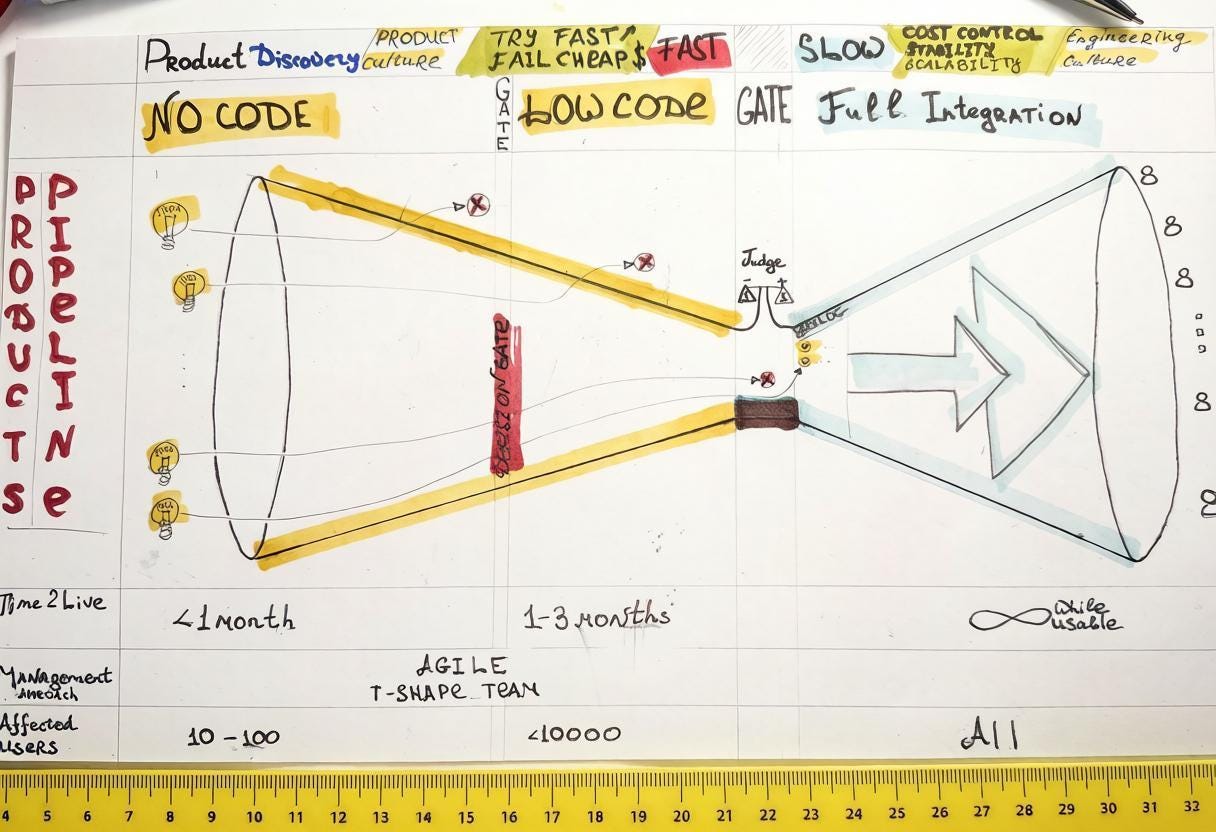
Think of the system as three sequential filters that ideas pass through before becoming scalable products.

Now let’s walk through each loop in detail.
🧪 No-Code Loop: The Idea Lab
This is the least technical loop. There should be no production code in the traditional sense here at all. The team consists of product designers, researchers, marketers, and possibly one developer for rapid prototypes built with no-code builders.
How it works:
- Hypotheses are generated about customer pain points, new features, or changes to the business model.
- Validation uses landing pages with fake buttons (to measure interest), Wizard of Oz (manual work behind the curtain), and Concierge (personalized service for early customers).
- No industrial code — only disposable prototypes on Tilda, Google Forms, and no-code tools.
- The only output is knowledge: is the hypothesis confirmed or not? Should we move forward?
Key metrics: ✅ Cycle speed: hypothesis → experiment → conclusion ✅ Cost per experiment ✅ Hypothesis confirmation rate
❌ The mistake: trying to write code right away or embed the prototype into the shared infrastructure. This kills speed and creates technical debt before the idea is even proven.
⚡ Low-Code Loop: The First-Version Factory
Hypotheses that pass the No-Code loop and show potential value land here. Now we need to build a minimum viable product that real users can actually touch — to validate demand and understand the economics.
How it works:
- The Low-Code team is made up of full-stack generalists who can quickly assemble a working prototype with minimal but sufficient functionality.
- Code is written fast, often “in debt” — the priority is getting the product to early customers and starting to collect data.
- They use off-the-shelf libraries, cloud services, and templates. Integrations with corporate security and fraud monitoring systems are not required (at this stage, risks are low and speed matters more).
- The team analyzes user behavior, gathers feedback, and iterates rapidly.
Key metrics: ✅ Time from idea to first user (Time-to-Live) ✅ Customer acquisition cost (CAC) ✅ Retention on early cohorts ✅ Confirmation of unit economics
❌ The mistake: demanding documentation, tests, or corporate standard compliance from the Low-Code team. This turns it into a slow production loop and defeats the entire purpose.
🏭 Full Integration Loop: The Industrial Giant
If the Low-Code loop proves the product is in demand and the economics add up, it moves to the Full Integration loop. This is where a completely different life begins.
How it works:
- The product is rewritten or radically refactored to meet reliability, scalability, and security requirements.
- The team consists of highly skilled engineers, database specialists, DevOps, and SREs. Their job is to make the system run like clockwork under any load.
- Mandatory: load testing, automated test coverage, documentation (ADRs, runbooks), and full integration with all corporate systems (security, compliance, monitoring).
Key metrics: ✅ SLA / SLO ✅ Incident count and mean time to recovery (MTTR) ✅ Operational cost per user ✅ Automation percentage (tests, deployment, monitoring)
❌ The mistake: trying to “patch up” the code written in the Low-Code loop, endlessly accumulating technical debt. It’s cheaper and more reliable to rewrite from scratch with the right architecture.
🔗 How the Loops Interact: The Handoff System
The hardest part is organizing seamless handoffs between loops. This isn’t just “throwing code over the fence.” Clear processes are required:
- From No-Code to Low-Code: what gets handed over is not code, but a package of hypotheses and research results (what was confirmed, what wasn’t, what users expect). The Low-Code team decides how to technically implement the validation.
- From Low-Code to Full Integration: the handoff includes the prototype, operational data, metrics, and — most importantly — proven business value. The Full Integration team doesn’t get stuck maintaining messy code; they get the mission to build a robust system based on validated requirements.
⚠️ Critical: there must be no “gray zones” where responsibility is blurred. This requires clear role definitions and service-level agreements between the loops.
🧠 Governing the Three-Loop System: Competencies and Culture
This system won’t emerge on its own. To launch it, you need:
- Theory of Constraints — to find bottlenecks in the value stream and prevent any one loop from becoming overloaded.
- Regular management — for setting OKRs, allocating resources, and coordinating efforts.
- Technology management — to choose the right tools for each loop and avoid mixing stacks.
- Architectural approaches — to ensure loose coupling between loops (e.g., via clear APIs and contracts).
- Leadership and culture — you need to help teams understand that working in different loops requires different mindsets, and that’s perfectly normal. An engineer from Full Integration shouldn’t look down on the “hacks” from Low-Code, and a product manager shouldn’t demand startup speed from the production loop.
🏁 Conclusion
The three-loop system isn’t just an organizational framework — it’s a way to resolve the tension between innovation and stability at the scale of a large enterprise. It demands serious investment in management competencies and culture, but it pays off handsomely:
- The No-Code loop generates a steady stream of validated ideas with zero development cost.
- The Low-Code loop quickly filters out non-viable options without burdening core engineers.
- The Full Integration loop turns validated solutions into reliable revenue engines.
The key is not to oversimplify the system by sliding back into hybrid chaos. The path to efficiency lies in embracing complexity and building structures that manage that complexity — rather than pretending it doesn’t exist.
🖥️ The Technology Layer: Infrastructure and Data Access
Each of the three loops has fundamentally different infrastructure requirements. Trying to use a single technology stack for all of them is a guaranteed way to slide back into hybrid chaos.
🧪 No-Code Loop: Lightweight and Isolated
- Landing page builders (Tilda, Webflow) and no-code tools.
- Access to external survey services (Typeform, Google Forms).
- Sandbox with anonymized data (analytical replicas) — to test hypotheses on real patterns without business risk.
- Interface prototyping tools (Figma, Miro).
📌 The rule: no production code and no access to real transactional systems. Experiments must die cheaply.
⚡ Low-Code Loop: Flexibility and Read-Only Access
- Isolated environments, separate from production but with similar data profiles.
- Read-only access to analytical replicas of core databases.
- API gateways with rate limiting for controlled interaction with corporate services.
- Short lifecycle — code shouldn’t live longer than 2–3 months. Infrastructure must support rapid creation and teardown of services (containerization, serverless).
🏭 Full Integration Loop: Reliability and Control
- A classic enterprise stack: fault-tolerant clusters, load balancers, monitoring, backups, security scanning.
- Provides services and data to the other two loops in a controlled manner:
- Via analytical replicas (for No-Code and Low-Code).
- Via authenticated, rate-limited APIs (for Low-Code).
- Via a Data Lake / Data Warehouse for reporting.
👥 Team Qualifications: Three Different Worlds, Three Mindsets
The heart of any system is people. Each loop requires specialists with fundamentally different competencies, cognitive styles, and even values.
🧪 No-Code Loop: Designer-Researchers
- Product designers (Figma, prototyping, usability).
- Researchers (in-depth interviews, surveys, behavioral data).
- Marketers (landing pages, targeting, conversions).
- Possibly, one low-code developer (Tilda, Webflow).
Core qualities: curiosity, empathy, creativity, comfort with ambiguity. Career path: deepening research expertise, mentoring on product practices.
⚡ Low-Code Loop: Generalist Speedsters
- Full-stack developers (backend, frontend, databases, deployment).
- Dev-designers (design + markup).
- Data analysts (event tracking, dashboards, initial insights).
Core qualities: speed, adaptability, tolerance for “messy” code, quick decision-making. Career path: horizontal growth — new projects, new technologies, mentoring. Moving to Full Integration requires a profession change.
🏭 Full Integration Loop: Architects and Deep-Specialist Engineers
- System architects (building fault-tolerant systems for years ahead).
- SRE engineers (reliability, automation).
- Database experts (PostgreSQL, ClickHouse).
- Security engineers, QA engineers (load testing, automated tests).
Core qualities: depth, rigor, systems thinking, long-term focus. Career path: the classic engineering ladder — from developer to architect.
📊 Two Parallel Career Tracks: Why You Can’t Mix Them
A common mistake is treating a move from Low-Code to Full Integration as a promotion. This is destructive for both sides:
- A developer who excels at rapid prototyping will get bored by the bureaucracy and long cycles in Full Integration — and will either start making mistakes or burn out.
- A deep-specialist engineer dropped into Low-Code will demand documentation and tests, killing velocity, and will feel deeply uncomfortable in the chaos.
The solution: two parallel career ladders:
- The Researcher/Generalist Track (No-Code + Low-Code) — growth in breadth, new tools, new launches.
- The Expert Engineer Track (Full Integration) — growth in depth, architecture, scale.
Each track has its own levels (junior, senior, lead, expert). They must be equal in status and compensation.
🎯 Governance Structure: Three Captains and One Admiral
Each loop has its own leader, accountable for its specific metrics. Above them sits a single leader who holds the whole system together.
🧪 No-Code Loop Lead (Director of Research)
Metrics: number of experiments, cycle speed, hypothesis confirmation rate, cost per experiment. Scope of responsibility: ends with handing the hypothesis over to Low-Code.
⚡ Low-Code Loop Lead (Director of Launches)
Metrics: Time-to-Live, number of MVPs launched, retention, unit economics, iteration speed. Scope of responsibility: rapid implementation and user validation.
🏭 Full Integration Loop Lead (Director of Engineering)
Metrics: SLA, incidents (MTTR), operational cost, automation rate, platform solutions. Scope of responsibility: stability, scale, profitability.
⚓ The Role of the Overarching Leader (The Admiral)
When each loop has its own metrics, natural tension arises. Without coordination, the system falls apart.
The Admiral’s mandate (Head of Product Engineering / VP of Product Delivery):
- Aligning OKRs across all three loops.
- Resolving priority conflicts (e.g., refactoring vs. urgent launch).
- Monitoring the flow — where is the bottleneck?
- Strategic decisions — what to invest in and what to sunset.
- Preventing the “flooding” of production — having the courage to say “no” to unvalidated hypotheses.
System-level success metrics for the Admiral:
- End-to-end time from hypothesis to scaled production.
- Percentage of ideas that reach Full Integration.
- Ratio of R&D/MVP spend to production revenue.
- Team satisfaction (absence of burnout).
🧠 The key point: the Admiral’s job isn’t to maximize any single loop — it’s to find the balancewhere the company extracts maximum long-term value.
💬 In Lieu of an Afterword
The three-loop system does not tolerate oversimplification. It demands management maturity, cultural readiness, and a willingness to invest in organizational complexity. But it is exactly what allows a large enterprise to retain its entrepreneurial boldness while preserving the rock-solid stability that its business relies on.
This article draws on 12 years of hands-on management experience, formal professional development, and ongoing self-education gained across multiple roles — from Chief Technology Officer and Co-Founder to Team Lead, Unit Lead, and Project Manager.
How are research and production flows organized in your company? Is there a clear separation, or are you still looking for that mythical “universal soldier”? 👇
메타데이터
- post_id
- 5e85f6826d5e
- slug
- white-paper-the-governance-machinery-for-combining-startup-agility-and-enterprise-reliability-in-5e85f6826d5e
- url
- https://medium.com/@avgrudin_14459/white-paper-the-governance-machinery-for-combining-startup-agility-and-enterprise-reliability-in-5e85f6826d5e
- canonical_url
- https://medium.com/@avgrudin_14459/white-paper-the-governance-machinery-for-combining-startup-agility-and-enterprise-reliability-in-5e85f6826d5e
- author_url
- https://medium.com/@avgrudin_14459
- status
- ok
- fetched_at
- 2026-07-28 00:11:24