Subjective or Objective Data Modelling
Data modelling is the backbone of data architecture, serving as a blueprint that structures, organizes, and represents data to support…
Subjective or Objective Data Modelling
Data modelling is the backbone of data architecture, serving as a blueprint that structures, organizes, and represents data to support business and analytical objectives. Within this domain, a pivotal debate arises: should data models be subjective or objective? Understanding the distinction and the interplay between these two approaches is crucial for effective data strategy and decision-making.
What is Data Modelling?
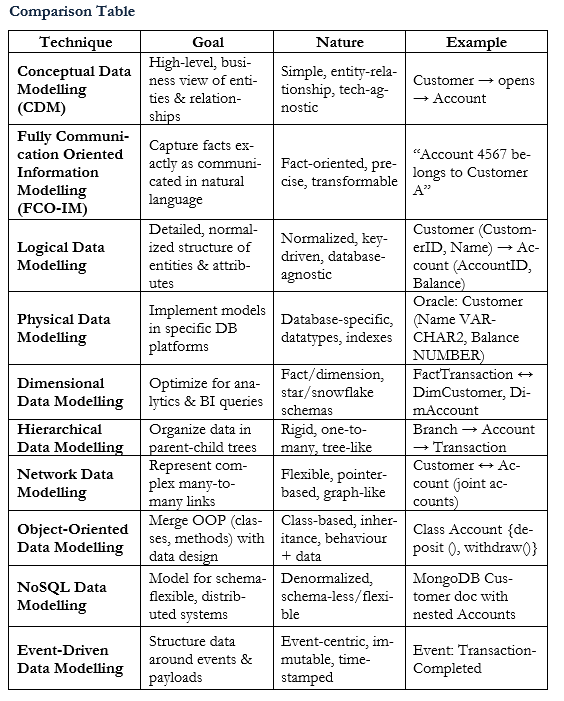
Data modelling is the process of designing a data structure that captures and represents information for a specific purpose. It involves defining data entities, their attributes, and the relationships between them. These models serve as a guide for database design, system architecture, and data analytics.
However, the approach to data modelling can vary based on context, purpose, and perspective:
· Objective Data Modelling: Based on facts, standards, and universal truths.
· Subjective Data Modelling: Influenced by human interpretation, context, and specific needs.
Objective Data Modelling: Rooted in Facts
Objective data modelling focuses on creating universal, context-independent structures. This approach emphasizes data accuracy, consistency, and reproducibility, relying heavily on standards and methodologies like relational modelling or dimensional modelling.
Key characteristics of objective data modelling:
· Data-Driven: Models are built based on factual data available at the source, without contextual interpretation.
· Standardized: Adheres to industry standards such as Normalization for relational databases or Kimball’s methodology for data warehouses.
· Scalable and Repeatable: Designed for broad applicability, making them suitable for large-scale systems.
· Focus on Accuracy: Ensures data integrity and minimizes ambiguity.
Examples of Objective Data Modelling
-
A customer database that records attributes like name, address, and contact details in a normalized structure.
-
A financial reporting model based on International Financial Reporting Standards (IFRS), ensuring consistency across global organizations.
Subjective Data Modelling: Context Matters
Subjective data modelling, on the other hand, incorporates human judgment and context-specific considerations and aligns with the semantic layer in data solutions. It aligns data structures with specific business needs, perspectives, or interpretations. While this approach introduces flexibility, it also risks introducing bias or inconsistency.
Key characteristics of subjective data modelling:
· Contextualized: Tailored to meet the specific needs of a department, team, or user group.
· Flexible and Adaptive: Prioritizes usability and relevance over standardization.
· Dynamic Interpretations: Recognizes that the same data can have different meanings or importance depending on the audience.
· Focus on User Experience: Enhances the usability and decision-making ability for specific scenarios.
Examples of Subjective Data Modelling
-
A marketing dashboard highlighting leads and customer engagement metrics relevant to a campaign.
-
A healthcare data model prioritizing patient history based on a doctor’s specialty or focus area.

Choosing the Right Approach
The decision between subjective and objective data modelling is not binary. Instead, it depends on:
-
Use Case: What problem is the data model solving? Generalized models suit enterprise-wide applications, while specific needs benefit from tailored solutions.
-
Audience: Who will consume the data? Analysts, executives, or customers may require different levels of granularity and context.
-
Longevity: Will the model need to evolve? Objective models often serve as a foundation, while subjective models address immediate or changing needs.
Balancing Subjective and Objective Data Modelling
Modern data strategies often blend these approaches to create hybrid models. For example:
· Layered Models: An objective core model (data warehouse) supports subjective views (dashboards, analytics).
· Metadata Enrichment: Metadata adds contextual information to otherwise objective data structures.
· Feedback Loops: Business insights from subjective models feed back into objective data refinement.
This balance ensures that models remain relevant, scalable, and insightful.
Challenges in Implementing Subjective and Objective Models
· Data Governance: Aligning subjective flexibility with objective consistency requires robust governance frameworks.
· Stakeholder Alignment: Bridging the gap between technical teams (objective focus) and business users (subjective focus) can be challenging.
· Evolving Standards: Adapting to changing business needs without compromising objective integrity.
The Future of Data Modelling
The rise of advanced technologies like AI and machine learning adds new dimensions to this debate. For instance:
· AI-driven models can adapt dynamically, balancing subjective and objective perspectives.
· Knowledge graphs and graph databases enable context-rich (subjective) views built on factual (objective) foundations.
Organizations that navigate this balance effectively will gain a competitive advantage, leveraging data as both an asset and a strategic tool.
메타데이터
- post_id
- 5e8b281be7cd
- slug
- subjective-or-objective-data-modelling-5e8b281be7cd
- url
- https://medium.com/i-am-datapedia/subjective-or-objective-data-modelling-5e8b281be7cd
- canonical_url
- https://medium.com/i-am-datapedia/subjective-or-objective-data-modelling-5e8b281be7cd
- author_url
- https://medium.com/@mustafaisonline
- status
- ok
- fetched_at
- 2026-06-12 18:14:10