Volcanoes as a Possible Refuge for Life During the End-Cretaceous Mass Extinction
Hypotheses and models on the role of the Deccan Traps in modulating climate and potentially facilitating the survival of certain species…
Volcanoes as a Possible Refuge for Life During the End-Cretaceous Mass Extinction
Hypotheses and models on the role of the Deccan Traps in modulating climate and potentially facilitating the survival of certain species during the K/Pg event
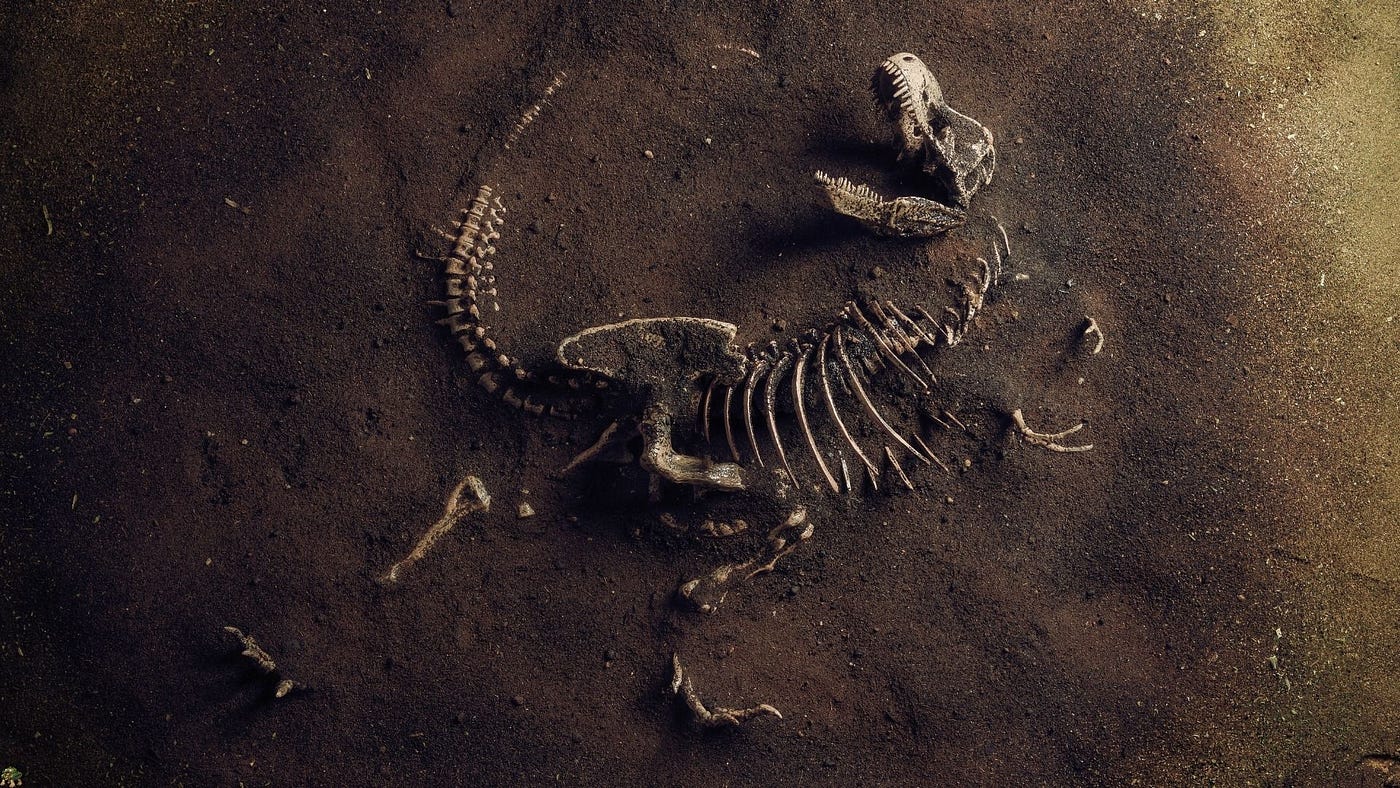
Illustration of a Tyrannosaurus rex skeleton. Powered by Canva
We all know, in one way or another, how the dinosaurs went extinct — or rather, the non-avian dinosaurs, since modern birds have survived to the present day. What is particularly interesting is that the most widely accepted scientific theory is that the extinction was caused by the impact of a celestial body, which led to the extinction of many groups. However, there are other researchers who instead support an extinction primarily driven by volcanic eruptions.
What follows is that, setting aside this debate, volcanoes may have played a fundamental role in the “protection” of those species that did not go extinct at the end of the Cretaceous, about 66 million years ago. This is because volcanic activity may have “warmed” the planet after a dark period characterized by low temperatures.
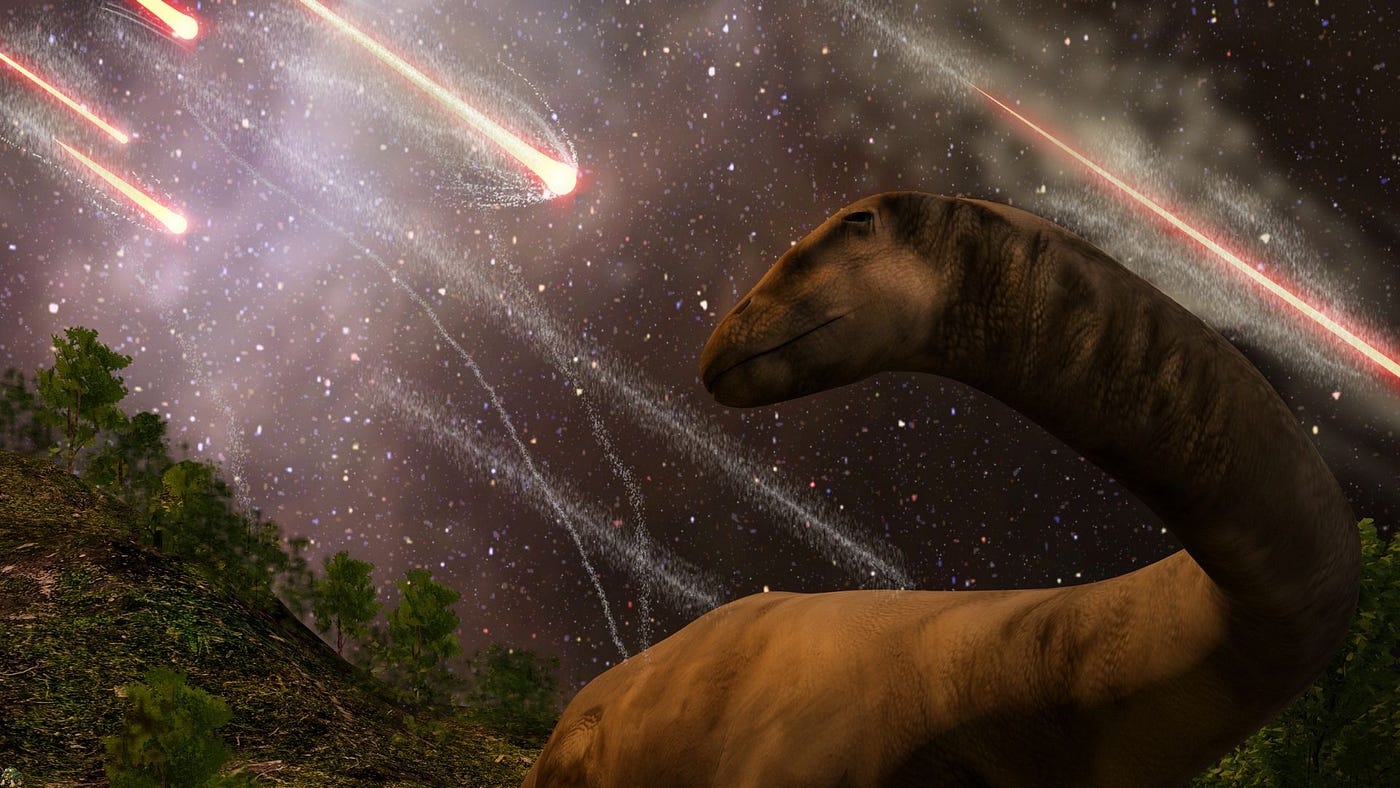
Illustration of a sauropod during the great event at the end of the Cretaceous period. Powered by Canva
This study is very important because it can provide significant information on how the Earth and organisms respond to rapid environmental change. Modeling tools were used that allowed researchers to simulate devastating scenarios through three situations: the impact of the celestial body, volcanic eruptions alone caused by the Deccan Traps, and a combination of the previous scenarios. The celestial body left a crater approximately 190 km wide, and large amounts of material were released into the atmosphere from the impact site, which cooled the planet. Immediately afterward, the skies darkened, a multitude of tsunamis occurred, and many areas were affected by a kind of fire rain across an area spanning hundreds of kilometers.
In all of this, the most striking and disturbing result is that temperatures dropped by more than 30°C, and approximately three-quarters of the species present on Earth at that time went extinct. Among the main contributors to the extinction was likely an extensive volcanic complex (the Deccan Traps) located in what is now southern India, which released, during its eruptions, over 800,000 cubic kilometers of lava and an unimaginable quantity of gases that altered the climate.
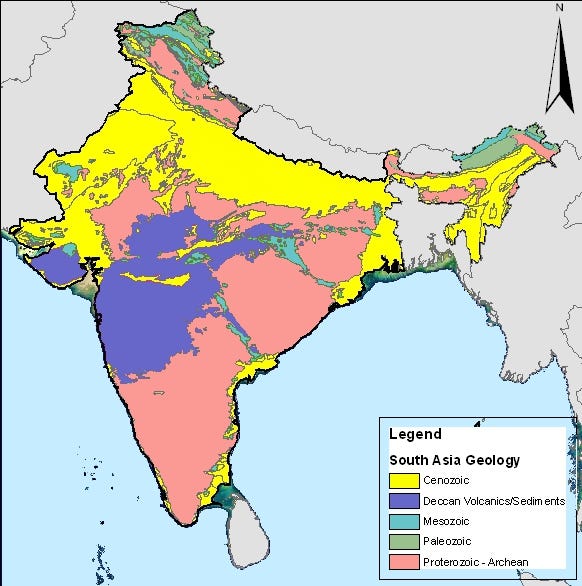
Geological zones of India, highlighting the Deccan Traps, one of the largest volcanic provinces on Earth, formed by massive flood basalt eruptions at the end of the Cretaceous (~66 million years ago) and often discussed in relation to the environmental changes surrounding the Cretaceous–Paleogene transition. Image by CamArchGrad, released into the public domain via Wikimedia Commons.
It has long been assumed that they actively contributed to the extinction of non-avian dinosaurs and other species, but their role may be reconsidered (although their participation in the extinction is not excluded). Through simulations, the sole effect of the celestial impact rendered Earth inhospitable for all non-avian dinosaurs, whereas the Deccan Traps volcanism may have made Earth more hospitable.
Geological data indicate that the Deccan Traps may have erupted repeatedly over a period of about 700,000 years, overlapping with the Chicxulub impact. Therefore, the Traps could have influenced life on Earth in the short term, when the release of sulfur dioxide may have cooled the planet and contributed to acid rain; in the long term, they may have released large amounts of CO₂, leading to a warming of global temperatures.
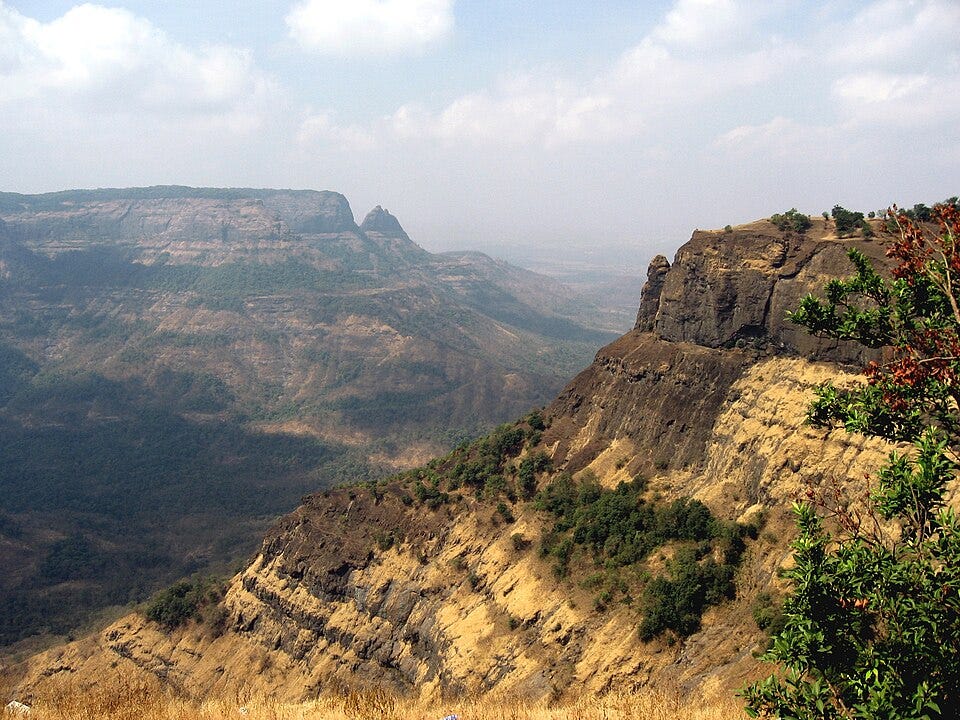
Western Ghats hills at Matheran, Maharashtra (India), part of the ancient Deccan Plateau margin. The Western Ghats represent one of the oldest mountain chains in India and are closely linked to the geological evolution of the Deccan Traps volcanic province, which played a major role in shaping the Indian subcontinent’s topography and Late Cretaceous–Paleogene environmental changes. Image by Nicholas (Nichalp), via Wikimedia Commons, licensed under CC BY-SA 2.5.
The simulations were designed taking both events into account, and the fossil sites where dinosaur remains have been found were mapped. Overall, the results indicate that the Deccan Traps may not have caused the die-off of non-avian dinosaurs and other species, but they may instead have expanded their distribution and habitats. Overall, the simulations indicate that temperatures dropped by between 20 and 30 °C, well below freezing, and precipitation decreased by as much as 95%. Thus, the Deccan Traps may have allowed life to find a temporary refuge and to proliferate, thanks to the released CO₂, which in some way acted as a buffer against the severe winter temperatures. The volcanoes erupted continuously over hundreds of thousands of years without disrupting life in the same way as rapid, large-scale events.
A previous publication indicates that in the tens of thousands of years following the Chicxulub impact, the oceans acidified almost immediately due to acid rain, but ocean pH remained stable for at least 100,000 years before the impact, when the Deccan Traps were already erupting. Another study also suggests that 300,000 years before the impact, global temperatures fluctuated in response to CO₂ released by volcanic activity, but this does not appear to have been an extreme condition, since temperatures increased by “only” about 2.2 °C.
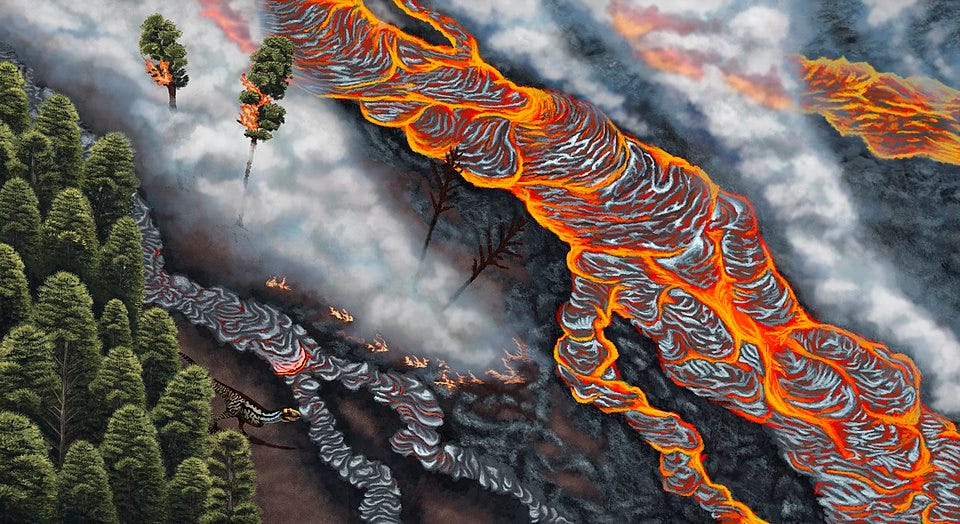
Reconstruction of Rajasaurus in the Lameta Formation (India), closely associated with the Deccan Traps volcanic province. This depiction illustrates Late Cretaceous ecosystems that were strongly influenced by volcanic activity linked to the Deccan flood basalts, one of the largest igneous events in Earth’s history and a key factor in discussions about the end-Cretaceous environmental crisis. Image by Leonardo HerSan, via Wikimedia Commons, licensed under CC BY-SA 4.0.
Let’s briefly examine why the Deccan Traps may have played a role in the recovery of life:
- The cooling induced by the celestial impact may have been mitigated by volcanic eruptions, which acted as a “buffer” against the cooling effect.
- During this catastrophic event, fossil evidence indicates an increase in mammalian diversity and body size, coinciding with warming pulses and the radiation of major angiosperm clades. This may be linked to the enrichment of gases released by volcanism.
- At the impact site, communities re-established within 30,000 years after the K/Pg boundary, suggesting a rapid recovery of marine productivity. This contrasts with previous studies that proposed prolonged volcanism delayed ecosystem recovery. There is no clear evidence of a sustained decline. Marine macrofossils from Antarctica indicate that a sudden catastrophic factor triggered the extinction. This event appears to have lasted less than 1,000 years, and only sea-surface temperatures were affected by the extinction event, while the rest of the water column (>1,000 m) was not significantly impacted, suggesting that the marine environment recovered quickly, within a few thousand years to 1 million years.
- The rocks affected by the Chicxulub impact released hundreds of gigatonnes of sulfates, and in addition to lowering temperatures by almost 30 °C, temperatures remained below freezing for only 3 to 16 years, with full recovery within 30 years. The event, overall, was relatively short compared to what might be expected from volcanic eruptions, and recovery was rapid, as would be expected in a volcanic context. Even the tropics were affected by this temperature drop.
Non-avian dinosaurs were the most severely affected and went completely extinct; mammals, birds, and squamates also suffered major losses, while crocodilians, choristoderes, and turtles were less affected. Body size, diet, habitat, physiology, and geographic range may have played a role, all of which may be linked to temperature fluctuations. Ecosystem structure can be severely impacted by drastic temperature changes.
Thermal refugia may have been associated with deep valleys, fluvio-lacustrine systems, coastal regions, and tropical zones, which could have provided shelter for taxa such as mammals, birds, turtles, crocodilians, lizards, and snakes.
Source:
A.A. Chiarenza, A. Farnsworth, P.D. Mannion, D.J. Lunt, P.J. Valdes, J.V. Morgan, & P.A. Allison, Asteroid impact, not volcanism, caused the end-Cretaceous dinosaur extinction, Proc. Natl. Acad. Sci. U.S.A. 117 (29) 17084–17093, https://doi.org/10.1073/pnas.2006087117 (2020).
Published in Palaeopress. **Follow **to explore everything old!
메타데이터
- post_id
- 5e8cc17e6913
- slug
- volcanoes-as-a-possible-refuge-for-life-during-the-end-cretaceous-mass-extinction-5e8cc17e6913
- url
- https://medium.com/palaeopress/volcanoes-as-a-possible-refuge-for-life-during-the-end-cretaceous-mass-extinction-5e8cc17e6913
- canonical_url
- https://medium.com/palaeopress/volcanoes-as-a-possible-refuge-for-life-during-the-end-cretaceous-mass-extinction-5e8cc17e6913
- author_url
- https://medium.com/@mattia.paparo1994
- status
- ok
- fetched_at
- 2026-07-09 08:27:28