How OXO turned a simple peeler into a universal design icon
What we can learn about inclusive design from the Good Grips story
How OXO turned a simple peeler into a universal design icon
What we can learn about inclusive design from the Good Grips story

©OXO
How did OXO become a big name in Universal Design?

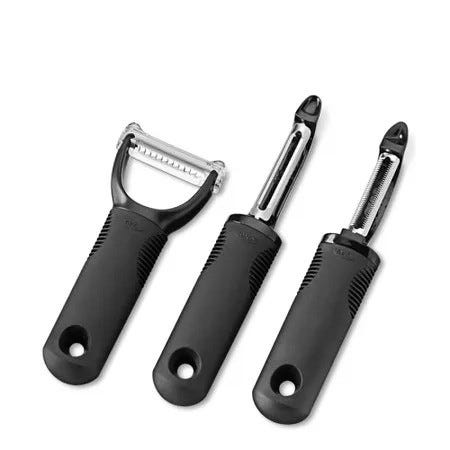
OXO Good Grips Peeler is considered as the poster child when talking about Universal Design ©OXO

100 great designs of modern times © Illinois Institute of Technology
Look at the table above: 100 great designs of modern times.
What products do you expect to see in that table?
I’ve never expected to find a humble kitchen peeler with thick rubbery handles in the list, and it is ranked at the 6th position.
Fortune magazine and the Institute of Design (ID) at Illinois Institute of Technology collaborated to re-run the 100 Best-Designed Products research. The study was originally done in 1959 by then-director of ID Jay Doblin, based on a survey sent out to 100 famous professionals. To recognize the 60-year anniversary, they partnered once again in 2019.
In the report, we can see familiar products or services such as iPhone (#1), Google (#3), Post-it Note (#15) and Amazon Prime (#24). After seeing all these influential products and services, it makes us even wonder what is so special about the kitchen peeler.
Let’s have a look at the comment featured in Fortune.
“Perhaps the best example of inclusive design, this peeler and the Good Grips line of innovations shows that design made more accessible to all is also better design for everyone.”
- Brandon Schauer, Head of enterprise design, Capital One.
User-oriented design: serious about grip
The legendary OXO’s origin story began domestically with Sam Farber and his wife Betsey. In the late 1980s, they both were on a holiday in Southern France. Sam watched his wife peeling apples for a tart. She was struggling with a standard metal peeler due to her mild arthritis. Sam was not happy about the kitchen tool, and it was the spark.

Peeling puts a lot of strain on hands and wrists. The primitive all-steel design of the time made it worse. ©The Cook’s Cupboard
He had a deep understanding of kitchen utensils from his experience of running cast-iron cookware company COPCO from 1960. He sold the company in 1982, and mostly retired from work for a while. Then, this aha-moment came. To develop the idea, he worked with Smart Design founded by Davin Stowell with whom he had a good relationship since COPCO.

Lots of mock-ups for grip. Optimizing usability is a constant iteration of development and tests. ©OXO
Material that maintains grip even in wet condition
Materials and form are the two most important elements for grip. Material determines how products feel, durability and weight. Form decides whether the tool fits the hand in a way that feels effortless.
Farber and Stowell realized that a kitchen tool needed a rubber-like surface in order to work in wet conditions. The problem was that rubber-handled kitchen tools didn’t exist. They eventually found a material called Santoprene, a type of thermoplastic rubber (TPV).
It’s common across industries today, but in the 1980s it was used mostly for sealing and watertight closures. In the end, they secured the material by partnering with the company called Monsanto that was developing it at the time.
A thick handle for anyone who struggles with fine control
In the prototype stage, the team recruited volunteers from the American Arthritis Foundation to run usability tests. Through observation, they found that people with arthritis needed a handle bigger and fatter than a typical thin stainless-steel handle.
A simple analogy of young children who struggle with thin pencils makes it easier to understand. When children’s fine motor skills are still developing, they find thick crayons more comfortable to use.
The same principle applies. Products for people with arthritis or reduced dexterity should provide better control and comfort through a larger, easier-to-grasp handle. This is why OXO Good Grips peeler has a handle with real volume.

How fin shape handles evolved. It was inspired by the handle of bicycles. ©OXO

A handle of bicycles. Those small raised parts are called ‘fin’ structures. It reduces fatigue, prevents slipping, and maintains traction even when hands are sweaty or wet. ©beautylucky
The ‘fin’ detail for different grip strength
When you hold a peeler, your index finger and thumb naturally form a pinch. Early on, Farber and the Smart Design team explored multiple ways to make that contact point more comfortable and more obvious, so users would intuitively understand where to place their fingers. This is where Farber’s business instincts showed up.
They ended up borrowing inspiration from a bicycle handle that uses fin structure for comfort (Please see a picture above). Besides, it doesn’t become slippery even in wet conditions. The area for the thumb and index finger is filled with fins, so users can press in for more grip when they need it.

They tested the fin spacing and dimensions a lot, and the final design used densely spaced fins. However, finding a manufacturer capable of producing the detail was another problem. ©OXO
Manufacturing
A design isn’t a design until it can be made as a real product. If it can’t be made, it doesn’t exist.
Many times, they were told that their final design with thin fins can’t be manufactured at scale. It seemed to be not feasible to produce it in the U.S. Farber and Stowell went looking for a partner who could implement the details. They even visited a Japanese company that makes samurai swords.
Finally, in 1990, they launched the product at the Gourmet Products Show in San Francisco.

©OXO
Packaging that invites touch
The package makes the finned grip visually obvious and physically accessible. The grip section is outside of the package inviting anyone to test it. The simple black and white identity also helps people easily notice the product in busy retail environments. This packaging system has barely changed in over 30 years.
Problem solving strategy : user perspectives
“We’re not an ‘inventing’ company. We’re an ‘innovating’ company. Innovation is improvement.”
“First, we decide a category and pick the top five best sellers in the market. Then we go out and look for the pain points. We try to see everything the way a real user does, because if you aren’t the user, you can’t find the inconvenience.”
- Alex Lee, Former OXO CEO (from interview with Chosun biz, 2011)
OXO is relentlessly focused on users. The company analyzes and solves every frustration in detail. This philosophy came from the founder Sam Farber, and it was Alex Lee who carried it forward and turned it into a system.
Alex Lee became OXO’s CEO in the mid 1990s, following founders Sam and John Farber. He was a designer by training. Alex studied product design at Parsons School of Design in New York, then spent 8 years working under postmodern architect Michael Graves. Later, he did an MBA from Harvard and went on to lead OXO International for more than two decades until 2017.
In a 2011 interview, the company’s philosophy ran through the entire conversation: OXO is an ‘innovation’ for inconveniences users live with every day. It aims for both commercial success and exceptional usability. As can be seen from the quote above, it studies best selling products and makes them easier and comfortable to use. You can see that philosophy across the product line below.

A salad spinner solves a very ordinary problem. OXO made drying washed greens as simple as pressing a button. The design was led by the New York-based agency Pensa. ©OXO

The organizer is designed for items to be hung and removed effortlessly. Even long-handled tools like brooms can be stored with a one-handed push. Insert the tool from the front and it locks securely into a non-slip gripping system. This was designed by Smart Design. ©OXO
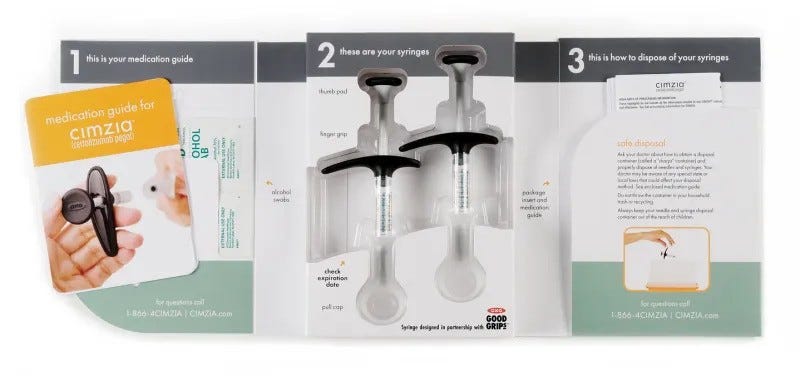

OXO’s Good Grips partnered with global biopharma company UCB to create an injection device and packaging system designed for people with difficulty using their hands. The injector has a hook which makes it easier to remove its cap and inject. The design was also done by Smart Design. ©OXO

These are OXO’s airtight dry food containers. Pressing a button on the lid seals the lid, and pressing it again makes the button pop up and become a handle. These were designed by the Japanese design agency Form. ©OXO
Operation strategy : Design outsourcing
As Alex Lee put it in the interview, “OXO doesn’t have an in-house design team. We partner with external design agencies.” From the beginning, OXO builds products through long-term partnerships with outside design studios. Since the mid 2010s, the company has developed an internal design team and released in-house designed products such as the Frame Rack (2020) and the Scale with Timer (2018).
However, most Good Grips lines have come from external collaborations. The longest-running partner is Smart Design, which has worked with OXO for 30 years since Sam Farber’s era. Lee also mentioned that OXO partnered with 7 in the U.S. and 2 in Japan, including Smart Design, Pensa, Boston Labs, Bally and Form. Japanese studios tended to lead on an airtight container system, while Good Grips lines and digital products were designed mostly in the U.S.

OXO’s Good Grips grater lineups, designed by Bally based in Pittsburgh. Even after OXO built an internal design function in the 2010s, the outsourcing model remained strong because as Lee suggested, it allowed the company to develop multiple design directions in parallel. ©OXO
OXO’s principles for inclusive product design
Intuitive interaction is ‘must’
Truly intuitive products don’t need explanations. Everyday products such as kitchen tools shouldn’t need instructions to use. For those with limited hand mobility or low vision, intuitive design matters because it ties to their confidence, dignity and self-respect.
User experience is not limited to the time at ‘use’
We tend to define ‘user experience’ as the moment of use, but it actually includes every touchpoint: storing, carrying, even cleaning. Take a vacuum cleaner, for example. Experience around it is not only hoovering over the floor. What about cleaning the vacuum itself like pulling hair and dust out of the head or dealing with tangled debris inside.
What’s impressive about OXO is that the design also takes those maintaining moments into consideration.
Inclusive usability ‘without’ stigma
Inclusive design is not the design for people with arthritis.
In the early days of the Good Grips peeler, OXO put a certification from the Arthritis Foundation on the packaging. But, Farber and Smart Design eventually realized that the most important part of inclusive design is avoiding stigma. If a product is labeled ‘for people with arthritis,’ then the audience shrinks.
Instead, OXO expanded its target: people with temporary hand mobility issues (like injury), older users whose grip strength has changed, anyone who simply wants better control and comfort. That shift is part of why the Good Grips peeler became a kitchen tool for anyone who wants a better grip.
Inclusive design can begin with the needs of a specific group of people. But when it’s done well, the benefit expands and ends up improving the experience for everyone. That may be one of the most important directions design can take today.
All my articles are grounded in real-world insights drawn from recent projects. Each piece is carefully crafted by me and thoughtfully edited by Andy Taekhyung Kim in the UK. By reading and sharing my stories, you’re supporting a genuine human effort to make the world a more inclusive place.
If you’re interested in insights on inclusive UX and accessibility, particularly in South Korea, the UK, or Southeast Asia, feel free to reach out (hello@missionit.co). I’d love to connect.
메타데이터
- post_id
- 5e93181f033e
- slug
- how-oxo-turned-a-simple-peeler-into-a-universal-design-icon-5e93181f033e
- url
- https://medium.com/design-bootcamp/how-oxo-turned-a-simple-peeler-into-a-universal-design-icon-5e93181f033e
- canonical_url
- https://medium.com/design-bootcamp/how-oxo-turned-a-simple-peeler-into-a-universal-design-icon-5e93181f033e
- author_url
- https://medium.com/@hello_37058
- status
- ok
- fetched_at
- 2026-06-09 15:37:30