When Island Nations Finally Get a Seat at the Table: Can SIDS Actually Win Climate Finance at COP31?
When Enele Sopoaga, Tuvalu’s prime minister, walked to the podium at COP23 in 2017, he literally waded through water. The staging was…
When Island Nations Finally Get a Seat at the Table: Can SIDS Actually Win Climate Finance at COP31?
When Enele Sopoaga, Tuvalu’s prime minister, walked to the podium at COP23 in 2017, he literally waded through water. The staging was deliberate — Tuvalu was drowning, and the world needed to see it. Nine years later, that same nation will host a leaders forum on climate action, not as a desperate plea for attention but as a deliberate power play in global climate politics. This shift from symbolic drowning to structural leverage marks the most significant realignment of climate negotiating power since the Paris Agreement.
Small Island Developing States are about to get their moment. But they’ll need to seize it ruthlessly.
The Setup: How SIDS Got Handed the Negotiating Playbook
For decades, island nations have shown up to climate conferences, given stirring speeches about rising seas and disappearing coastlines, and then watched wealthy countries negotiate their climate obligations behind closed doors. It was theater masquerading as participation. The system was rigged, and everyone knew it.
This year’s climate negotiation architecture is different — almost shockingly so. The Pacific will host the UNFCCC Pre-COP, meaning preliminary negotiations happen in Fiji before the main conference even starts in Turkey. That’s not just symbolic geography; it fundamentally changes who sets the agenda. When you control the preliminary conversation, you shape everything that follows.
Then there’s the split presidency arrangement that reads like political theater but actually matters. Turkey holds the official presidency as host nation. Australia gets the newly created role of “President of Negotiations” — which sounds ceremonial until you realize it means Australia literally drafts negotiation texts, selects who facilitates which discussions, and manages the communication strategy for the entire conference.[5] That’s enormous power.
Why does this matter for SIDS? Because Australia is invested in the Pacific. It’s their backyard geopolitically and economically. An Australian presidency negotiating under pressure from its Pacific neighbors carries different weight than, say, a wealthy European nation that views island nations as a distant climate justice issue.
Add in Turkey’s explicit commitment to protect “development priorities” for developing countries,[4] and suddenly SIDS have two major powers positioned — at least rhetorically — to champion their interests. It’s the most favorable institutional setup island delegations have had in years.
The Money Problem: Billions Promised, Pennies Delivered
Here’s the thing about climate finance: rich countries love making pledges and hate writing checks.
SIDS contribute roughly 0.03 percent of global greenhouse gas emissions — essentially nothing. Yet they face the most severe climate impacts on the planet.[2] A one-meter rise in sea levels would devastate island economies dependent on tourism and fishing. Kiribati, with a population of 130,000 spread across 33 atolls, sits barely above sea level. For citizens there, climate change isn’t an environmental concern — it’s an extinction event.
The finance gap is staggering. SIDS need approximately $60 billion annually to adapt to climate impacts and pursue low-carbon development.[2] They currently receive perhaps $5–10 billion annually through existing climate finance mechanisms. The gap is so wide it might as well be an ocean — which, ironically, is exactly what threatens to swallow these island nations.
Last year’s COP30 in Brazil made headlines by committing to triple adaptation finance globally. That sounds massive. And it is. Except the problem is identical to every other climate finance commitment: the money gets lost in bureaucratic machinery before it reaches the nations that need it most.
Take a typical SIDS climate project. A small island nation identifies a urgent adaptation need — seawalls to protect fishing villages from storm surge, or mangrove restoration to build natural coastal barriers. They apply for funding through the Green Climate Fund or multilateral development banks. Then comes the nightmare. The application requires environmental impact assessments, rigorous due diligence processes, detailed project implementation plans, proof of co-financing commitments, and technical capacity demonstrations. Many SIDS lack the staff or expertise to navigate this bureaucratic labyrinth. By the time a small island ministry gets through the paperwork, larger nations with better-resourced climate departments have already captured available funding.
That’s not accidental inefficiency. That’s a system designed for wealthy countries with extensive technical capacity.
The Climate Finance Accessibility Crisis Nobody Talks About
A recent Forbes investigation revealed something damning: SIDS remain systematically locked out of existing climate finance mechanisms despite decades of policy commitments to support vulnerable nations.[1] The research found that complex application processes, stringent co-financing requirements, and finance instruments designed for larger economies created barriers that made many SIDS ineligible for funding they theoretically qualified for.
One example: the Green Climate Fund allows projects to be 50% donor-funded, meaning SIDS must contribute the other 50% themselves. Sounds reasonable until you realize that Tuvalu’s entire annual government budget is roughly $45 million.[2] A $10 million coastal adaptation project would require $5 million in co-financing — more than 10 percent of the nation’s entire budget. Most development priorities fall apart under that weight.
COP30 acknowledged this problem and shifted toward “needs-based” climate finance allocation instead of capability-based approaches. In practical terms: your access to climate funding should be determined by how much climate risk you face, not by your administrative sophistication. It’s an obvious principle that somehow took the international climate system a quarter-century to embrace.
COP31 will take this further. The conference will feature a dedicated session focused specifically on SIDS’ climate finance needs, with pledges directed toward the new Pacific Resilience Facility.[2] This facility becomes critical infrastructure for island nations — not just another funding pool but a specialized mechanism designed for SIDS’ unique economic circumstances.
The Renewable Energy Revolution: Island Nations Can Win This One
Here’s where SIDS actually catch a break from geography and climate physics.
Most island nations sit in tropical or subtropical regions with exceptional solar resources and consistent trade winds — perfect for renewable energy. Yet many islands pay 20–40 cents per kilowatt-hour for electricity because they import diesel for power generation.[2] By comparison, average US electricity costs roughly 12 cents per kilowatt-hour. That cost difference crushes island economies, raising the price of everything from hotels to hospitals.
COP30 delivered a $1 trillion global agreement on clean grids and infrastructure.[1] If even a fraction of that gets channeled to island energy transitions through accessible financing, it could transform island energy economics within a decade. Fiji could harness its solar potential to cut energy costs in half. Tuvalu could become energy independent. Kiribati could redirect the wealth spent on diesel imports into education and healthcare.
This isn’t charity. It’s economic transformation that simultaneously cuts emissions and improves island economies. That’s the rare climate win-win that actually works.
The timeline matters here too. COP31’s clean infrastructure commitments need to translate into actual project financing and installation by 2028 to hit 2030 climate targets. That’s tight. SIDS need to emerge from November’s negotiations with concrete mechanisms — not pledges, but actual financing pathways — that allow island nations to begin utility-scale renewable projects immediately.
The “Just Transition” Framework: Whose Jobs Matter Anyway?
Here’s where things get politically thorny.
Island economies depend heavily on tourism, fishing, and agriculture — sectors that face both climate impacts and pressure to cut emissions. Fiji’s tourism industry, which employs roughly 15 percent of the workforce and generates 30 percent of government revenue,[2] will transform radically as aviation decarbonizes and travelers face flight surcharges. Fishing communities in Tuvalu and Kiribati face overfishing pressures and climate-driven changes in fish migration patterns that threaten food security and export revenue.
A “just transition” framework should address these realities. It should say: when developing nations pursue climate action, they don’t sacrifice development. They transform their development model with external support.
That sounds good in principle. In practice, wealthy nations resist because “supporting just transition” means writing bigger checks than they want to commit. It’s easier to say “cut emissions” than to say “cut emissions and simultaneously fund economic diversification and workforce development so your workers don’t suffer.”
Turkey and Australia have both signaled that protecting development priorities will shape COP31 discussions.[4] This is crucial for SIDS. It means the conference explicitly acknowledges that climate action and development advancement aren’t competing objectives. They’re interlocked.
For island nations, this framework unlocks possibilities. Instead of choosing between tourism revenue and climate action, SIDS can pursue sustainable tourism that protects marine ecosystems while generating revenue. Instead of abandoning fishing communities, island nations can invest in sustainable fisheries management and alternative livelihoods. Instead of letting workers become casualties of climate transition, SIDS can build renewable energy sectors that create skilled jobs.
But only if the money follows the words.
The Real Power Moves: What SIDS Must Actually Do
Institutional advantage means nothing if island delegations squander it. Here’s what matters:
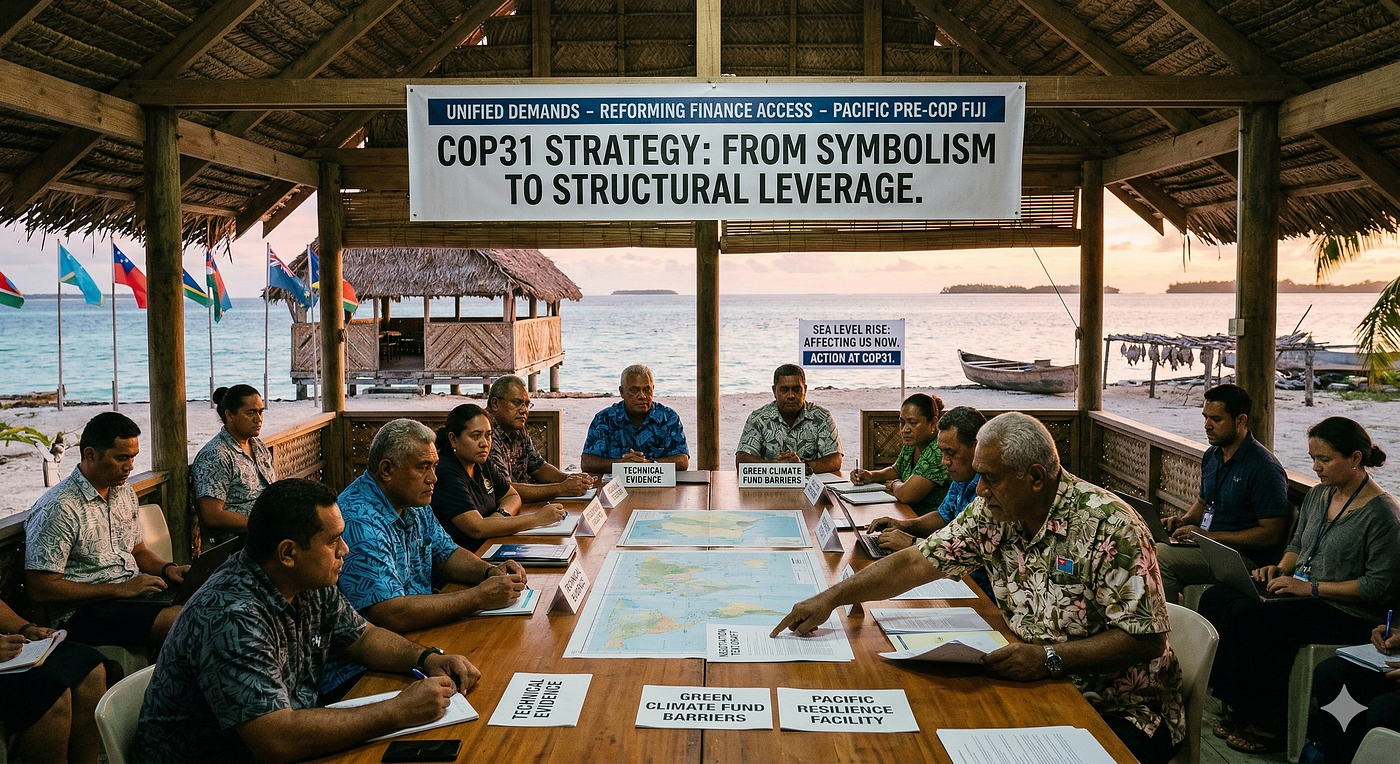
First, island nations need unified demands. SIDS shouldn’t negotiate separately, each hoping for slightly better terms. They need a collective negotiating position on core demands: specific dollar amounts for adaptation finance, mandatory accessibility reforms for climate funding mechanisms, binding timelines for Pacific Resilience Facility operationalization, and concrete pledges from developed nations. Individual SIDS pursuing selective benefits will weaken collective bargaining power.
Second, they need to weaponize Australia’s presidency. Before COP31 even starts, SIDS delegations should secure commitments from Australia that island climate finance demands will be prioritized within the negotiation agenda, that negotiating co-facilitators will include experts focused on developing-world climate finance, and that draft negotiating texts explicitly address SIDS’ barriers rather than burying island concerns in generic developing-country language.
Third, technical documentation matters more than speeches. Sopoaga’s 2017 theater was compelling. But COP31 needs detailed analysis: specific case studies of SIDS applying for climate finance and hitting barriers, evidence about which institutional reforms would improve access without compromising financial oversight, concrete projections of SIDS’ climate finance needs broken down by sector and timeline. Technical documentation transforms emotion into evidence.
Fourth, build alliances strategically. SIDS should establish formal partnerships with developed nations already sympathetic to island interests — Germany, Denmark, several Caribbean nations. Joint negotiating positions multiply influence and demonstrate that climate finance accessibility has support beyond the SIDS constituency.
The Climate Ministers Meeting scheduled for Brisbane on March 19–20 offers the first critical moment to cement these strategies.[2][3] The Pacific Pre-COP in Fiji follows, then the Leaders Forum in Tuvalu. These aren’t ceremonial events. They’re power plays where island nations can consolidate leverage before the full COP31 conference in Antalya.
The Stakes: This Actually Matters
For wealthy nations, COP31 is another climate conference — important, sure, but ultimately just one event in an ongoing series of negotiations. For SIDS, this conference determines whether their societies have a future.
Tuvalu doesn’t need symbolism. It needs seawalls, mangrove restoration, agricultural adaptation, and economic diversification. It needs financing accessible enough that its 12,000-person government can actually deploy it. It needs a global climate system that acknowledges its existential stake in climate action without requiring its government to navigate bureaucratic labyrinths to access money supposedly allocated for vulnerable nations.
Fiji needs renewable energy infrastructure to cut electricity costs and create jobs. Kiribati needs fishing community support and climate adaptation resources. Palau needs tourism that generates revenue without destroying the marine ecosystem its people depend on.
These aren’t abstract development goals. They’re survival imperatives.
The institutional arrangement for COP31 — the Pacific Pre-COP, the split presidency favoring development priorities, the dedicated SIDS financing session, the shift toward needs-based allocation — creates real structural space for transformation. Whether that space translates into material change depends on whether island nations maximize their leverage ruthlessly and hold developed nations accountable to binding, implementable commitments.
Here’s the reality: wealthy nations will make inspiring pledges at COP31. They always do. The difference this year is whether SIDS come away with specific financial commitments, reformed access mechanisms, and timelines for implementation — or whether they get another cycle of rhetorical commitment unaccompanied by transformative action.
Given what hangs in the balance, island nations should bet everything on making this moment count. Because unlike wealthy nations that can merely regret missed climate opportunities, SIDS are literally betting their futures.
메타데이터
- post_id
- 5e99fa47e2d5
- slug
- when-island-nations-finally-get-a-seat-at-the-table-can-sids-actually-win-climate-finance-at-cop31-5e99fa47e2d5
- url
- https://medium.com/@mohsengul/when-island-nations-finally-get-a-seat-at-the-table-can-sids-actually-win-climate-finance-at-cop31-5e99fa47e2d5
- canonical_url
- https://medium.com/@mohsengul/when-island-nations-finally-get-a-seat-at-the-table-can-sids-actually-win-climate-finance-at-cop31-5e99fa47e2d5
- author_url
- https://medium.com/@mohsengul
- status
- ok
- fetched_at
- 2026-06-24 11:06:28