Where Do Story Ideas Come From?
I have written five works of fiction, and whenever I appear at a bookstore or a library to promote these works, I always hear a variety of…
Where Do Story Ideas Come From?

I have written five works of fiction, and whenever I appear at a bookstore or a library to promote these works, I always hear a variety of questions related to the characters, the setting, the point of view, or the theme, among others. Invariably, though, someone will ask the one question that perplexes many writers, especially beginning writers. That one most popular question is “Where did you get the idea for this book?”
That’s a great question, of course, especially if you’re a writer, and you’re experiencing a case of writer’s block — which is exactly where I find myself today. During the last ten years, I have been working on a biography/memoir of our 30-year-old daughter, Maria, who passed away from a previously undiagnosed breast cancer that had spread to her brain. The book, entitled Our Sweet Maria: Her First 30 Years and Her Final 30 Days, came out last summer, and since then, I’ve been trying to come up with a strong idea for my next book. Thus, I thought it might be helpful to review the ideas I used for my previous books to see if they might provide some insight and some impetus for my next project. This investigation led me to five strong sources for ideas, ideas that I hope will help all writers.
Photo by Jayde Keroi on Unsplash
Write About an Emotional and Unforgettable Experience
The first book I ever wrote was an autobiographical novel or what some writers call a “roman à clef.” The autobiographical novel is often a first novel for a lot of writers because they want to write about something they’ve experienced, but they may not want to identify the real people involved. Benét’s Reader’s Encyclopedia (1996) describes the roman à clef as “a novel with a key or secret meaning. Such a work of fiction contains one or more characters and situations based upon actual persons and their lives” (882). The goodreads website has a list of over 100 such novels including Animal Farm by George Orwell, Little Women by Louisa May Alcott, and The Catcher in the Rye by J.D. Salinger. Also, this fictional format gives writers the freedom to craft a story that may need certain elements for a broader appeal.
In my case, I wrote a book about my first experience with death, when I was 12 years old. My four-year-old sister, Peggy, passed away after experiencing many physical problems during her short life. I called the book Let’s Go, Gaels because I was so wrapped up in playing basketball for my grade-school team that her death completely shattered my world, so much, in fact, that I found myself writing about Peggy and her passing many times in subsequent years. Whenever a teacher asked us to write an essay about “A Day I Will Never Forget” or “A Special Person in My Life” or something similar, I always wrote about Peggy or about that particular day when she left us. Thus, by the time I was ready to write my first short novel some 30 years later, I had already written a portion of the novel without realizing it, and I rounded out the story with some fictional elements to create a stronger novel around that universal experience, that rite of passage.
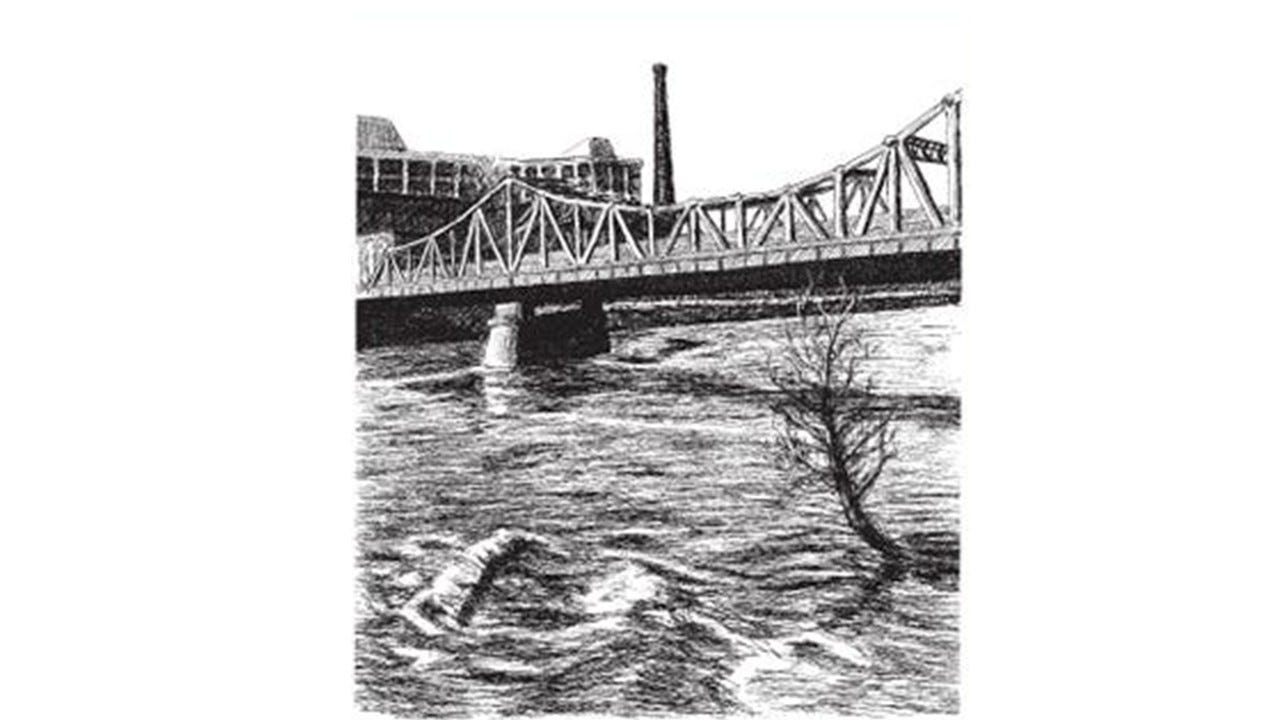
Drawing by Jeff Mosher and Provided by Jim LaBate
Write About a Significant Experience of Another
A few years after Peggy’s passing, I heard a funny story about one of my best friends, Larry. Larry was a sophomore and a year ahead of me in school, and we both tried out for the junior varsity basketball team. I was fortunate enough to make the team, but Larry was cut — and not happy about it at all. Thus, rather than wait for our ride home, Larry stormed out of the South Side Armory where we had tried out, and he began walking. When he reached the bridge that carried traffic and pedestrians over the Mohawk River to the North Side of Amsterdam, he had boiled over to such a degree that when he reached the midpoint of the bridge, he hurled his gym bag into the river — with his new sneakers and all his other basketball gear and his school books and notebooks inside. Honestly, I wish I could have seen it.
Fortunately, Larry’s story had a happy ending. Despite getting into a bit of trouble with his parents and his teachers, Larry actually made the team a few days later because one of the guys selected didn’t qualify academically, and our coach asked Larry to join the team after all. Naturally, Larry said “Yes,” and after school that day, he used his paper-route money to buy a new gym bag and new sneakers, among other things.
So you’re probably assuming that Larry’s river toss alone would not be enough for a full story, and you’d be right. But during the years afterwards, I used to tell that humorous story often, and the more I thought about it, I began to wonder: Could I manufacture a character’s life story based solely on all the things he threw in the river during his lifetime? I wasn’t sure I could, but I decided to try. Naturally, I began with Larry’s story, and I devised a collection of others to write a novel entitled, fittingly, Things I Threw in the River.

Golfito Sunset from Wikipedia
Write About an Unusual Setting
When I graduated from college, I knew I wanted to be a high-school English teacher, but I also knew I didn’t want to go immediately from a college classroom as a student to a high-school classroom as a teacher. I felt like I needed another type of life experience, one that I could bring to the classroom when I felt I was ready. Thus, I signed up for the Peace Corps. I had actually been thinking about the Peace Corps ever since John F. Kennedy had first proposed the idea during his presidential quest in 1960, and on my application, I wrote that I was willing to go anywhere and do anything. At the time, I was an idealistic 22-year-old, and I wanted to save the world. When I received my acceptance letter, they assigned me to work as a “sports promoter” in Costa Rica. “Costa Rica,” I said aloud to my family when I read the letter. “Where’s that?”
Yes, I’m embarrassed to admit that I didn’t know that Costa Rica is a small country in Central America, just above Panama and below Nicaragua. And since the young people of that country only played one sport — soccer — the authorities wanted the Volunteers to teach them how to play other sports such as baseball, basketball, and volleyball. Sounded good to me. As a result, I spent two years in a small town called Golfito (“small gulf”) doing just that as I also enjoyed the sunshine and the proximity to the Pacific Ocean.
So what was so unusual about this setting? Golfito was originally a planned community built by an American company to grow and export bananas. The town itself was built on a thin strip of land between the water and the mountains. The plantations were outside of town, so the bananas had to be transported by train to the port in town. Since the land for the town was so limited, the company built most of the facilities and most of the homes for the employees, and they assigned these homes according to rank. At the northern end of town, they built an airport, a school, a golf course with a private clubhouse, a swimming pool, and a group of homes for the major executives, many of whom were Americans. Moving to the south, the next neighborhood included an office building, a hospital, a grocery store, a church, and some smaller homes for those who would work in those buildings. The next section included the port, a large public restaurant and bar, and homes for all the port workers. Other sections followed, but you get the idea. This unusual layout intrigued me, and I knew I wanted to write a story that would take place there with characters who would either stay in their predetermined location in town or venture out at some point to better themselves. The result is my novel entitled, not surprisingly, Streets of Golfito.
Photo by RUT MIIT on Unsplash
Write About an Exaggerated Possibility
Have you ever experienced a small, unusual event that piques your interest, one that on the surface should be easily forgotten but one that also won’t leave your brain and rattles around up there until you do something with it? I experienced this dilemma one morning when I was preparing to teach a college writing class by logging into the computer system that would also project my lesson on a big screen at the front of the classroom. I did this all the time and never had a problem, but on this particular day, I made a simple mistake. First, I entered my username into the system, with a standard format that appeared on the screen. But before I moved the cursor down to the password box, where one’s password is always blacked out, I absentmindedly typed my password right next to my username in the first box, so both were visible on the screen. Fortunately, I noticed my error immediately, deleted my visible password, and entered it in the appropriate box where it belonged, hidden from my students.
As I did so, I noticed that only three students were in the classroom when I made my error and revealed my password, and not one of them was looking my way. Thus, I continued with my instruction for the day and breathed a small sigh of relief. I didn’t even think about my minor mistake again that day until I went home and told my wife about what had happened.
“Why are you telling me this?” She asked innocently.
“Because if a devious student knew my password, he could go into my computer account and change his grades or read my emails or who knows what other mischief he could get into.”
“I wouldn’t worry about it,” she commented nonchalantly.
And, honestly, I didn’t worry about it, but just talking about those possibilities made me realize that I might have an interesting story on my hands, an exaggeration of what I had experienced. Thus, within days, I was writing a book I eventually titled My Teacher’s Password, a novel about a student who sees his teacher’s password on the screen and decides to enter and explore his teacher’s computer world.
Photo by Courtney Cook on Unsplash
Write About an Interesting Hypothetical Situation
This last possibility is somewhat similar to the previous one, one that Stephen King calls the “What if question.” In his book On Writing — A Memoir on the Craft (2000), King mentions that in his own search for book ideas, he sometimes imagines hypothetical situations. For example, he cites three of his novels and the situations and the questions they are based on: Salem’s Lot — “What if vampires invaded a small New England village?” Desperation — “What if a policeman in a remote Nevada town went berserk and started killing everyone in sight?” Cujo — “What if a young mother and her son became trapped in their small car by a rabid dog?” (169–70). While my hypothetical situation is not as interesting or as frightening as those mentioned by King, I did learn a valuable lesson during the writing process.
When I was in my teens, my dad often went golfing with his buddies on Sunday afternoon, and he typically asked me to go with him and carry his golf bag. While I enjoyed being with Dad and his friends, I thought golf was the most boring sport I had ever encountered. As a result, I often found myself daydreaming while they played, and one peculiar idea entered my thoughts, a what-if idea. “What if,” I asked myself, “Arnold Palmer, Gary Player, and Jack Nicklaus (three famous golfers from that era) were playing golf with Dad?” Then, I thought, “Or, what if those same three golfers and Dad played a round of golf on the city streets?” They could hit down the main street in each neighborhood and putt on somebody’s front lawn. I thought that was a great idea, and at one point later in my life, I actually started writing about that crazy possibility.
Unfortunately, I didn’t make much progress. I realized early on that I didn’t know much about golf or appreciate its finer details. I would have to seriously play the game or do a ton of research to write a somewhat believable golf story. Thus, I needed to switch sports, and I settled on baseball, my favorite and the American pastime. My choice of a main character was easy too: Mickey Mantle, the All-Star centerfielder for the New York Yankees. All I needed was a “what if,” and I settled on “What if Mickey Mantle’s car broke down near Amsterdam, so he had to spend the night at my house and play ball with me and my friends the next day while his car was being repaired?” Sounds like fun, right? Absolutely. I had a blast writing Mickey Mantle Day in Amsterdam.
Photo by K. Mitch Hodge on Unsplash
So have I discovered a topic for my next book by reviewing the five possibilities listed above? No. Not yet. Still, I remain optimistic, and still, I keep writing. I keep writing (short stories and essays) because I know the longer I go without writing, the more difficult it will be to get started again. To put a twist on Isaac Newton’s first law of motion and apply it to writing, one might say, a writer who is writing regularly will keep on writing while a writer who is not writing will likely remain dormant.
메타데이터
- post_id
- 5e9d71a7a94e
- slug
- where-do-story-ideas-come-from-5e9d71a7a94e
- url
- https://medium.com/@jimlabate/where-do-story-ideas-come-from-5e9d71a7a94e
- canonical_url
- https://medium.com/@jimlabate/where-do-story-ideas-come-from-5e9d71a7a94e
- author_url
- https://medium.com/@jimlabate
- status
- ok
- fetched_at
- 2026-06-27 08:10:51