How to Improve QuickBooks Desktop Disaster Recovery Readiness
A disaster can affect a business without warning. Hardware failure, accidental deletion, software problems, power interruptions, file…
How to Improve QuickBooks Desktop Disaster Recovery Readiness
A disaster can affect a business without warning. Hardware failure, accidental deletion, software problems, power interruptions, file corruption, or security incidents can make important accounting information temporarily unavailable. For businesses that rely on QuickBooks Desktop, losing access to financial records can interrupt invoicing, payments, payroll, reporting, and other daily operations.
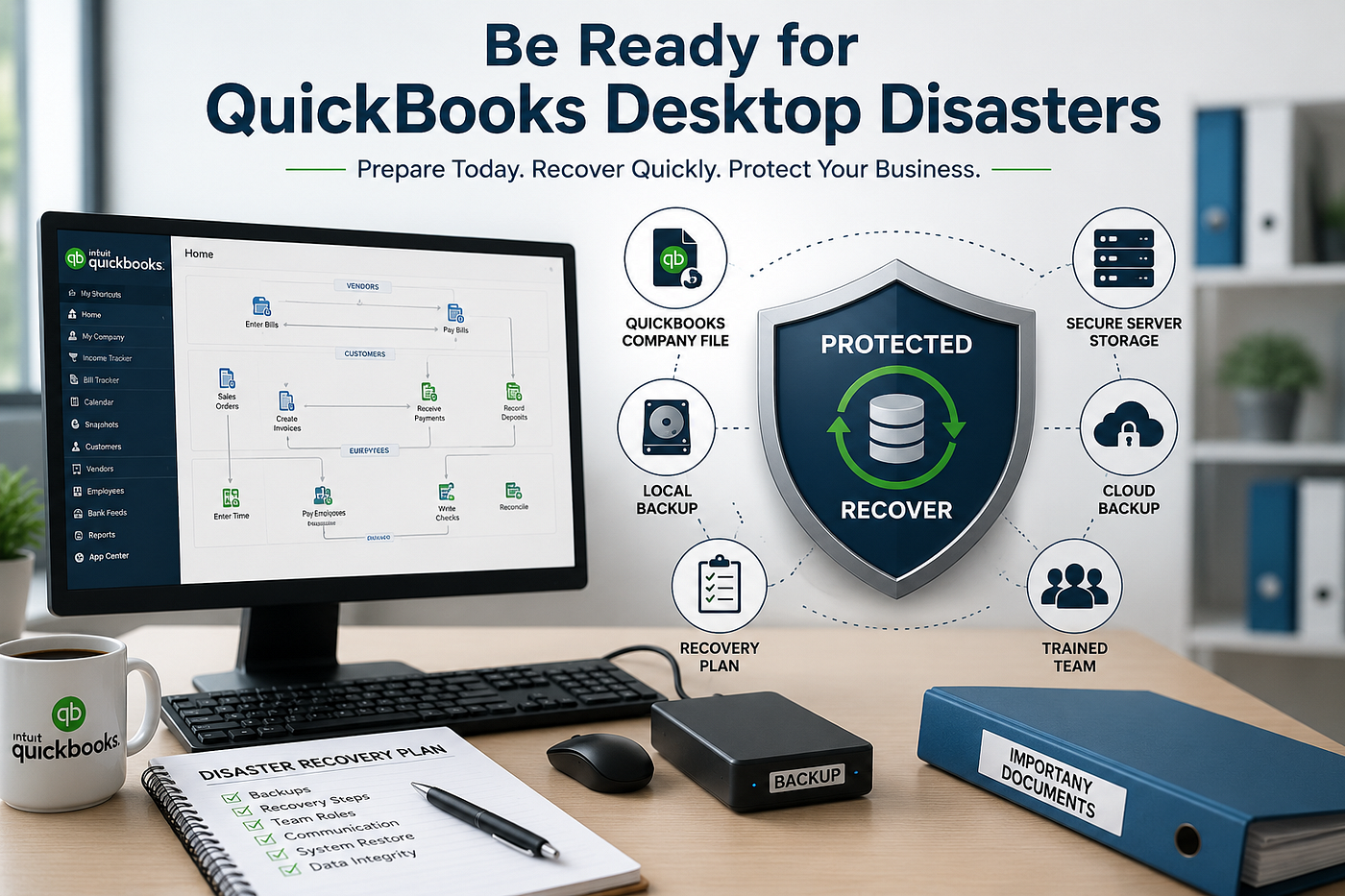
Disaster recovery readiness is therefore an important part of financial data management. Businesses should not wait until a system fails before deciding how to recover their accounting information. A proactive strategy should include regular backups, secure storage, recovery procedures, employee responsibilities, system maintenance, and routine testing.
By establishing a structured recovery process, businesses can reduce downtime and improve their ability to restore accounting operations after an unexpected event.
Understand Your Disaster Recovery Risks
The first step toward better disaster recovery is identifying the situations that could affect your accounting environment.
Common risks include computer hardware failure, damaged storage drives, accidental deletion, software conflicts, operating-system problems, power interruptions, network failures, and unauthorized access.
Businesses should also consider human error. An employee may accidentally overwrite important information, delete a file, or work with an outdated copy of the company file.
Understanding these risks helps businesses determine which information needs to be protected and how quickly it must be recovered.
A simple risk assessment can identify critical systems, important accounting files, backup locations, and the employees responsible for recovery.
Create a Reliable Backup Strategy
Backups are the foundation of a QuickBooks Desktop disaster recovery plan. Businesses should establish a regular schedule for creating copies of their accounting information.
The backup frequency should reflect how often the company processes transactions. A business with frequent daily transactions may require more frequent backups than one with limited accounting activity.
A **QuickBooks Desktop backup file** can provide an important recovery option when the primary company file becomes inaccessible or when a previous version of financial information needs to be restored.
Backups should be clearly labeled and organized so employees can quickly identify the appropriate recovery point.
Businesses should also avoid relying on only one backup copy. Multiple recovery points can provide additional flexibility if an issue is discovered after the most recent backup was created.

Store Backups Separately From the Primary File
Keeping the active company file and every backup in the same location creates unnecessary risk.
For example, if a computer’s storage drive fails, both the primary file and locally stored backups could become inaccessible.
Businesses should therefore maintain backup copies in a separate, secure location. Depending on business requirements, this could involve approved external storage, a secure network location, or an appropriate cloud-storage solution.
Access to backup locations should be restricted to authorized personnel.
Separating backups from the primary accounting environment increases the chances that a recovery copy will remain available after a localized system failure.
Test Backup Recovery Regularly
A backup strategy is incomplete if the business never verifies whether the backups can actually be used.
Businesses should periodically test their recovery process in a controlled environment. The objective is to confirm that backup files are accessible and that employees know how to restore accounting information when necessary.
Testing should not involve experimenting with the original company file. A separate recovery environment can be used where appropriate.
The business should document the results of each test and address any problems that are discovered.
Regular testing provides greater confidence that the recovery process will work during an actual emergency.

Define Recovery Priorities
Not every business process has the same level of urgency after a disaster.
Accounting teams should identify which activities need to resume first. For example, accessing customer balances, recording payments, processing invoices, and reviewing cash-flow information may be critical for daily operations.
Businesses should determine which systems and files are essential and how quickly they need to be restored.
This allows the recovery team to focus on the most important functions instead of trying to restore everything simultaneously.
Clear recovery priorities can reduce confusion and help employees make better decisions during an unexpected interruption.
Document the Disaster Recovery Procedure
A disaster recovery plan should be written down rather than stored only in someone’s memory.
The document can include:
- Location of backup files
- Backup frequency
- Recovery responsibilities
- Important software information
- Company-file location
- Contact information for responsible personnel
- Recovery verification procedures
- Communication steps
- Temporary accounting procedures
The instructions should be written in clear language so employees can follow them even when the situation is stressful.
The document should also be reviewed periodically and updated whenever the accounting environment changes.
Assign Specific Recovery Responsibilities
Businesses should identify who is responsible for each part of the recovery process.
One person may coordinate the technical recovery while an accounting manager verifies financial information. Another employee may communicate the situation to other team members.
Clearly assigning responsibilities prevents confusion.
Employees should know who has authority to make recovery decisions and who should be contacted when QuickBooks Desktop becomes inaccessible.
Responsibilities should also be documented so that recovery does not depend entirely on one employee being available.
Protect the QuickBooks Company File
The company file should be stored in a controlled and secure location.
Employees should know which file is the official accounting record and should avoid creating unauthorized copies.
Multiple copies can create confusion if different employees make changes to different versions.
Businesses should maintain a consistent folder structure separating the active company file, backups, archived information, and exported reports.
This organization can make it easier to identify the correct file during a recovery situation.
Follow Strong Data Integrity Practices
Disaster recovery is closely connected to data integrity. Restoring a damaged or outdated file does not solve the problem if the underlying accounting information is already inconsistent.
Businesses should establish **QuickBooks Desktop data integrity practices** that include accurate transaction entry, regular account reconciliation, consistent account categorization, controlled user access, and routine financial reviews.
Employees should investigate unusual transactions and correct errors promptly.
Maintaining accurate information before a disaster occurs makes the recovery process much more useful because the restored data is more likely to represent the company’s actual financial position.

Control User Access
Unauthorized changes can compromise accounting information just as easily as technical failures.
Businesses should create individual user accounts and assign permissions based on job responsibilities.
Employees should only receive access to the functions and information they need.
For example, an employee who records invoices may not require access to administrative settings or sensitive financial information.
User permissions should be reviewed regularly. When employees change roles, their access should be updated. Access for former employees should be removed promptly.
These practices improve both security and accountability.
Secure Backup Locations
Backup files contain financial information and therefore require protection.
Businesses should restrict access to backup storage and avoid leaving backup devices in unsecured locations.
If removable storage is used, it should be kept safely when not in use. If network or cloud storage is used, appropriate access controls should be applied.
Employees should also avoid copying accounting backups to personal devices or unauthorized storage accounts.
A backup is valuable only when it is both available for legitimate recovery and protected from unauthorized access.
Maintain Updated Systems
QuickBooks Desktop and the operating system should be maintained appropriately.
Businesses should monitor available updates and follow suitable installation procedures. Other software used on accounting computers should also be kept current where appropriate.
Before making major system changes, businesses should ensure that a recent backup is available.
Employees should avoid installing unapproved software on accounting computers because software conflicts can affect system stability.
Maintaining a controlled software environment can reduce some avoidable technical problems.
Prepare for Hardware Failure
Hardware failure is one of the common situations that can interrupt accounting operations.
Businesses should identify the computers, storage devices, and servers that are essential to their QuickBooks Desktop environment.
Important installation information, licensing details, recovery instructions, and backup locations should be documented separately from the primary computer.
Organizations can also maintain a plan for replacing failed hardware when necessary.
Preparing for replacement in advance can reduce the amount of time required to resume accounting operations.
Protect Against Power Interruptions
Power problems can interrupt accounting work and affect computers while files are being accessed.
Businesses that depend heavily on desktop accounting systems can consider appropriate backup power equipment for critical computers or servers.
Employees should also follow safe shutdown procedures rather than turning off systems abruptly.
A stable power environment can reduce unnecessary interruptions and support more reliable accounting operations.
Maintain Adequate Storage Capacity
Storage capacity should be monitored regularly.
The accounting environment needs sufficient space for the operating system, QuickBooks Desktop, company files, backup copies, temporary files, and other required information.
When storage becomes critically low, performance and backup operations may be affected.
Businesses should establish an appropriate retention and archiving process rather than deleting financial records without review.
Old information should be removed or archived according to business requirements.
Create an Emergency Communication Plan
A disaster can create confusion if employees do not know what is happening.
Businesses should establish a communication process explaining how employees will be informed about accounting-system availability.
For example, employees should know whether they should wait for QuickBooks Desktop access to be restored or record urgent transactions temporarily using an approved process.
If manual records are created during downtime, they should be organized carefully so they can later be entered into QuickBooks without creating duplicate transactions.
Clear communication can help keep financial operations organized during an interruption.
Train Employees on Recovery Procedures
Employees should understand the basic disaster recovery process.
Training can cover where the company file is stored, how backups are handled, who is responsible for recovery, and what employees should do if they encounter a problem.
Employees should also know not to repeatedly attempt random fixes when important accounting data may be at risk.
Short refresher sessions can help keep recovery procedures familiar.
Training is especially important when new employees join the accounting team or when the company’s systems change.
Verify Financial Information After Recovery
Restoring a backup should not be considered the final step.
After recovery, accounting personnel should verify important financial information before normal operations resume.
The review may include recent transactions, customer balances, vendor balances, bank information, accounts receivable, accounts payable, and other critical records.
If something appears incomplete or incorrect, employees should investigate the issue before entering additional transactions.
A post-recovery review can help identify problems early and prevent incorrect information from becoming part of future accounting records.

Maintain a Recovery Checklist
A checklist can make disaster recovery more organized.
The checklist can include:
- Confirm the system problem.
- Identify the affected computer or company file.
- Contact the designated recovery personnel.
- Identify the most appropriate backup.
- Restore the backup in a controlled environment.
- Verify important financial information.
- Confirm user access.
- Communicate system availability to employees.
- Resume accounting operations.
- Document the incident and recovery results.
The exact steps should be customized according to the organization’s accounting environment.
Review and Improve the Plan
A disaster recovery plan should not remain unchanged for years.
Businesses should review it periodically and update it when employees, computers, storage locations, software, or accounting procedures change.
After every significant recovery test or actual incident, the business should document what worked and what caused delays.
These observations can help management improve future recovery efforts.
Regular reviews ensure that the recovery plan remains practical and relevant.
Reduce Dependence on a Single Recovery Method
A strong recovery strategy should use multiple protective measures rather than depending on one solution.
Regular backups, separate storage, user-access controls, system maintenance, employee training, and documented recovery procedures work together to create a more resilient accounting environment.
If one protection method fails, another may still provide support.
This layered approach is particularly useful for businesses that rely heavily on QuickBooks Desktop for daily financial operations.
Conclusion
Improving QuickBooks Desktop disaster recovery readiness requires preparation before a problem occurs. Businesses should create reliable backups, store them separately, test recovery procedures, protect financial information, maintain updated systems, and assign clear recovery responsibilities.
Data integrity should also remain a central part of the strategy. Accurate transaction entry, regular reconciliation, controlled access, secure file management, and consistent financial reviews help ensure that recovered information remains reliable.
A documented recovery plan gives employees clear instructions during an unexpected interruption, while regular testing helps identify weaknesses before a real disaster occurs.
By combining backup protection, security controls, employee training, system maintenance, and recovery testing, businesses can reduce potential downtime and return to normal QuickBooks Desktop operations more confidently after an unexpected system failure.
메타데이터
- post_id
- 5eb7586f0107
- slug
- how-to-improve-quickbooks-desktop-disaster-recovery-readiness-5eb7586f0107
- url
- https://medium.com/@akshukim4/how-to-improve-quickbooks-desktop-disaster-recovery-readiness-5eb7586f0107
- canonical_url
- https://medium.com/@akshukim4/how-to-improve-quickbooks-desktop-disaster-recovery-readiness-5eb7586f0107
- author_url
- https://medium.com/@akshukim4
- status
- ok
- fetched_at
- 2026-08-17 21:38:56