Siebel EAI vs EIM: When to Use Each (With Real Project Scenarios)
A practical Siebel developer’s guide to choosing between EAI and EIM for real-time integrations, bulk data loads, migrations, and…
Siebel EAI vs EIM: When to Use Each (With Real Project Scenarios)
A practical Siebel developer’s guide to choosing between EAI and EIM for real-time integrations, bulk data loads, migrations, and production scenarios.
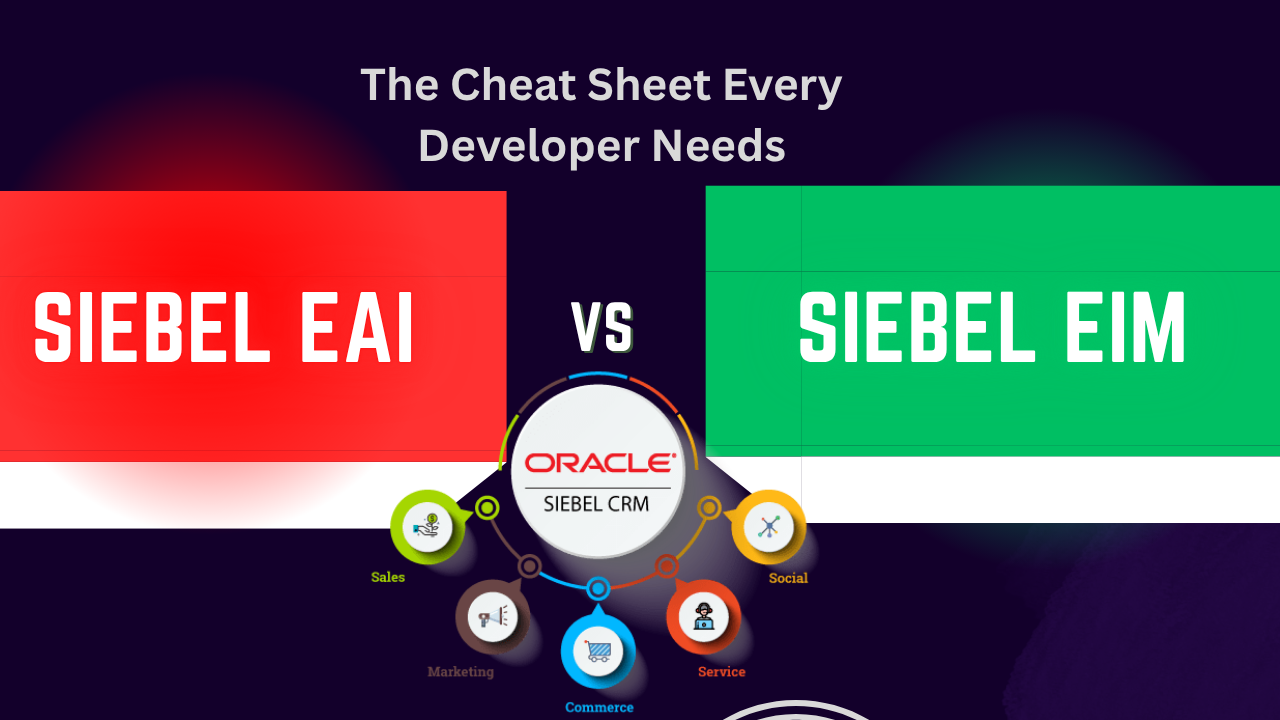
Cover Image made from Canva.
A nightly migration job needs to process 2 million Siebel records. Would you use EAI or EIM?
Choose the wrong one, and a job that should finish quickly can become an overnight performance bottleneck.
Here’s the short answer: use EAI for real-time, transactional integration. Use EIM for high-volume bulk data operations.
But real Siebel projects are rarely that simple.
What about nightly synchronization? A 50,000-record interface? An external REST service updating Siebel? Or a one-time legacy CRM migration?
This guide breaks down Siebel EAI vs EIM using practical project scenarios so you can choose the right approach before performance problems reach production.
If you’ve spent any real time on a Siebel project, you’ve heard both acronyms thrown around in the same breath — usually by an architect who assumes everyone already knows the difference. EAI and EIM sound like they do the same job. They don’t. Mixing them up is one of the fastest ways to design an integration that technically works in testing and then falls over the moment real data volume hits it.
This is the cheat sheet I wish someone had handed me before my first integration-heavy Siebel engagement. Bookmark it, screenshot it, keep it open in a tab during your next design call.
1. Siebel EAI vs EIM: The 30-Second Answer
- Use EAI when data needs to move in real time through Siebel’s business layer.
- Use EIM when large volumes of data need to be loaded, updated, merged, or deleted in bulk.
- If your requirement says API, web service, real-time, or synchronous integration, think EAI.
- If it says migration, millions of records, batch load, or bulk processing, think EIM.
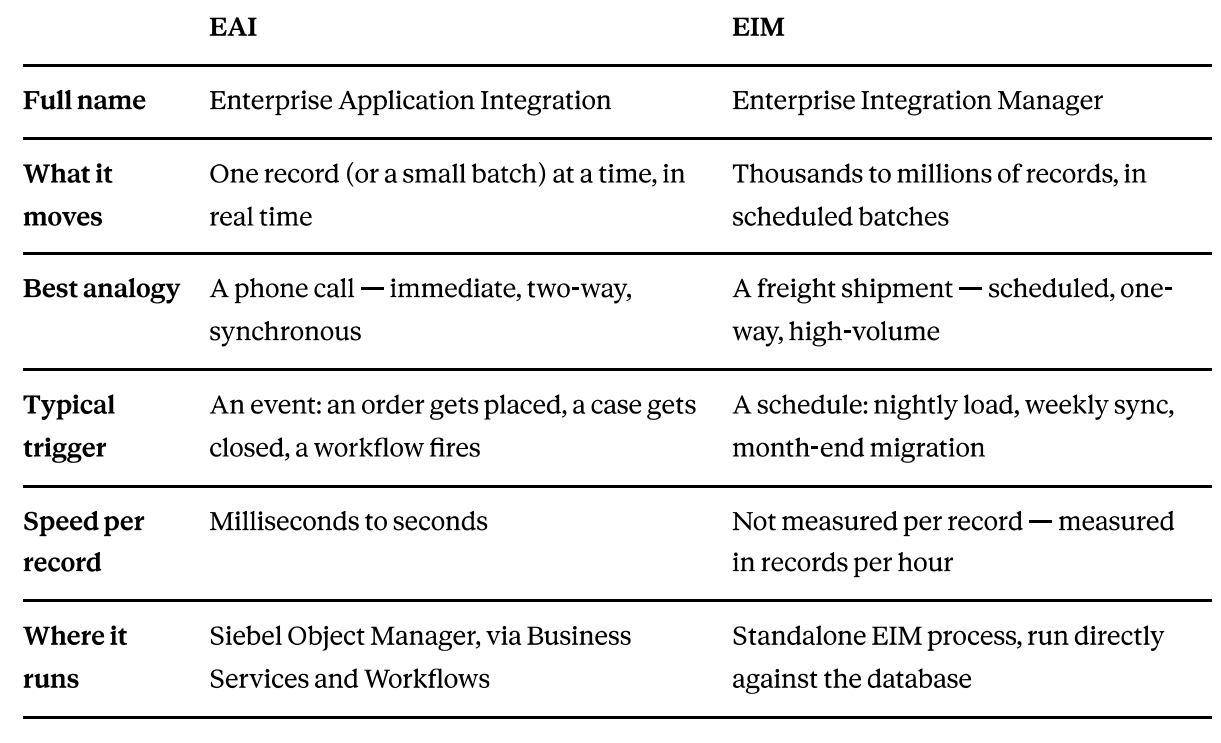
Fig. : A basic comparative study between EAI and EIM
Non members can read here **LINK**
If you remember nothing else from this article, remember this: EAI is for talking, EIM is for shipping. Everything else is detail.
2. EAI: The Real-Time Translator
Think of EAI as the multilingual staff member at passport control. Every external system — a payment gateway, an order management platform, a partner’s ERP — speaks its own language: JSON, XML, flat file, SOAP, whatever. Siebel speaks its own internal format. EAI’s entire job is standing at that border, translating both directions, instantly, for every single transaction that crosses it.

Fig. : Core EAI Building Blocks
The EAI Flow, in Order
- External system sends data — usually XML, JSON, or a flat structure — through a transport (HTTP, MQ, JMS, File).
- A Business Service receives it and typically converts it into an Integration Object hierarchy.
- The EAI Siebel Adapter maps the IO to real Siebel Business Components — this is the moment external data becomes an actual Siebel record.
- A Workflow Process orchestrates the whole thing, adding validation, branching logic, and error handling around the core translation.
- A response goes back (for synchronous calls) confirming success, failure, or returning requested data.
When You Reach for EAI
- A customer submits a form on your company’s website and it needs to appear in Siebel immediately as a lead.
- A field service technician updates a case status on a mobile app, and Siebel needs to reflect that update in real time.
- Siebel needs to check inventory on an external warehouse system before letting a rep confirm an order.
Notice the pattern: all of these need an answer right now. That’s the tell. If waiting even five minutes would break the business process, you’re in EAI territory.
3. EIM: The Bulk Freight Operator
Now picture the opposite problem. Your company just acquired another business, and you need to load 800,000 customer accounts into Siebel by Monday morning. Nobody is sitting at passport control processing 800,000 people one at a time through a workflow — that’s what cargo terminals are for. That’s EIM.
EIM doesn’t go through the Siebel application layer at all. It talks directly to the underlying database, using a dedicated set of staging tables designed for exactly this kind of bulk movement.

Fig. : Core EIM Building Blocks
The EIM Flow, in Order
- Data lands in an EIM interface table — often loaded there by a separate ETL tool (Informatica, SSIS, or a custom script) that’s done its own cleansing first.
- You configure an .IFB file specifying: which interface table, which base table, which process type (Import/Export/Delete/Merge), and which User Key to match on.
- You run the EIM process — typically via server component, either ad hoc or scheduled.
- EIM validates, maps, and writes to the base tables, logging anything it couldn’t process into error/reject tables for review.
- You check the logs. Always. EIM fails quietly if you’re not watching — a bad load can silently skip thousands of rows while reporting “success” on the ones that did work.
When You Reach for EIM
- Initial data migration during a Siebel implementation.
- Nightly or weekly bulk syncs from a data warehouse.
- Any scenario where “real time” is not just unnecessary but actively wasteful — you don’t need a passport check for every crate in a container ship.
4. The Cheat Sheet Comparison Table
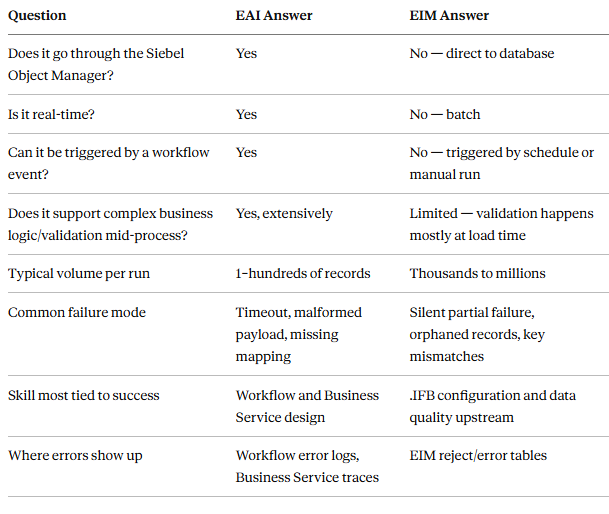
Fig. : Cheat Sheet Comparison Table
*(New to the Siebel object model? My [Siebel architecture cheat sheet](https://pub.towardsai.net/understanding-oracle-siebel-in-a-cheat-sheet-1e2d3d9a2e3a) explains Business Objects, Business Components, and the core architecture behind these integrations.)*
5. Common Mistakes I See Repeatedly
Using EAI for a migration. I’ve seen teams try to push a 200,000-record legacy migration through an EAI web service, one call at a time. It technically works. It also takes four days and falls over halfway through when a connection drops. That’s an EIM job, full stop.
Using EIM where real-time matters. The opposite mistake — scheduling an EIM batch job every 15 minutes to “simulate” real-time sync. It’s not real-time, it adds unnecessary database load, and it introduces a data-freshness gap that eventually causes a business-facing problem (a rep sees a customer record that’s 14 minutes out of date and makes a decision based on it).
Forgetting that EIM bypasses business rules. Because EIM writes directly to base tables, none of your carefully configured Siebel business rules, workflows, or validations fire during the load. If your data quality depends on Siebel-side validation, that validation needs to happen before the data reaches EIM — either in your ETL layer or through a post-load reconciliation step.
Not checking User Keys before a big load. A wrong or incomplete User Key configuration in EIM is the single most common cause of duplicate records I’ve encountered in migration projects. Test your User Key logic against a small sample before you run the full 800,000-row load — it’s much cheaper to catch it there than in production.
6. A Quick Decision Test
Next time you’re in a design meeting and someone asks “should this be EAI or EIM,” ask these three questions:
- Does the business need an answer within seconds? → EAI.
- Is this a one-time or scheduled bulk movement of data? → EIM.
- Does the record need to pass through Siebel’s business logic and validation on the way in? → EAI (or a hybrid: land via EIM, then trigger a batch workflow to run business rules afterward).
If you’re still unsure, default to asking: “What happens if this data is ten minutes late?” If the honest answer is “nothing bad,” you almost certainly don’t need EAI.
7. What Happens When You Choose the Wrong Tool?
Imagine processing 2 million migration records one transaction at a time through EAI. The integration may technically work, but the overhead of business-layer processing can turn a bulk operation into a serious performance problem.
Now imagine using EIM for an application that needs an immediate response after a customer updates an account. EIM’s batch-oriented workflow is a poor fit for that real-time requirement.
The question isn’t whether EAI or EIM is better. The question is whether your integration is transactional or volume-driven.
8. Still Confused? Ask These Four Questions
Before choosing EAI or EIM, ask:
- Does the caller need an immediate response? → EAI
- Are we processing hundreds of thousands or millions of records? → EIM
- Does the operation need Siebel business-layer validation in real time? → EAI
- Is this primarily a migration or bulk data operation? → EIM
In most Siebel projects, these four questions will quickly point you in the right direction.
9. Final Takeaway
EAI and EIM solve different integration problems.
EAI is built for real-time, transactional integration. EIM is built for high-volume bulk data processing.
The expensive mistakes happen when teams choose based on familiarity instead of data volume, response-time requirements, and integration design.
If you’ve worked on a Siebel project, I’m curious: what’s the largest EIM batch you’ve handled in production?
If this cheat sheet saved you a Teams message to your architect, it did its job — and if it actually helped, a clap 👏 (or twenty — Medium lets you clap 👏 up to 50 times per post) genuinely helps this reach more Siebel developers who are stuck exactly where I used to be.
If you found this useful, I’ve got a few other breakdowns from the same “no-hype, practical” angle:
- **Understanding Oracle Siebel in a Cheat Sheet** — the object model this post builds on
- **Why I Chose Claude Over Copilot for My Siebel Project** — where AI tools actually help (and don’t) in day-to-day Siebel work
- **5 AI Tools Every Siebel Developer Should Know** — practical tools worth trying this year
Follow along if you want more of this — I’m writing my way through the enterprise-CRM-plus-AI space one honest post at a time, and I’d rather it be useful than polished.
메타데이터
- post_id
- 5ecd491b49f4
- slug
- siebel-eai-vs-eim-the-cheat-sheet-every-developer-needs-5ecd491b49f4
- url
- https://levelup.gitconnected.com/siebel-eai-vs-eim-the-cheat-sheet-every-developer-needs-5ecd491b49f4
- canonical_url
- https://levelup.gitconnected.com/siebel-eai-vs-eim-the-cheat-sheet-every-developer-needs-5ecd491b49f4
- author_url
- https://medium.com/@eshitanandy
- status
- ok
- fetched_at
- 2026-07-14 03:27:34