The Oracles of Delphi 👁👁
Top 10 Prophets, Prognosticators, & Visionaries- #1
The Oracles of Delphi 👁👁
Top 10 Prophets, Prognosticators, & Visionaries- #1
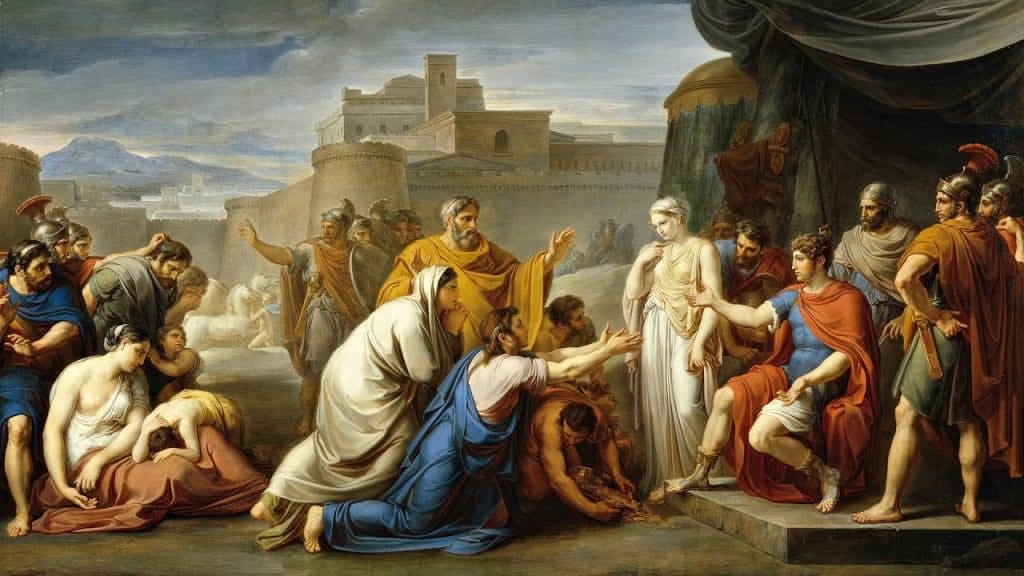
The most revered woman in ancient Greece.
⚡ In the book Future Shock, Alvin Toffler wrote…
“We offer our children courses in history; why not courses in ‘Future’?”

Part #1) The Oracles of Delphi —
from about 700 B.C. to A.D. 362
According to ancient Greek myth, ZEUS⚡ the King of the Gods, once commanded two eagles to fly around the earth, sending one to the north and one to the south. Where the two eagles finally converged was deemed the center of the world, the most beautiful vista in all of Greece.
That was Delphi.
The rocky terrain was originally a place where goats thrived. But then one troubled day, a massive earthquake broke open a natural chasm, from which strange gasses escaped. The goats — then the goat-herders — started acting freakishly.
A period of chaos followed. People flocked to the site, where they often became overwhelmed by the vapors. Many started speaking in completely different voices. {Formerly, even the braying of the goats had been distorted, when the animals were subjected to the fumes}. Other visitors went into trances.
A few Greeks died falling into the pit.
Around 700 B.C., construction began on the stone temple of Apollo, the god of Truth and Prophecy. A single young woman was appointed by the locals to act as Apollo’s mouthpiece. She would breathe the vapors emanating from below, which would then allow the deity to speak through her. A three-legged stool was constructed for her to sit directly above the churning smoke.
She was called the Dragon Priestess of Earth — the PYTHIA — in honor of a dragon-serpent named Python, who was believed to have been slain by Apollo at that site.

Michelangelo’s depiction of the Oracle of Delphi in the Sistine Chapel
Soon after the Oracle was established at Delphi, one of the first prophetesses was kidnapped and raped. After that shocking incident, it was decided it was safer to choose more aged women for the role.
Deep faith, good health, and honorable behavior became the qualifications for these wise-women. Once tested and chosen, the Pythia purified herself daily. Even the sturdiest women still didn’t live long after taking the job. In one instance, an entranced oracle threw herself to the ground so violently, she later died.
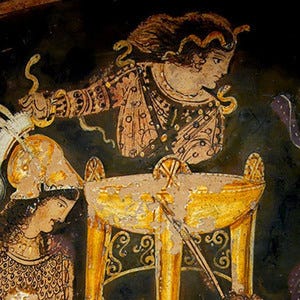
The Pythia.
The height of Delphi’s fame occurred in the fifth century B.C..
By then, two priestesses were constantly kept busy answering querents, with a third on standby. The prophetesses spoke in gravelly voices, rambled obscurities, shrieked uncontrollably, sometimes even barked. It was the role of male priests to act as translators. These men were always present, but they weren’t prophets themselves; they were just highly educated in interpretation.
Great care was given to predictions, especially when responding to mighty rulers. One King in the 600s B.C. tried to trick a Pythia. He sent messengers to Delphi to ask this question…
“What will the King be doing in his palace one hundred days after his messengers leave?”
One hundred days later, King Croesus did the most bizarre, unlikely thing he could imagine. He chopped up a tortoise and a lamb, broiling both in a bronze pot that he covered up to make certain no one could look inside.
The Pythia sent back her astonishing response…
“I know the number of grains of sand, and all the measures of the sea. I understand the dumb, and the speechless I hear. The smell has come to my nostrils of a hard-skinned tortoise as it is boiled with lamb’s flesh in a covered vessel, all of bronze.”
Astonished, King Croesus sent gifts of gratitude, including pearl robes, gold statues, and a gigantic golden bowl big enough to hold five thousand gallons of wine. He offered three hundred sacrificial animals to Apollo.

When Alexander the Great was on his quest to conquer all the known world, he eventually arrived in Delphi… and experienced the worst luck. He was told the Pythia wasn’t prophesying on the day that he was in town!
Furious, Alexander went to the oracle’s home, intent on dragging her to the temple. When she saw him, she told the conqueror, “You are invincible, my son.” He left after that, apparently having heard exactly what he wanted to hear.

When the infamous Roman emperor Nero went to Delphi, he received this message…
“Your presence outrages me. Begone, matricide! Beware of seventy-three!”
Since he was thirty, Nero accepted this as good news, thinking he’d live another forty-three years. Still, he had murdered his own mother, and he was enraged about being called out for it.
Nero ordered the prophetess and the attending male priests to be seized, and their hands and feet to be cut off.
Then, to add insult to injury, they were all buried alive.
Feeling better about himself after that, Nero took five hundred of Delphi’s finest statues and returned to Rome.
He died just a year later.
His successor, Galba, was seventy-three-years-old.

Ancient Greek thinkers questioned everything… but they trusted Delphi. Socrates, Greek’s most intellectual philosopher wholeheartedly endorsed the Pythia. Of course, the Oracle did declare him “the wisest of men,” so he might have been a little bit prejudicial in his opinion.
There were no rational explanations for the oracle’s accuracy. Yes, in some cases, vague answers were given that could be interpreted in many different ways. But in other instances, the Pythia’s precision was uncanny. And the auguries were wide-ranging.
Beyond the personal predictions, political prognostications influenced ruling empires. For many powerful reasons, Delphi’s influence prevailed for more than a thousand years.
Roughly 362 years after the birth of Jesus, a prophecy was given to the Roman emperor Julian, the last emperor to oppose Christianity. The Oracle of Delphi foretold her own demise…
“The voice is stilled.”
⚡This concludes Part One of this Series.

Delphi
~Part 2 follows👇 : The Sibyls of Rome~
[embed]The Sybils of Rome Top 10 Prophets, Prognosticators, & Visionaries- #2william-oneal.medium.com
메타데이터
- post_id
- 5edabefadc3c
- slug
- the-oracles-of-delphi-5edabefadc3c
- url
- https://medium.com/@william-oneal/the-oracles-of-delphi-5edabefadc3c
- canonical_url
- https://medium.com/@william-oneal/the-oracles-of-delphi-5edabefadc3c
- author_url
- https://medium.com/@william-oneal
- status
- ok
- fetched_at
- 2026-07-09 03:40:04
