Pope Leo XIV’s Magnifica Humanitas
The Three Questions of Chris Olah (Question — 1)
Pope Leo XIV’s Magnifica Humanitas
The Three Questions of Chris Olah (Question — 1)

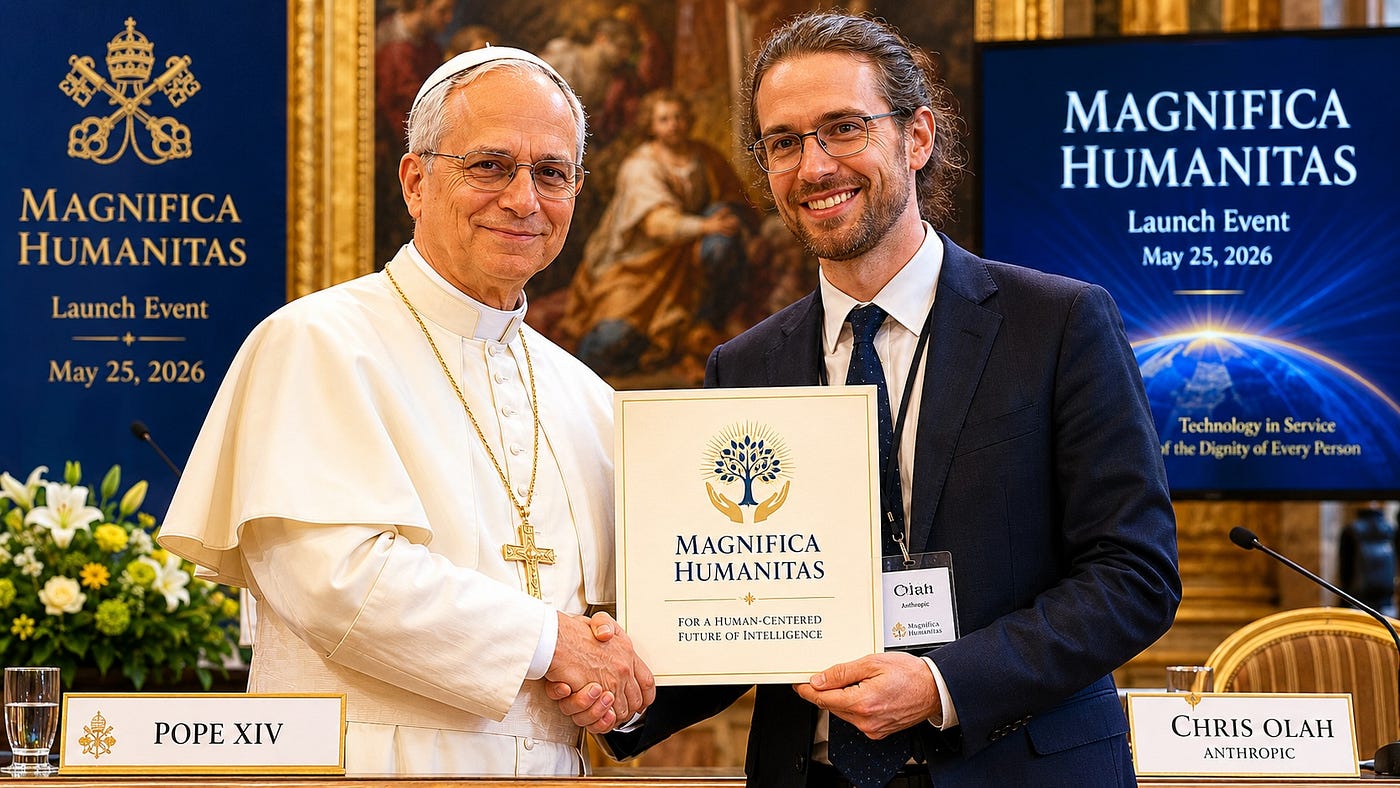
Gemini Generated Image
Magnifica Humanitas is the first encyclical of Pope Leo XIV, focusing on safeguarding the human person in the age of artificial intelligence. It was signed on May 15, 2026, and officially released on May 25, 2026. The document has five chapters.
Just before we seriously dive in, some trivia :
- There are 245 paragraphs
- Roughly 55,00 words
- AI or Artificial Intelligence is repeated 110 times
- The top five words are human (412), dignity(198), person (176), technology(154) and common(good)(142)
- These counts reflect the document’s strong focus on human dignity, the human person, technology, and the common good
When Pope launched Magnifica Humanitas, Anthropic co-founder Chris Olah was also invited to speak at the encyclical’s presentation in Vatican City on May 25, 2026, and he raised the following three questions.
1. The first is our duty to the global poor.
2. The second is the need for moral imagination and ambition in the pursuit of human flourishing.
3. The third is the need for discernment on the nature of AI models.
Chris Olah is not a casual interlocutor. As a co-founder of Anthropic and one of the foremost researchers in AI interpretability, the science of understanding what is actually happening inside neural networks, his presence at the Vatican presentation of Magnifica Humanitas was itself a signal. His three questions were not rhetorical. They were the questions of someone who builds these systems, who has stared at their opacity, and who is genuinely uncertain what they are. This blog maps the encyclical’s answers to each question and captures where the document is strong, where it is incomplete, and where it leaves the question productively open.
Question One: Our Duty to the Global Poor
What Olah Was Likely Pointing At
AI development is concentrated in a small number of wealthy countries, companies, and research institutions. The benefits — productivity, access to knowledge, medical diagnostics, and educational tools are unevenly distributed. The costs in terms of labour exploitation, environmental extraction, and data colonialism fall disproportionately on the world’s poorest people. The question is: what do those who build and deploy AI owe to those who will neither benefit from it nor have any voice in how it is designed?
How the Encyclical Answers
The Pope’s answer is structured around four interlocking principles that together constitute something more demanding than charity: “justice” as a precondition for legitimate technological development. The document does not treat the global poor as beneficiaries of AI philanthropy. It treats current arrangements as a violation of justice that requires structural correction — in ownership models, supply chain standards, data governance, and development policy. Whether those corrections are achievable within existing political and economic frameworks is a question the document wisely does not pretend to resolve.
On development policy, the encyclical insists that “to think that new technologies will automatically benefit everyone is to ignore the evidence.” Growth that increases consumption for some while shifting costs onto the most disadvantaged is not development at all.
The Universal Destination of Goods
This is the encyclical’s most radical economic claim. The document argues explicitly that among the goods universally intended for everyone, we must now include “patents, algorithms, digital platforms, technological infrastructure and data.” The wealth of nations increasingly depends on knowledge and technology, and when these remain concentrated in the hands of a few without adequate forms of sharing and access, “a new imbalance is created that contradicts the universal destination of goods.”
This is not a call for charity toward the poor. It is a claim that the current architecture of AI ownership is structurally unjust — that the concentration of AI capability violates a principle as foundational as the right to food or clean water. The document states that data “is the product of many contributors and should not be treated as something to be sold off or entrusted to a select few.” It calls for thinking creatively about managing data as a common or shared good.
The Hidden Supply Chain
The encyclical goes further than most AI ethics documents by specifically identifying who the global poor are in the AI economy. It identifies three groups whose exploitation underpins the entire system:
First, the millions engaged in data labelling, model training, and content moderation — described as “essential yet largely unseen activities,” often involving disturbing material, performed predominantly by young women in precarious conditions for minimal wages.
Second, children and adolescents are working in dangerous conditions to extract the rare earth materials required for the devices and microprocessors that AI depends on. The document uses striking language: “The bodies of these people are scarred, injured and worn down so that computational flow may continue uninterruptedly.”
Third, victims of trafficking are recruited, controlled, and transported through the same digital circuits that underpin the global economy — with criminal networks exploiting profiling techniques, anonymous payment methods, and AI-enabled image manipulation to operate at scale.
The encyclical draws a direct line from each of these to a moral obligation: “It is not enough to invoke efficiency, nor to celebrate the benefits of innovation, if they are built on a chain of exploitation that remains deliberately hidden.”
New Colonialism
The document introduces the concept of data colonialism — a form of extraction that does not dominate bodies but appropriates data, transforming personal lives into exploitable information. It specifically identifies health data, epidemiological profiles, genetic maps, and demographic information gathered from structurally fragile regions, “under the pretext of aid, research or innovation,” as a form of structural leverage. Whoever controls this data can shape which populations receive medicines, investments, and protections. The encyclical calls this “one of the most urgent moral challenges of our time.”
What Is Required
The document sets out several concrete obligations. Supply chains must become transparent so that no competitive advantage is built on hidden exploitation. Companies and investors must adopt clear criteria for preventive ethical verification — due diligence that includes protecting workers, eliminating forced labour, and assessing social impact. Digital platforms must cooperate with authorities and civil society to prevent their tools from becoming channels for trafficking and exploitation. Access to AI and the education needed to use it must be universal. “To speak of the universal destination of goods in the AI age means finding ways to guarantee this.”
To speak of the universal destination of goods in the AI age means finding ways to guarantee this.
The sentence is easy to read past. Buried in a document of 245 numbered paragraphs, surrounded by more dramatic language about slavery and warfare, it can appear to be a routine gesture toward digital inclusion — the kind of thing every technology policy document says, and no one acts on. It is not routine. It is arguably the most structurally disruptive claim in the entire encyclical.
To understand why, you need to understand what the universal destination of goods actually means in Catholic Social Doctrine — not as a metaphor or aspiration, but as a foundational principle with legal, economic, and political teeth. Once you grasp that, the sentence becomes a challenge to the entire architecture of how AI is currently built, owned, governed, and taught.
What the Universal Destination of Goods Actually Means
The principle holds that the goods of the earth, created by God and developed by human ingenuity, are meant for the benefit of all people, not only those who happen to own them at any given moment. This is not communism. The encyclical is explicit that it does not abolish private property. But it insists that private property rights are always subordinate to the prior claim that goods serve the common good.
John Paul II, quoted in the document, called this subordination “the golden rule of social conduct and the first principle of the whole ethical and social order.”
Notice what this means in practice. When someone owns a piece of land, the principle holds that ownership is legitimate insofar as it serves the broader good and can be legitimately constrained when it does not. When a company patents a pharmaceutical, the principle holds that the patent right is real but not absolute, which is why compulsory licensing exists in international law for essential medicines.
The encyclical explicitly extends this principle to a new category of goods: patents, algorithms, digital platforms, technological infrastructure, and data. It states this directly in paragraph 67. The extension is not casual. It is the theological and philosophical foundation for everything the document subsequently says about AI governance, data ownership, and universal access.
When the encyclical says that access to AI and the education needed to use it must be universal, it is not making a development aspiration. It is making a justice claim, that the current concentration of AI capability in a small number of entities violates a foundational moral principle, in the same category as denying people access to food, water, or basic healthcare.
The Two Components: Access and Education
The sentence pairs two things that are often separated in policy discourse: access to AI itself and the education needed to use it. This pairing is deliberate and important. Each is incomplete without the other.
Access to AI
What does it mean to have access to AI? The encyclical does not reduce this to merely having a smartphone or an internet connection, though those matter. It points to something deeper — access to the infrastructure of AI capability itself.
Computational access. AI at any serious level of sophistication requires computational power that is currently concentrated in the data centres of a small number of companies — primarily in the United States and China. Training a frontier model requires resources that no university, government department in a developing nation, or civil society organisation can afford. The encyclical’s claim that computational resources cannot remain in the hands of a few has radical implications for the economics of cloud computing, the pricing of AI APIs, and international development policy on digital infrastructure.
Model access. The most capable AI models are either proprietary, accessible only through commercial arrangements that price out most of the world’s population, or open-source, which still requires significant technical capacity and infrastructure to deploy effectively. The document’s logic suggests that making only degraded versions of AI available to poor communities, while reserving the most capable systems for wealthy customers and governments, violates the universal destination of goods — analogous to providing essential medicines only in their least effective formulations to those who cannot pay full price.
Data access. The encyclical makes a specific claim about data that is often overlooked. It argues that data is “the product of many contributors” — meaning that the training data underlying AI models is derived from humanity’s collective intellectual output: books, articles, conversations, creative works, scientific papers, and cultural expression accumulated over centuries. The companies that trained these models did not create that data. They harvested it. The document argues that data so constituted cannot be treated as purely private property and should be governed as a common or shared good.
This has significant implications. If the training data powering the world’s most capable AI systems is drawn from collective human knowledge, the outputs of those systems carry an obligation to the communities whose knowledge built them. This framework offers a way to think about AI reparations, revenue sharing with content creators and knowledge communities, and the governance of AI development, all of which are almost entirely absent from current regulatory proposals.
Platform access. The encyclical explicitly names digital platforms as goods subject to the universal destination principle. This means the conditions of access to platforms, who can participate, on what terms, with what protections, are not purely a matter of business model design. They carry a public obligation. The document’s language on subsidiarity for digital platforms, requiring transparency of algorithms, equitable access to data, and avenues for recourse, flows directly from this.
The Education Needed to Use AI
This is the more neglected half of the pair, and the encyclical addresses it with considerable sophistication. It does not simply mean teaching people to use AI tools. It means something much more demanding.
Critical literacy, not operational literacy. The document consistently distinguishes between using a technology and understanding what you are doing when you use it. It warns that AI systems present themselves as objective when they are not — they reflect the cultural assumptions, biases, and priorities of those who designed and trained them. In the encyclical’s framework, education in AI must include the capacity to interrogate these assumptions, not merely to operate the interface.
The education to know when not to use AI. This is one of the document’s most counterintuitive educational prescriptions. It explicitly states that educating people about AI involves teaching them to decide “when and for what purpose it ought not to be used.” The document warns that the speed and ease with which AI produces answers risk extinguishing the desire to ask questions — a process that only bears fruit over time. Education must cultivate both the capacity to resist and the capacity to engage.
The three challenges of educational systems in the AI age.
The encyclical identifies these with precision:
The socio-political challenge: significant inequalities in access to education, both basic and advanced, within and between nations. Without addressing this foundation, digital education initiatives build on sand.
The pedagogical challenge, educational systems were designed for a different era and are becoming obsolete faster than they can adapt. The document calls for rethinking not only the curriculum but also the organisation of schools, physical spaces, evaluation methods, and teachers’ roles. It insists on the ongoing formation of teachers throughout their professional lives.
The intellectual and epistemological challenge is the most important and least discussed. The encyclical warns against an educational system in which an incessant flow of information replaces genuine research, reflection, and discernment. When knowledge becomes increasingly fragmented, it becomes difficult to ask profound questions, develop critical thought, or maintain a sense of purpose. The document describes educators already reporting signs of what it calls dehumanisation — people who know many things but struggle to find direction, unable to connect information with deeper knowledge.
This third challenge directly addresses the risk that AI education becomes purely instrumental — training people to be better users of AI tools without cultivating the deeper capacities of judgment, discernment, and wisdom that distinguish human intelligence from machine processing.
Education as protection. The encyclical makes a specific and urgent argument about children and adolescents. Early and unsupervised exposure to digital devices and social media can negatively impact sleep, attention, emotional regulation, and relationships. Online phenomena, including grooming, blackmail, and sexual exploitation, are made more insidious by AI tools capable of manipulating images and videos. The document calls for an alliance among policymakers, educational institutions, and families to protect children, not by keeping them away from technology, but by ensuring they develop the inner freedom and critical capacity to engage with it safely.
The Global Gap: What Universal Access Would Actually Require
To speak of universal access to AI and AI education is to name a gap of staggering proportions. Understanding the real dimensions of that gap is necessary for any serious engagement with the encyclical’s claim.
Infrastructure. Reliable electricity is a prerequisite for digital access. As of the mid-2020s, hundreds of millions of people in sub-Saharan Africa and Asia still lack reliable power. Without it, no AI access strategy is meaningful. The encyclical’s reference to AI’s enormous energy consumption sits in uncomfortable tension with universal access, expanding AI infrastructure at the pace required to genuinely universalise access will itself require massive energy investment, with significant environmental consequences that will fall unevenly on the world’s poorest communities.
Connectivity. Internet access remains deeply unequal. Rural populations, women, older people, and communities in low-income countries are systematically underconnected. Even where connectivity exists, bandwidth limitations mean that the kind of AI applications available to a user in Seoul or San Francisco are not meaningfully available to a user in rural Bihar or sub-Saharan Mali.
Language. The most capable AI systems are trained predominantly on English-language data. Performance degrades significantly for other languages, and for the majority of the world’s 7,000+ languages, these systems are effectively useless. This is not a minor technical detail. It means that the universal destination of AI goods currently excludes by design the majority of the world’s cultural and linguistic communities.
Affordability. Even where connectivity exists, the cost of AI tools, both the direct subscription costs and the indirect costs of the devices required to run them, is prohibitive for most of the world’s population. A monthly subscription to a leading AI assistant costs more than the daily wage of a majority of the world’s workers.
Educator capacity. Universal AI education requires educators who are themselves AI-literate and have the pedagogical tools to teach critical engagement with AI. This educator capacity does not exist at scale anywhere in the world, including in wealthy nations. In most low-income countries, the gap is not marginal — it is foundational.
Governance capacity. The encyclical’s vision of AI governance, transparent algorithms, equitable data access, accountability mechanisms, and avenues for recourse requires institutional capacity that many nations simply lack. Regulatory frameworks require not just laws but the technical expertise, judicial infrastructure, and enforcement mechanisms to make those laws meaningful.
What the Encyclical Proposes and What It Leaves Open
The document proposes several specific mechanisms, though it wisely does not pretend to offer a comprehensive blueprint.
Data as a common good. The encyclical calls for creative thinking about managing data as a common good , governed not by private ownership alone but by frameworks that recognize the collective contribution of the many. This points toward data trusts, data cooperatives, mandatory data sharing regimes, and international frameworks for the governance of AI training data. None of these exist at the scale required.
Subsidiarity applied to AI governance. Decisions about AI that affect communities must not be made entirely by distant platform companies. Communities must have a voice in the discernment and oversight of systems that shape their lives. This implies localized AI governance bodies, mandatory community consultation requirements, and mechanisms for local contestation of algorithmic decisions — again, structures that barely exist anywhere.
International cooperation. The document calls for international cooperation capable of defining common strategies, especially in favor of the most vulnerable countries and people. It recognizes that the current UN system and multilateral frameworks are inadequate for this purpose and need profound reform. What those reformed institutions would look like is left open.
The educational alliance. Specifically regarding education, the document calls for a renewed alliance among policymakers, educational institutions, and families. It asks for far-sighted public policies to oppose platform interests when they conflict with the wellbeing of young people. It calls for legislators to set age limits and hold service providers accountable rather than shifting the burden entirely to families.
Corporate obligation. The document places a specific obligation on companies. Every introduction of automation and AI should be accompanied by verifiable measures to protect employment, enable retraining, and ensure worker participation. Quality and dignity of work must be included among corporate indicators of success. The cost of adaptation must not fall solely on individuals.
The Productive Tension at the Heart of the Claim
There is a tension in the encyclical’s position on universal access that deserves naming because it is real, and the document does not fully resolve it.
On one hand, the document insists that access to AI and AI education must be universal — a demand that implies massive expansion of AI infrastructure, connectivity, and educational capacity globally.
On the other hand, the document insists that AI systems require enormous amounts of energy and water, significantly increasing carbon dioxide emissions. It calls for more sustainable technological solutions. And it warns that the environmental costs of technological development fall disproportionately on the poorest communities.
These two demands — universal access and environmental sustainability — are in genuine tension. Universalizing AI access at anything approaching current infrastructure requirements would dramatically accelerate exactly the environmental harms the document elsewhere condemns. The encyclical does not resolve this tension. It calls for sustainable AI development alongside universal access, without specifying what that combination looks like in practice.
This is not a criticism of the document. It is an honest acknowledgment that these are genuinely hard problems. But it is worth flagging, because the tension is one that business leaders making AI infrastructure and deployment decisions will have to navigate and pretending it does not exist is itself a form of moral failure.
The encyclical’s claim about universal access and education lands differently depending on where the decision maker (Governments & Corporate Boards) sits.
If they lead a technology company, it asks them to examine who benefits from their AI. Who pays the hidden costs? Is your data governance genuinely consistent with the principle that data is a collective contribution, not purely a private asset? What are you doing to make your AI capabilities accessible to communities that cannot pay market rates? What does your supply chain look like all the way down?
If they lead a company that uses AI rather than builds it, it asks: Are you choosing AI vendors based only on capability and cost, or also on their governance practices, their labor standards, their environmental footprint? When you deploy AI internally, who in your organization is being upskilled and who is being displaced, and what obligation do you have to the latter?
If they lead a company in a developing market, it asks something different again: What is the obligation of global AI companies to build for your context? And what is your obligation to advocate for governance frameworks that do not lock in the current concentration of AI capability in wealthy nations?
The encyclical does not offer answers to these operational questions. But it provides something more useful: a principle with genuine moral weight, a tradition of applying that principle to new forms of property and power, and a framework for asking whether what you are building and deploying is genuinely serving the human person or merely serving the shareholder.
The universal destination of goods in the age of AI is not a soft aspiration. It is a hard standard. And the gap between where we are and where it demands we be is one of the defining leadership challenges of this decade.
The next part of this blog will dive deep into the second question of “the need for moral imagination and ambition in the pursuit of human flourishing”
메타데이터
- post_id
- 5ee54729283d
- slug
- pope-leo-xivs-magnifica-humanitas-5ee54729283d
- url
- https://medium.com/illumination/pope-leo-xivs-magnifica-humanitas-5ee54729283d
- canonical_url
- https://medium.com/illumination/pope-leo-xivs-magnifica-humanitas-5ee54729283d
- author_url
- https://medium.com/@prabhu_nambiappan
- status
- ok
- fetched_at
- 2026-06-09 15:37:30