Fear Is Sin : My Gurudev Still Speaks To Me
The Gravity Weekly Reflection
Fear Is Sin : My Gurudev Still Speaks To Me
The Gravity Weekly Reflection
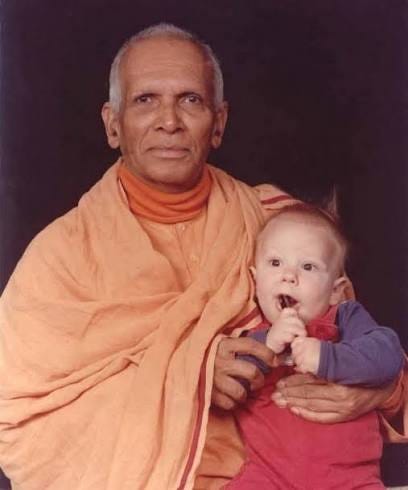
Srimat Swami Ranganathanandaji Maharaj (1908–2005). 13th President of the Ramkarishna Math and Mission. This photograph has hung in my family home for many years and remains one of my favourite images of my Gurudev.
Monika Mahadev recently posed a question that made me stop scrolling:
Who is that one person in your life who is always there for you, who listens without judgment?
When I look at my own life today, the honest answer sounds like a paradox. The person who still listens to me, the one whose presence anchors me more than any other, passed away more than twenty years ago.
He was Srimat Swami Ranganathanandaji Maharaj, the 13th President of the Ramakrishna Math and Mission. To many people, he was a renowned monk and a towering teacher.
To me, he was simply my Gurudev.
Our conversation began when I was five years old in Hyderabad, when my parents first took me to meet him, and somehow, it has never stopped. What I remember most from those early days is not the lectures or the books.
It was the calm certainty with which he spoke. As a child, I remember being struck by the feeling that he simply wasn’t afraid of anything. But as the seasons of my life have changed, I have come to realize that the exact same words can mean completely different things depending on the weight you are currently carrying.
The first lesson was entirely un-spiritual. I was a young boy, completely consumed by a paralyzing, irrational terror after reading Bram Stoker’s Dracula. It wasn’t a mild case of the creeps; it was proper childhood dread. I refused to go upstairs alone. I wouldn’t walk down a dark corridor.
When I was brought before Gurudev, I didn’t confess a grand existential crisis; I confessed my terror of vampires. He listened patiently and then said something that puzzled me for years:
“Fear is sin.”
As a child, it felt like an impossible, almost unfair standard. How could fear be a sin when Dracula was so obviously waiting for me at the top of the stairs? I wish I could say I was cured immediately. I wasn’t; that night, I still ran up the dark stairs in a panic. It took me years to understand that he wasn’t scolding my childhood cowardice; he was warning me against giving away my power to things that only exist in the dark.
Years later, when he gave me diksha (spiritual initiation), the conversation evolved. He gave me a companion phrase to carry into my youth:
“Develop atmashraddha. Atmavishwas. I can, I can.”
As a teenager and a young professional, I interpreted this through the conventional lens of modern confidence. It became my armor for university exams, nervous interviews, and navigating the competitive anxieties of early adulthood. I thought “I can” was a motivational chant to help me win.
I was wrong. It was meant for a much deeper winter.
Today, I find myself navigating a quiet season of professional uncertainty and reinvention. It is a period of transition where the silence after sending applications can feel just as loud as the monsters of my childhood.
The fear has changed, but the lesson has not.
The monsters aren’t vampires anymore. They are the anxieties of adult life: the fear of failure, the fear of rejection, and the fear of having to begin again.
Now, when I hear his voice echo through memory, “Fear is sin” doesn’t feel like a commandment. It feels like a rescue line. It means that fear should not be allowed to make my decisions for me. And “I can, I can” has stopped sounding like a loud, energetic cheer. It has become a stubborn, silent resolve to put one foot in front of the other, trusting that the ground will be there to catch it.
Monika asked us to write about the person who stands beside us through every phase of life without asking a hundred questions.
I was fortunate enough to find that person in a monk who left this physical world in 2005. Yet, twenty years later, when doubt arrives uninvited, I still find myself returning to that conversation.
“Fear is sin.”
“I can, I can.”
Twenty years later, I am still learning what he meant.
Some conversations, it turns out, never really end.
A heartfelt thank you to Monika Mahadev and Smriti Pathak for organizing this space for honest reflection. And a special note of gratitude to Parvathi J for tagging me and inviting me to reflect on this prompt. It gave me an opportunity to revisit a conversation that has quietly accompanied me through every stage of life.
I would love to tag my friends to share their own anchors : Suhani Bajpai, Anchal Bhuyan, Sudeshna Hajra, Phaguni Shrivastava, Golam Mohiuddin, and Garima Tiwari.
[embed]The Person Who Listens The Gravity Weekly Reflectionmedium.com
메타데이터
- post_id
- 5eebf3ef5d36
- slug
- fear-is-sin-my-gurudev-still-speaks-to-me-5eebf3ef5d36
- url
- https://medium.com/the-gravity/fear-is-sin-my-gurudev-still-speaks-to-me-5eebf3ef5d36
- canonical_url
- https://medium.com/the-gravity/fear-is-sin-my-gurudev-still-speaks-to-me-5eebf3ef5d36
- author_url
- https://medium.com/@sourojitdas
- status
- ok
- fetched_at
- 2026-06-23 03:48:11