The Sadness You Were Already Expecting
On impermanence, the petals on the ground, and why we keep showing up
The Sadness You Were Already Expecting
On impermanence, the petals on the ground, and why we keep showing up
This piece follows an earlier essay written during hanami along the Okawa River in Osaka. If you haven’t read that one, it isn’t required — but it may add some context to where this one begins.
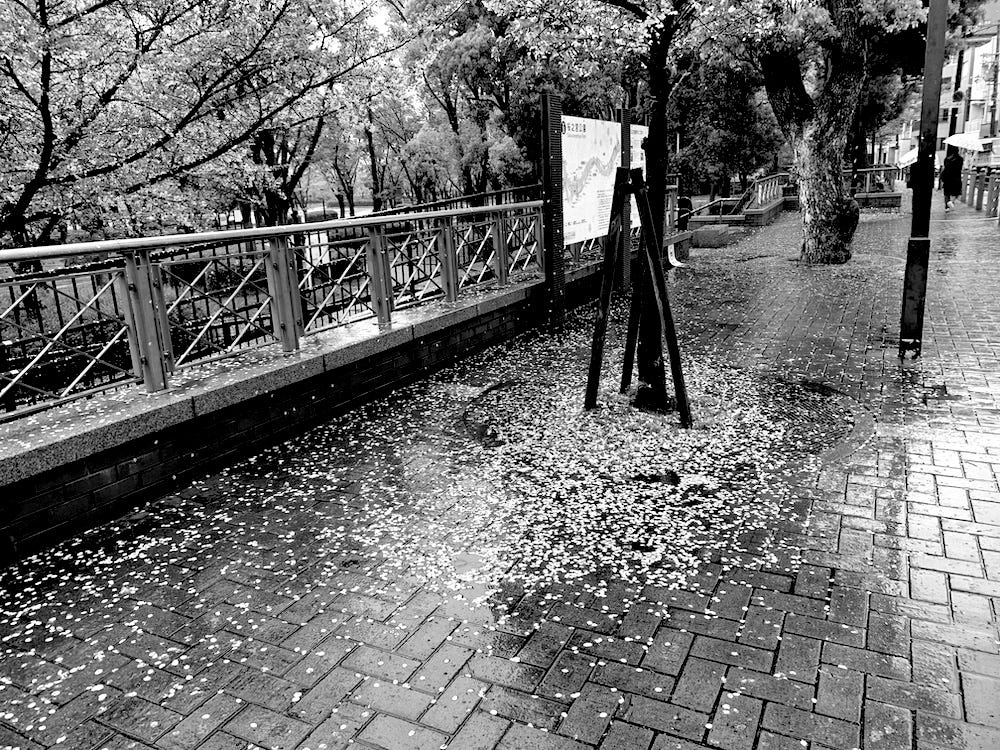
The cherry blossom petals along the Okawa River have fallen (Photo by Takeshi Kitagawa)
The blossoms are gone now.
I walked past the Okawa last week, and the ground along the path was covered in petals — pale, softened by a few days of rain, pressed flat against the pavement. The branches above were filling in with that particular yellow-green of early spring leaves, urgent and a little startling against the grey sky.
I stopped and looked for a moment.
Ah. They’ve scattered.
There’s no English phrase that carries quite the same weight as that. In Japanese we might say chitte shimatta — not just “they fell” but something closer to “they’ve gone and fallen on us.” A mild reproach. Fond. The kind of thing you’d say about a friend who left the party before you were ready.
I wasn’t surprised. I knew this was coming. I watched the blossoms at their peak, felt the afternoon, drank the beer. And now here was the other side of it — the expected ending, arriving exactly as expected.
What I didn’t expect was how it would feel anyway.
The Grief You Prepared For
There’s an interesting thing about anticipated sadness. You’d think that knowing something is going to end would soften the blow. You brace yourself. You make your peace in advance. And yet when it actually arrives — the empty branch, the scattered petals, the party over — there’s still something in it that lands.
I think this is because the mind is very good at knowing and very bad at feeling ahead. I knew the blossoms would fall. That knowledge didn’t protect me from the small, quiet pang of finding them on the ground.
But here’s what I’ve been sitting with: that pang is not separate from the joy of hanami. It’s the same thing, arriving in its second form.
When I was sitting under the trees on April 6th — petals drifting, friends laughing, the canopy still full above us — part of what made that afternoon feel so complete was the awareness, sitting somewhere underneath the enjoyment, that it was already ending. We were inside it and losing it at the same time. The blossoms were beautiful partly because they were already becoming memory.
And then the petals fell. And I felt the loss.
And that loss confirmed, retroactively, that the afternoon had been real.
Why We Come Back
Every year, the same thing happens.
The forecast is released. People get restless. The blossoms peak. Hanami. And then, within a week, the petals are on the ground.
And every year, the following spring, people do it again.
I used to think of this as simply tradition — something you do because you’ve always done it, because everyone does it, because it’s spring. But I think there’s something more precise happening. The loss teaches you something that the beauty alone couldn’t. And the next year, when the blossoms open again, you bring that knowledge with you. You sit under the flowers differently when you remember what it felt like to find them on the ground.
This is, I think, what mono no aware actually does in practice. It’s not just a bittersweet feeling you have in the moment. It’s a kind of education — slow, repeated, accumulated over years of watching the same trees bloom and fall.
The sorrow isn’t a side effect of the beauty. It’s the mechanism by which the beauty becomes yours.
By which this particular afternoon, these particular people, this particular branch heavy with pink above your head, become irreplaceable.
Impermanence, fully received, doesn’t make you mourn the present before it’s gone. It makes you present inside it.
The Thing We Keep Forgetting
I want to be honest about something, though.
I know all of this. I’ve known it for most of my adult life, in the way that things you’ve grown up around become part of how you understand the world without you ever deciding to learn them. Martial arts practice teaches it through the body — the technique that was there yesterday and gone today, the conditioning that requires daily maintenance or it quietly disappears. Zen points at it repeatedly, from different angles, until you stop thinking the lesson is about something other than your own life.
I know, in other words, that nothing holds.
And I still forget.
Not always dramatically. I don’t usually need a crisis to remind me. It’s more like a gradual drift — weeks where I’m moving through days efficiently, getting things done, planning ahead, and somewhere in the middle of all that forward motion, I stop noticing what’s actually around me. The light in the afternoon. The particular quality of a conversation with a friend. The fact that this version of my life, right now, is its own unrepeatable thing.
I forget, and then something calls me back. Sometimes it’s a piece of music. Sometimes it’s a conversation that goes somewhere unexpected. This year, it was the petals on the ground along the Okawa.
Chitte shimatta. They’ve scattered.
And just like that, I was paying attention again.
What Impermanence Is Actually Asking
I’ve been thinking about what it means to “affirm” impermanence — which is a phrase I used in my previous essay and have been turning over since.
It would be easy to read it as passive acceptance. A shrug. Everything ends, so why fight it. But that’s not what I mean, and I don’t think that’s what hanami embodies either. The people drinking under the blossoms aren’t resigned. They’re choosing. There’s a difference.
To affirm impermanence, as I understand it, is to let the fact of ending sharpen your attention to what is presently here.
It is not a philosophy of letting go — or not primarily. It is a practice of showing up, more fully, to the thing that is in front of you right now, because you know it won’t always be.
The petals fall. And because they fall, the afternoon they fell from becomes something you carry.
Your daily life is full of things like this — people, seasons, versions of yourself, periods of difficulty that are harder than you think they’ll be and then, quietly, over. The difficulty of applying this isn’t intellectual. Most people, if you ask them, already understand that things don’t last. The difficulty is in keeping that understanding alive — not as an abstract idea filed away somewhere useful, but as something present enough to actually change how you move through an ordinary Tuesday.
The cherry blossoms are almost obscenely good at this. They don’t let you forget. They give you one week, full bloom, and then they give you the ground covered in petals. The lesson is inescapable.
Most of life is less obvious. Which is why, I think, we need the blossoms.
A Question I’m Still Carrying
What would it mean to live with this kind of attention all year — not just for the week the cherry blossoms are out?
I don’t have a clean answer to that. I’m not sure it’s possible to sustain the quality of presence that hanami, at its best, produces. Some things require the contrast. The blossoms work partly because they’re surrounded by months of ordinary weather.
But I do think there’s something in the practice of noticing what is passing — of pausing, occasionally, to register that this particular thing, this particular moment, will not come around again in exactly this form.
Not as a discipline. Not as mindfulness homework. Just as a habit of attention. A small fidelity to the present.
The petals are on the ground now. The new leaves are in. Somewhere, the tree is already preparing for next spring.
And I am already looking forward to it — with all the anticipatory sadness that implies.
SHIBUMIWORKS PROJECT explores Japanese philosophy, aesthetics, and culture — not as a guide, but as a mirror. The views in this piece are my own — shaped by how I grew up, what I practiced, and what I noticed. They are not the correct interpretation of Zen, or of anything else. English is not my first language; I use AI as a linguistic tool to bridge that gap. The thinking is mine. The words are a collaboration.
메타데이터
- post_id
- 5ef5a0fdb350
- slug
- the-sadness-you-were-already-expecting-5ef5a0fdb350
- url
- https://medium.com/illumination/the-sadness-you-were-already-expecting-5ef5a0fdb350
- canonical_url
- https://medium.com/illumination/the-sadness-you-were-already-expecting-5ef5a0fdb350
- author_url
- https://medium.com/@shibumi4011
- status
- ok
- fetched_at
- 2026-07-11 04:18:25







