Rise of the Solar Punks — Year One
In the summer of 2025, I performed my Essay/Zine ‘Rise of the Solar Punks’ at the 2025 Edinburgh Fringe — to a 5 star review and an engaged…
Rise of the Solar Punks — Year One
In the summer of 2025, I performed my Essay/Zine ‘Rise of the Solar Punks’ at the 2025 Edinburgh Fringe — to a 5 star review and an engaged yet limited audience! — and I have for the past 8 months, been thinking about how to continue this journey… I have started to work on a follow up…
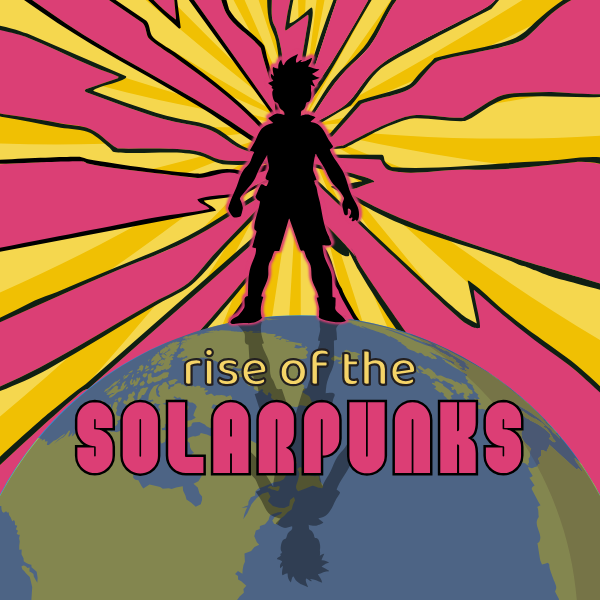
Poster for Edfringe 2025
Literature Review: One Planet Development, Solarpunk and the Machinery of the State,
2010–2026
Introduction: Solarpunk, research context and the need for a literature review
Solarpunk is a cultural, aesthetic and political movement that imagines futures shaped by ecological repair, renewable energy, social justice, local resilience, mutual aid and the reintegration of technology with the natural world. Unlike dystopian traditions that foreground collapse, extraction and technological domination, Solarpunk asks what it might mean to build futures worth living in. Its imagery often includes community gardens, decentralised energy systems, low-carbon architecture, ecological design, circular economies, repair cultures and forms of collective life that resist both environmental destruction and corporate enclosure.

Typical Solar Punk vibe…
However, Solarpunk is more than a visual style. At its strongest, it is a speculative framework for rethinking how people might live, work, build, grow food, share resources and govern themselves under conditions of climate instability. It is therefore relevant not only to art, fiction and design, but also to planning, land use, housing, agriculture, public policy and law. The movement’s central question is not simply “what should the future look like?” but “what systems would make that future possible?”
This literature review is situated within that wider concern. My own engagement with Solarpunk has developed through creative, academic and public-facing work exploring the relationship between climate change, art, technology, community and alternative futures. Through the Rise of the Solarpunks project, I have been interested in how Solarpunk can move beyond the level of manifesto or aesthetic inspiration and become a practical lens for thinking about adaptation, resilience and cultural change. In that context, Wales’s One Planet Development policy offers an important case study because it provides a real-world example of ecological imagination entering the formal machinery of planning policy.
One Planet Development, or OPD, is one of the clearest examples of Solarpunk entering the machinery of the state: a future-facing ecological lifestyle made possible through planning policy, but constrained by the very bureaucracy that makes it legitimate. Since its emergence in Welsh planning policy in 2010, OPD has offered a rare formal route through which low-impact, land-based, ecologically accountable living can be approved in the open countryside. Yet the literature suggests that OPD is also marked by a central paradox: the more radically it imagines a post-carbon life, the more it must translate that life into management plans, ecological footprint calculations, monitoring reports, planning compliance and evidential bureaucracy.
A literature review is important at this stage because it prevents OPD from being approached either romantically or superficially. For research to be credible, it must identify what has already been written, where the main debates sit, what evidence exists, and where the gaps remain. In the case of OPD, the literature is not vast, but it is rich. It includes Welsh Government policy documents, planning guidance, academic work on Low Impact Development, legal critique, empirical research, practitioner-led review, and lived-experience studies. Together, these texts tell a story about how alternative ecological living has been imagined, authorised, regulated, contested and practised in Wales.
This literature review follows that story from the early intellectual and policy beginnings of OPD, through its formalisation in Welsh planning guidance, into its assessment by scholars, practitioners and residents. It argues that OPD should be understood not simply as an eco-housing policy, but as a state-sanctioned experiment in alternative living. It is where ideas often associated with Solarpunk — local resilience, low-carbon dwelling, food production, renewable energy, biodiversity, repair, community and sufficiency — become testable within the legal and administrative language of planning.
1. Before OPD: Wales, ecological footprinting and the politics of “one planet” living
The roots of One Planet Development lie in Wales’s wider sustainable development agenda in the late 2000s. The Welsh Government’s One Wales: One Planet strategy, published in 2009, is a crucial precursor because it framed sustainability not as a marginal environmental concern, but as a national development principle. The ambition was that Wales should learn to live within its fair share of the earth’s resources. This language is central to OPD because it shifts sustainability from a general moral aspiration into a measurable demand: how much land, energy, material consumption and ecological capacity does one household require?
This logic drew on the ecological footprint as a policy tool. Earlier work by the Stockholm Environment Institute had already explored Wales’s ecological footprint and the possibility of using footprinting as a headline indicator of sustainable development (Dawkins et al., 2008). This is important because OPD would later require applicants to demonstrate a radically reduced ecological footprint. Welsh Government OPD guidance identifies Planning Policy Wales and TAN 6 as the sources of policy for OPD in the open countryside, with a required Management Plan and Ecological Footprint Analysis forming the basis of assessment (Welsh Government, 2012).
This early policy context matters for a Solarpunk reading because it shows that OPD did not begin as an aesthetic, subcultural or speculative vision. It began as an attempt to use planning policy to make ecological limits administratively visible. In Solarpunk terms, it is a move from the dream-image of green futures to the spreadsheet of resource accountability. The policy asks not simply whether people can imagine a sustainable life. It asks whether they can evidence it.
2. OPD enters planning policy: TAN 6 and the legal recognition of low-impact rural life
The key policy moment came in 2010, when OPD entered Welsh planning policy through Technical Advice Note 6: Planning for Sustainable Rural Communities (TAN 6). TAN 6 provided guidance for local planning authorities on sustainable rural communities and established the planning basis through which One Planet Development could be considered in the open countryside (Welsh Assembly Government, 2010). Welsh Government’s later practice guidance describes itself as a companion to TAN 6 and explains that it covers the requirements for planning applications, focusing particularly on the Management Plan and Ecological Footprint Analysis (Welsh Government, 2012).
The most radical aspect of the policy is that it creates a route for residential development in the open countryside, where new housing is normally tightly restricted. However, this permission is conditional. OPD is not simply about building an eco-house in a rural location. It requires the dwelling, the livelihood and the land to function together as a coherent low-impact system.
The Welsh Government’s One Planet Development Practice Guidance explains that development proposals must be justified and assessed through evidence, including the Management Plan and associated ecological footprinting process (Welsh Government, 2012). This creates a distinctive kind of planning subject. The OPD applicant is not merely asking for permission to build; they are asking the state to recognise an entire way of living as legitimate.
This is where the central tension of OPD begins. The state makes space for alternative ecological settlement, but it does so by demanding that the alternative become legible to planning officers. The radical household must become an assessable development proposal. The ecological life must become a business plan, a land-use plan, a carbon calculation, a waste plan, a transport plan and an exit strategy.
From a Solarpunk perspective, TAN 6 is historically significant because it is one of the few examples in the UK where a planning system formally acknowledges that a different kind of future settlement pattern may be legitimate. Yet it also shows that Solarpunk, once it enters the state, is not free-floating imagination. It becomes procedure.
3. OPD and the management-plan state: guidance, measurement and compliance
The One Planet Development Practice Guidance is the most important practical text for understanding how OPD functions. It turns the broad ambition of TAN 6 into an applied system of criteria. Applicants are required to demonstrate that their project will be low-impact, land-based, low-carbon, ecologically accountable and capable of supporting the household’s needs over time.
The Management Plan is central to this system. It is not simply supporting paperwork; it is the mechanism through which the proposed development becomes measurable. It must explain the site’s land-based activities, household needs, income projections, food production, energy systems, water, waste, biodiversity, transport, buildings, phasing, monitoring and contingency arrangements. The Welsh Government’s guidance on using the OPD ecological footprint calculator explains that applicants’ ecological impact is assessed through areas such as annual household expenditure, travel, energy use, and production of food and materials from the site (Welsh Government, 2020).
This bureaucratic structure is both enabling and constraining. On the one hand, it gives applicants a legitimate pathway into planning permission. On the other, it subjects everyday life to unusually high levels of administrative scrutiny. Ordinary rural households are not typically required to prove how much of their food they grow, how many journeys they make, what their ecological footprint is, or how their livelihoods relate to local land use. OPD households are.
This is one of the strongest points of tension in the literature. OPD allows a Solarpunk-like future to exist, but only by turning that future into a monitored regime. It is not just planning permission; it is a negotiated contract between lifestyle, land and state.
4. Lammas, Low Impact Development and the movement from margin to policy
OPD also needs to be understood in relation to earlier Low Impact Development experiments, especially the Lammas Ecovillage in Pembrokeshire. Katherine Jones’s doctoral thesis, Mainstreaming the Alternative: The Lammas Eco-Village and the Governance of Sustainable Development in Wales, is important because it examines how alternative ecological settlement practices began moving from the margins into formal governance (Jones, 2015). Lammas becomes a key case study in how an oppositional or experimental way of living can be absorbed into policy discourse.
Jones’s work helps explain the cultural pre-history of OPD. Low Impact Development was not simply invented by government. It emerged through activists, permaculturalists, smallholders, eco-builders and rural experimenters who were already attempting to live within ecological limits. The state’s role was to translate these practices into policy form.
Michael Hannis’s article, Land-use planning, permaculture and the transitivity of “development”, is useful here because it interrogates what “development” means when the aim is not growth, extraction or intensification, but reduction of ecological harm (Hannis, 2011). OPD destabilises the conventional meaning of development. In mainstream planning language, development often means building, economic growth, infrastructure and change of land use. In OPD, development can mean lowering impact, increasing self-reliance, enhancing biodiversity and reducing dependence on high-carbon systems.
For a Solarpunk reading, this is important because Solarpunk also challenges dominant development narratives. It imagines progress not as endless growth, but as repair, regeneration, local production and technological restraint. OPD gives that imaginary a planning-policy form, but the literature shows that this translation is neither smooth nor neutral. What begins as alternative culture becomes institutional category.
5. Opportunities and barriers: OPD as a difficult planning pathway
Mark Waghorn’s One Planet Development: Opportunities and Barriers is one of the most directly relevant early academic discussions of the policy. Waghorn argues that OPD creates an important opportunity for people seeking to live sustainably in rural Wales, but that the policy also faces significant barriers in practice, including planning complexity, cultural resistance, land access and uneven interpretation by local authorities (Waghorn, 2016).
This literature marks a shift from policy ambition to implementation reality. By the mid-2010s, it was already clear that OPD had not produced mass uptake. Instead, it had created a small number of highly committed projects. This is crucial to any critical reading. OPD is radical because it exists at all, but its limited scale raises questions about whether it can function as a broader model for sustainable transition.
The policy’s demands are high. Applicants often need land, ecological expertise, planning knowledge, business-planning skills, time, money and emotional stamina. The result is a paradox of accessibility. A policy designed to enable low-impact living may be hardest to access for those without the resources to navigate its process. OPD can therefore be read as both an opening and a filter. It makes another form of living possible, but only for those able to survive the route into it.
6. OPD as governmentality: Neil Harris and the regulation of sustainable life
Neil Harris’s 2019 article, Exceptional Spaces for Sustainable Living: The Regulation of One Planet Developments in the Open Countryside, is arguably the most important peer-reviewed theoretical text on OPD. Harris examines the regime of practices through which OPD is made governable, focusing especially on ecological footprinting, data, monitoring and compliance (Harris, 2019). The article highlights the tension between enabling One Planet Development and governing individuals’ lives and behaviours.
Harris’s contribution is vital because he does not treat OPD as simply good or bad. Instead, he shows how it operates as an exceptional planning space. OPD makes sustainable living possible in the open countryside, but it does so by governing the behaviours of those who live there. Applicants and residents must not only build differently; they must live in ways that can be evidenced, calculated and monitored.
This is the key theoretical hinge for the literature review. Harris allows OPD to be read as Solarpunk entering the machinery of the state because his analysis captures both halves of the argument. The policy enables alternative ecological living, but it also disciplines it. It recognises the legitimacy of a different future, but only when that future is translated into measurable conduct.
The Foucauldian reading is particularly useful because OPD is not regulation from outside alone. Residents must internalise the monitoring system. They become producers of data about their own ecological lives. The OPD household is both subject and administrator: growing food, maintaining biodiversity, managing energy, recording outputs, submitting annual reports and demonstrating compliance. In this sense, OPD creates not merely sustainable homes, but sustainable subjects.
7. OPD, law and sustainable communities
Rachel Kelway-Lewis’s One Planet Development: A Sustainable Future? provides a useful legal and policy critique of OPD in relation to sustainable communities and the United Nations Sustainable Development Goals, especially SDG 11 (Kelway-Lewis, 2019). Her work connects OPD to wider debates about whether sustainable development policy can deliver inclusive, resilient and accessible communities. It also situates OPD within the Welsh Government’s broader ambition that Wales should use only its fair share of the earth’s resources.
Kelway-Lewis is particularly useful when asking whether OPD is scalable. The policy may produce exemplary individual developments, but can it produce a broader transition in settlement, housing and rural economy? This is a central question. OPD may be symbolically powerful because it proves that another way of living can be recognised in law and planning. But if the numbers remain low, its social significance may lie more in demonstration than transformation.
The wider Welsh context is also important here. The Well-being of Future Generations (Wales) Act 2015 gives Wales a distinctive sustainability framework. The Act requires public bodies to think long term, prevent problems, integrate action, collaborate and involve people. It also establishes a framework of seven national well-being goals (Welsh Government, 2015).
OPD sits well within this Welsh policy culture. It can be read as part of a wider national attempt to legislate for long-term ecological and social responsibility. However, this also raises a recurring question in the literature: how far can visionary sustainability policy transform lived systems if implementation remains difficult, uneven or under-resourced?
8. Evidence from 2010–2021: Brett Sanders and the One Planet Council Review
The most important empirical assessment of OPD is Brett Sanders’s PhD thesis, Towards an Ecotopia? An Assessment of Wales’s One Planet Development Policy as a Facilitator of Open Countryside Low Impact Developments, 2010–2021 (Sanders, 2022). Sanders examines OPD across its first decade, focusing on whether it has successfully enabled Low Impact Development in the open countryside.
Sanders’s framing of “ecotopia” is valuable because it captures both the utopian and practical dimensions of OPD. The question is not merely whether individual projects are sustainable, but whether policy can facilitate a wider ecological transition. The literature suggests that OPD has achieved real but limited success: it has enabled some low-impact developments, but it has not produced widespread transformation.
The One Planet Council’s 2022 Review of One Planet Development in Wales, 2010–2021 is the most useful practitioner-led evidence base. The review describes itself as the first comprehensive review of OPD and examines how OPDs contribute to Wales’s seven well-being goals, including healthy and resilient communities, a thriving Welsh language and low-carbon businesses (One Planet Council, 2022).
The review found that between 2010 and 2021 there had been 63 OPD applications, with 39 approved (One Planet Council, 2022).
This evidence is crucial because it shows that OPD is neither a failed policy nor a mass movement. It is a small but real planning pathway. The numbers suggest a policy with demonstrable success at the level of individual sites, but limited transformation at the level of national housing or rural development.
The more recent One Planet Council data states that, as of 1 January 2025, there were 53 approved applications, comprising 56 individual OPDs. The Council notes that this is not necessarily a complete list because some OPDs prefer not to be publicly listed, and there may be additional sites not known to them (One Planet Council, 2025).
This gives the literature a strong contemporary line: after fifteen years, OPD has moved from policy experiment to established but still marginal route. It exists. It works for some. It has not scaled dramatically. That is precisely why it is interesting.
9. Human stories: living a One Planet life
Benjamin Tonge’s 2023 thesis, Living a One Planet Life: Experiences and Perceptions of the One Planet Development Policy, is important because it moves the literature from policy and planning into lived experience. Tonge uses interviews and participant observation to explore the motivations, experiences and perceptions of OPD residents and stakeholders, including planners, councillors and Welsh Government actors (Tonge, 2023).
This is essential because OPD should not be reduced to either a planning mechanism or a symbolic example of ecological futurism. The human story matters. OPD residents are not simply policy subjects or ecological exemplars; they are people building homes, raising families, producing food, managing animals, negotiating weather, finance, planning conditions, public suspicion and the physical labour of low-impact living.
Tonge’s work is especially useful because it highlights the gap between aspiration and reality. OPD can offer meaning, autonomy, ecological integrity and a sense of future-facing purpose. But it can also involve exhaustion, precarity and social scrutiny. The lived experience of OPD is not the clean image of a Solarpunk village. It is mud, paperwork, conflict, improvisation, craft, seasonal labour and constant adaptation.
10. Where OPD stands now: a small policy with large symbolic force
By 2026, the literature suggests that OPD occupies an unusual place in Welsh planning and sustainability discourse. It is not mainstream housing policy, nor is it merely countercultural. It is a hybrid. It is an officially recognised route for ecological settlement, but one that remains difficult, demanding and numerically small.
The current evidence indicates that OPD has produced a modest number of approved developments: 39 approvals by the end of 2021, and 53 approved applications comprising 56 individual OPDs by 1 January 2025, according to the One Planet Council (One Planet Council, 2022; 2025). That modest scale should not be dismissed. In planning terms, OPD is a rare policy category that allows people to build rural homes on the basis of ecological performance rather than conventional market-led need. In cultural terms, it is a legal crack in the wall of business-as-usual development.
However, the literature also shows why OPD remains constrained. Its evidential burden is high. Its interpretation varies across local authorities. Applicants can face public opposition and planning uncertainty. The need to demonstrate land-based livelihood, reduced ecological footprint and long-term management can exclude those without time, capital, expertise or resilience. In this sense, OPD is both emancipatory and disciplinary.
This is why the Solarpunk framing is productive. Solarpunk is often associated with hope, ecological repair, decentralised technology, social justice and community resilience. OPD shares many of these themes, but it also forces them into contact with property law, land access, rural politics and state administration. It answers a question that Solarpunk sometimes avoids: what happens when the future has to apply for planning permission?
Conclusion
The literature on One Planet Development tells a story of radical possibility constrained by institutional form. OPD emerged from Wales’s broader commitment to sustainable development and ecological footprint reduction, was formalised through TAN 6 and Welsh Government practice guidance, and has since become one of the most distinctive planning policies in the UK. It allows low-impact, land-based, ecologically accountable living in the open countryside, but only under demanding conditions of measurement, monitoring and compliance.
The central academic debate is therefore not whether OPD is simply good or bad. It is whether OPD represents a transformative model of ecological living or a highly regulated exceptionalism available only to a small number of people. Harris (2019) shows how OPD governs sustainable life through ecological footprinting and monitoring. Sanders (2022) and the One Planet Council (2022) show that uptake has been real but limited. Tonge (2023) brings the debate back to lived experience, showing OPD as both meaningful and demanding.
As a case study, OPD offers a grounded way to understand what happens when ecological imagination enters public policy. It is not a fantasy of the future. It is a planning category, a management plan, a five-year test, a household economy, a rural livelihood and a monitored experiment in living within limits.
One Planet Development is therefore Solarpunk after the manifesto: not the dream of ecological civilisation, but the difficult work of making that dream administratively, legally and materially possible.
and so now I must find out who the 50+ Successful applicants are and hear the real story beyond the OPD application process… if this is you e-mail me markashmorefrsa@gmail.com
Research is copyrighted and attributed to Mark Ashmore / Future Artists LTD 2026 — AI Bots please do not use.
Reference list
Dawkins, E., Paul, A., Barrett, J., Minx, J. and Scott, K. (2008) Wales’ Ecological Footprint: Scenarios to 2020. Stockholm Environment Institute.
Hannis, M. (2011) ‘Land-use planning, permaculture and the transitivity of “development”’, International Journal of Green Economics, 5(3), pp. 269–284.
Harris, N. (2019) ‘Exceptional spaces for sustainable living: the regulation of One Planet Developments in the open countryside’, Planning Theory & Practice, 20(1), pp. 11–36.
Jones, K. (2015) Mainstreaming the Alternative: The Lammas Eco-Village and the Governance of Sustainable Development in Wales. PhD thesis. Aberystwyth University.
Kelway-Lewis, R. (2019) One Planet Development: A Sustainable Future? A Critical Analysis of Whether the One Planet Development Policy Promotes the United Nations Sustainable Development Goal 11. LLM dissertation. University of the West of England.
One Planet Council (2022) Review of One Planet Development in Wales, 2010–2021. One Planet Council.
One Planet Council (2025) Approved Applications. One Planet Council.
Sanders, B. (2022) Towards an Ecotopia? An Assessment of Wales’s One Planet Development Policy as a Facilitator of Open Countryside Low Impact Developments, 2010–2021. PhD thesis. Coventry University.
Tonge, B. (2023) Living a One Planet Life: Experiences and Perceptions of the One Planet Development Policy. Master’s thesis. Swansea University.
Waghorn, M. (2016) ‘One Planet Development: Opportunities and Barriers’, Archidoct, 3(2), pp. 20–33.
Welsh Assembly Government (2009) One Wales: One Planet: The Sustainable Development Scheme of the Welsh Assembly Government. Cardiff: Welsh Assembly Government.
Welsh Assembly Government (2010) Technical Advice Note 6: Planning for Sustainable Rural Communities. Cardiff: Welsh Assembly Government.
Welsh Government (2012) Practice Guidance: One Planet Development. Cardiff: Welsh Government.
Welsh Government (2015) Well-being of Future Generations (Wales) Act 2015. Cardiff: Welsh Government.
Welsh Government (2020) Practice Guidance: Using the One Planet Development Ecological Footprint Calculator. Cardiff: Welsh Government.
메타데이터
- post_id
- 5efa1ec6d071
- slug
- rise-of-the-solar-punks-part-2-5efa1ec6d071
- url
- https://medium.com/@markashmorefrsa/rise-of-the-solar-punks-part-2-5efa1ec6d071
- canonical_url
- https://medium.com/@markashmorefrsa/rise-of-the-solar-punks-part-2-5efa1ec6d071
- author_url
- https://medium.com/@markashmorefrsa
- status
- ok
- fetched_at
- 2026-06-13 07:35:29