From .NET to Neural Nets
A Developer’s Journey Into the Heart of Modern AI
From .NET to Neural Nets
A Developer’s Journey Into the Heart of Modern AI
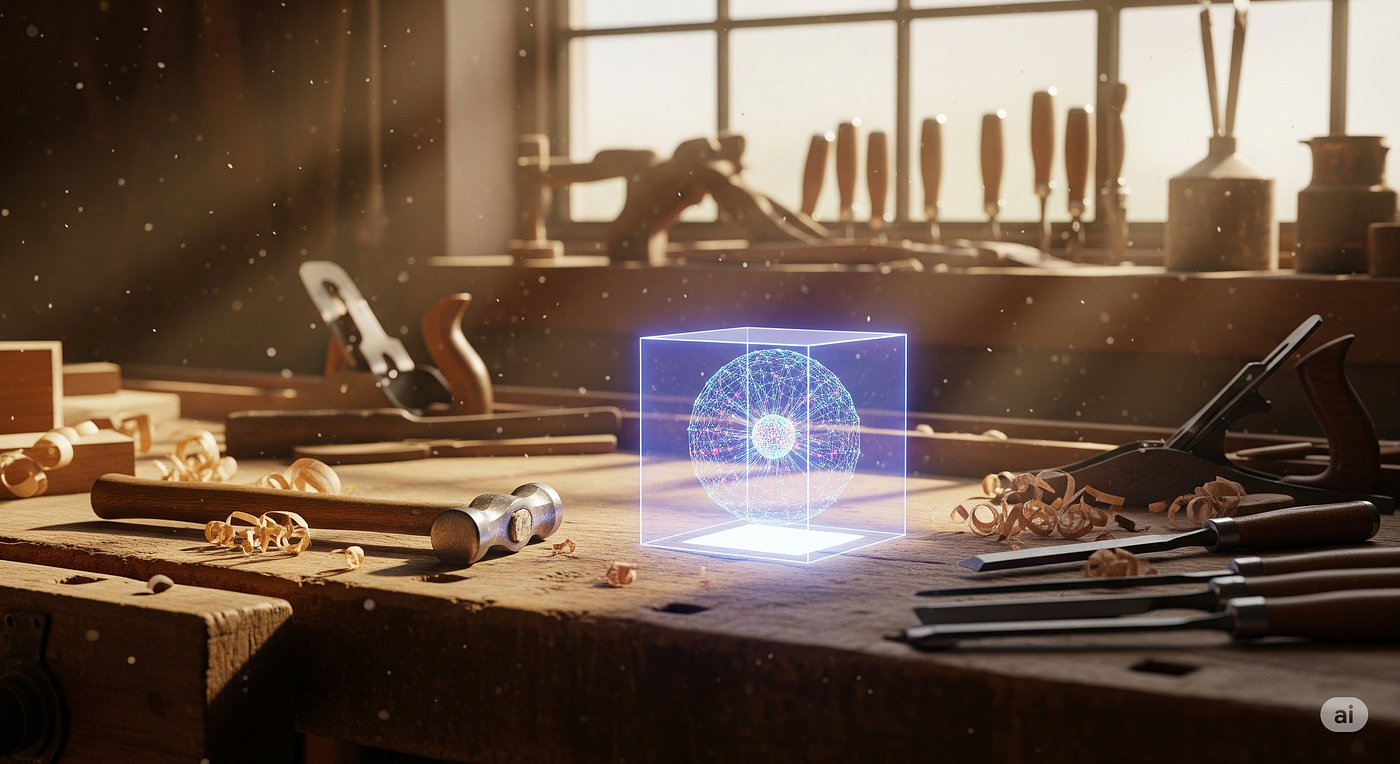
Imagen Image
It Turns Out You Can Teach an Old Dog New Tricks, but First, You Have to Confuse Him Considerably
I’ve been writing code for a little over fifty years. My journey started in the military, with machines that filled a room and hissed with the sound of a thousand tiny relays all clicking at once.
You didn’t so much write code as you did physically negotiate with a behemoth, feeding it punch cards like a zookeeper feeding a very logical, very demanding beast.
Back then, the ghost in the machine wasn’t a ghost at all. It was you. Every single action, every calculation, every flicker of a light was a direct, traceable result of an instruction you explicitly laid down.
The machine was a perfect, unthinking servant.
Fast forward to today. I’m sitting here asking a box on my desk to write a Python script for me, and it doesn’t just do it; it apologizes for a potential inefficiency in its own code.
The ghost is real now, and it has opinions. For a developer raised on the rigid certainty of frameworks like .NET, this new world of AI feels less like an evolution and more like we’ve invited a friendly, slightly unpredictable alien to sit at the desk next to us.
The Comfort of the Blueprint: Life in the .NET Framework
For most of my career, I’ve been an architect. Not of buildings, but of systems. Working with something like the .NET framework is like having the world’s best-stocked workshop.
You have blueprints (your design patterns), precision tools (your IDE and compiler), and high-quality materials (your libraries and APIs).
When a client wanted a house, I built them a house.
I knew where every wire would run, where every nail would be hammered. I could tell you, with absolute certainty, why a button was blue or how the data would travel from a user’s form to the database and back again.
It was a world of control, of craftsmanship. If the house fell down, it was because I, the architect, made a mistake in the plans. The logic was pure and accountable.
This structured universe is comfortable. It’s predictable. It rewards careful planning and deep knowledge of the rules. For decades, this was the gold standard of software development.
We built castles of logic, and we were the masters of our domains.
Meeting the New Neighbors: The Weird World of Neural Nets
Then came the new neighbors. They moved in next door to my perfectly structured castle, and they started… gardening.
My first real encounter with a neural network was a profound lesson in humility. I tried to apply my architect’s brain to it, and I failed spectacularly. I wanted to see the blueprints.
Where was the if-then-else statement? Where was the loop that processed the data? There wasn’t one. Not in a way I recognized.
I quickly realized that building an AI model is nothing like architecture. It’s like being a gardener. You don’t lay bricks; you cultivate.
You choose the right seeds (your model architecture), you prepare the soil (your dataset), and you provide sunlight and water (your training process).
You can guide the plant, prune it, and give it the best possible environment to grow, but you don’t command every cell into existence.
You are teaching a system to find its own rules. This shift from explicit instruction to guided cultivation is a fundamental, and frankly, unsettling change for someone who has spent a lifetime writing the rules himself.
Lost in Translation: What the Heck Is a ‘Tensor’ Anyway?
Stepping into the world of AI is like landing in a foreign country where you don’t speak the language. The locals are friendly, but they keep using words like “backpropagation,” “gradient descent,” and “tensors.”
You nod along, pretending you understand, while secretly feeling like a complete imposter.
Let’s pick one of those scary words: tensor. I heard it for months and just pictured some kind of sci-fi energy crystal.
Here’s the simple, folksy truth I eventually figured out. A tensor is just a box for numbers. That’s it. Sometimes it’s a simple list of numbers (a 1D tensor). Sometimes it’s a grid of numbers, like a spreadsheet (a 2D tensor).
And sometimes, it’s a stack of spreadsheets (a 3D tensor). We call them “tensors” because it sounds more impressive than “a bunch of numbers in a fancy box,” but that’s all they are.
Once I realized that, the other dominoes started to fall. The jargon is just a shorthand for concepts. And most of those concepts are far less alien than they sound.
The ‘Aha!’ Moment: It’s Just Math with a Rocket Strapped to It
My big turning point came when I stopped seeing AI as a new form of code and started seeing it for what it is: math. Specifically, it’s probability and statistics running on a scale we’ve never had access to before.
The “black box” of a neural network isn’t magic. It’s a blazingly fast pattern-finding machine.
It ingests millions of data points — pictures of cats, sentences from books, lines of code — and it calculates the statistical likelihood of things co-occurring.
It learns that the pixels that form pointy ears and whiskers are often associated with the label “cat.”
It’s not thinking. It’s calculating probabilities.
It’s like learning a human language. You don’t memorize a billion grammar rules. You listen to patterns, and eventually, your brain just knows that “we was going” sounds wrong and “we were going” sounds right.
You can’t always explain the grammatical rule, but you recognize the pattern. An AI is doing the same thing, but with a rocket strapped to its back.
The Million-Dollar Question: Is This Thing Going to Take My Job?
Let’s get to the question that keeps seasoned developers up at night. Are we about to be put out to pasture by a clever algorithm?
Not a chance. But our jobs are absolutely changing.
Think about it this way: the invention of the power drill didn’t get rid of carpenters. It made them faster, more efficient, and capable of building things they couldn’t before.
It took away the tedious task of turning a screwdriver a thousand times a day and freed them up to focus on the bigger picture: the design, the structure, the craft.
AI is our new power tool. It’s a power tool for thought. It can handle the tedious parts — writing boilerplate code, finding a bug in a 10,000-line file, drafting a unit test.
Our role is shifting from the person who lays every single brick by hand to the master architect who directs a team of tireless, logic-driven assistants.
Why the Old Dogs Have the Best New Tricks
In this new world, you might think the advantage goes to the young coder who grew up speaking Python and TensorFlow. They have a head start on the language, sure. But we have something far more valuable: context.
A rookie can ask an AI to write a function, and the AI will do it. A veteran has the wisdom to ask, “Is this function even a good idea?”
We’ve seen systems fail.
We’ve untangled spaghetti code.
We understand the subtle, long-term consequences of a short-term shortcut.
AI doesn’t have wisdom. It has data. It can generate a solution, but it can’t understand the why.
It doesn’t know about business needs, or project budgets, or the nightmare of maintaining a poorly designed database schema five years down the road.
That’s our job.
We provide the guardrails. We provide the essential, irreplaceable human oversight that comes from decades of experience, both good and bad.
The Next Line of Code
So, what’s the verdict on this journey from the comfortable world of .NET to the wild frontier of neural nets? It’s been humbling. It’s been confusing.
And it’s been the most exciting thing to happen in my career in a very long time.
To my fellow veterans in the trenches, I say this: do not fear the new tools. Our foundational skill was never about mastering a specific framework or language.
It has always been about problem-solving. And the problems we have to solve just got a whole lot more interesting.
The journey isn’t over. We’re just starting a new chapter. The next line of code is waiting to be written, and we’re the ones with the experience to know what it should be.

Created with the assistance of AI Tools
메타데이터
- post_id
- 5efda591f30e
- slug
- from-net-to-neural-nets-5efda591f30e
- url
- https://medium.com/ai-hub/from-net-to-neural-nets-5efda591f30e
- canonical_url
- https://medium.com/ai-hub/from-net-to-neural-nets-5efda591f30e
- author_url
- https://medium.com/@richard-a-brown
- status
- ok
- fetched_at
- 2026-06-09 21:21:26