The ‘ positive good’ argument: Defending extremism in the status quo
When extremists have clearly established control over a territory, their strategies shift from mobilizing to demobilizing.
The ‘ positive good’ argument: Defending extremism in the status quo
When extremists have clearly established control over a territory, their strategies shift from mobilizing to demobilizing.
By J.M. Berger
In my 2023 paper Lawful Extremism: Extremist Ideology and the Dred Scott Decision, I set out to use the American regime of racial slavery analyze some of the ways that dominant extremist movements — those that enjoy public support and governing power — differ from fringe extremist movements like ISIS or the Ku Klux Klan.
While the paper focused on the legal aspects of a specific racial extremist ruling, there are other lessons we can take from those who sought to defend slavery during the run-up to the Civil War.
Extremism is the belief that an in-group’s success or survival can never be separated from the need for hostile action against an out-group. Antebellum proslavery ideologues believed that their in-group (White Americans) could only succeed if it enslaved an out-group (Black people of African descent).
The fringe extremists of today seek to mobilize their adherents in an effort to overthrow systems that oppose their beliefs, resulting in a large amount of academic scholarship on extremist mobilization strategies.[i]
In contrast, proslavery ideologues had the law on their side, as well as the political support of a very large share of the White in-group. Because the hostile action toward an out-group (race-based slavery) was enshrined in the legal and social status quo, proslavery ideologues did not seek to mobilize people to become slaveholders. Rather, they sought to demobilize an antislavery movement that sought to abolish the institution.
This distinction impacted the shape of proslavery ideologies in many ways — perhaps most importantly by making the proslavery argument into an exercise in post-hoc rationalization and defensive maintenance. Proslavery ideologues were not revolutionaries engaged in an effort to transform the world into something new, nor reactionaries seeking to restore some mythical golden age; they were trying to preserve the current status quo against the forces of transformation.
A proverbial saying of unknown origin states that “the only thing necessary for the triumph of evil is for good men to do nothing.”[ii] Proslavery arguments first and foremost sought to dissuade members of the eligible in-group from taking action that would change the existing state of affairs.
One of the biggest problems for advocates of enslavement was the institution’s brutal and all-too-visible reality. Even those who supported slavery were sometimes dismayed at its cruelty, degradation and violence. Popular antislavery works such as Harriet Beecher Stowe’s bestselling novel Uncle Tom’s Cabin helped intensify the average American’s growing discomfort with the institution’s depravity.[iii] Grappling with the ugly nature of the hostile action, proslavery ideologues often found themselves engaged in disingenuous mental contortions, solemnly posing rhetorical questions that sound absurd to modern ears.
— Is slavery a necessary evil?
— Is slavery evil at all? Could slavery actually be good?
— Does slavery benefit the enslaved (out-group)?
For years prior to the Civil War, some White Americans argued that slavery was a benefit to the enslaved. In 1819, American lawyer Robert Walsh Jr. wrote that the effect of slavery on Black people was “positively good,” leaving them “exempt from those racking anxieties — the exacerbates of despair” that afflicted free workers.[iv] Walsh would later change his opinion and write in opposition to slavery, but the coinage would persist. Again and again, defenders of slavery would characterize the practice not as a necessary evil, but as a “positive good” that benefited enslaved Black people.
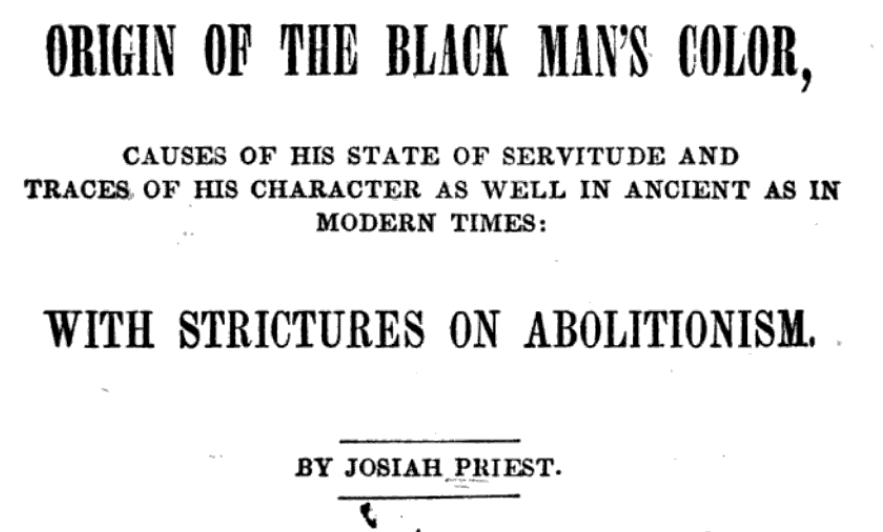
The concept was summarized in fairly typical manner by proslavery ideologue Josiah Priest: “The relation of master and servant harmonizes strictly with the best interests of the inferior or African race in particular, in securing to him that protection and support which his native imbecility of intellect disqualifies him from securing for himself.”[v]
Perhaps the most infamous articulation of the “positive good” argument came on the floor of the United States Senate. Senator John C. Calhoun of South Carolina, responding in 1837 to abolitionist petitions before Congress, argued that the South — and the Union itself — faced an existential crisis. The status quo — the “existing relations between” the Black and White races — was essential to the continued “peace and happiness” of the United States. To upset the status quo could only lead to “drenching the country in blood, and extirpating one or the other of the races.”
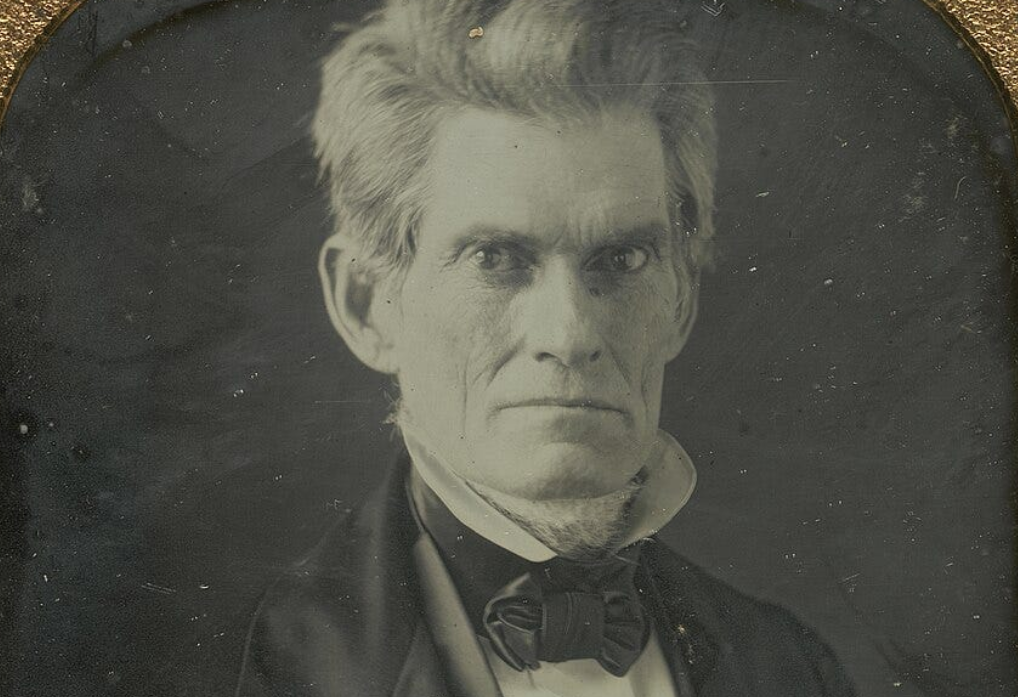
Daguerreotype of John C. Calhoun, c. 1843.
Calhoun’s speech was squarely aimed at White Americans (the “eligible in-group,” so called because of their racial eligibility for in-group membership). It was a statement of defiance from “the South” (proslavery) toward “the North” (antislavery), warning that any concessions by the former would lead to a “slippery slope” and ultimate defeat.
Calhoun’s argument was firmly based in racism, presuming the superiority of White people to Black people, but he took issue with another senator’s earlier comment characterizing slavery as a “lesser evil” in comparison to emancipation. “I hold that in the present state of civilization, where two races of different origin, and distinguished by color, and other physical differences, as well as intellectual, are brought together, the relation now existing in the slaveholding States between the two, is, instead of an evil, a good — a positive good,” Calhoun said.
Although Calhoun wove various social and economic critiques into his comments, his core argument was relatively simple. Black people, he speciously claimed, had a higher quality of life as slaves than they would if free. “Never before has the black race of Central Africa, from the dawn of history to the present day, attained a condition so civilized and so improved, not only physically, but morally and intellectually,” he said without evidence. The arrangement was also good for White people of European descent, he claimed, praising the “virtue, intelligence, patriotism [and] courage” of Southern slaveholders, who had not “degenerated” because of the practice.
Calhoun claimed that the living conditions endured by slaves compared favorably to the situation (as he imagined it) of Black people living freely in Africa and to that of impoverished free White laborers. He claimed that slaveholders provided “kind care” to old and infirm slaves, relative to the “forlorn and wretched” poor houses that awaited destitute free White workers. Parallel to these arguments, Calhoun mounted a pointed attack on capitalism and free labor practices.
The “positive good” argument inverts the traditional extremist formula, disingenuously arguing that the out-group can never be healthy of successful unless it is being enslaved by the in-group. The “positive good” argument was meant to disguise the hostile nature of the action the White in-group wanted to inflict on the Black out-group.
Even if the sentiment were sincere, the attempt to camouflage hostile intent would be absurd since slavery by its intrinsic nature forcibly denies consent to the enslaved. And at any rate, the sentiment was not sincere. At the very start of his speech, Calhoun put his cards on the table, perhaps unintentionally. Describing the need for slaveholders to fight back against the abolitionist tide, he said that making any concession would be “fatal” and warned that “those who do not meet aggression steadfastly are prepared to become slaves” (emphasis added). Enslavement might be a “positive good” for Black people, as understood through the prism of a constructed racial identity, but for Calhoun and his fellow White Southerners, it was an unthinkable fate.
The positive good argument owed much to secular identity construction narratives, which sought to “scientifically” prove that Black people were, due to their intrinsic nature, happier and healthier in conditions of bondage, but the religious argument made similar claims. Proslavery ideologues like Louisiana author John Fletcher argued that labor (in the form of slavery) bettered the souls of enslaved Black people, who would fall into sin because of idleness, if left to their own devices. In the words of another prominent religious ideologue:
…Hamitic bondage in America [is] God’s plan for ameliorating the condition of the Hamites, and the only feasible one to subject them to God’s law of labor, and obedience to the gospel. By doing this we shall better the condition of the slave, and inspire new zeal in the advancing cause of emigration to Africa.[vi]
A similar effort to recast hostile action can be found in the “separate but equal” rationale for maintaining racial segregation in the United States during the 20th century, which attempted to square the realities of segregation with the ideas of the U.S. Constitution’s guarantees of equal rights. In a formal endorsement by the Supreme Court almost 40 years after Dred Scott, the majority wrote that the Constitution (as amended after emancipation) “undoubtedly [enforced] the absolute equality of the two races before the law, but, in the nature of things, it could not have been intended to abolish distinctions based upon color.” Segregation, the Court wrote, did not inflict a “badge of inferiority” on Black people, even if Black people “put that construction upon it.”[vii] While some argued that segregation was a positive good for Black people, a more common justification and the basis of the legal argument was that segregation simply was not bad for Black people. The goal, again, was to convince critics of the hostile action to remain passive, and that no change to the status quo was necessary.
The “positive good” argument does not function solely as a defense of the status quo, but it is arguably more effective when it seeks to demobilize potential eligible in-group opponents to accept the way things are. The positive good narrative benefits from the impulses described in John T. Jost’s System Justification Theory, which argues that people have a predisposition to perceive an existing state of affairs as just. The positive good narrative seeks to exploit that tendency, increasing support for the status quo while reducing the perceived moral benefit of changing an existing system. As a defense of the status quo, the positive good argument also empowers the use of anecdotal evidence and experiential narratives that are not available to movements seeking to upset the status quo. This can be clearly seen in proslavery arguments, which frequently charged that abolitionists who had not lived in the South and interacted with Black people there could not make a fair assessment of slavery’s impact.[viii]
Some fringe extremists do try to employ the positive good argument for their hostile actions — for instance, many modern white nationalists refer to themselves as separatists and claim that racial segregation benefits all races, not just their in-group.[ix] But this is a much tougher row to hoe, and there is little evidence that this line of argument is effective. Critically, this approach differs from the proslavery argument in that it seeks to mobilize and attract disengaged eligible in-group members rather than passivize in-group members who are actively working against the extremist ideology. Such positive good narratives may work to some extent as an enticement to curious non-adherents who seek moral reassurance before exploring an extremist movement. But as a recruit’s engagement with the movement deepens and radicalizes, the positive good argument generally fades and eventually vanishes.
This article is adapted from The Social Construction of Extremism, by J.M. Berger, available in full here.
[i] e.g. Stern, J. (2016). Radicalization to extremism and mobilization to violence: What have we learned and what can we do about it?. The Annals of the American Academy of political and social science, 668(1), 102–117.
[ii] Reuters Fact Check. (2021). “Edmund Burke did not say evil triumphs when good men do nothing.” Reuters. https://www.reuters.com/article/factcheck-edmund-burke-quote/fact-check-edmund-burke-did-not-say-evil-triumphs-when-good-men-do-nothing-idUSL1N2PG1EY, retrieved September 21, 2024.
[iii] Reynolds, D. S. (2011). Mightier than the Sword: Uncle Tom’s Cabin and the Battle for America. WW Norton & Company.
[iv] Tise, L. E. (1990). Proslavery: A history of the defense of slavery in America, 1701–1840. University of Georgia Press. p. 49.
[v] Priest, J. (1851). Bible defence of slavery. p. vi.
[vi] Baldwin, S. D. (1857). Dominion; or, the unity and trinity of the human race: With the Divine Political Constitution of the World, and the Divine Rights of Shem, Ham, and Japheth.
[vii] PLESSY v. FERGUSON. (1896, May 18). LII / Legal Information Institute. https://www.law.cornell.edu/supremecourt/text/163/537, retrieved September 21, 2024.
[viii] e.g. Elliott, E. N. (1860). Cotton is king, and pro-slavery arguments. Negro Universities Press (New York). pp. 671–673.
[ix] Dobratz, B. A., & Shanks-Meile, S. L. (2006). The strategy of white separatism. Journal of Political & Military Sociology, 49–79.
메타데이터
- post_id
- 5f2ab6aeed5d
- slug
- defending-extremism-in-the-status-quo-5f2ab6aeed5d
- url
- https://medium.com/the-berger-dispatch/defending-extremism-in-the-status-quo-5f2ab6aeed5d
- canonical_url
- https://medium.com/the-berger-dispatch/defending-extremism-in-the-status-quo-5f2ab6aeed5d
- author_url
- https://medium.com/@jmbergerauthor
- status
- ok
- fetched_at
- 2026-06-09 15:37:30