Intent Data in 2026: The SaaS CMO’s Unfair Advantage
A practical guide to first-party, second-party, and third-party intent data — and how to wire them into your GTM motion to catch buyers at…
Intent Data in 2026: The SaaS CMO’s Unfair Advantage
A practical guide to first-party, second-party, and third-party intent data — and how to wire them into your GTM motion to catch buyers at peak purchase readiness.
If your GTM playbook still treats M&A activity, hiring sprees, and technology changes as the hottest purchase-decision triggers, you’re operating on a 2021 map in a 2026 market. Your competitors already have those signals. Everyone has those signals. You’re not early — you’re just more politely late.
Here’s what’s changed: the bar for “intent signal” has moved from “this company might be thinking about buying” to “this company is actively buying, and here’s what they had for breakfast.”
The CMOs’ winning pipeline in 2026 is doing something fundamentally different. They’re not just collecting intent data — they’re wiring it into automated GTM motions that compress the window between signal detection and sales conversation to hours, not weeks. That’s the unfair advantage. And it’s available to you, right now.
Let’s break it down.
Why the Old Triggers Aren’t Enough Anymore
For years, B2B GTM teams treated hiring activity, technology installs, and funding rounds as the golden trifecta of purchase intent. Hire a new CISO? They’re buying security tools. Raise a Series B? They’re deploying the budget. Switch from Marketo to HubSpot? They’re in motion.
Here’s the awkward truth: everybody sees those signals. The same data flowing into your SDR outreach queue is hitting every competitor’s sequence simultaneously. The window for uniqueness closed. When every vendor in a category pounces on the same Series B announcement within 24 hours, the “personalized” outreach stops feeling personal — it starts feeling like spam from people who read TechCrunch.
In 2026, buyer intent has moved from passive indicators to active, real-time behavioral signals. B2B buyers spend the vast majority of their time making purchase decisions before they ever talk to a vendor. The research happens in private Slack communities, AI agents, G2 review threads, Reddit, and dark social channels that third-party trackers simply can’t see.
The shift from generic “intent” to hyper-custom, actionable signals is the real story of 2026. Think less about “company researching cybersecurity topics” and more about “company where the CISO posted on LinkedIn about AI-driven threat detection, AND they just posted three SOC analyst job reqs, AND they visited your pricing page twice this week.” That’s a buying committee. That’s a signal worth acting on.
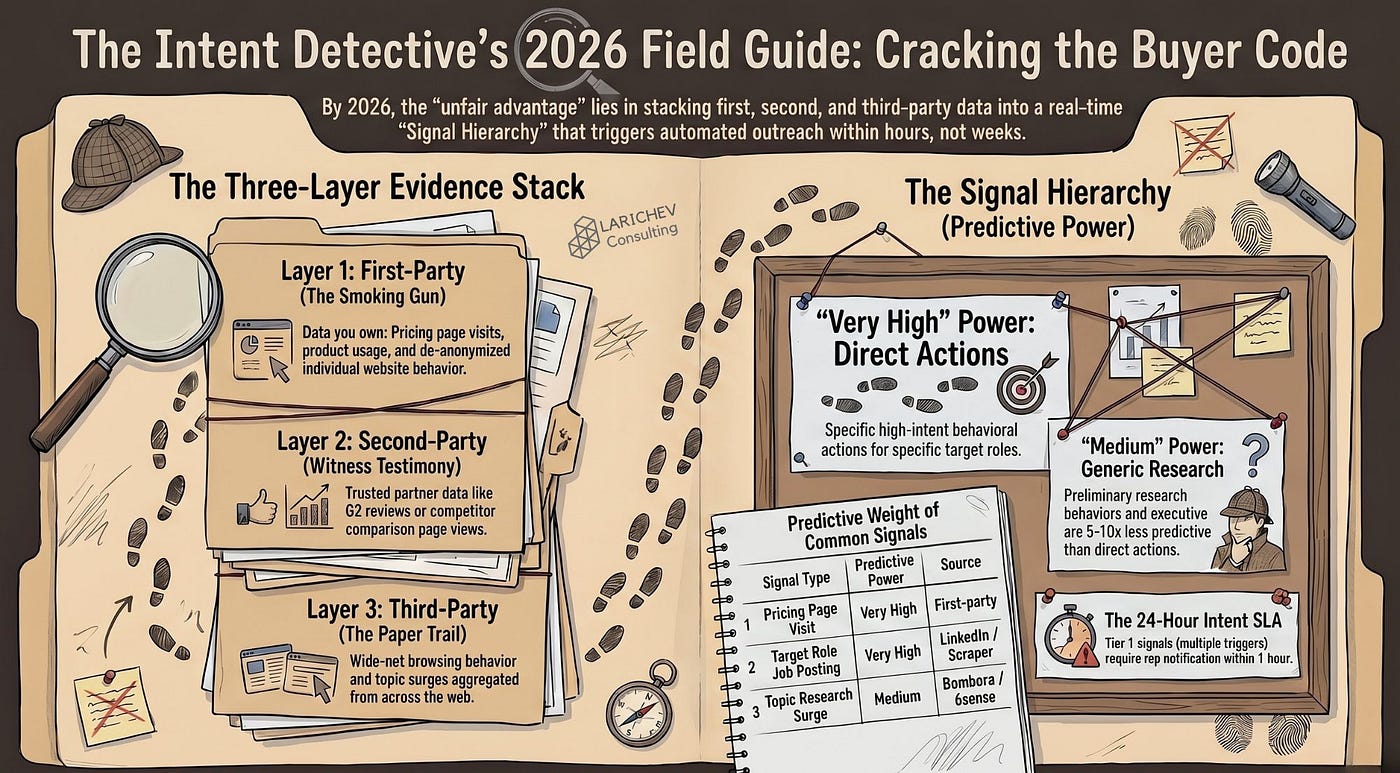
The Three-Layer Intent Stack: A Refresher With 2026 Updates
Layer 1: First-Party Intent — Your House, Your Rules
First-party intent is data you collect from your own digital properties: website visits, pricing page behavior, content downloads, email click patterns, CRM engagement, demo tool interactions, and product usage signals.
This is the highest-quality signal you own, and most teams underutilize it catastrophically.
What’s working in 2026:
- Website de-anonymization at the person level, not just the company level. Tools like Common Room deanonymized 4.5 million web visits at the individual level for their customers in a recent 90-day period — not just “Acme Corp visited,” but who from Acme.
- PLG product signals as intent triggers. If you run a product-led motion, the highest-intent moments are hiding in your product data: paywall hits (multiple times in a week are buying moments), pricing calculator interactions, and multiple seats signing up from one company domain.
- CRM resurrection signals. Stalled deals, contacts who went dark 90 days ago, and churned customers are warmer than any cold outbound list. One revisit to a pricing page from a ghosted prospect is worth 50 cold emails.
- Interactive demo behavior. Tools like Walnut now sync every click, feature explored, and drop-off point directly into Salesforce or HubSpot — turning demo engagement into automated follow-up sequences.
First-party tooling to know: Koala (acquired by Cursor, alternatives now at the fore), Warmly, Common Room, HockeyStack, and your existing CRM + product analytics stack wired through Segment or PostHog.
Layer 2: Second-Party Intent — Borrowed Trust, Real Signals
Second-party data is first-party data shared by a trusted partner. It’s the middle child of intent data — less talked about, massively underrated.
G2 Buyer Intent is the flagship example. When a prospect visits your G2 profile, browses your category, or compares you against a competitor on G2, that is a second-party signal — G2’s first-party data, shared with you. They’re powered by Bombora’s co-op under the hood, which means you’re getting both the G2 review-stage signal and broader content research signals in one integration.
What’s working in 2026:
- G2 → Slack integration: Get an alert the moment a prospect browses your G2 page. Not in a weekly report. Now. That’s a sub-24-hour response window.
- Media and publisher partnerships: Foundry and TechTarget sell audience engagement data from their owned publications — high-quality signals for technical buyers consuming specific content categories.
- Review platform triangulation: A contact who reviews you on G2 and visits your pricing page is significantly more in-market than either signal alone. Cross-matching is where second-party data earns its keep.
Layer 3: Third-Party Intent — Cast Wide, Act Fast
Third-party intent data aggregates browsing behavior from across the web — thousands of B2B publications, research sites, and content networks — to identify accounts surging in topic interest.

The honest 2026 critique of third-party data: It’s crowded. As soon as a company triggers a Bombora topic surge, they’re in every SDR’s queue in your category. Third-party intent data is table stakes now. It doesn’t create competitive advantage — it prevents competitive disadvantage. Use it to prioritize outreach, not as your sole sourcing engine.
The Real Unfair Advantage: AI-Layered Signal Stacking
Here’s where it gets interesting. The teams generating real pipeline in 2026 aren’t choosing between first-party, second-party, and third-party — they’re stacking and scoring all three with AI, then triggering automated workflows that would have required a dedicated RevOps engineer to build just two years ago.
The Signal Hierarchy (Predictive Power Ranking)
Not all signals are equal. Here’s how they actually stack up:

The top three signals are 5–10x more predictive than generic content research signals — yet most teams over-weight the third-party content signals because that’s what the platforms sell.
A company that visits a G2 category page is mildly interesting. A company that does that, plus posts a Director of Demand Gen job req, plus just raised a Series B? That’s a pipeline opportunity, and AI can surface it in real time.
The Clay Playbook: Your GTM Automation Engine
Clay became the operating system for signal-based prospecting in 2026. It connects to 150+ data providers and lets you build multi-signal waterfall workflows without writing a line of code.
Here’s what a high-performing Clay workflow actually looks like:
- Signal ingestion: Monitor for job postings, funding news, tech stack changes, website visits, LinkedIn engagements, social mentions — simultaneously
- Waterfall enrichment: When a signal fires, Clay runs enrichment sequentially across providers. If Apollo can’t find an email, it tries Hunter, then Prospeo — achieving 70–85% valid email coverage vs. 40–60% from a single provider
- Claygent AI research: An AI agent browses the web to answer bespoke questions about the account — what they’re building, what’s changed, what pain point just became urgent
- Score + route: Accounts with multiple signals firing receive a high score and are routed to a rep via Slack. Single-signal accounts get dropped into a nurture sequence
- Context-aware copy generation: AI writes the first outreach message referencing the specific signal that fired. “Saw you posted a Director of Demand Gen role last week” is a 10x better opener than “Hope you’re well.”
Common Room takes a similar aggregation approach: GitHub contributors, website visitors, LinkedIn engagers, product signups, form submissions, and Slack community members in one view. Their customers generated $1.2B in pipeline and $333M in closed-won revenue in a single quarter across 2,051 data source connections. That’s the power of unified signal intelligence.
The “Dark Intent” Problem Nobody Talks About
Here’s the elephant in the room: a growing chunk of buyer research never generates a traditional intent signal.
In 2026, buyers increasingly research in:
- Private Slack and Discord communities
- AI chatbots (ChatGPT, Claude, Perplexity) that don’t leave public trails
- LinkedIn DMs and off-platform conversations
- Gated analyst reports and peer networks
This is called “dark intent” — and it’s where your prospect is furthest along in their evaluation journey before they ever touch a trackable surface. By the time they hit your website, they may already have a vendor shortlist.
How to counter it:
- Build community presence. Reddit threads, LinkedIn comment sections, Slack groups in your category — this is where dark research happens. Be in the conversations, not just the ad feeds
- Publish comparison and evaluation content. Buyers asking AI assistants “what’s the best [your category] tool?” are getting answers from indexed content. Own that content layer
- Monitor competitor engagement. Tools like Tapistro track when your existing customers start engaging with competitor content on LinkedIn — giving you a churn early-warning system before they ever fill out a competitor trial form
Wiring Intent Into Your GTM Motion: The Practical Plumbing
Collecting intent signals is the easy part. The revenue is in the activation. Here’s a practical framework for wiring intent data into your existing motion:
The 24-Hour Intent SLA
Intent signals have a half-life. An account that visits your pricing page today is 10x more responsive to outreach within 24 hours than after 5 days. The teams seeing the best results have explicit SLAs:
- Tier 1 signal (multiple intent signals firing simultaneously): Rep notified via Slack within 1 hour. Personalized outreach within 24 hours
- Tier 2 signal (single high-quality signal like pricing page visit or G2 profile browse): Automated email sequence launched within 4 hours, rep alerted within 48 hours
- Tier 3 signal (topic surge, content consumption): Account added to targeted ad audiences and nurture tracks; no SDR intervention until secondary signal fires
CRM Integration Is Non-Negotiable
Intent data living in a separate dashboard is ignored. Every signal needs to:
- Update a lead/account score field in Salesforce or HubSpot
- Trigger workflow automation (sequence enrollment, task creation, rep notification)
- Append context to the account record so reps have the why behind the outreach
HubSpot’s Breeze AI agents and Salesforce’s flow automation can handle most of this natively in 2026 — but the setup still requires intentional architecture, not bolt-on band-aids.
Build Your Signal Stack Progressively
Don’t try to run all three layers simultaneously on Day 1. Here’s the recommended rollout sequence:
Month 1 — First-party foundation:
- Install website deanonymization (Warmly, Common Room, or your MAP’s tracking)
- Create Slack alerts for pricing page visits from named accounts
- Set up demo tool sync to CRM
Month 2 — Second-party layer:
- Activate G2 Buyer Intent if you’re not already; wire it to CRM
- Map G2 signal alerts to rep notifications in Slack
Month 3 — Third-party + AI orchestration:
- Add Bombora or 6sense topic surge data for ICP accounts
- Build Clay workflows to stack and score signals
- Implement AI-generated, signal-aware outreach sequences
Practical Use Cases: Where Intent Data Actually Books Meetings
Use Case 1: The Pricing Page Rescue
Setup: Website visitor ID (Warmly/Common Room) + CRM lookup + Clay enrichment
Trigger: A company that’s been in your CRM for 6+ months (stalled deal or cold contact) visits your pricing page
Action: Clay enriches the contact with current role, tenure, and recent LinkedIn activity. Claygent checks whether they’ve recently posted about relevant pain points. SDR gets a Slack alert with all context. Rep sends a one-line email: “Noticed you were back on our pricing page — anything changed on your end?”
Why it works: Timing + relevance + zero creepiness. You’re responding to their action, not cold calling.
Use Case 2: The Hiring Signal → Personalized Sequence
Setup: Clay monitoring LinkedIn jobs API + Bombora topic data + CRM
Trigger: ICP account posts a job for “VP of Revenue Operations” or “Director of Demand Generation” (roles that signal they’re buying tools in your category)
Action: Clay enriches the account, identifies the current CRO or CMO as the likely buyer, checks for concurrent Bombora topic surge, scores the account, and enrolls in a targeted sequence. Outreach references the specific hire: “Building out your RevOps function — curious what’s driving the investment.”
Why it works: Hiring data is predictive, specific, and public. It tells you exactly what problem they’re trying to solve.
Use Case 3: The Competitor Review Intercept
Setup: G2 Buyer Intent + CRM integration + competitor monitoring
Trigger: An existing customer starts browsing G2 profiles of your competitors, and their product usage has declined over the past 30 days
Action: CSM gets an immediate alert. Account goes into a proactive “retention play” — executive outreach, personalized case studies, and a QBR invitation. Not a discount. A conversation.
Why it works: You’re not chasing churn — you’re catching it 60 days early. The signal-to-action window is the difference between a renewal and a churned logo.
Use Case 4: The Dark Social Lead Capture
Setup: Social listening via Clay or Tapistro + Slack keyword monitoring + community presence
Trigger: A prospect posts on Reddit or LinkedIn asking for recommendations in your category (“anyone have experience with [your category]?”)
Action: The monitoring tool flags the post. A relevant team member engages authentically — not pitching, just adding value. Contact info captured via natural follow-through (DM, LinkedIn connection). Added to a soft nurture sequence.
Why it works: Buyers researching in public communities are at peak consideration. Being helpful in the moment > being generic in their inbox.
The Action Items (Don’t Scroll Past These)
Let’s be honest — most articles end with vague “build your intent strategy” advice. Here’s what to actually do in the next 30 days:
- [ ] Audit your first-party blind spots. Is visitor identification for the pricing page enabled? Are product usage signals flowing to your CRM? If not, fix this first — it’s the highest-ROI, lowest-cost signal available to you
- [ ] Implement a 24-hour intent SLA. Define what a Tier 1 vs. Tier 2 signal looks like for your business, and build the routing logic in HubSpot or Salesforce this week
- [ ] Activate G2 Buyer Intent. If you’re listed on G2 and not tracking profile views and category research, you’re leaving closed-loop attribution (and pipeline) on the table
- [ ] Build one Clay workflow. Start small: pick one signal (funding round, job posting, pricing page visit) and build a workflow that enriches the contact and sends a Slack alert to the right rep. One workflow. Prove the concept
- [ ] Add dark social monitoring. Set up keyword alerts for your product category and competitor mentions on Reddit, LinkedIn, and relevant Slack communities. Respond helpfully, not salesily
- [ ] Score signals in your CRM, not in the intent tool. Intent data siloed in a separate dashboard is ignored. Get it into Salesforce/HubSpot lead scores this quarter
- [ ] Define your “signal stack threshold.” How many signals need to fire simultaneously before a rep picks up the phone vs. letting automation run? Document this. Your team needs a repeatable playbook, not heroics
So, What’s Your Stack?
The SaaS CMOs I respect in 2026 aren’t the ones who’ve purchased every intent data platform in the G2 Grid. They’re the ones who’ve wired a thoughtful signal stack into a motion that actually moves pipeline — and they can tell you exactly which signals generate meetings and which ones generate noise.
The unfair advantage isn’t the data. Everybody has data now. The unfair advantage is the speed, precision, and AI orchestration that turn a signal into a conversation before your competitor even opens their morning dashboard.
Hiring, M&A, and tech stack changes? Those are still useful signals. But they’re the opening act now, not the headliner.
Which intent data tools are delivering a real pipeline for you? Drop your stack in the comments. 👇
I’m particularly curious about what’s working for mid-market SaaS CMOs (Series B–D) who don’t have enterprise ABM budgets but do have a Clay subscription and a motivated RevOps team.
Yury Larichev is a Fractional SaaS CRO with 20+ years in Sales Management. He helps SaaS companies scale from $5M to $50M+ ARR. Connect on LinkedIn.
메타데이터
- post_id
- 5f2b50ea6bc1
- slug
- intent-data-in-2026-the-saas-cmos-unfair-advantage-5f2b50ea6bc1
- url
- https://medium.com/@yurylarichev/intent-data-in-2026-the-saas-cmos-unfair-advantage-5f2b50ea6bc1
- canonical_url
- https://medium.com/@yurylarichev/intent-data-in-2026-the-saas-cmos-unfair-advantage-5f2b50ea6bc1
- author_url
- https://medium.com/@yurylarichev
- status
- ok
- fetched_at
- 2026-06-10 18:44:10