A Field Guide to Failing at OKRs
Ten species of broken objectives — and where the cures are taught.
A Field Guide to Failing at OKRs
Ten species of broken objectives — and where the cures are taught.
www.okwww.okrinternational.com
Botanists have a habit I’ve come to admire. When they find something growing wrong — stunted, invasive, flowering at the wrong time — they don’t describe it vaguely. They name it, catalogue it, and teach others to recognise it on sight. Naming, in their field, is the beginning of knowing.
Somewhere around my fifteenth year of organisational development work, I started keeping a similar notebook. Not of plants, but of broken objectives. Every stalled OKR programme I was called into seemed, at first, unique — its own tangle of personalities and politics. But the notebook said otherwise. The same failures kept appearing, across industries and continents, with almost taxonomic reliability. Eventually I gave them names. The collection became the OKR Trap Atlas™: ten species of failure, each with its own field marks.
Specimens from the field
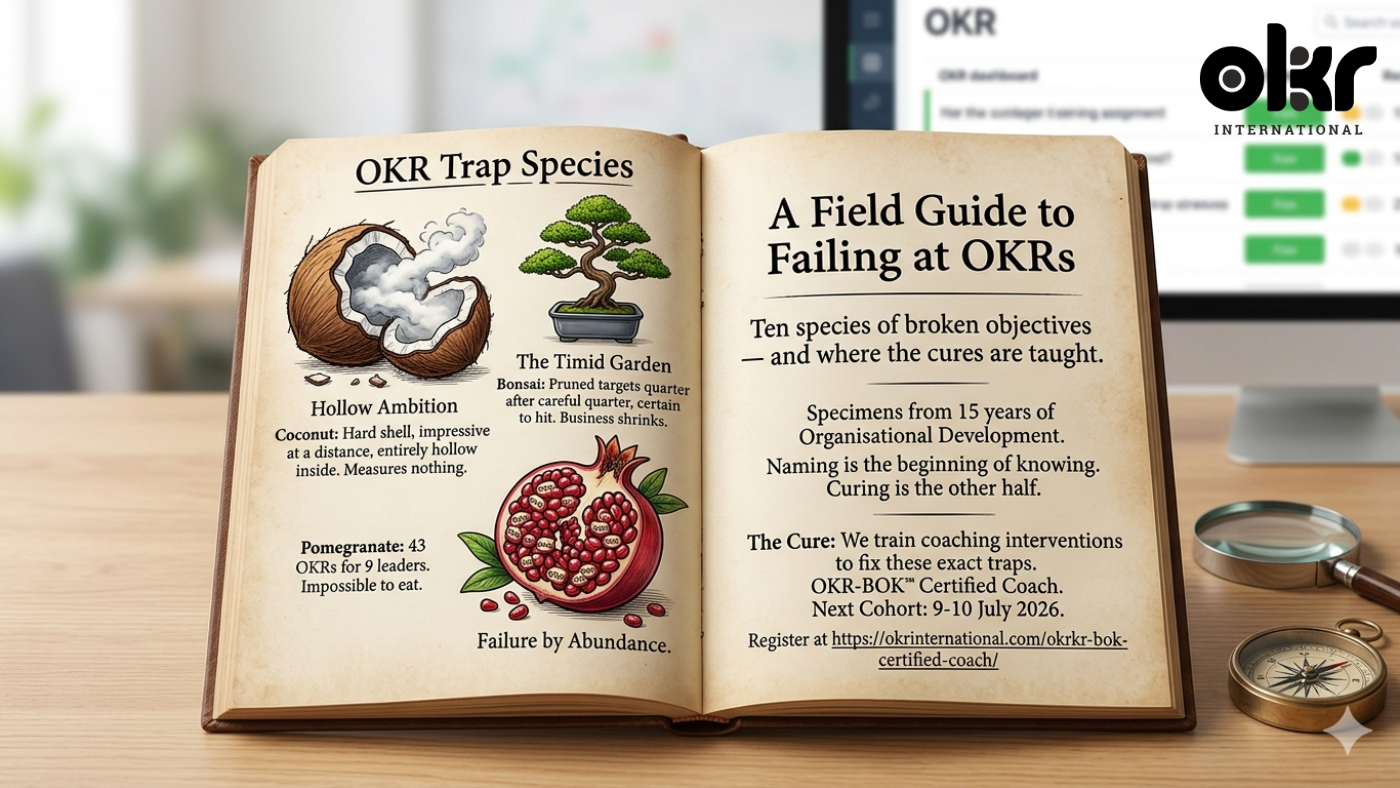
Consider the Coconut. A fintech I worked with had an objective that read, “Become the most loved brand in our category.” Stirring stuff. Hard shell, impressive at a distance — and entirely hollow. There was no key result underneath that could tell anyone, on an ordinary Tuesday, whether they were winning or losing. Coconut OKRs sound bold and measure nothing, and they thrive in boardrooms because applause arrives before accountability does.
Or the Bonsai, the Coconut’s timid cousin. At a sales organisation I advised, every target had been pruned, quarter after careful quarter, to a size the team was certain to hit. The bonuses flowed; the business shrank relative to every competitor that hadn’t learned to garden this way.
The Pomegranate is failure by abundance — one media company was running forty-three OKRs across a leadership team of nine; each seed defensible, the whole thing impossible to eat. The Treadmill is furious motion with no movement, activity metrics dressed up as outcomes. And the Heirloom may be the saddest specimen in the Atlas: the OKR copied forward every quarter because it has always been there. I once asked a team who had written their longest-standing objective. Nobody knew. It had simply always been on the slide, like a portrait of an ancestor nobody can name.
Naming is half. Curing is the other half.
The moment a leadership team can say “that’s a Bonsai” or “we have a Pomegranate problem,” something shifts. Vague frustration becomes specific diagnosis; blame becomes pattern recognition. But a field guide only gets you to the diagnosis. The cure for each trap is an intervention — a specific, learnable coaching move. The Bonsai needs a recalibrated ambition conversation that separates targets from bonuses. The Pomegranate needs someone with the standing and the technique to make a leadership team choose. The Heirloom needs a funeral that nobody feels punished by.
Those interventions are not improvised. They are the core of what we train in the OKR-BOK™ Certified Coach two live days, on 9 and 10 July 2026, in which participants practice diagnosing these exact traps in real cases and rehearse the interventions until they hold up in a real room. It is the only OKR certification endorsed by both the ICF and HRCI, which tells you something about the standard the craft is held to.
Learn to diagnose the traps — then train to cure them.
The 10 OKR Traps That Kill Strategy Execution
OKR-BOK™ Certified Coach — Live Cohort: 9–10 July 2026
16 hours live and experiential · ICF & HRCI endorsed (16 recertification hours each) · 1 year of e-learning · Lifetime credential · 5 Practitioner licenses ($2,500) and 5 AI+ Foundation™ licenses ($250) included.
The cohort after this one doesn’t run until October.
→ Curriculum, dates and enrolment:
https://okrinternational.com/okr-bok-certified-coach/
[embed]www.okrinternational.com
Nikhil Maini is the Founder & CEO of OKR International, creator of the OKR-BOK™ and Micro-OKRs™, and a member of the Forbes Business Council. He has led OKR and organisational development work across 500+ organisations in 23+ industries. He leads the OKR-BOK™ Certified Coach — the only OKR certification endorsed by both the ICF and HRCI. Next live cohort: 9–10 July 2026. https://okrinternational.com/okr-bok-certified-coach/
메타데이터
- post_id
- 5f396da6c7e9
- slug
- a-field-guide-to-failing-at-okrs-5f396da6c7e9
- url
- https://medium.com/@nikhil_52944/a-field-guide-to-failing-at-okrs-5f396da6c7e9
- canonical_url
- https://medium.com/@nikhil_52944/a-field-guide-to-failing-at-okrs-5f396da6c7e9
- author_url
- https://medium.com/@nikhil_52944
- status
- ok
- fetched_at
- 2026-06-13 09:11:36




