Exploring AI Browsers Through a Small Hybrid Local + Cloud LLM Experiment
There’s a lot happening right now in the AI browser space.
Exploring AI Browsers Through a Small Hybrid Local + Cloud LLM Experiment
There’s a lot happening right now in the AI browser space.
Tools like Comet, Claude browser integrations, Merlin, and Arc AI features are all exploring different ways AI can assist users directly inside the browsing experience.
Over the past year, browsers have started evolving from simple navigation tools into contextual AI workspaces. Some focus heavily on conversational interactions. Others prioritize productivity shortcuts, search augmentation, or workflow convenience.
A few months back, I started a small personal experiment to better understand how these AI browser assistants actually work under the hood.
Not to build a commercial product.
Not to compete with existing platforms.
But simply to explore the feasibility of creating a lightweight browser AI assistant capable of working with both local and cloud LLMs.
That exploration became:
Shinu’s Browser AI Assistant
A basic experimental browser extension focused on:
- Local + cloud LLM switching
- Browser-native AI assistance
- Lightweight orchestration workflows
- Privacy-first experimentation using Ollama
- Understanding the practical limitations of browser AI systems
GitHub Repository: https://github.com/shinulearning/Shinu-s-Browser-AI-assistant
Why This Experiment Interested Me
What fascinated me most while exploring this space was how different the architectural philosophies are across AI browser systems.
Some platforms are optimized for:
- Deep contextual understanding
- Long-form reasoning
- Conversational continuity
- Integrated user experience
For example, Claude’s browser experience feels particularly strong in:
- Context handling
- Summarization quality
- Natural conversational interactions
- Clean UX integration
- Long-form reasoning capability
Other browser AI tools seem more focused on:
- Quick productivity actions
- Search enhancement
- Lightweight prompt assistance
- Workflow convenience
- Fast interaction cycles
Even though these tools may appear similar from the outside, the underlying priorities are often very different.
That was one of the biggest learnings from this exploration.
What I Wanted to Understand
The experiment was less about features and more about understanding practical implementation realities.
Some of the questions I wanted to explore included:
1. How usable is local inference inside browser workflows?
Local LLMs are becoming increasingly accessible through tools like Ollama, but browser environments introduce unique constraints:
- memory usage
- latency
- model loading time
- resource management
- interaction responsiveness
I wanted to see where local models feel practical and where cloud models still clearly dominate.
2. What are the latency trade-offs?
One interesting observation was that local inference and cloud inference behave very differently.
Local models:
- often have higher initial response overhead
- depend heavily on hardware capability
- can feel predictable once loaded
- offer stronger privacy control
Cloud models:
- generally provide stronger reasoning quality
- handle larger contexts more effectively
- offer faster complex processing
- depend on API/network reliability
In many cases, a hybrid approach actually felt more practical than purely local or purely cloud workflows.
3. Can browser-native AI orchestration remain lightweight?
Modern AI workflows can quickly become complex.
I wanted to understand whether lightweight orchestration patterns inside a browser extension could remain:
- usable
- responsive
- maintainable
- flexible for experimentation
This was especially important while experimenting with multiple LLM providers.
4. What are the privacy implications?
Privacy becomes increasingly relevant when AI systems gain access to browsing workflows.
Local inference opens interesting possibilities for:
- sensitive workflows
- offline experimentation
- reduced dependency on cloud APIs
- developer-controlled execution paths
At the same time, local execution introduces practical trade-offs around performance and capability.
One Important Observation
AI browsers still feel like a very early exploration space.
Right now, many implementations are essentially:
- intelligent overlays
- contextual assistants
- summarization layers
- productivity accelerators
But the direction itself feels important.
Browsers are slowly evolving into:
- contextual workspaces
- AI-assisted execution environments
- research copilots
- workflow orchestration layers
And the architectural decisions being made now will likely shape how these systems evolve over the next few years.
Why I Open-Sourced the Experiment
The goal of this project was never product positioning.
It was simply an engineering exploration to better understand:
- browser AI integration patterns
- local vs cloud workflows
- orchestration trade-offs
- practical limitations
- emerging interaction models
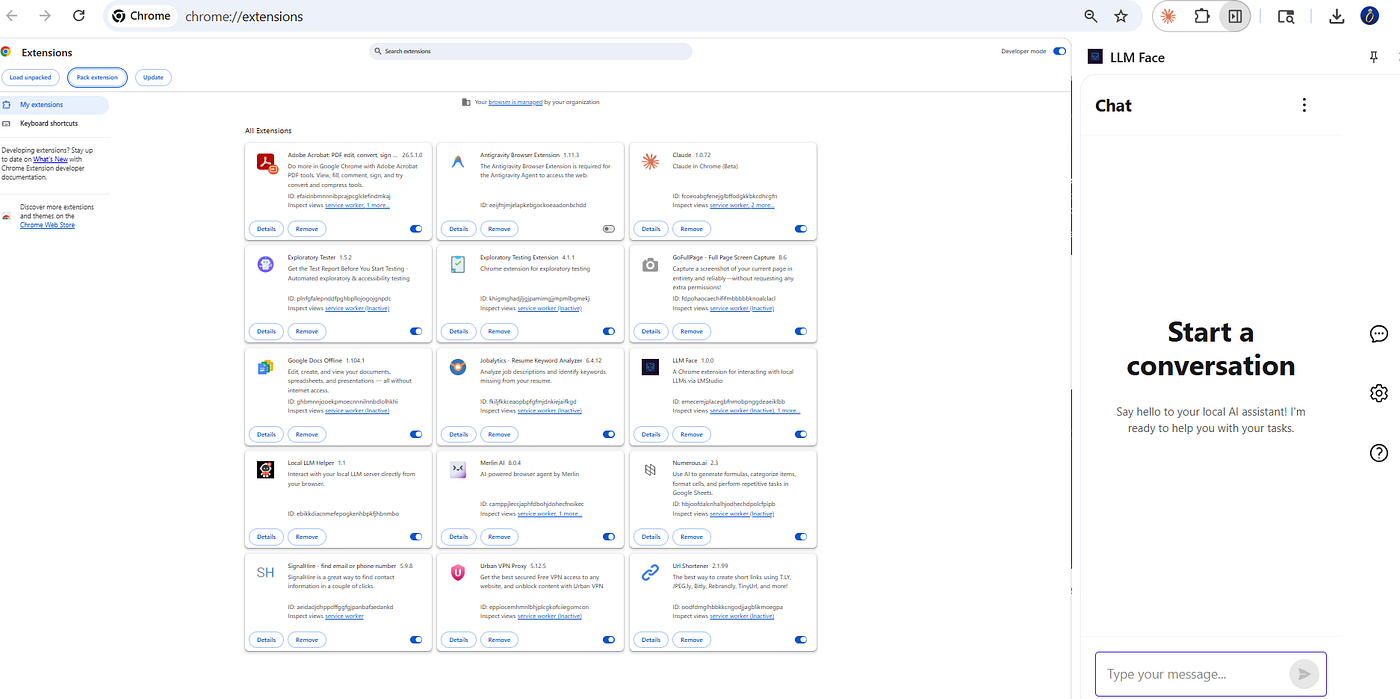
I’ve attached screenshots comparing different AI browser experiences along with my lightweight experimental implementation for learning purposes.
Sometimes small engineering experiments provide the best understanding of where technology is actually heading.
Final Thoughts
One thing this experiment reinforced for me is that there probably won’t be a single “best” AI browser architecture.
Different approaches optimize for different priorities:
- privacy
- reasoning quality
- speed
- extensibility
- workflow integration
- developer control
The interesting part is watching how these trade-offs evolve as browsers become increasingly AI-native.
Curious to hear from others exploring this space:
What matters most to you in an AI browser assistant today?
- Privacy?
- Context awareness?
- Local AI capability?
- Speed?
- Workflow integration?
- Developer extensibility?
AI #BrowserAI #ClaudeAI #Ollama #GenerativeAI #LLM #Automation #AIEngineering #OpenAI #Groq #AIWorkflows #Innovation


메타데이터
- post_id
- 5f4cedee006c
- slug
- exploring-ai-browsers-through-a-small-hybrid-local-cloud-llm-experiment-5f4cedee006c
- url
- https://medium.com/@shinulearning/exploring-ai-browsers-through-a-small-hybrid-local-cloud-llm-experiment-5f4cedee006c
- canonical_url
- https://medium.com/@shinulearning/exploring-ai-browsers-through-a-small-hybrid-local-cloud-llm-experiment-5f4cedee006c
- author_url
- https://medium.com/@shinulearning
- status
- ok
- fetched_at
- 2026-06-23 03:48:11