Ramanujan in His Final Days
Srinivasa Ramanujan was born on December 22, 1887, in the small village of Erode, about 250 miles southwest of Madras, in southern India…
Ramanujan in His Final Days
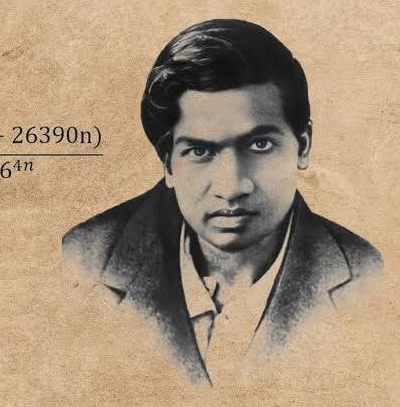
Ramanujan ( 1887–1920)
Srinivasa Ramanujan was born on December 22, 1887, in the small village of Erode, about 250 miles southwest of Madras, in southern India. His life began, and in many ways remained, confined by severe limitations: persistent poverty, fragile health, and an irregular path through formal education. Even when he finally reached the prestigious Trinity College, Cambridge, he encountered not only recognition but also the marks of racial prejudice and religious intolerance.
Still, his bold, intuitive, and at times unsettling ideas gradually asserted themselves. Clifford Scholl would later compare him to Mozart in music and Einstein in physics, placing him, with rare emphasis, among the great creators of human thought.
At Cambridge’s Trinity College, an institution that had housed figures such as Newton, Byron, and Bertrand Russell, Ramanujan met G. H. Hardy, an already renowned mathematician whose reputation would become intertwined with that of the young Indian. Hardy, a committed atheist and advocate of “pure science,” believed mathematics should exist free from practical applications. Ironically, many of his works, including those coauthored with Ramanujan, later proved fundamental in fields such as cryptography and engineering.
Their encounter began with an unlikely letter. After two attempts went unanswered, Ramanujan sent a third letter to Hardy, introducing himself with striking humility. He was a clerk with no formal university training, yet deeply immersed in the self-taught study of divergent series. Over nine pages, he presented more than a hundred theorems, most without proof.

G. H. Hardy (1877–1947)
Hardy hesitated. Some results were already known, but others displayed a singular brilliance. Intrigued, he shared the material with John Edensor Littlewood, also a professor at Cambridge. Together, they recognized errors, but also unmistakable originality. What puzzled Hardy most was that some of the most brilliant results generalized ideas he himself had been working on, but had not yet published. Impressed, Hardy later remarked that these ideas were so inventive they could hardly have been the product of fraud.

J. E. Littlewood (1885–1977)
An intense exchange of correspondence followed. Hardy insisted on proofs, Ramanujan, guided by near-visionary intuition, offered results. From this productive tension emerged not only a collaboration, but the decision to bring the young mathematician to Cambridge.
During his four years at Trinity College, Ramanujan published twenty papers in major Western journals. Yet academic success was not enough to halt the decline of his health or ease his homesickness. In March 1919, he returned to India.
In his report detailing Ramanujan’s achievements following the scholarship granted by the Government of India, Hardy described him as a National Treasure, a man whose simplicity remained intact despite international recognition.
His return, however, proved difficult. Family conflicts surfaced, including the discovery that his mother had concealed letters intended for his wife.
His health deteriorated rapidly. Even so, in January 1920, he sent Hardy new discoveries: the so-called “mock theta functions,” ideas that would remain ahead of their time for decades. Part of this work was compiled in a notebook later lost and rediscovered only in 1976, now known as Ramanujan’s Lost Notebook. Mock theta functions are now used to model cancer cell proliferation and to describe energy systems in black holes.
Ramanujan died on April 26, 1920, at the age of 32.
In an obituary published in Nature, Hardy highlighted his extraordinary ability to create and reshape ideas, suggesting that few, if any European mathematicians could have matched him. More than a prodigy, Ramanujan was, in a sense, a singular phenomenon, someone who seemed to operate on his own frequency, where mathematics revealed itself not as invention, but as discovery. Hardy wrote: “It is not too much to say that Ramanujan was the greatest mathematician of his time… He combined a power of generalization, a sense of form, and an extraordinary capacity to modify his hypotheses when he recognized errors, in all this, he had no equal.”
His legacy endures. Research groups, academic prizes, scientific journals, and cultural representations continue to revisit both his work and his life. In a distinctive tribute, the prestigious Springer publishing house established The Ramanujan Journal in 1997, dedicated to research connected to his discoveries.
Since 2011, his birthday has been celebrated as National Mathematics Day in India, a belated but fitting tribute to a man who, against all odds, reshaped the boundaries of mathematical thought.
In 2012, to commemorate his 125th anniversary, Google altered its homepage logo in his honor.

Google Logo in 12/22/2012
메타데이터
- post_id
- 5f554cebc36c
- slug
- ramanujan-in-his-final-days-5f554cebc36c
- url
- https://medium.com/@fernandoalmeidapradojr/ramanujan-in-his-final-days-5f554cebc36c
- canonical_url
- https://medium.com/@fernandoalmeidapradojr/ramanujan-in-his-final-days-5f554cebc36c
- author_url
- https://medium.com/@fernandoalmeidapradojr
- status
- ok
- fetched_at
- 2026-07-25 23:20:03