Defending Against Vulnerabilities in AI Code
When AI coding assistants first hit the scene, my product team, like many others, observed a significant increase in development velocity…
Defending Against Vulnerabilities in AI Code
When AI coding assistants first hit the scene, my product team, like many others, observed a significant increase in development velocity. This felt like a breakthrough, enabling us to accelerate through sprints and achieve ambitious key performance indicators.
But after a few initial security retrospectives, the ‘vibe coding’ euphoria began to diminish. We quickly realized that while tools like GitHub Copilot and OpenAI Codex were incredibly productive, they often prioritized functionality over production-ready security, which presented a significant challenge for AI-generated code security. Early studies were already showing that a significant portion of AI-generated snippets, though functional, contained real-world AI coding assistant vulnerabilities.
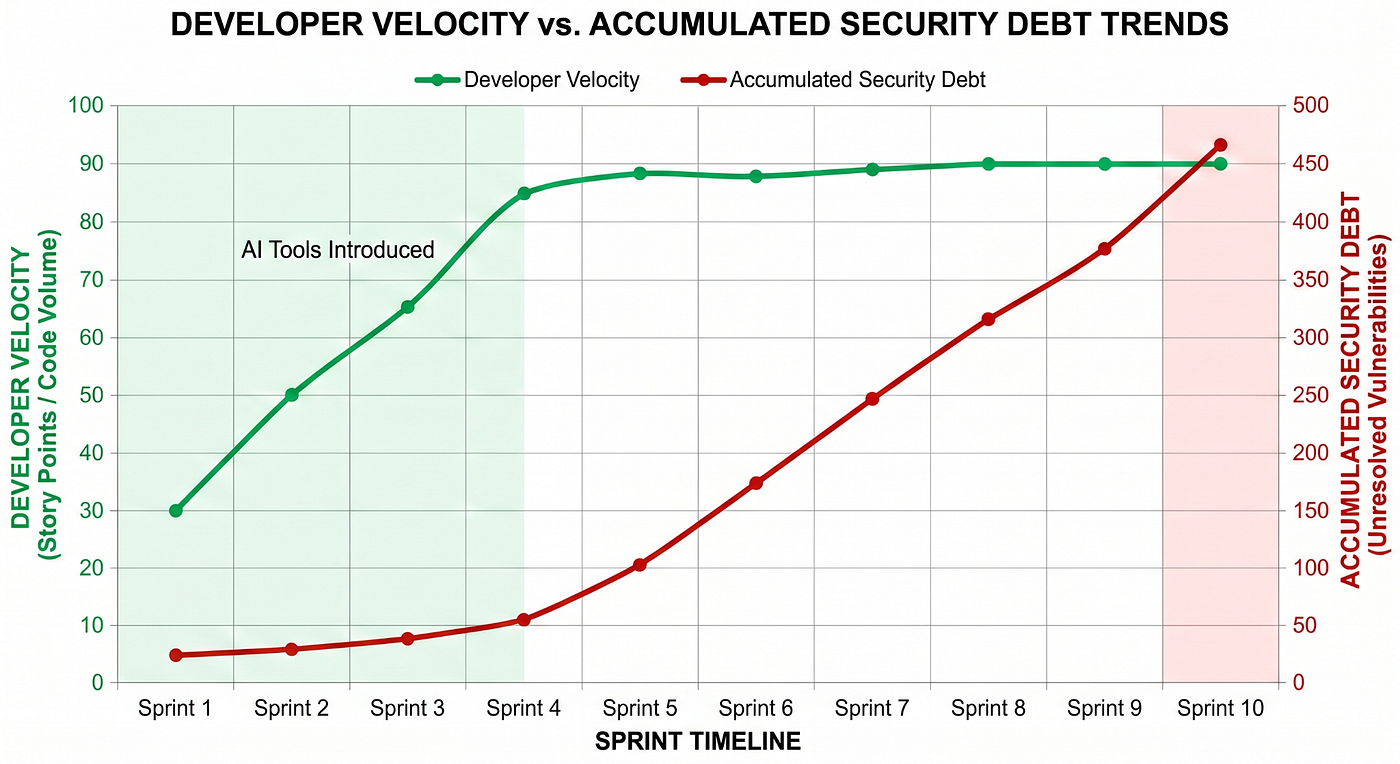
This led to a silent accumulation of potential technical debt that was not immediately visible on our dashboards. We were shipping faster, but I was beginning to worry about the long-term cost of that speed, a concern that our initial security audits would soon validate in stark detail. The trade-off became painfully clear.
This image illustrates the core problem we faced: a direct correlation between rising productivity and increasing security debt.
Why AI-generated code introduces security risks
As we dug deeper into our code audits, it became clear why these ‘smart’ models introduced security risks. From a founder’s perspective, understanding these LLM security risks boils down to incentives: LLMs are trained to produce ‘working’ code, not inherently ‘secure’ code. They learn from vast public repositories, many of which contain insecure patterns, leading to vulnerabilities I refer to as ‘learned vulnerabilities.’ The models lack a true contextual understanding of critical concepts like authentication, authorization, or how a piece of code fits into our specific threat model or deployment environment.
This can lead to subtle but dangerous semantic vulnerabilities, where the code appears to work correctly but contains a hidden, exploitable flaw. For instance, an LLM might generate a file upload function that checks the file extension but not the MIME type, opening a backdoor for malicious file execution. The code is functionally correct for the happy path but fundamentally insecure. This nuance highlights that AI-generated code, while powerful, requires diligent, expert oversight.
The following table breaks down how these tendencies manifest against established secure coding principles.
Secure Coding Principles vs. LLM Tendencies and AI Code Vulnerabilities

Common vulnerabilities in AI-generated code
Our sprint retrospectives quickly identified recurring patterns of common vulnerabilities in AI-generated code, often mapping directly to specific Common Weakness Enumeration (CWE) types. Our data confirmed what we suspected: this was not merely a coincidence. Empirical analysis, like Schreiber and Tippe’s study of 7,703 AI-generated files, highlighted 4,241 CWE instances across 77 distinct vulnerability types, with Python code showing the highest prevalence.
We saw everything from obvious SQL injection risks, where the model failed to use parameterized queries, to more insidious hardcoded secrets and insecure deserialization flaws buried deep in boilerplate code. These issues are not theoretical; we have had to actively remediate these security problems. It reinforces the need for rigorous static analysis (SAST) in our pipelines, identifying issues before they reach production. These tools became our first line of defense, catching easily detectable issues and freeing our engineers to focus on more complex, context-dependent vulnerabilities that automated scanners might miss.
Emerging real-world threats in AI code
Beyond accidental flaws, the threat landscape around AI code has quickly evolved. We are now seeing attackers actively target the AI generation process itself. Just as we once worried about supply-chain attacks on dependencies, I now find myself concerned about attacks directly on the code generation model. Beyond generating ‘bad code,’ we are now confronting malicious actors who leverage adversarial prompt perturbation to manipulate LLMs, producing vulnerable code or even backdoor implants. Imagine an attacker crafting a prompt that, even after seemingly benign paraphrasing, causes your AI assistant to generate code with a hidden flaw.
Watch out: Adversarial attacks can be incredibly subtle. A slight change in a comment or variable name within a prompt could be enough to bypass an LLM’s safety filters and produce exploitable code.
Research like Tessa et al.’s “How Secure is Secure Code Generation?” showed that even ‘secure’ methods can collapse under such conditions. These are not theoretical exploits; they represent a significant concern. I think about supply-chain poisoning and AI-generated malware assistance that could slip past our existing defenses. This new attack vector requires a fundamental shift in how we approach security in an AI-driven development life cycle.
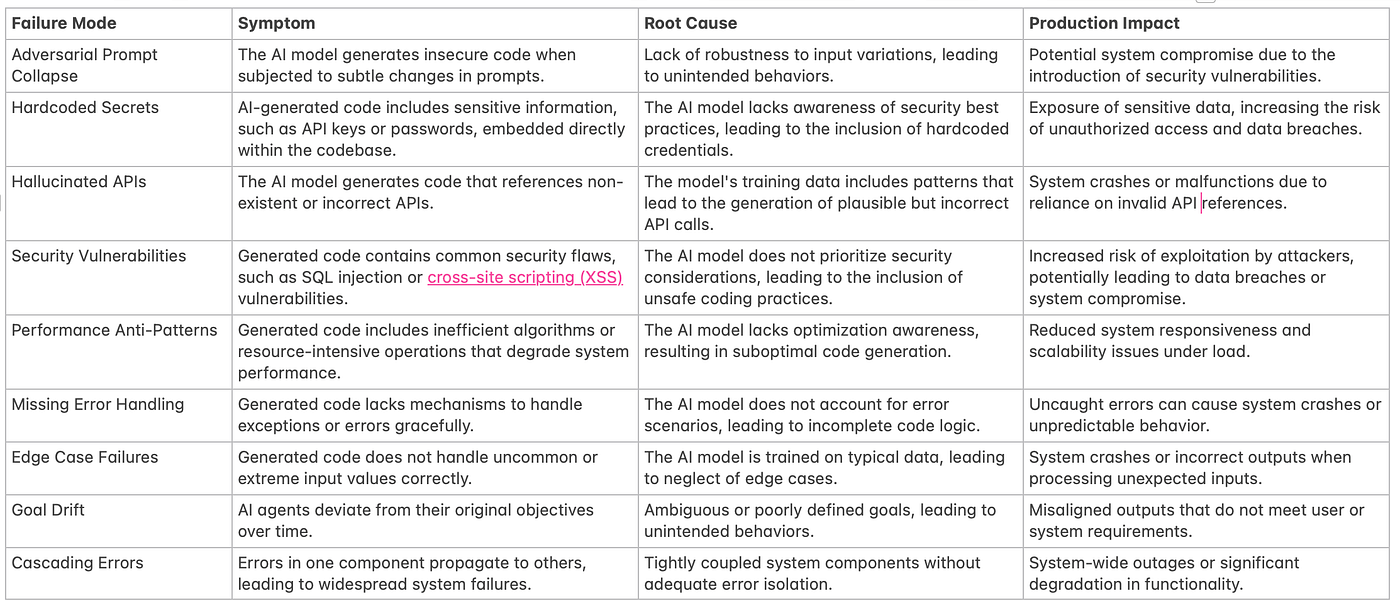
The taxonomy of these failures reveals just how fragile the process can be.
Categorization of AI Code and Agent Failure Modes
Defending against AI code vulnerabilities
What is our checklist for defending against these threats? For my team, it starts with a simple, non-negotiable principle: treat all AI-generated code as untrusted until verified. This is not about slowing down; it is about building a sustainable, secure velocity. This mindset translates into several key practices integrated directly into our workflow.
- First, rigorous human code reviews are mandatory, especially for critical paths involving authentication, data access, or financial transactions. We pair this with robust static analysis (SAST) tools like GitHub’s CodeQL , which we run automatically in our CI/CD pipelines. We have also seen promising results from specialized tools like DeVAIC, which has a high recall for AI-generated snippets.
- Second, we practice security-focused prompt engineering. Instead of just asking for a function, we guide the model with explicit security constraints.
Practical tip: Explicitly telling an LLM to “avoid unsafe deserialization” or “use parameterized queries to prevent SQL injection” can significantly improve the security posture of the generated code.
- Following guidance from frameworks like NIST SP 800–218A on secure software development practices for GenAI has become non-negotiable, guiding our data governance and red-teaming efforts. For teams looking to build a strong foundation, understanding secure software development practices is a critical first step.
We are also exploring models that use vulnerability reward modeling or prefix-tuning to enhance secure AI code generation and optimize for secure-and-correct generation rates. Crucially, we limit AI agent permissions and enforce least privilege, recognizing that the cost, latency, and operational overheads of secure generation or scanning at scale remain an area we are continually optimizing for.
Our development pipeline now reflects this defense-in-depth strategy.

The future of secure AI-assisted development
Looking ahead, the landscape of secure AI-assisted development is rapidly evolving, and we are monitoring it closely for our next product iterations. The goal is to move from a reactive, scanning-based posture to a proactive, secure-by-design model. We are seeing promising work in improving secure-and-correct generation rates through methods like DeepGuard’s multi-layer semantic aggregation and SecCoderX’s online reinforcement learning with vulnerability reward models. The idea of ensemble or consensus generation, where multiple LLMs contribute to and validate a solution, seems particularly powerful in improving security and robustness.
Practical tip: Stay updated on emerging research. The field is moving incredibly fast, and what seems like an academic paper today could be an enterprise-ready tool in six months. A solid grasp of Generative AI Essentials helps in evaluating these new approaches.
However, it is vital that future evaluations move beyond simple static analyzer checks. As we have learned, static analyzers can significantly overestimate security, flagging simple issues while missing complex, semantic vulnerabilities. We need to push for adversarial robustness benchmarks that test models under realistic prompt perturbations. The question of real-world exploitability of detected vulnerabilities across diverse domains remains an area requiring further investigation, pushing us to continuously refine our own penetration testing and red-teaming exercises. The ultimate goal is a model that is not just correct, but resilient.
My takeaways on securing AI-assisted development
Reflecting on our journey, it is clear: AI coding assistants are powerful productivity tools, but they undeniably expand our software attack surface. As a founder, I have learned that security cannot be an afterthought; it must be interwoven into every sprint, every KPI, and every code review in an AI-assisted workflow. We had to shift our definition of “done” to include “verified secure.” This meant adding new steps to our process and, at times, accepting a slight reduction in raw coding speed for a massive gain in production stability and safety.
My primary conclusion is that while the tools get smarter, human vigilance remains paramount. The future of software development is undoubtedly AI-assisted, but the success of AI-generated code security hinges on how diligently we validate, monitor, and defend the code these systems produce. It is an ongoing product challenge, requiring continuous iteration and a commitment to transparency in our security practices.
메타데이터
- post_id
- 5f5af9e84a38
- slug
- defending-against-vulnerabilities-in-ai-code-5f5af9e84a38
- url
- https://medium.com/@milesk_33/defending-against-vulnerabilities-in-ai-code-5f5af9e84a38
- canonical_url
- https://medium.com/@milesk_33/defending-against-vulnerabilities-in-ai-code-5f5af9e84a38
- author_url
- https://medium.com/@milesk_33
- status
- ok
- fetched_at
- 2026-07-20 00:44:07






