Back-of-the-Envelope Estimations: The Secret Skill for System Design at Scale
“Don’t guess. Estimate.”
Back-of-the-Envelope Estimations: The Secret Skill for System Design at Scale
“Don’t guess. Estimate.”
When designing scalable systems, there’s one underrated but essential technique that separates quick thinkers from chaos: Back-of-the-Envelope (BOTE) Estimations.
This article explores what BOTE estimations are, why they’re useful, and how to do one effectively — using a real-world inspired example from a large-scale platform like Twitter.
What Is a Back-of-the-Envelope Estimation?
It’s a fast, rough calculation you do to evaluate feasibility or scale — even on something as simple as a napkin or the back of an envelope. The goal isn’t accuracy; it’s to be directionally correct.
This kind of estimation helps answer questions like:
- How much infrastructure is needed?
- What kind of storage growth can be expected?
- Will this architecture scale with usage?
- What’s the cost implication for current traffic volume?
Why Are These Estimations Important?
Imagine you’re planning system deployment and someone asks:
- How many users will your system support?
- How many read/write operations will your database handle?
- How much media storage is needed in a year?
Without BOTE, you might throw out arbitrary numbers. With BOTE, you use logical assumptions and math to get close enough answers that guide decision-making.
A Real-World BOTE Walkthrough: Twitter-Like Platform
Let’s apply this to estimate the backend infrastructure for a platform with similar behavior to Twitter.
Step 1: Define Assumptions
Let’s set our scenario:
- 300 million monthly active users
- 50% login daily → 150 million daily active users
- Each user posts about 2 tweets per day
- Around 10% of tweets contain an image or video, averaging 1MB in size
- All data is retained for 5 years
Always list assumptions up front — it creates a transparent baseline for estimation.
Step 2: Estimate Traffic Volume (QPS)
First, calculate total tweets per day:
- 150 million users × 2 tweets = 300 million tweets per day
Then, convert that into per-second load:
- 300 million ÷ 86,400 seconds ≈ 3,500 tweets per second
To be safe, factor in peak traffic. Assuming peak is about 2× average:
- Peak = 3,500 × 2 = 7,000 write operations per second
This gives an idea of the database or message queue throughput required to handle peak write loads.
Step 3: Estimate Media Storage
Let’s break this down:
- 10% of tweets include media → 30 million media tweets per day
- Each file averages 1MB → 30 million MB = 30TB daily
Extend that over 5 years:
- 30TB × 365 days × 5 years ≈ 55 Petabytes
That’s 55PB of storage needed just for media, not counting replication, metadata, or redundancy overhead.
Techniques for Quick Estimation
Approximate Everything
BOTE is all about simplification:
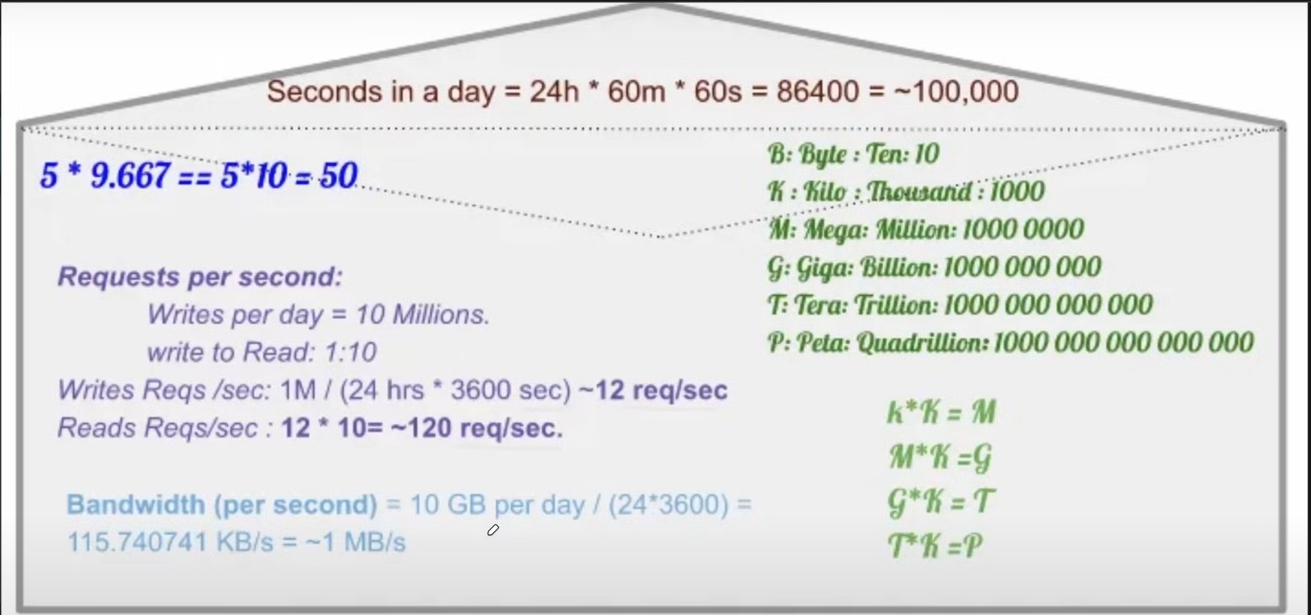
- Use 100,000 seconds instead of 86,400 for daily calculations
- Round 1MB as 1 million bytes, 1GB as 1 billion bytes
- Don’t obsess over binary vs decimal units unless precision matters
Know Key Unit Relationships
Quick mental math becomes easier when you’re familiar with unit scales:
- 1 KB = 1,000 bytes
- 1 MB = 1,000,000 bytes
- 1 GB = 1,000,000,000 bytes
- 1 TB = 1⁰¹² bytes
- 1 PB = 1⁰¹⁵ bytes
This mental model will save time and help validate product specs, cloud estimates, or architectural proposals quickly.
Latency Reference Points
Having rough latency numbers in your mental toolbox helps you decide which components are potential bottlenecks. Here are common latency values:
- L1 cache: ~0.5 nanoseconds
- RAM access: ~100 nanoseconds
- SSD read: ~10 microseconds
- HDD read: ~10 milliseconds
- Network call across data centers: ~100ms to 1 second
These figures help when estimating time-sensitive operations or evaluating trade-offs between speed and cost.
Final Pointers for Strong BOTE Practice
- Always list out your assumptions clearly
- Label units and be consistent
- Prefer estimation over guessing
- Understand peak vs average load
- Estimate storage over time, not just per day
- Use rounding and order-of-magnitude thinking
Practice Makes Precision-Enough
Back-of-the-envelope estimation is a skill built with time. The more systems you design or debug, the more natural these calculations feel.
At some point, you’ll instinctively know how many writes per second your system handles or how much cache to allocate for a service — without diving into logs or Grafana.
Wrapping Up
BOTE estimations are foundational in building scalable systems. Whether planning traffic loads, database sizing, or cloud budgets — it’s the fastest way to stay grounded in logic instead of guesses.
Start applying it. Not just when asked, but during every design, every review, every whiteboard discussion. That’s where real system intuition begins.
메타데이터
- post_id
- 5f6e082e8a3c
- slug
- back-of-the-envelope-estimations-the-secret-skill-for-system-design-at-scale-5f6e082e8a3c
- url
- https://medium.com/@rudrakshkanungo2022/back-of-the-envelope-estimations-the-secret-skill-for-system-design-at-scale-5f6e082e8a3c
- canonical_url
- https://medium.com/@rudrakshkanungo2022/back-of-the-envelope-estimations-the-secret-skill-for-system-design-at-scale-5f6e082e8a3c
- author_url
- https://medium.com/@rudrakshkanungo2022
- status
- ok
- fetched_at
- 2026-07-09 06:11:55